建设银行

Search documents
智通ADR统计 | 2月20日
智通财经网· 2026-02-19 23:23
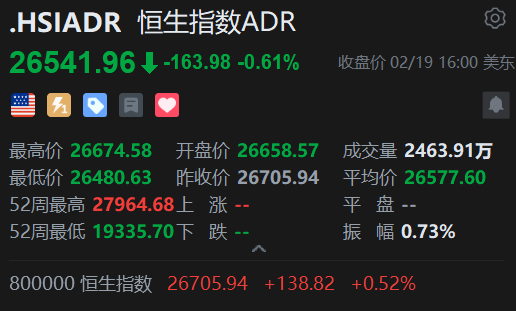
Market Overview - The Hang Seng Index (HSI) closed at 26,541.96, down by 163.98 points or 0.61% on February 19 [1] - The index opened at 26,658.57, reached a high of 26,674.58, and a low of 26,480.63, with a trading volume of 24.6391 million [1] Major Blue-Chip Stocks Performance - HSBC Holdings closed at HKD 135.722, up by 1.13% compared to the previous close [2] - Tencent Holdings closed at HKD 532.399, down by 0.11% compared to the previous close [2] Stock Price Movements - Tencent Holdings (00700) latest price is HKD 533.000, with a slight increase of 1.000 or 0.19% [3] - Alibaba Group (09988) latest price is HKD 154.700, down by 0.700 or 0.45% [3] - HSBC Holdings (00005) latest price is HKD 134.200, down by 1.500 or 1.11% [3] - AIA Group (01299) latest price is HKD 82.350, up by 2.050 or 2.55% [3] - Meituan (03690) latest price is HKD 82.050, down by 0.100 or 0.12% [3] - JD.com (09618) latest price is HKD 105.900, down by 0.500 or 0.47% [3]






雄安探索金融科技和社保业务深度融合
Xin Lang Cai Jing· 2026-02-19 23:02
转自:河北日报 雄安探索金融科技和社保业务深度融合 (来源:河北日报) 本报讯(见习记者郝金钰)2月6日,雄安新区公共服务局与金融系统战略合作银行共同举行社银合作签 约仪式,积极探索金融科技和社保业务的深度融合,构建"15分钟社保服务圈",推动社保服务数字化、 智能化升级,助力打造智慧社保新模式。 雄安新区公共服务局与中国工商银行雄安分行、中国农业银行雄安分行、中国建设银行雄安分行、中国 银行雄安分行、交通银行雄安分行、中国邮政储蓄银行雄安分行共同签署社银合作协议,并进行授牌。 根据协议,雄安新区公共服务局与这6家国有银行将共同推动城乡居民基本养老保险参保登记、城乡居 民基本养老保险待遇申领、失业保险金申领等13项社银服务事项延伸至基层网点,构建政策统一、标准 规范、服务高效、监督到位的合作体系。此举将雄安新区社保经办服务触角延伸至"最后一米",标志着 打造覆盖城乡、便捷高效的社保服务体系迈出关键一步。 在网点服务方面,各银行将依托其遍布雄安的营业网点和自助服务终端,打造雄安社银合作示范网点, 设置社保服务专区,配备专职导办人员,将灵活就业人员养老保险参保登记、领取养老金人员待遇资格 认证、参保人员信息查询等 ...
金价回调了!今年2月19日最新行情,明后两天或迎更大变盘
Sou Hu Cai Jing· 2026-02-19 18:32
Group 1 - The gold price has experienced adjustments, with significant fluctuations expected in the next 48 hours, suggesting potential buying opportunities for jewelry and gold bars [1] - Retail prices for gold jewelry from various brands are reported to be around 1499 to 1510 yuan per gram, with differences primarily due to brand and processing fees [1][2] - The wholesale price for AU9999 gold is reported at 1109 yuan per gram, with retail prices in major cities like Beijing and Shanghai reflecting higher prices due to festive demand [2][4] Group 2 - Bank gold prices vary, with Industrial and Commercial Bank's gold bar priced at 1105.14 yuan per gram and Agricultural Bank's at 1144.92 yuan per gram, typically adding 12-18 yuan per gram as channel costs [4] - The Shanghai Gold Exchange's latest price for gold is 1108.50 yuan per gram, with daily highs and lows indicating market volatility [4] - The price differences between spot and futures contracts can create emotional market responses, highlighting the need for careful consideration before purchasing [4]
金价一夜大反转!2月19日全国金店最新价出炉,现在入手划算吗?
Sou Hu Cai Jing· 2026-02-19 04:45
2026年2月19日,国际贵金属报价分化明显:伦敦现货黄金约4903美元/盎司,美黄金约4921美元/盎司;白银约73.5—73.6美元/盎司,国内实时金价约1085 元/克,白银18.3元/克,铂金460元/克。 品牌门店报价集中在1492—1536元/克:周大福1499元/克、六福1497元/克、周生生1500元/克、谢瑞麟1499元/克、潮宏基1499元/克等普遍回落;老凤祥1510 元/克、老庙黄金1516元/克、菜百1505元/克相对偏高。 同一天里"水贝低、品牌高"并不矛盾,品牌金饰价格不仅跟随金价,还叠加工费、门店运营、款式溢价与活动策略,终端价差更像"渠道成本差",不是纯粹 的"黄金本身差"。 三、水贝分品类报价 深圳水贝细分报价体现了"纯度定价"的规律:足金999约1266元/克、足金999.9约1267元/克、足金999.99约1268元/克,古法金与5G黄金多在1267元/克附近, 3D硬金约1266元/克;18K金约956元/克;铂金约556元/克;金条约1266元/克。 以"保值与可变现"为主要目标,更应关注高纯度金条/足金计价产品的综合成本;若以"佩戴与设计"为主要需求,工艺与品牌 ...

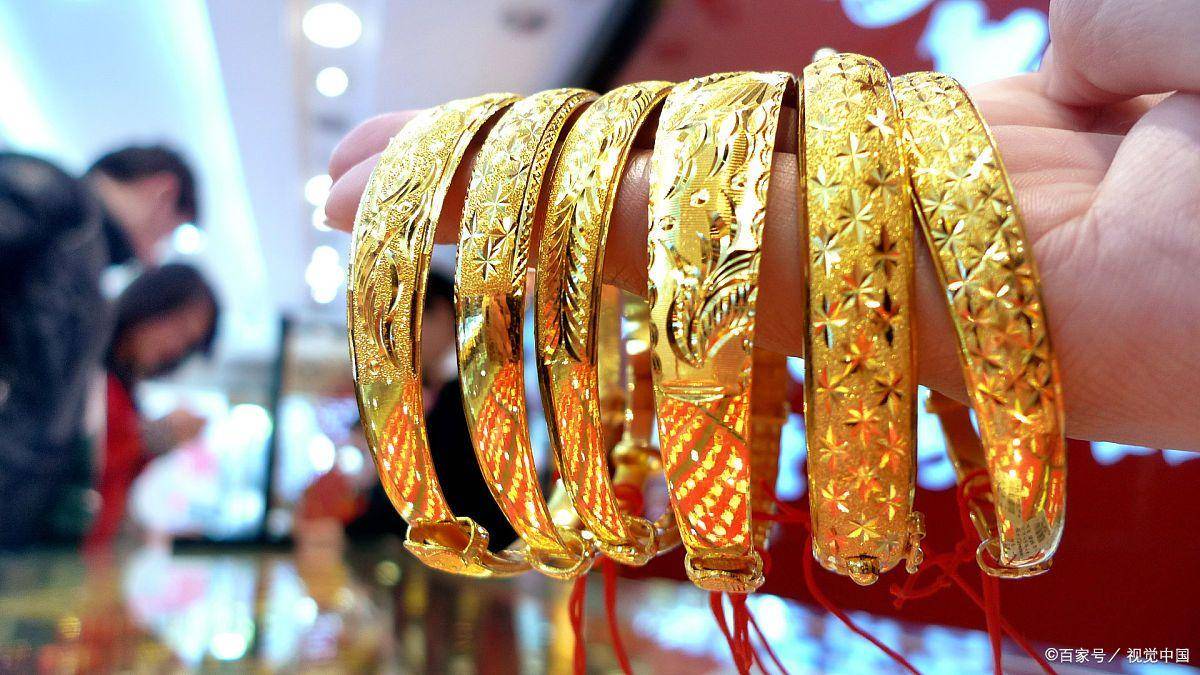
国际黄金强势反弹,国内金饰价格却跌破1500元大关。周大福一天跌61元,老凤祥也扛不住了,你敢买吗?
Sou Hu Cai Jing· 2026-02-19 03:17
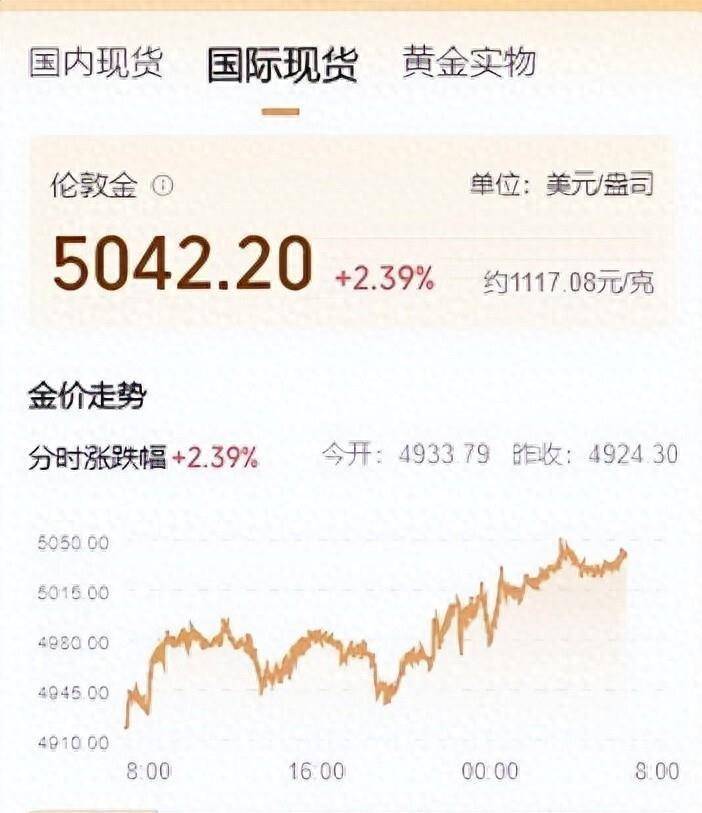
Price Movements in Domestic and International Gold Markets - The price of gold jewelry from major domestic brands has dropped below the psychological threshold of 1500 yuan per gram, with prices reported at 1499 yuan from Chow Tai Fook and 1510 yuan from Lao Feng Xiang, reflecting a decrease of 61 yuan per gram in just one day [1][7] - In contrast, international gold prices have surged, with spot gold rising from 4878.89 USD to 5042.20 USD, marking a daily increase of 2.39% [3][8] - The domestic gold market is experiencing a lag in price adjustments compared to international markets, influenced by fixed costs such as brand premiums and processing fees [11] Geopolitical Influences on Gold Prices - The recent progress in US-Iran negotiations has reduced the likelihood of military conflict, leading to a withdrawal of some safe-haven funds from the gold market [13] - Despite the positive developments, uncertainties remain as Iran refuses to discuss its ballistic missile program, complicating the potential for a formal agreement [9][13] Federal Reserve's Monetary Policy Outlook - Federal Reserve officials have expressed differing views on interest rate adjustments, with some indicating a potential for 75 basis points of rate cuts, while others advocate for maintaining stable rates for a period [5][9][13] - The latest survey from Bank of America shows that 50% of fund managers consider "going long on gold" as the most crowded trade, indicating a strong interest in gold as an investment [5][6] Market Sentiment and Investment Trends - The allocation towards commodities has reached its highest level since May 2022, with a net 28% overweight in commodities among surveyed fund managers [6][11] - The cash levels among investors have slightly increased from a record low, indicating a cautious approach amidst market volatility [11]





智通港股通资金流向统计(T+2)|2月19日
智通财经网· 2026-02-18 23:32
Key Points - Tencent Holdings (00700), Yingfu Fund (02800), and Shandong Gold (01787) ranked the top three in net inflow of southbound funds, with net inflows of 736 million, 423 million, and 393 million respectively [1] - Alibaba-W (09988), SMIC (00981), and Hua Hong Semiconductor (01347) ranked the top three in net outflow of southbound funds, with net outflows of -524 million, -391 million, and -199 million respectively [1] - In terms of net inflow ratio, Nanhua Futures (02691), Southern East Select (03441), and Oculent (00501) led the market with ratios of 70.54%, 59.14%, and 56.33% respectively [1] - In terms of net outflow ratio, Zhengzhou Bank (06196), China Energy Construction (03996), and Hongye Futures (03678) had the highest ratios at -50.51%, -49.70%, and -48.03% respectively [1] Top 10 Net Inflow Stocks - Tencent Holdings (00700) had a net inflow of 736 million with a net inflow ratio of 5.67% and a closing price of 548.000 [2] - Yingfu Fund (02800) recorded a net inflow of 423 million with a net inflow ratio of 5.13% and a closing price of 27.480 [2] - Shandong Gold (01787) saw a net inflow of 393 million with a net inflow ratio of 31.27% and a closing price of 40.180 [2] - Bilibili-W (09626) had a net inflow of 335 million with a net inflow ratio of 27.53% and a closing price of 252.800 [2] - China National Offshore Oil Corporation (00883) recorded a net inflow of 301 million with a net inflow ratio of 22.88% and a closing price of 24.800 [2] Top 10 Net Outflow Stocks - Alibaba-W (09988) experienced a net outflow of -524 million with a net outflow ratio of -6.30% and a closing price of 160.100 [2] - SMIC (00981) had a net outflow of -391 million with a net outflow ratio of -6.39% and a closing price of 70.000 [2] - Hua Hong Semiconductor (01347) recorded a net outflow of -199 million with a net outflow ratio of -15.56% and a closing price of 99.600 [2] - Changfei Optical Fiber (06869) saw a net outflow of -172 million with a net outflow ratio of -5.33% and a closing price of 107.500 [2] - WISCO (01208) had a net outflow of -168 million with a net outflow ratio of -32.19% and a closing price of 10.160 [2] Top 10 Net Inflow Ratios - Nanhua Futures (02691) had a net inflow ratio of 70.54% with a net inflow of 5.40 million and a closing price of 11.230 [3] - Southern East Select (03441) recorded a net inflow ratio of 59.14% with a net inflow of 5.74 million and a closing price of 11.650 [3] - Oculent (00501) had a net inflow ratio of 56.33% with a net inflow of 1.45 million and a closing price of 103.900 [3] Top 10 Net Outflow Ratios - Zhengzhou Bank (06196) had a net outflow ratio of -50.51% with a net outflow of -3.13 million and a closing price of 1.150 [3] - China Energy Construction (03996) recorded a net outflow ratio of -49.70% with a net outflow of -16.96 million and a closing price of 1.180 [3] - Hongye Futures (03678) had a net outflow ratio of -48.03% with a net outflow of -5.22 million and a closing price of 3.220 [3]


省大数据局印发数智贵州建设2026年工作要点
Xin Lang Cai Jing· 2026-02-18 12:08
1.发展以智算为重点的算力产业。加快培育服务器、机架、电源设备等算力硬件制造产业。大力发展云 服务、云计算等算力运营服务产业,持续壮大云服务"首位产业"。培育数据中心运维、安全、算力适配 等算力配套产业。组织开展算力产业供需对接。集聚华为云生态企业累计达到150家。(责任单位:省大 数据局、省工业和信息化厅,各市〔州〕、贵安新区数据管理部门。除专门列出外,以下任务均涉及各 市〔州〕、贵安新区数据管理部门,不再重复) 2.发展以建设高质量数据集为重点的数据产业。加快推进博彦科技、东软等企业或项目落地见效,培育 壮大数据企业矩阵。支持企业开放数据标注需求,"一企一策"推动已建数据中心数据标注业务落地。积 极争创建设国家数据产业集聚区、数据标注试点。全省从事数据标注人员达到2万人以上。(责任单位: 省大数据局、贵州大数据集团) 3.发展以行业大模型应用为重点的人工智能产业。深入实施"人工智能+"行动,推进政务、广电等重点 领域人工智能应用,培育10个以上行业大模型应用标杆,打造100个以上人工智能典型应用场景。推动5 个生成式人工智能服务通过备案或登记。建设人工智能应用推广中心。用好省人工智能实验室,积极争 取人工 ...

中国手机银行用户规模见顶,行业逻辑转向存量提升
Xin Lang Cai Jing· 2026-02-18 05:56
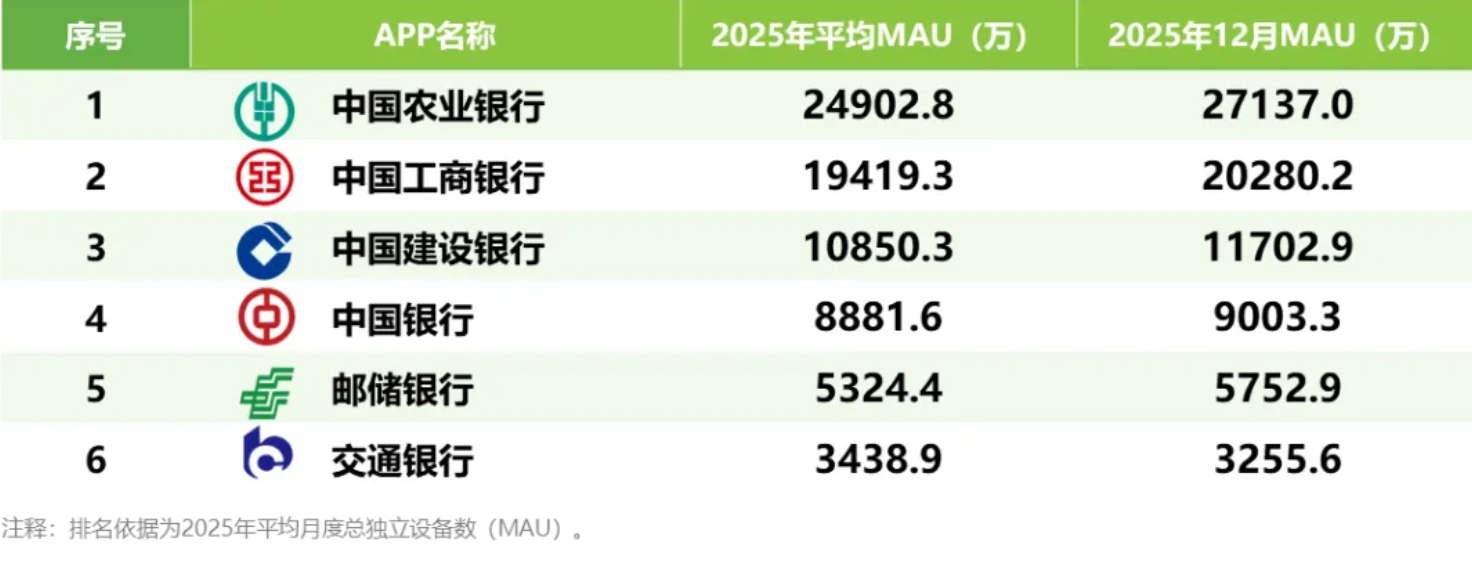
Core Insights - The report indicates that the average monthly active users (MAU) for major Chinese mobile banking apps in 2025 shows a significant user base, with the Agricultural Bank of China leading at approximately 24.9 million users [1]. Group 1: User Metrics - The average MAU for the top five mobile banking apps in 2025 are as follows: Agricultural Bank of China (24.9 million), Industrial and Commercial Bank of China (19.4 million), China Construction Bank (10.9 million), Bank of China (8.9 million), and Postal Savings Bank (5.3 million) [1]. - The total number of independent devices for mobile banking in China is projected to stabilize between 648 million and 739 million, indicating a plateau in user growth [1]. Group 2: Industry Trends - The report highlights a shift in industry dynamics from acquiring new users to enhancing existing user engagement, as the flow of new users has reached a ceiling [1]. - User behavior is changing structurally, with the effective daily usage time per device decreasing from 4.9 minutes in 2023 to around 2.7 minutes by mid-2025, stabilizing at approximately 3 minutes [1]. - The trend towards high-frequency, short-duration, and function-oriented usage is prompting financial institutions to streamline processes and focus on core transaction scenarios [1].





国有大行主导手机银行市场,生态嵌入构筑护城河
Jing Ji Guan Cha Wang· 2026-02-18 05:47
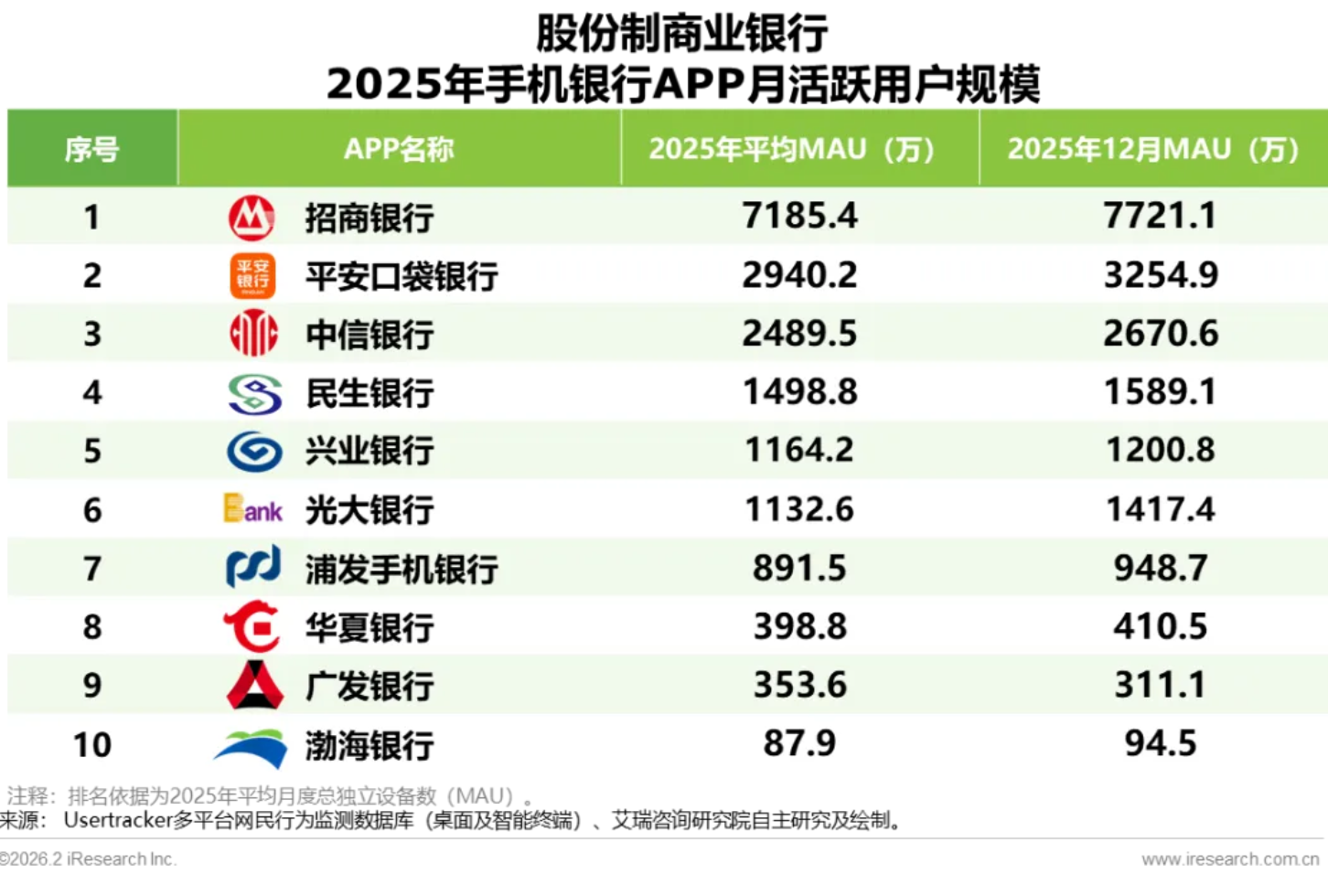
Core Insights - The Chinese mobile banking market is entering a stage of stock competition in 2025, with monthly active users (MAU) stabilizing between 648 million and 739 million [2] - State-owned commercial banks dominate the market due to their ecological embedding advantages, with Agricultural Bank of China leading at 249 million MAU, followed by Industrial and Commercial Bank of China (194 million) and China Construction Bank (109 million) [2] - Private banks are expected to collectively exit the top 50 MAU rankings in 2025 due to a lack of offline branch support and local living ecosystems [2] Group 1: Major Players - Agricultural Bank of China has the highest MAU at 249 million, followed by Industrial and Commercial Bank of China with 194 million and China Construction Bank with 109 million, forming the first tier of banks [2] - China Bank and Postal Savings Bank have MAUs exceeding 50 million, constituting the second tier [2] - China Merchants Bank leads the joint-stock banks with 71.85 million MAU, while Ping An Bank and CITIC Bank form the second tier, with other joint-stock banks generally below 20 million MAU [2] Group 2: Market Dynamics - The core advantage of state-owned banks lies in their "full-scenario integration" capabilities, embedding services deeply into high-frequency life scenarios such as government affairs, social security, healthcare, and education [2] - Agricultural Bank of China extends its services to rural areas through intelligent service matching and customer customization, while Industrial and Commercial Bank of China utilizes its "Gong Xiao Zhi" model for interactive service [2] - Regional banks like Jiangsu Bank, Beijing Bank, and Ningbo Bank show stable performance by focusing on local markets, with some rural commercial banks like Fujian Rural Credit exceeding 4.5 million MAU, indicating the sustainability of localized operations in the stock market [2]

手机银行TOP50再无民营 生态壁垒高筑草根绝迹
Jing Ji Guan Cha Wang· 2026-02-18 05:47
Core Insights - The monthly active users (MAU) of mobile banking apps in China have stabilized between 648 million and 739 million, indicating that user growth has reached a ceiling, marking the end of a decade-long traffic dividend period [2] - User behavior has shifted significantly, with average session duration decreasing from 4.9 minutes in 2023 to approximately 2.7 minutes by mid-2025, reflecting a preference for high-frequency, short-duration, and function-oriented usage [2] - Major state-owned banks have solidified their market dominance, with all six major state-owned banks ranking in the top ten for MAU, led by Agricultural Bank of China with 249 million MAU [2] Industry Dynamics - The core competitive advantage of state-owned banks lies in their "full-scenario integration" capabilities, providing financial services deeply embedded in public services such as government, social security, healthcare, and education [3] - Joint-stock banks are adopting specialized development strategies, with China Merchants Bank leading its peers with 71.85 million MAU, while Ping An Bank and Citic Bank are leveraging AI technology to enhance service processes and maintain user engagement [3] - Local banks are experiencing polarization, with some city commercial banks maintaining MAU above 3 million due to their deep understanding of local markets, while private banks like WeBank and MYbank have fallen out of the top 50 due to challenges in customer acquisition and retention [3] Future Trends - As the industry standard for single-session usage time becomes 3 minutes, banks must rethink their value creation strategies [4] - AI-driven service process optimization, real-time risk control systems, and multi-device collaboration within ecosystems are reshaping the competitive landscape [4] - Key factors for institutional success in the future will include precise user insights, prudent risk management, and robust ecosystem integration capabilities [4]