携程集团

Search documents
智通ADR统计 | 2月3日
智通财经网· 2026-02-02 22:23
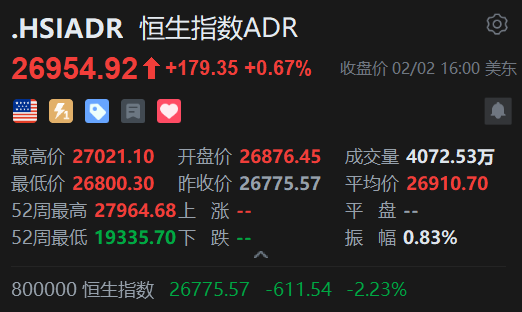
Market Overview - The Hang Seng Index (HSI) closed at 26,954.92, up by 179.35 points or 0.67% as of February 2, 16:00 Eastern Time [1] - The index reached a high of 27,021.10 and a low of 26,800.30 during the trading session, with a trading volume of 40.725 million shares [1] Major Blue-Chip Stocks Performance - HSBC Holdings closed at HKD 139.961, increasing by 3.91% compared to the Hong Kong close [2] - Tencent Holdings closed at HKD 595.694, down by 0.47% compared to the Hong Kong close [2] Stock Price Movements - Tencent Holdings: Latest price HKD 598.500, down by HKD 7.500 or 1.24% [3] - Alibaba Group: Latest price HKD 163.300, down by HKD 5.900 or 3.49% [3] - HSBC Holdings: Latest price HKD 134.700, down by HKD 1.900 or 1.39% [3] - AIA Group: Latest price HKD 89.050, down by HKD 1.300 or 1.44% [3] - Meituan: Latest price HKD 94.850, down by HKD 2.350 or 2.42% [3] - BYD Company: Latest price HKD 91.000, down by HKD 6.750 or 6.91% [3] - Kuaishou Technology: Latest price HKD 77.000, down by HKD 3.150 or 3.93% [3]





去哪过年?春运首日答案揭晓
Mei Ri Jing Ji Xin Wen· 2026-02-02 12:59
Core Insights - The 2026 Spring Festival travel season has commenced, with a projected 9.5 billion trips expected, marking a historical high [1] - The travel patterns show an early peak and diverse flow, driven by a late Spring Festival date and extended holidays [1] - Family travel, particularly with children, is a significant driver of this year's travel demand [4] Group 1: Travel Volume and Trends - The first day of the travel season saw over 420,000 passengers transported by Eastern Airlines, with flight operations exceeding 3,000 [2] - Major cities like Beijing, Shanghai, Guangzhou, and Shenzhen have seen hotel search interest surge by over 70% [2] - The first travel peak is anticipated on February 7, with traditional business routes like Guangzhou-Shanghai and Beijing-Shenzhen among the most popular [2] Group 2: Emerging Destinations and Travel Patterns - Southern cities are experiencing a surge in travel demand, with destinations like Shantou and Jieyang seeing booking increases of 186% and 162% respectively [3] - Non-traditional routes are gaining popularity, with significant growth in long-distance flights such as Ordos-Haikou, which saw a fivefold increase in interest [3] - The "reverse Spring Festival" trend highlights the appeal of major cities as destinations for travelers returning home [2] Group 3: Family Travel and Market Dynamics - Family units, especially those with children, are driving the majority of travel bookings, with over half of domestic travel orders being for family trips [4] - The average price for family rooms is 9% higher than standard bookings, indicating a shift in consumer spending patterns [4] - The extended holiday period has stimulated demand for medium to long-distance travel, particularly among the "post-80s" demographic [5] Group 4: International Travel and Recovery - The inbound tourism market is experiencing a strong recovery, with Russian visitor bookings increasing by 471% and South Korean bookings up by 95% [5] - Cities like Shanghai and Shenzhen are popular among foreign tourists seeking a blend of modernity and traditional Chinese New Year experiences [5]
中国连锁经营协会释放信号:AI 驱动渠道服务全面升级
Sou Hu Cai Jing· 2026-02-02 07:20
Core Insights - The article emphasizes the transformative impact of AI on customer service and user experience, shifting the focus from traffic and efficiency to service experience and deepening user relationships [1][10]. Group 1: Large Enterprises Leading Service Chain Reconstruction - Leading companies are deeply integrating AI into their core business channels, significantly enhancing operational efficiency and creating unprecedented service scenarios that build user loyalty and competitive barriers [3]. Group 2: Alibaba's Tmall - Tmall is upgrading its engine for the 2025 Double 11 event, transforming its AI system into a "smart retail hub" that enables precise matching of 20 billion products with hundreds of millions of consumers and coordinates offline inventory from millions of stores [4]. - The AI system addresses efficiency bottlenecks by constructing a decision-making hub that comprehensively understands products and users [4]. - The platform's recommendation click-through rate increased by 10%, and merchant advertising ROI improved by 12%, with some brands experiencing order growth of several times in stores integrated with flash purchase [4]. - This practice marks the entry of e-commerce competition into the "computing power dividend" era, where AI becomes a foundational infrastructure for retail [4]. Group 3: Carrefour - Carrefour collaborates with Google Cloud to create a digital expert and chief content officer using generative AI, achieving a conversion rate of up to 70% [5]. - The AI-driven "wine steward" interacts with customers to understand their needs and recommends wine from a database, while the "personalized showcase" generates content based on user behavior [6]. - The AI wine steward's conversion rate is remarkably high at 70%, and the automated content generation significantly enhances team productivity [6]. Group 4: L'Oréal - L'Oréal's AI beauty advisor "Beauty Genius" on WhatsApp provides personalized services 24/7, accumulating over 480,000 conversations [7]. - This tool integrates L'Oréal's research database and product catalog to offer personalized consultations, virtual try-ons, and product recommendations [7]. - Consumers who interacted with the AI advisor showed significantly higher conversion rates and average order values compared to those who did not [7]. Group 5: Ctrip - Ctrip's "AI Trip Planner" simplifies complex travel planning into a one-stop, personalized smart service [8]. - The assistant uses Ctrip's vertical model and real-time data to predict user interests and optimize routes, significantly enhancing decision-making efficiency by 40% [8]. - This service integrates various resources into a unified smart interface, reinforcing Ctrip's core value as a one-stop platform [8]. Group 6: Small and Medium Enterprises Innovating with AI - Many small and medium enterprises are leveraging deep insights into vertical markets to achieve innovative breakthroughs in user service through agile AI applications [10]. Group 7: Tingmei Xiaowu - Tingmei Xiaowu transforms thousands of stores into personalized skincare service centers using an AI skin detection device, creating a closed-loop service model [11]. - The transformation leads to a repurchase rate exceeding 60% and a conversion rate over 30%, with some stores experiencing several times growth in performance [11]. - This practice establishes a new standard for "human-centered service" in physical retail by applying AI deeply in service processes [11]. Group 8: Bottle Planet - Bottle Planet employs an AI-based user analysis and co-creation mechanism to enhance traditional tasting channels and upgrade user service experiences [12]. - This mechanism allows AI to analyze user feedback and generate optimized strategies, creating a sustainable feedback loop for product refinement [12]. - The practice expands the channel's function from a transaction point to a relationship maintenance and value co-creation interface, providing a lightweight path for deepening channel value [12]. Conclusion - As algorithms begin to understand needs and data flows can anticipate expectations, service becomes a starting point for building trust, transforming cold efficiency into perceivable care, and shifting the value focus from scale and speed to depth and relationships [13].

【展望二〇二六】满足人民群众消费新期待
Jing Ji Ri Bao· 2026-01-31 05:13
Core Viewpoint - The Chinese market is undergoing significant regulatory changes in 2026, impacting competition in the food delivery and retail sectors, with a shift from aggressive price wars to a focus on service quality and consumer trust [1][2][3]. Group 1: Regulatory Changes - The State Council's Anti-Monopoly Committee announced investigations into the food delivery platform market and the alleged monopolistic behavior of Ctrip, indicating increased regulatory scrutiny [1][2]. - The Ministry of Finance and the State Taxation Administration will eliminate VAT export rebates for solar products starting April 1, 2026, reflecting a broader regulatory tightening [1]. - The market supervision authority released a list of major cases related to "involution" competition, highlighting ongoing efforts to address unfair practices in various industries [1][2]. Group 2: Market Dynamics - The competitive landscape in the food delivery sector is shifting from a "burning money" model to a focus on optimizing user experience and sustainable business practices [2][3]. - Major platforms are transitioning from merely delivering food to providing a broader range of retail services, indicating a strategic pivot towards becoming comprehensive retail infrastructures [4][5]. - The competition is expected to evolve into a "full-scenario retail war," integrating offline experiences, supply chain efficiency, and product quality [4][5]. Group 3: Consumer Behavior - Consumers are increasingly rejecting "involution" products characterized by extreme price cuts, signaling a demand for better quality and service [6][7]. - The market is anticipated to segment into two layers: one focused on efficiency and cost-effectiveness, and another on emotional and personalized experiences [8][12]. - The rise of local and individual creators is fostering a diverse ecosystem, enhancing consumer engagement and satisfaction [12][14]. Group 4: Food Safety and Transparency - Regulatory efforts are shifting from reactive measures to proactive prevention in food safety, aiming for a comprehensive regulatory framework to ensure consumer trust [9][10]. - New standards and regulations are being developed for pre-packaged food, emphasizing transparency and accountability in the food supply chain [9][10]. - The implementation of traceability systems and enhanced monitoring is expected to improve food safety and consumer confidence [10][11].


Baidu’s AI Models Continue to Expand with Ernie Assistant Surpassing 200 million Monthly Active Users
Yahoo Finance· 2026-01-30 20:23
Baidu, Inc. (NASDAQ:BIDU) is one of the Top 15 Chinese Companies on US Exchanges. On January 20, WSJ reported that Baidu, Inc.’s AI assistant has surpassed 200 million monthly active users. Amid the growing AI competition among Chinese tech giants, Baidu’s flagship AI model Ernie Assistant is integrated into the company’s leading search engine app and on personal computers. Baidu's AI Models Continues to Expand With Ernie Assistant Surpassing 200 million Monthly Active Users Gil C / Shutterstock.com Er ...
【窩輪透視】攜程多條均線發出買入信號,短期震盪還是反彈?
Ge Long Hui· 2026-01-30 12:43
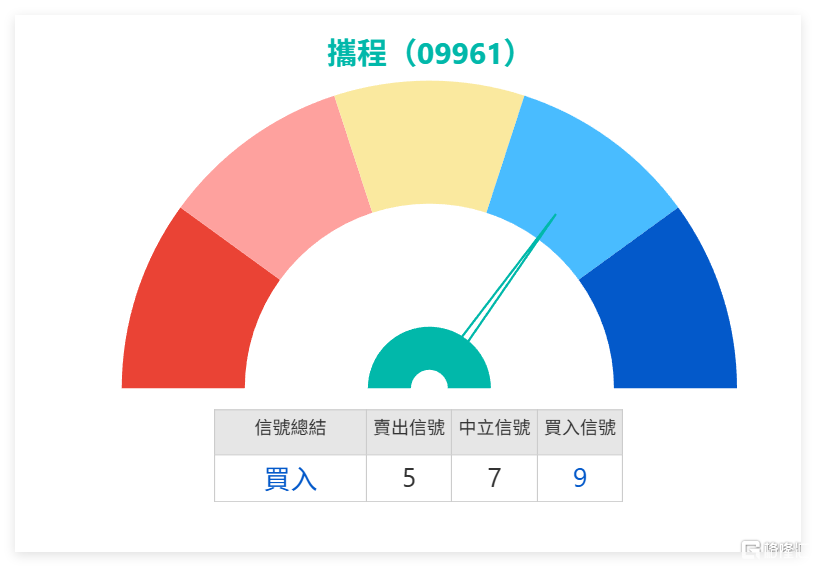
Core Viewpoint - Ctrip (09961) shows signs of a potential short-term rebound despite a recent decline, with technical indicators suggesting a strong buy signal due to oversold conditions [1][2]. Group 1: Stock Performance - On January 29, Ctrip's stock closed at 482.2 HKD, down 2.66% with a trading volume of 20.16 billion HKD, indicating a lack of significant bottom-fishing activity [1]. - Ctrip's performance was similar to that of NetEase (09999), both experiencing declines over 2.5%, while Baidu (09888) only saw a minor drop of 0.38% [1]. - The Relative Strength Index (RSI) for Ctrip is at 38, indicating it is in the oversold territory, suggesting a potential for a technical rebound [1]. Group 2: Technical Indicators - Multiple moving averages have issued strong buy signals for Ctrip, with a signal strength of 9, indicating a robust buy recommendation [1]. - The short-term moving average pressure is evident, with a need for the stock to surpass the MA10 at 483.58 HKD for a rebound to be confirmed [1]. Group 3: Support and Resistance Levels - As of January 30, Ctrip's latest price is 485 HKD, reflecting a 0.58% increase, with resistance levels identified at 531 HKD (Resistance 1) and 585 HKD (Resistance 2) [2]. - Short-term support levels are at 457 HKD (Support 1) and 379 HKD (Support 2), with a 56% probability of a rebound if the stock can maintain above the 457 HKD support [2]. Group 4: Derivative Products - Two call options are highlighted for investors expecting a short-term rebound: - Morley Call Option (24926) with a leverage of 4.7 and an exercise price of 531.38 HKD, noted for its low premium [6]. - Morgan Call Option (24761) with a leverage of 4.6 and a slightly lower exercise price of 530.88 HKD, suitable for conservative investors [6]. - Two put options are recommended for those anticipating continued downward movement: - Bank of China Put Option (19962) with a leverage of 11.4 and an exercise price of 420.88 HKD, ideal for high-risk tolerance investors [7]. - Morley Put Option (20768) with a leverage of 12.4 and a balanced risk profile, suitable for investors seeking to capitalize on price declines [8].

春节红包大战,是互联网从流量博弈到AI智能生态的变革
Huan Qiu Wang· 2026-01-30 12:23
Core Insights - The 2026 Spring Festival sees a shift in the "red envelope" competition, with AI becoming the central player as major internet companies like ByteDance, Tencent, Alibaba, and Baidu enter the fray [1][4] - The competition is not just about mobile payment traffic but about establishing dominance in the AI ecosystem, with companies leveraging the Spring Festival as a strategic battleground for user engagement [1][4] Group 1: Company Strategies - ByteDance has secured a key partnership with CCTV for the Spring Festival Gala, positioning its AI assistant, Doubao, to engage users through various interactive features, aiming for high-frequency user touchpoints [1][4] - Tencent is reviving its red envelope initiative with a cash incentive of 1 billion yuan, introducing a new AI social feature called "Yuanbao Pai" to extend its social advantages into the AI domain [2][4] - Alibaba's Qianwen app is central to its AI ecosystem, integrating with core services like Taobao and Alipay to create a seamless AI service experience across various sectors [2][4] Group 2: AI Integration and User Engagement - Baidu's strategy involves embedding its AI assistant, Wenxin, within its widely used app, allowing users to access AI features without additional downloads, thus converting traditional search users into AI users [3][4] - The initial launch of Baidu's "Spring Festival Red Envelope" saw over 1 million participants on its first day, with a maximum single envelope amount reaching 6,666 yuan [3][4] Group 3: Competitive Landscape and Future Outlook - The overarching goal of these companies is to capture the next generation of AI interaction, using red envelope subsidies as a means to attract users into their respective AI ecosystems [4][5] - Companies are investing heavily in AI infrastructure, with ByteDance allocating half of its 2026 capital expenditure to AI processors, while Tencent and Alibaba are enhancing their AI capabilities through strategic hires and technology integration [4][5] - The competition is evolving beyond individual AI assistants to a comprehensive ecosystem approach, focusing on user needs across various scenarios, indicating that the future AI entry point may not be a standalone app but a deeply integrated smart layer in digital life [5]
智通ADR统计 | 1月30日
智通财经网· 2026-01-29 22:41
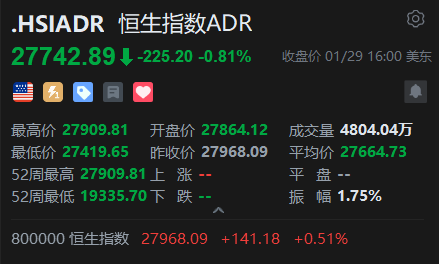
Market Overview - The Hang Seng Index (HSI) closed at 27,742.89, down by 225.20 points or 0.81% as of January 29, 16:00 Eastern Time [1] - The index reached a high of 27,909.81 and a low of 27,419.65 during the trading session, with an average price of 27,664.73 [1] - The 52-week high for the index is 27,909.81, while the 52-week low is 19,335.70 [1] Blue-Chip Stocks Performance - Most large-cap stocks experienced declines, with HSBC Holdings closing at HKD 138.219, up 0.45% compared to the Hong Kong close [2] - Tencent Holdings closed at HKD 619.286, down 0.44% from the Hong Kong close [2] Individual Stock Movements - Tencent Holdings (00700) latest price is HKD 622.000, with a slight increase of 1.000 or 0.16% [3] - Alibaba Group (09988) latest price is HKD 173.300, down by 0.200 or 0.12% [3] - HSBC Holdings (00005) latest price is HKD 137.600, up by 0.100 or 0.07% [3] - China Construction Bank (00939) latest price is HKD 8.160, up by 0.130 or 1.62% [3] - AIA Group (01299) latest price is HKD 90.950, up by 2.100 or 2.36% [3] - Xiaomi Group (01810) latest price is HKD 36.620, up by 0.300 or 0.83% [3] - NetEase (099999) latest price is HKD 206.600, down by 5.400 or 2.55% [3] - Meituan (03690) latest price is HKD 98.600, up by 0.250 or 0.25% [3] - Industrial and Commercial Bank of China (01398) latest price is HKD 6.640, up by 0.050 or 0.76% [3] - Hong Kong Exchanges and Clearing (00388) latest price is HKD 444.200, up by 5.000 or 1.14% [3] - Ping An Insurance (02318) latest price is HKD 73.300, up by 2.350 or 3.31% [3] - Baidu Group (09888) latest price is HKD 155.500, down by 0.600 or 0.38% [3] - China Bank (03988) latest price is HKD 4.760, up by 0.090 or 1.93% [3] - BYD Company (01211) latest price is HKD 101.800, down by 1.000 or 0.97% [3] - JD.com (09618) latest price is HKD 114.600, down by 1.700 or 1.46% [3] - Ctrip Group (09961) latest price is HKD 482.200, down by 13.200 or 2.66% [3]
亿客行集团东南亚及南亚地区公共政策、政府和企业事务负责人马丁:各项决策和投入都精打细算,不断丰富旅游体验层次
Mei Ri Jing Ji Xin Wen· 2026-01-29 12:50
史上最长的9天春节假期进入倒计时,面对俄罗斯、澳大利亚、新西兰、土耳其、巴西等越来越多的免 签目的地,中国游客出境游的选择从未如此繁多。 去哪儿数据显示,2026年寒假及春节期间,中国游客的酒店预订遍布全球3000余个城市,临近的泰国、 韩国、新加坡等国家虽仍居热门目的地前五,但土耳其等新晋免签目的地的预订量同比猛增2.3倍。 这种"精打细算"直接体现在数据上。根据新加坡贸工部2025年11月21日发布的最新报告,2025年新加坡 的旅游总收入已比2019年高出7.6%。值得玩味的是,游客总人次并未完全恢复,但总收入却逆势增 长,秘诀在于"人均消费"大幅跃升——较2019年增长24.4%。 "每年1月参加东盟旅游部长会议时,我们都会倡导'优质旅游',这是一种更细腻、更具多维度的可持续 增长路径,不仅关注游客数量,更重视每个游客能带来的价值。"马丁解释道,"由于新加坡面积狭小, 我们必须在推动旅游增长的同时,审慎平衡其可能对公共基础设施等方面带来的压力。" 这与许多旅游大国"以量取胜"的逻辑截然不同。新加坡的旅游管理部门隶属于贸易和工业部——一个经 济管理部门。"这意味着,我们对旅游业增长的关注核心,始终围绕其 ...
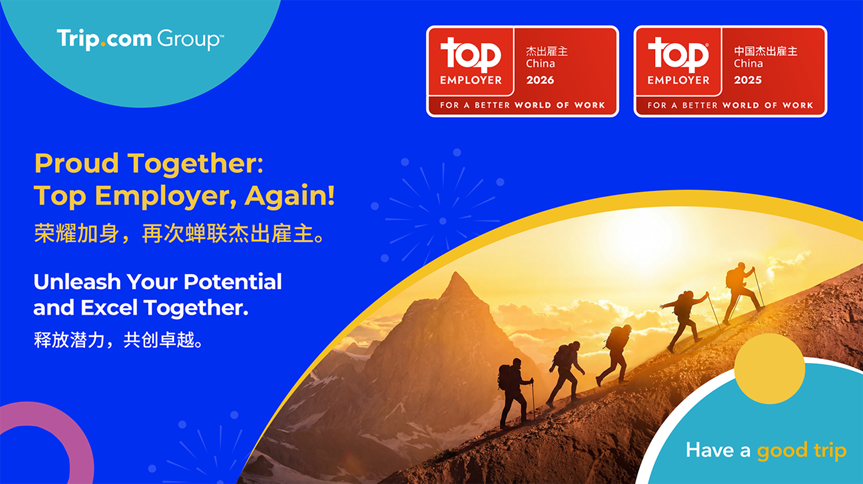
携程集团连续两年获“杰出雇主”认可
Xin Lang Cai Jing· 2026-01-29 12:13
近期,杰出雇主调研机构正式发布2026年度杰出雇主榜单,携程集团连续第二年获得该奖项。 携程集团再度获得中国"杰出雇主"认可 获奖现场 携程集团人力资源相关负责人表示,携程集团会持续投入提升员工的体验,为每一位与携程同行的人才提供包容、保护与 支持。 近期,杰出雇主调研机构正式发布2026年度杰出雇主榜单,携程集团连续第二年获得该奖项。 携程集团再度获得中国"杰出雇主"认可 获奖现场 携程集团人力资源相关负责人表示,携程集团会持续投入提升员工的体验,为每一位与携程同行的人才提供包容、保护与 支持。 ...