禾望电气

Search documents
南华期货2025年度铁合金四季度展望:成本与需求角力交织
Nan Hua Qi Huo· 2025-09-30 10:12
1. Report Industry Investment Rating No relevant information provided. 2. Core Views of the Report - The ferroalloy price in the third quarter was mainly affected by the coking coal price showing a volatile trend after a rapid increase. In the fourth quarter, the ferroalloy futures are expected to be volatile, with the price at the stage when the "anti - involution" was proposed at the beginning of July regarded as the policy bottom and the high price at the end of July as the resistance level. The downstream products like rebar are the core variables affecting the ferroalloy price, and coking coal affects its cost. Ferroalloy mainly follows their prices but with lower elasticity. Policy expectations will dominate the rhythm, the fundamentals of coking coal and ferroalloy will determine the direction and space, and market sentiment may amplify short - term fluctuations. If the ferroalloy production remains at a medium - high level, the supply - demand pressure will rise and the effectiveness of cost support may be challenged when the downstream enters the off - season or the peak season fails to meet expectations [1][4]. - The price range of the Si - Fe 2601 contract is predicted to be between 5300 - 6400, and that of the Si - Mn 2601 contract between 5500 - 6500. The supply - demand of ferroalloy is relatively loose but easily affected by the anti - involution policy. Buying when the price reaches the level at the beginning of July has a high cost - performance ratio and safety margin, i.e., around 5300 for the Si - Fe 2601 contract and around 5500 for the Si - Mn 2601 contract [1]. 3. Summary According to the Table of Contents 3.1 Chapter 2: Market Review - In the third quarter, the ferroalloy price was mainly affected by the coking coal price. In July, driven by macro - sentiment and the "anti - involution" policy expectation, coking coal rose rapidly, leading the rise of the entire black sector, and ferroalloy followed the price increase of coking coal and rebar. In August, due to the exchange's policy of restricting positions and raising handling fees for coking coal futures and the increase in production stimulated by the profit recovery of ferroalloy in July while the downstream demand was less than expected, the increase of ferroalloy gradually declined with a larger decline than the finished products. In September, supported by the steel mills' restocking of coke, ferroalloy rebounded slightly due to cost support (the increase in the prices of semi - coke and manganese ore), but the downstream consumption remained weak, and ferroalloy showed a narrow - range volatile trend [2]. - In 2025, the price of Si - Fe futures had a strong negative correlation with its total position. In most cases, the increase in price was accompanied by a decrease in position, and vice versa, which may be related to the participation of hedging funds. The price of Si - Mn futures had a strong positive correlation and a characteristic of periodic divergence with its total position, i.e., in most cases, the increase in position was accompanied by a price rebound, and vice versa, which may be related to the participation of speculative funds [2]. 3.2 Chapter 3: Core Focus Points 3.2.1 Anti - Involution Policy Expectation - In the third quarter, the main factors affecting the ferroalloy price were the anti - involution policy expectation and market sentiment. The anti - involution started in July, but it mainly affected the photovoltaic sector at first. After July 18, relevant policies gradually began to affect the black sector, especially coking coal, which had multiple daily limit up. Ferroalloy also rose rapidly under the drive of coking coal but with a smaller increase. On July 25, after the news that large manganese - based ferroalloy producers reached a consensus on a 30% reduction in ferromanganese and a 40% reduction in Si - Mn production was spread, ferroalloy hit the daily limit and reached the peak of this round of market [15]. - In the fourth quarter, the price fluctuation of ferroalloy futures will be dominated by policy expectations in terms of rhythm, and the fundamentals of coking coal and ferroalloy will determine the direction and space. Policies mainly affect the market by changing industry expectations, and market sentiment may amplify short - term fluctuations [15]. 3.2.2 Downstream Steel Mill Demand Rhythm Realization - In the first three quarters of this year, the hot metal production has been maintained at a high level, with only a short - term decline in late September due to the military parade and then returning to normal. The high - level hot metal production is mainly due to the strong export demand in the first half of the year. From January to August 2025, the net export of steel products was 73.54 million tons, a year - on - year increase of 11.29%, and the net export of billets was 8.65 million tons, a year - on - year increase of 975%. Another reason is the high profit of steel mills, which is supported by strong exports and the price reduction of coking coal and iron ore in the first half of the year. However, since the third quarter, the cost has rebounded, and the profit of steel mills has gradually declined, which poses a challenge to maintaining high - level hot metal production [16]. - In the fourth quarter, the "Golden September and Silver October" is the peak demand season in China, but the demand for the five major steel products has been weak, with the apparent consumption remaining at the lowest level in the same period in the past five years and the production also at a low level. Since August, the production of the five major steel products has been significantly higher than that of last year, but the apparent consumption has not increased synchronously and is still lower than that of last year, resulting in inventory accumulation instead of the seasonal inventory reduction in the peak season [16]. - In the fourth quarter, it is necessary to pay attention to the realization of the downstream steel mill demand rhythm. If the construction rush in the fourth quarter fails to meet expectations, the inventory accumulation of steel mills will suppress the price rebound space, and the off - season may come earlier. If the winter storage is postponed, the situation of "no peak season in the peak season and no off - season in the off - season" may occur, leading to a price rhythm contrary to expectations [17]. 3.2.3 Effectiveness of Cost Support - Since July, the raw material prices of the ferroalloy cost side have changed. The electricity price has been relatively stable, but the price of semi - coke has risen, increasing the production cost of Si - Fe by about 300 yuan/ton from the bottom and providing some support for the Si - Fe price. For Si - Mn, supported by the high operating rate of downstream factories, the manganese ore price has risen slightly, and the chemical coke price has also increased under the drive of coking coal, moving the cost center of Si - Mn upward and providing some support for the Si - Mn price [24]. - In the long run, the production area of Si - Mn is concentrating in the northern regions with low electricity prices, new production capacity is constantly being released, and affected by factors such as the decline of the real estate market, the effectiveness of the cost support for Si - Mn may gradually weaken. The cost support of Si - Mn is affected not only by its own over - capacity but also by manganese ore, and its price elasticity basically depends on event - driven factors. In the short term, the supply pattern of manganese ore is relatively loose, the manganese ore price maintains a low - level volatile trend, and the market pricing may be anchored to the Inner Mongolia production area with the lowest cost [25]. - In the short term, before the National Day, the cost support of ferroalloy is relatively strong due to the release of raw material restocking demand. But in the medium - to - long term, if the ferroalloy production remains at a medium - high level, when the downstream enters the off - season or the peak season fails to meet expectations, the supply - demand pressure will rise, and the effectiveness of cost support may be challenged [25]. 3.2.4 Short - Term Disturbance at the Manganese Ore Shipping End - From January to August 2025, the cumulative import of manganese ore was 20.68 million tons, a year - on - year increase of 9.59%, and the cumulative shipping volume was 25.51 million tons, a year - on - year increase of 9.91%. The main reason is that the Australian manganese ore has gradually resumed production this year after the shutdown last year, and the supply of manganese ore is relatively sufficient with the price maintaining a low - level volatile trend. The spread between semi - coke and manganese ore has gradually widened, and the cost - performance ratio of going long on the spread between the two types of ferroalloys is relatively high [29]. - Although the supply of manganese ore is sufficient, it is necessary to pay attention to short - term disturbances. There are rumors that the shipping volume of Gabonese manganese ore will decrease in October, but it has not been confirmed. Currently, the inventory of manganese ore at ports is low, and the market is likely to hype if there are disturbances at the shipping end [29]. 3.3 Chapter 4: Valuation Feedback and Supply - Demand Outlook 3.3.1 Ferroalloy Valuation - Currently, the valuation of ferroalloy is relatively neutral and on the low side. In the short term, it is supported by the downstream restocking demand, but in the medium - to - long term, attention should be paid to the inventory pressure after the demand declines. The profit of ferroalloy has been continuously declining. The production of Si - Fe remains at a high level, and there is not much motivation for Si - Fe enterprises to increase production. The production of Si - Mn enterprises has begun to decline as the southern production areas enter the dry season. If the downstream demand fails to meet expectations and the inventory pressure increases, it will put pressure on the ferroalloy price, and the enterprise inventory and warehouse receipt inventory are not low at present [45]. 3.3.2 Ferroalloy Supply - Side Outlook - From January to August 2025, the cumulative production of Si - Mn was 6.62 million tons, a year - on - year decrease of 3.8%, and the cumulative production of Si - Fe was 3.58 million tons, a year - on - year increase of 1.1%. Looking forward to the fourth quarter, according to the seasonal law, there is an expectation of an increase in production due to the arrival of the "Golden September and Silver October" peak season, but the continuous decline of the alloy production profit does not support the further increase of ferroalloy production. Instead, the possibility of producers reducing production is increasing. With the arrival of the normal water season, the production in the southern Si - Mn production areas may also decline. Especially, the production profit of Si - Fe has declined significantly, and there is a greater motivation to reduce production, with the production expected to decline slightly. The production profit of Si - Mn is relatively stable, and the production is expected to remain stable or decline following the Si - Fe production but with a smaller decline. It is expected that the ferroalloy production in the fourth quarter will decline slightly compared with the third quarter [50]. 3.3.3 Ferroalloy Demand - Side Outlook - From January to August 2025, the cumulative crude steel production in China was 671.81 million tons, a year - on - year decrease of 2.8%, the cumulative production of the five major steel products was 295.31 million tons, a year - on - year decrease of 6%, and the cumulative production of rebar was 73.52 million tons, a year - on - year decrease of 2.2%. Looking forward to the fourth quarter, according to the seasonal law, there is an expectation of an increase in demand due to the peak season, but currently, the profits of rebar and hot - rolled coils are declining, mainly because the inventory of the five major steel products is accumulating, while in previous years, the inventory should have decreased in the peak season. The inventory - to - sales ratio of the five major steel products has also increased seasonally, and the current warehouse receipt inventory of rebar is at the highest level in the same period in the past five years, which restricts the increase in demand for upstream ferroalloy [55]. - The hot metal production remains at a high - level volatile state, but the profitability of steel enterprises shows a downward trend, and it is difficult to maintain a high - level hot metal production for a long time, so the steel - making demand for ferroalloy may decline. In terms of non - steel - making demand, the decline of the Si - Fe export profit is expected to affect the Si - Fe export volume. In general, it is difficult for the ferroalloy demand to increase in the fourth quarter, and the demand is expected to remain weak [55]. 3.3.4 Ferroalloy Supply - Demand Balance Sheet - The supply - demand balance sheets of Si - Fe and Si - Mn from January 2024 to December 2025 are provided, including production, import, export, apparent consumption, inventory, and supply - demand difference, showing the changes in the supply - demand situation of ferroalloy over time [70].

禾望电气涨2.15%,成交额7.77亿元,主力资金净流出1513.77万元
Xin Lang Zheng Quan· 2025-09-30 05:22
Company Overview - Hezhong Electric, established on April 20, 2007, and listed on July 28, 2017, is located in Nanshan District, Shenzhen, Guangdong Province. The company focuses on the field of electric energy conversion, providing efficient, reliable, and high-quality solutions for power generation, consumption, and transmission [1][2]. Financial Performance - For the first half of 2025, Hezhong Electric achieved operating revenue of 1.884 billion yuan, representing a year-on-year growth of 36.39%. The net profit attributable to shareholders was 243 million yuan, reflecting a year-on-year increase of 56.79% [2]. - Since its A-share listing, Hezhong Electric has distributed a total of 299 million yuan in dividends, with 170 million yuan distributed over the past three years [3]. Stock Performance - As of September 30, Hezhong Electric's stock price increased by 81.75% year-to-date, with a 5.62% rise over the last five trading days, 8.35% over the last 20 days, and 11.54% over the last 60 days. The stock was trading at 36.06 yuan per share, with a market capitalization of 16.392 billion yuan [1]. - The company has appeared on the "Dragon and Tiger List" seven times this year, with the most recent appearance on August 12, where it recorded a net buy of -274 million yuan [1]. Shareholder Structure - As of June 30, 2025, Hezhong Electric had 26,900 shareholders, a decrease of 8.91% from the previous period. The average number of circulating shares per shareholder increased by 10.23% to 16,895 shares [2]. - The top ten circulating shareholders include Hong Kong Central Clearing Limited as the second-largest shareholder, holding 13.4852 million shares, an increase of 7.4263 million shares from the previous period. New shareholders include Southern CSI 1000 ETF, holding 4.1895 million shares [3]. Market Position - Hezhong Electric operates within the power equipment sector, specifically in wind power equipment and components. The company is part of various concept sectors, including mid-cap, semiconductors, margin trading, smart grid, and heavily held by funds [2].
禾望电气股价涨5.03%,中银证券旗下1只基金重仓,持有4万股浮盈赚取6.84万元
Xin Lang Cai Jing· 2025-09-29 03:04
Core Viewpoint - Hezhong Electric experienced a 5.03% increase in stock price, reaching 35.71 CNY per share, with a trading volume of 1.029 billion CNY and a turnover rate of 6.45%, resulting in a total market capitalization of 16.233 billion CNY [1] Company Overview - Hezhong Electric, established on April 20, 2007, and listed on July 28, 2017, is located in the Nanshan District of Shenzhen, Guangdong Province. The company specializes in the field of electric energy conversion, assisting clients in achieving efficient, reliable, and high-quality generation, consumption, and transmission of electricity [1] - The revenue composition of Hezhong Electric includes: 80.88% from new energy control business, 11.99% from engineering transmission business, and 5.02% from other sources [1] Fund Holdings - According to data, a fund under Bank of China Securities holds a significant position in Hezhong Electric. The Bank of China Securities New Energy Mixed A Fund (005571) held 40,000 shares in the second quarter, accounting for 3.06% of the fund's net value, ranking as the eighth largest holding [2] - The Bank of China Securities New Energy Mixed A Fund (005571) was established on August 2, 2018, with a latest scale of 27.0731 million CNY. The fund has achieved a year-to-date return of 53.39%, ranking 844 out of 8244 in its category, and an annual return of 86.12%, ranking 662 out of 8080 [2] Fund Manager Information - The fund manager of the Bank of China Securities New Energy Mixed A Fund (005571) is Zhang Lixin, who has been in the position for 2 years and 281 days. The total asset scale of the fund is 12.2 million CNY, with the best return during the tenure being 10.99% and the worst return being 1.69% [3]

禾望电气股价涨5.03%,宏利基金旗下1只基金重仓,持有59.89万股浮盈赚取102.41万元
Xin Lang Cai Jing· 2025-09-29 02:58
9月29日,禾望电气涨5.03%,截至发稿,报35.71元/股,成交10.21亿元,换手率6.40%,总市值162.33 亿元。 风险提示:市场有风险,投资需谨慎。本文为AI大模型自动发布,任何在本文出现的信息(包括但不 限于个股、评论、预测、图表、指标、理论、任何形式的表述等)均只作为参考,不构成个人投资建 议。 责任编辑:小浪快报 宏利新能源股票A(012126)成立日期2021年5月26日,最新规模2.18亿。今年以来收益42.2%,同类排 名1028/4220;近一年收益54.89%,同类排名1328/3835;成立以来收益22.63%。 宏利新能源股票A(012126)基金经理为李坤元。 截至发稿,李坤元累计任职时间15年132天,现任基金资产总规模23.94亿元,任职期间最佳基金回报 44.03%, 任职期间最差基金回报-40.32%。 资料显示,深圳市禾望电气股份有限公司位于广东省深圳市南山区西丽官龙村第二工业区11栋,成立日 期2007年4月20日,上市日期2017年7月28日,公司主营业务涉及专注于电能变换领域,帮助客户实现高 效、可靠、高品质的发电、用电和电能传输。主营业务收入构成为:新能 ...
万联晨会-20250929
Wanlian Securities· 2025-09-29 01:33
Market Overview - The A-share market experienced a collective decline on Friday, with the Shanghai Composite Index down 0.65%, the Shenzhen Component down 1.76%, and the ChiNext Index down 2.6%. The total trading volume in the Shanghai and Shenzhen markets was 21,466.51 billion yuan [1][7] - In the industry sector, oil and petrochemicals, environmental protection, and public utilities led the gains, while computer, electronics, and media sectors saw declines. Concept sectors such as soybeans, delisting, and glyphosate had the highest gains, while indices related to Tonghuashun Guo and AI PC saw the largest declines [1][7] Important News - From January to August, China's industrial enterprises above designated size achieved a total profit of 46,929.7 billion yuan, a year-on-year increase of 0.9%. In August, profits turned from a 1.5% decline in the previous month to a 20.4% increase [2][8] - The Ministry of Industry and Information Technology proposed several development suggestions at the 2025 World New Energy Vehicle Conference, including support for technological breakthroughs in automotive chips and batteries, and measures to expand market consumption [2][8] Industry Insights - The lithium battery sector saw a recovery in Q2 performance, with significant profit restoration in the anode and cathode material segments. The overall revenue of the lithium battery industry chain in H1 2025 was 400.76 billion yuan, a year-on-year increase of 13.74%, with net profit rising by 30.38% to 37.278 billion yuan [14][15] - The inverter export market remained stable, with August exports amounting to 6.284 billion yuan, a year-on-year increase of 2.07%. Cumulative exports from January to August reached 43.255 billion yuan, up 7.62% year-on-year [20][21] - The power equipment export sector showed stable performance, with total exports in August reaching 7.920 billion yuan, a year-on-year increase of 25.23%. Cumulative exports from January to August were 56.949 billion yuan, up 34.60% year-on-year [27][28] Investment Recommendations - The lithium battery industry is expected to continue its recovery, with a focus on midstream material companies and leading battery manufacturers as potential investment opportunities. Emerging technologies such as solid-state batteries are also highlighted for their growth potential [19] - In the power equipment sector, the recommendation is to focus on leading companies with strong market positions and technological advantages, particularly in the context of global renewable energy growth and increasing storage demand [25][32]
南华期货苹果产业周报:晚富士陆续摘袋-20250928
Nan Hua Qi Huo· 2025-09-28 12:58
Group 1: Report Investment Rating - No information provided on the industry investment rating Group 2: Core Views - The core contradictions affecting apple price trends are the good fruit rate and the opening price of late Fuji apples. The recent rise in apple futures prices is mainly due to concerns about the good fruit rate, and the prices of early - harvested Fuji and Gansu Huaniu are higher than last year, setting the tone for the late Fuji opening price [2] - The near - end trading logic focuses on the good fruit rate of late - maturing Fuji, the opening price, and the new late - Fuji price trend. The market's bet on quality issues has led to a continuous rise in the futures market. The far - end contracts are weaker, with an expectation of price decline after a high opening, but the decline may be limited [3][4] - The apple market is currently in an uptrend, but the 01 contract faces pressure around 8500 - 8600 [7] Group 3: Summary by Directory Chapter 1: Core Contradictions and Strategy Recommendations 1.1 Core Contradictions - The main factors influencing apple prices are the good fruit rate and the opening price of late Fuji. Eastern apples have smaller fruit sizes and may have problems like reverse greening and chicken - claw marks due to rainy weather after bag - removal. Western apples also face similar issues, and their fruit sizes are smaller than usual [2] - The opening prices of Gala and early Fuji are good, with the early - harvested Fuji price 0.5 yuan/kg higher than last year and Gansu Huaniu 1 yuan/kg higher [2] 1.2 Speculative Strategy Recommendations - The apple market's upward momentum continues. The 10 - contract reached a new high last week, and the winning positions hold more than 4000 net long positions. The 01 contract faces pressure around 8500 - 8600 [7] 1.3 Industrial Customer Operation Recommendations - For inventory management, if worried about a high - yield season and low purchase prices, enterprises can short apple futures (25% at 8500 - 8600) and sell call options (50% at 20 - 30) to lock in profits and reduce costs [9] - For procurement management, if worried about high purchase prices due to low old - crop inventory and a shortage of good - quality new - crop apples, enterprises can buy apple futures (50% at 8300 - 8400) and sell put options (75% at 50 - 60) to lock in purchase costs [9] Chapter 2: This Week's Important Information and Next Week's Focus Events 2.1 This Week's Important Information - As of September 17, national cold - storage inventory decreased. Steel Union data shows 12.18 tons, a 4.14 - ton decrease from last week, and Zhuochuang data shows 14.79 tons, a 6.02 - ton decrease. Shandong's cold - storage capacity ratio decreased [10] - This week, late Fuji in the east and west entered the bag - removal period. Western bag - removal was postponed by a week, and the progress is similar to the east. Shandong's late Fuji may have problems with reverse greening and coloring due to rainy weather [11] - Western early - harvested Fuji prices are 0.5 yuan/kg higher than last year, and most are pre - ordered by merchants. Western late Fuji will be on the market after October 5, with large - scale listing in mid - October [11] - Gansu Huaniu has smaller fruit sizes and a lower commodity rate due to previous high - temperature and drought. The price is 1 yuan/kg higher than last year, but the large amount of fruit stored by farmers may not be favorable for the market [11] - The number of trucks arriving at three major markets in Guangdong decreased slightly due to a typhoon this week. With the approaching of festivals, the number of trucks increased slightly, but the overall sales were average [12] 2.2 Next Week's Important Information - Focus on the sales and remaining inventory of stored Fuji, as well as the weather, bag - removal, quality, and opening price of late Fuji [17] Chapter 3: Disk Interpretation 3.1 Price, Volume, and Capital Interpretation - Last week, apple futures prices rose, but the increase in the main contract was small. The total position is at the lowest level in the past 5 years but has increased recently. The winning positions have been increasing continuously. Technically, the main contract shows a fluctuating upward trend [17] 3.2 Basis and Spread Structure - The apple basis structure is complex due to inconsistent apple quality and changing futures delivery rules. The apple spread structure shows significant fluctuations in nearby contracts approaching the delivery month. The 10 - contract may be the strongest [19][20] Chapter 4: Valuation and Profit Analysis 4.1 Upstream and Downstream Profit Tracking in the Industry Chain - Apple profits include planting and storage profits. Short - term market attention is on storage profits, which are closely related to the opening price. The storage profit of Qixia first - and second - grade 80 apples in the 24/25 season is 0.3 yuan/kg, affected by the price drop of stored apples. The storage profit for the 25/26 season is yet to be determined [22] Chapter 5: Supply and Inventory Deduction 5.1 Supply - Demand Balance Sheet Deduction - Based on previous bagging data, the 25/26 season is expected to have a slight increase in national apple production, but the final output may decline compared to last year, and the quality may decline significantly. The quality of Gala apples makes people worried about the quality of late Fuji [24][25]
镍、不锈钢产业周报:节前减仓过度,基本面有所松动-20250928
Nan Hua Qi Huo· 2025-09-28 12:13
1. Report Industry Investment Rating No relevant content provided. 2. Core Views of the Report - The near - term trading logic of nickel and stainless - steel futures is mainly the uncertainty of nickel ore supply, while the medium - to - long - term trading logic focuses on the fundamentals, with the demand increment in the new energy field being more important [2][3][6]. - The current nickel and stainless - steel basis and monthly spreads are stable, with no obvious arbitrage opportunities [8]. - The nickel and stainless - steel futures markets showed a weak and volatile trend this week, affected by factors such as macro - economic indicators, nickel ore disturbances, and the overall macro - economic environment [12]. - The profits of the upstream and downstream of the nickel industry chain are relatively under pressure, but there is still support at the bottom [35]. - The supply of the nickel industry chain is relatively stable, and the demand is weak overall, with some growth in the new energy field and stable demand in the stainless - steel sector [38][42]. 3. Summary by Relevant Catalogs 3.1 Core Contradictions and Strategy Recommendations 3.1.1 Core Contradictions - The nickel futures market was mainly volatile this week, with limited actual adjustments in the fundamentals. Concerns in the nickel ore sector focus on government sanctions, cost increases after environmental optimization, and potential lower - than - expected quota approvals. The new energy sector still provides support, and the price of MHP and nickel salts has increased due to the extension of the cobalt export ban in Congo. The price of nickel iron has declined recently, and the stainless - steel market has entered a phase of inventory accumulation [2]. - The near - term trading logic is dominated by the uncertainty of nickel ore supply, and the long - term trading logic focuses on the fundamentals, especially the demand increment in the new energy field [3][6]. 3.1.2 Trading - Type Strategy Recommendations - The current nickel and stainless - steel basis and monthly spreads are stable, with no obvious arbitrage opportunities [8]. - The previous strategies of buying the SHFE nickel 2511 futures contract and the SHFE nickel 2511 call option 130000 have been exited [8]. 3.1.3 Industrial Customer Operation Recommendations - The predicted price range of SHFE nickel is 118,000 - 126,000 yuan/ton, with a current 20 - day rolling volatility of 15.17% and a historical percentile of 3.2% [8]. - For inventory management, it is recommended to short SHFE nickel futures and sell call options to hedge risks. For procurement management, it is recommended to buy SHFE nickel forward contracts, sell put options, and buy out - of - the - money call options [9]. - The predicted price range of stainless steel is 1,250 - 1,310 yuan/ton, and similar risk - management strategies are recommended for stainless - steel inventory and procurement [9][10]. 3.2 This Week's Important Information and Next Week's Concerns 3.2.1 This Week's Important Information - **Positive Information**: Congo is expected to extend the cobalt export ban and announce the total export quotas for 2025 and 2026. The Indonesian forestry working group took over the PT Weda Bay Nickel mine, and the Indonesian Energy Ministry imposed sanctions on 190 mining companies. The Indonesian APNI plans to revise the HPM formula, and Indonesia shortened the nickel ore quota license period from three years to one year [11]. - **Negative Information**: The inventory of pure nickel is high, Sino - US tariff disturbances still exist, and the spot trading of stainless steel is relatively weak [11]. - **Neutral Information**: Indonesia will approve the 2026 nickel ore quota in October [11]. 3.3 Disk Interpretation 3.3.1 Price - Volume and Fund Interpretation - **Domestic Market**: The nickel and stainless - steel futures markets showed a weak and volatile trend this week. The price of nickel was mainly affected by macro - economic indicators and nickel ore disturbances, and the price of stainless steel was restricted by the overall macro - economic environment. The net short positions of the main contracts decreased before the holiday, and the market sentiment was cautious [12]. - **Fund Flows**: The net positions of key profitable seats decreased, and some institutions began to reduce their positions. The inflow of funds into stainless - steel futures was more cautious, with some funds opening short positions at high prices and reducing positions for observation during the week [13]. - **External Market**: The external market trend was basically consistent with the domestic market. The nickel ore disturbances in Indonesia and the fluctuation of the US dollar index affected the market. The inventory of LME nickel was difficult to deplete, suppressing the upward space [28]. 3.4 Valuation and Profit Analysis - The profits of the upstream and downstream of the nickel industry chain are relatively under pressure. The profit space of producing electrolytic nickel by different processes is meager, and some pyrometallurgical production lines are in a state of continuous loss. The profit of selling MHP and nickel sulfate in the new energy integrated production chain is still positive, and the profit of the nickel - iron end has improved but has not turned positive [35]. 3.5 Supply - Demand and Inventory Deduction 3.5.1 Supply - Side and Deduction - The supply of the nickel industry chain is relatively stable. The inventory of nickel ore raw materials at domestic ports is at a high level, and the production of domestic enterprises has returned to normal. The production of domestic nickel iron and Indonesian nickel iron shows a seesaw effect, and the production of nickel iron and stainless steel may be slightly stronger in the future [38]. 3.5.2 Demand - Side and Deduction - The overall demand of the nickel industry chain is weak. The demand in the new energy field has some growth momentum due to the increase in new - energy vehicle sales. The demand in the stainless - steel sector is stable, with an expected increase in demand during the peak season in September and October. Attention should be paid to the impact of EU stainless - steel tariffs on exports [42]. 3.5.3 Balance Interpretation - In the short - term supply - demand balance, the supply side is relatively abundant, with continuous production expansion in Indonesia and China. The main variable in the supply - demand balance lies in the new energy demand. The marginal increment of stainless - steel demand is limited, and the marginal increment of the new energy sector has also weakened recently. Attention should be paid to the performance of stainless steel during the peak season and the development of the new energy sector [50].
电力设备行业周报:海上风电招标、交付、政策共振 天赐材料计划赴港上市
Xin Lang Cai Jing· 2025-09-28 10:30
Group 1: Photovoltaic Industry - President Xi Jinping announced a new target for wind and solar installed capacity to reach 3.6 billion kilowatts by 2035, which is over six times the scale of 2020 [1] - As of July 2024, the total installed capacity of wind and solar power in China reached 1.206 billion kilowatts, achieving the 2030 target six years ahead of schedule [1] - The new target implies the need for an additional 1.9 billion kilowatts of installed capacity over the next decade, boosting confidence in the high-quality development of the photovoltaic industry [1] - Key focus areas include supply-side reform opportunities, long-term growth from new technologies, and industrialization opportunities from perovskite technology [1] Group 2: Wind Power and Grid - Major offshore wind power projects are underway, including a 1.2 million kilowatt project in Hainan and a 1GW project in Liaoning [2] - As of August 2025, the total installed capacity of wind and solar power exceeded 1,690GW, with a target to reach 3,600GW in the next ten years, requiring an average annual addition of 190GW [2] - The National Energy Administration emphasizes the need for orderly development of offshore wind power and the upcoming deep-sea offshore wind planning [2] - Recommended companies include Goldwind Technology, Yunda Co., Mingyang Smart Energy, and Sany Heavy Energy [2] Group 3: Hydrogen Energy - Longi Hydrogen Energy signed a supply agreement for a significant green hydrogen project in Namibia, set to be operational by Q1 2027 [3] - The project aims to deploy hydrogen solutions across various sectors, contributing to decarbonization goals [3] - Recommended companies in the hydrogen sector include Shuangliang Eco-Energy, Huadian Heavy Industries, and Shenghui Technology [3] Group 4: Energy Storage - The bidding price range for the W3 energy storage system project in September was between 0.396 CNY/Wh and 0.684 CNY/Wh [3] - The average bidding price for W3 EPC was between 0.775 CNY/Wh and 1.38 CNY/Wh [3] - Companies to watch in the energy storage sector include Sungrow Power Supply, Haibo Technology, and Keda Clean Energy [3] Group 5: New Energy Vehicles - Tianci Materials has initiated an IPO process in Hong Kong, which is part of its global strategy to enhance international competitiveness [4] - The company signed long-term supply agreements with Ruipu Lanjun and Chuangneng New Energy for a total of at least 135,000 tons of electrolyte products by the end of 2030 [4] - The signing of these long-term contracts is expected to ensure production certainty and stable future performance for Tianci Materials [4]

电力设备行业跟踪报告:逆变器出口:出口整体稳定,大洋洲市场再创新高
Wanlian Securities· 2025-09-26 11:13
Investment Rating - The industry is rated as "Outperforming the Market" with an expected relative increase of over 10% compared to the market index in the next six months [4][43]. Core Insights - In August 2025, China's inverter export amounted to 6.284 billion yuan, showing a month-on-month decrease of 3.39% but a year-on-year increase of 2.07%. Cumulatively, from January to August 2025, the total export reached 43.255 billion yuan, reflecting a year-on-year growth of 7.62%, indicating stable market performance [14][11]. Summary by Region Asia - In August 2025, the inverter export to Asia was 1.941 billion yuan, with a month-on-month decline of 5.48% and a year-on-year increase of 2.37%. Notably, exports to the UAE saw a significant year-on-year growth of 132.13%, while exports to Saudi Arabia and Pakistan faced substantial declines [2][15]. Europe - The export to Europe in August 2025 was 2.692 billion yuan, with a month-on-month decrease of 4.91% and a year-on-year decrease of 1.62%. The Netherlands showed a strong performance with a year-on-year growth of 27.95% [3][23]. North America - In August 2025, the export to North America dropped significantly to 182 million yuan, with both month-on-month and year-on-year declines of 22.45% and 24.1%, respectively [28]. Latin America - The export to Latin America was 557 million yuan in August 2025, reflecting a month-on-month decrease of 5.25% and a year-on-year decrease of 22.42% [8][28]. Africa - In August 2025, the export to Africa was 431 million yuan, showing a month-on-month increase of 5.4% and a year-on-year increase of 1.48%. South Africa's exports rebounded significantly, while Nigeria faced declines [29]. Oceania - The export to Oceania reached a new high of 491 million yuan in August 2025, with a month-on-month increase of 23.6% and a year-on-year increase of 245.87%, driven primarily by strong performance in Australia [9][29]. Export by Shipping Location - In August 2025, the inverter export amounts from Guangdong, Zhejiang, Anhui, and Jiangsu were 2.265 billion, 1.651 billion, 752 million, and 830 million yuan, respectively. Guangdong showed a slight year-on-year growth, while Jiangsu experienced a notable month-on-month decline [10][35]. Investment Recommendations - The report suggests that the global renewable energy installation is expected to grow rapidly, leading to increased demand for energy storage. It highlights the potential for growth in emerging markets across Asia, Africa, South America, and Oceania, recommending attention to leading companies with strong market positions [11][40].
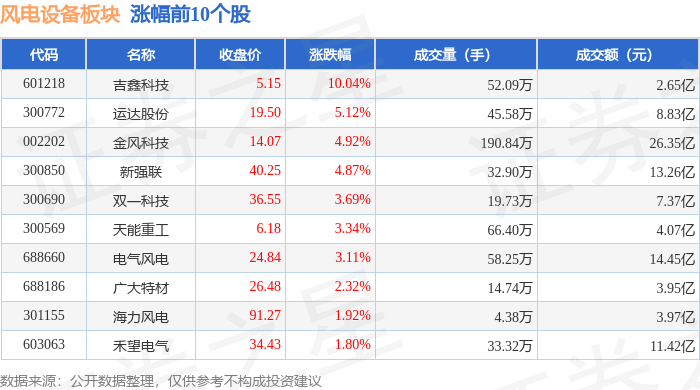
风电设备板块9月25日涨1.78%,吉鑫科技领涨,主力资金净流入1.65亿元
Zheng Xing Xing Ye Ri Bao· 2025-09-25 08:44
Group 1 - Wind power equipment sector increased by 1.78% on September 25, with Jixin Technology leading the gains [1] - Shanghai Composite Index closed at 3853.3, down 0.01%, while Shenzhen Component Index closed at 13445.9, up 0.67% [1] - Jixin Technology's stock price rose by 10.04% to 5.15, with a trading volume of 520,900 shares [1] Group 2 - The wind power equipment sector saw a net inflow of 165 million yuan from institutional investors, while retail investors experienced a net outflow of 120 million yuan [2][3] - Jixin Technology had a net inflow of 129 million yuan from institutional investors, accounting for 48.67% of its trading volume [3] - Other notable stocks included Yunda Co. with a 5.12% increase and Goldwind Technology with a 4.92% increase [1]