卡尔动力

Search documents
自动驾驶重卡商业价值远超Robotaxi?卡尔动力韦峻青:不追求100%无人化,更关注路线级盈利
Mei Ri Jing Ji Xin Wen· 2025-12-02 09:08
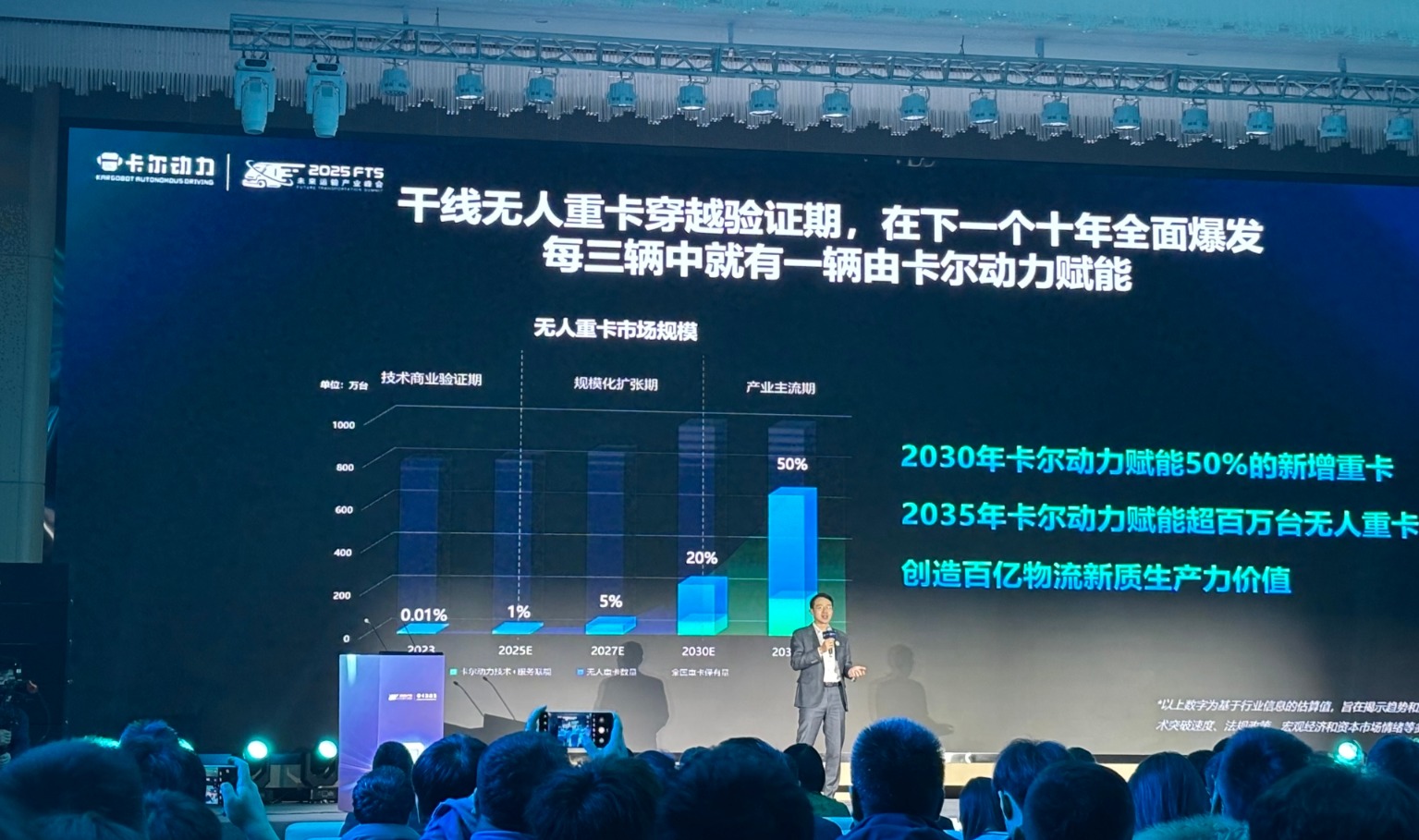
Core Insights - The focus of the industry is shifting towards L4 autonomous driving, particularly in the heavy-duty truck sector, which is seen as a high-value market with significant potential for commercialization [1][5] - The global market for autonomous trucks is expected to exceed 400 billion yuan by 2030, with full automation entering a validation phase by 2025 [1][5] - The company emphasizes that achieving profitability and scaling operations is more critical than pursuing 100% automation [1][4] Company Overview - The company, established in 2021 and incubated by Didi, has built a fleet of over 400 autonomous trucks, accumulating over 35 million kilometers in operational mileage and transporting a total of 1.2 billion tons [3][5] - The annual revenue of the company is approximately 500 million yuan, with a hardware cost of about 90,000 yuan per unit, offset by savings of over 100,000 yuan in driver costs annually [3][5] - The company aims to reduce overall logistics costs by 20% to 25% through autonomous driving technology and expects further efficiency gains from warehouse transport robots [3][5] Market Strategy - The company plans to focus on practical applications of autonomous driving, targeting a 50% to 80% reduction in labor costs while achieving scalable operations [4][5] - The company has received the first commercial operation qualification for autonomous freight transport in the country and aims to validate profitability on specific routes before scaling up [3][6] - The company has completed approximately 300 million yuan in Series A+ financing and does not currently face funding pressures, indicating strong market confidence in the potential of the autonomous truck sector [5][6] Future Projections - The company expects to add over 50 autonomous driving licenses by the end of the year, with plans to reach hundreds in the following year [6] - The company anticipates that the penetration rate of autonomous vehicles will double annually, with the potential for rapid scaling of profitable routes [6] - The company has developed seven mass-produced vehicle models and is accelerating the replication of successful operational models in new markets [6]

对话卡尔动力CEO韦峻青:自动驾驶卡车赛道即将形成商业闭环 | 巴伦精选
Tai Mei Ti A P P· 2025-11-30 07:19
Core Insights - The primary goal of the company is not to completely replace human labor but to significantly enhance the feasibility of logistics solutions by reducing labor costs by 50% to 80% through scalable operations [2] - The ultimate aim of autonomous driving is 100% automation, but the company emphasizes a balanced approach where machines handle standardized transport tasks while humans manage more complex operations [2][5] - The company has developed a hybrid intelligent convoy model, which combines manned lead vehicles with unmanned following vehicles, and has successfully implemented regular autonomous driving tests in various regions of China [2][4] Company Strategy - The company plans to test its kargoBot Space transport robot in 2026, which will have a 25% increase in cargo space and a 10% increase in effective load, leading to a fivefold increase in gross profit per vehicle [4] - The CEO predicts that in the next decade, there will be one million unmanned transport vehicles operating across urban and rural areas, supporting a new logistics network [5] - The company focuses on enhancing its AI capabilities, having achieved end-to-end autonomous driving, and aims to develop a specialized driving model for heavy trucks based on extensive operational data [5][6] Market Positioning - The company believes that the hybrid intelligent convoy model will remain relevant, especially for bulk commodity transport, and anticipates that it will capture a significant market share in the long term [8][11] - The company has deployed over 400 autonomous trucks, with a hardware cost of only 90,000 yuan per unit, and has achieved a gross profit increase of 3 to 6 times through its operational model [13][14] - The CEO emphasizes the importance of achieving route-level profitability rather than just focusing on individual vehicle profitability, aiming for a sustainable business model that can handle large volumes of freight [14][15] Technological Development - The company utilizes data-driven reinforcement learning techniques and various autonomous driving solutions to achieve fully unmanned operations in complex logistics scenarios [3] - The hybrid intelligent convoy model enhances safety, fuel efficiency, and intelligence by allowing vehicles to share sensor data and control commands, improving overall operational efficiency [12][13] - The company is positioned as a key player in the autonomous truck sector, with a focus on leveraging specific domain data and fine-tuning applications to enhance performance [7][16]
深夜,跳水!AI大变局;俄乌突发!直线下跌;新加坡,“转向”通义千问!人民币创新高
Sou Hu Cai Jing· 2025-11-26 00:15
Market Dynamics - The selection process for the new Federal Reserve Chair is in its final weeks, with Kevin Hassett seen as the frontrunner. The Treasury Secretary indicated that the nomination could be announced before the end of the year, with traders increasing bets on interest rate cuts [1] - U.S. stock indices rose for the third consecutive day, with Google challenging Nvidia in the AI model space. Google's stock saw a significant increase, while Nvidia's stock dropped [1] - The onshore and offshore RMB appreciated against the USD, reaching over a year-high, with the Nasdaq Golden Dragon China Index also seeing gains [2] - Southbound funds recorded a net purchase of approximately 11.166 billion HKD, with Alibaba and Kuaishou receiving significant inflows [3] Industry Developments - The Singapore National AI Strategy is shifting its focus to Alibaba's Qwen open-source architecture, marking a significant expansion of Chinese open-source AI models globally [2] - The global wafer foundry market is expected to reach $199.4 billion by 2025, driven by strong AI demand, with a projected CAGR of 14.3% from 2025 to 2030 [6] - The demand for SSDs is increasing, with North American cloud service providers planning to expand their use of SSDs for both warm and cold data applications [12] - The memory market is experiencing severe shortages, with expectations of continued price increases for DRAM and storage flash memory [12] Company Updates - Alibaba's cloud intelligence group reported a revenue of 39.82 billion CNY for Q2 of FY2026, a 34% year-on-year increase, with AI-related product revenue growing for nine consecutive quarters [4][5] - NIO reported a record delivery of 87,071 vehicles in Q3, a 40.8% year-on-year increase, with revenue reaching 21.79 billion CNY [14] - Meta Platforms is reportedly considering a significant investment in Google's TPU for its data center construction [8] - The company CFM noted a significant price increase in SSDs, driven by AI demand, with expectations of continued shortages in the memory market [12]
影响市场重大事件:新加坡国家AI计划放弃Meta模型 转向阿里千问;蓝箭航天朱雀三号将于11月29日首飞
Mei Ri Jing Ji Xin Wen· 2025-11-25 22:34
Group 1 - Singapore's National AI Strategy (AISG) has shifted from using Meta's model to Alibaba's Qwen open-source architecture for its Southeast Asian language model project, indicating a significant expansion of Chinese open-source AI models globally [1] - The newly launched "Qwen-SEA-LION-v4" model quickly ranked first in an open-source leaderboard measuring Southeast Asian language capabilities, outperforming Meta's model which struggled with regional languages like Indonesian, Thai, and Malay [1] Group 2 - The establishment of the Commercial Space Administration has been confirmed, which will integrate various functions related to the satellite industry, enhancing coordination and efficiency in commercial space launch approvals and satellite operation licensing [2] - The first flight of the medium-sized launch vehicle is imminent, supporting large-scale satellite constellation networking, with over a hundred satellites already in orbit [2] Group 3 - AI-driven high-performance computing (HPC) is increasing the demand for advanced packaging technologies, with cloud service providers considering a shift from TSMC's CoWoS solution to Intel's EMIB technology to accommodate more complex module integrations [3] Group 4 - The launch of the Zhuque-3 rocket by Beijing Blue Arrow Aerospace is scheduled for November 29, marking a significant milestone in China's manned space program [4] Group 5 - A new national standard for mobile power supplies is set to be implemented, which is expected to increase industry costs by 20%-30% due to higher quality component requirements and hardware upgrades [5] Group 6 - Huawei has officially launched the Mate80 series, with prices starting at 4699 yuan for the Mate80 and 5999 yuan for the Mate80 Pro, featuring the new HarmonyOS 6 [6] Group 7 - Beijing's AI Industry Investment Fund has invested in Pixel Bloom Technology, a developer of AI office tools, increasing its registered capital from approximately 2.85 million yuan to about 3.33 million yuan [7] Group 8 - LG Chem has announced a breakthrough in solid-state battery technology, improving battery capacity by approximately 15% and high-rate discharge capacity by about 50% compared to existing electrolytes [8] Group 9 - ADATA's chairman has indicated that the demand for memory chips, particularly DRAM and NAND Flash, is at a 20-year high, with supply shortages expected to persist into the first half of 2026 [9] Group 10 - Carl Power has unveiled a comprehensive solution for unmanned freight transport, with plans to begin demonstration operations of its first "transport robot" in the first half of 2026, aiming for 1 million units on the road within the next decade [10]
影响市场重大事件:新加坡国家AI计划放弃Meta模型,转向阿里千问;蓝箭航天朱雀三号将于11月29日首飞;商业航天司正式成立,卫星产业迎职能整合
Mei Ri Jing Ji Xin Wen· 2025-11-25 22:28
Group 1 - Singapore's National AI Strategy (AISG) has shifted from using Meta's model to Alibaba's Qwen open-source architecture, indicating a significant expansion of Chinese open-source AI models globally [1] - The newly launched "Qwen-SEA-LION-v4" model has quickly ranked first in an open-source leaderboard measuring Southeast Asian language capabilities, outperforming Meta's model in processing regional languages like Indonesian, Thai, and Malay [1] Group 2 - The establishment of the Commercial Space Administration is confirmed, which will integrate various functions related to the satellite industry, enhancing coordination and efficiency in commercial space launch approvals and satellite operation licensing [2] - The first flight of the medium-sized launch vehicle is imminent, supporting large-scale satellite constellation networking, with over a hundred satellites already in orbit [2] Group 3 - AI-driven high-performance computing (HPC) is increasing the demand for advanced packaging technologies, with cloud service providers considering a shift from TSMC's CoWoS solution to Intel's EMIB technology for better integration of complex functions [3] Group 4 - The launch of the Blue Arrow Aerospace Zhuque-3 rocket is scheduled for November 29, marking a significant milestone in China's manned space program [4] Group 5 - A new national standard for mobile power banks is set to be implemented, which is expected to increase overall industry costs by 20%-30% due to higher quality component requirements and hardware upgrades [5] Group 6 - Huawei has officially launched the Mate80 series, with prices starting at 4699 yuan for the Mate80 and 5999 yuan for the Mate80 Pro, featuring the new HarmonyOS 6 [6] Group 7 - Beijing's AI Industry Investment Fund has invested in Pixel Bloom, a developer of AI office tools, following a change in the company's shareholder structure and an increase in registered capital [8] Group 8 - LG Chem has announced a breakthrough in solid-state battery technology, achieving a 15% increase in basic capacity and a 50% increase in high-rate discharge capacity compared to existing electrolyte batteries [9] Group 9 - ADATA's chairman has reported a severe shortage of memory chips due to AI demand, with customers receiving only 30% of their orders, and expects this shortage to persist into the first half of 2026 [10] Group 10 - Carl Power has unveiled a comprehensive solution for unmanned freight transport, with plans to demonstrate its first "transport robot" in 2026 and aims for 1 million units to be operational within the next decade [11]
霸王茶姬CEO将与“光伏女神”结婚;俞敏洪称明年将选10个员工去南极;何同学称公司今年亏了一两百万;魅族回应出售总部大楼丨邦早报
创业邦· 2025-11-21 00:08
Group 1 - Yu Minhong responded to New Oriental employees' complaints, emphasizing that allowing employees to voice their dissatisfaction is a tradition of the company, and he encourages it as a means to correct issues [4] - Xiaomi announced the allocation of 29,366,734 shares to 3,334 selected participants, including employees and service suppliers, with a total value of approximately HKD 1.14 billion (around CNY 1.041 billion) [5] - The recent changes in the management of Pang Donglai Group were confirmed by internal sources, indicating that Yu Donglai will not be heavily involved in daily operations but will focus on empowering his team [5] Group 2 - ByteDance's valuation surged to USD 480 billion during a recent equity auction, with the price of shares rising from an initial USD 200 million to nearly USD 300 million due to competitive bidding [5] - The founder of Bawang Tea Ji, Zhang Junjie, is set to marry Gao Haichun, a prominent figure in the solar energy sector, indicating potential synergies between the two industries [5] - He Tongxue, a notable figure in the tech industry, reported a loss of CNY 1-2 million for his company this year, attributing it to a significant impact from a social media post [5] Group 3 - KargoBot appointed a new CFO, Zhan Ruinan, to accelerate its development in the autonomous driving sector, signaling a strategic move towards internationalization and capital expansion [5] - The first MPV from Hongmeng Zhixing is set to launch, featuring advanced technology and multiple powertrain options, showcasing the company's commitment to innovation in the automotive sector [5] - Meizu denied rumors of relocating its headquarters, affirming that its current building will continue to serve the company for a long time [7] Group 4 - GAC Toyota's sales vice president refuted claims that the company would cease production of several key gasoline vehicles, clarifying that such information is false [8] - Nvidia's recent earnings report highlighted significant contributions from various clients, including a lesser-known Saudi startup, Humain, which aims to supply a substantial portion of global AI computing power by 2034 [8] - Ant Group's CTO discussed the relationship between its Lingguang App and Alibaba's Qianwen App, emphasizing collaboration in the pursuit of AGI [8] Group 5 - The humanoid robot A2 completed a 100-kilometer cross-province walk, earning a Guinness World Record for the longest distance walked by a humanoid robot [10] - Meta's chief scientist, Yann LeCun, announced his departure to start a new venture focused on advanced machine intelligence, aiming to revolutionize AI capabilities [11] - WeRide's Robotaxi received a pure unmanned license in Switzerland, marking a significant milestone in the deployment of autonomous vehicles [11] Group 6 - Physical Intelligence, a robotics startup, raised USD 600 million in funding, achieving a valuation of USD 5.6 billion, indicating strong investor confidence in AI-driven robotics [12] - Star Motion Era completed nearly CNY 1 billion in A+ round financing, led by Geely Capital, to support its technology iterations and applications [12] - SoftBank plans to invest up to USD 3 billion in a factory to produce equipment for OpenAI's data center, reinforcing its commitment to AI development [12] Group 7 - IDC forecasts that the smart glasses market in China will reach a significant turning point by 2026, with expected shipments surpassing 4.915 million units [17] - The sales of pure electric large three-row SUVs have outperformed other powertrain types for two consecutive months, indicating a strong market trend towards electric vehicles [17]

新型马路判官上路,无人物流车狂奔
3 6 Ke· 2025-11-20 01:53
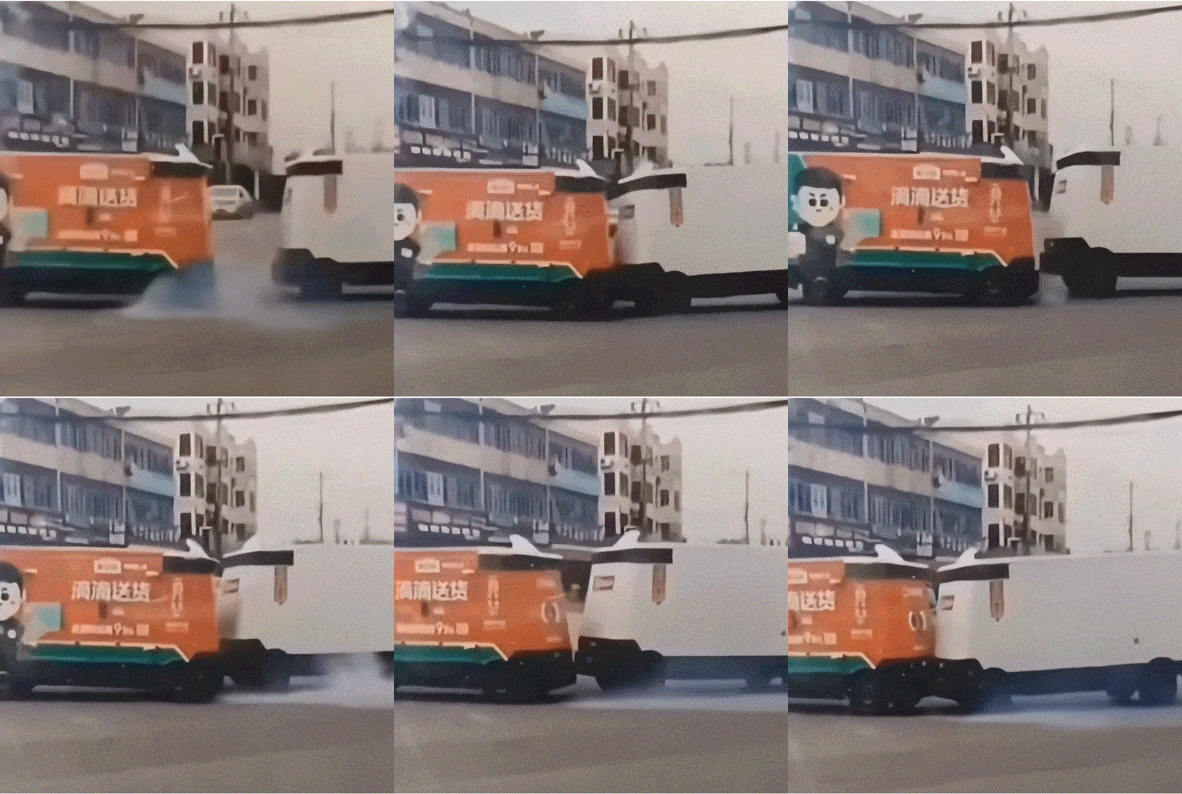
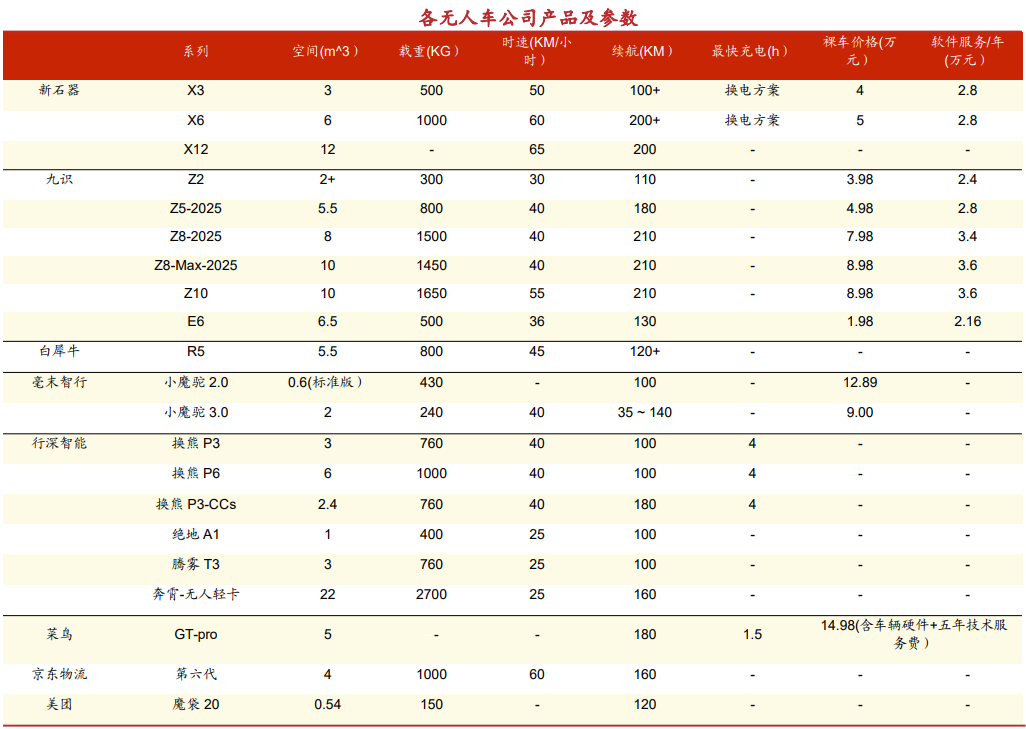
Core Insights - The rise of unmanned logistics vehicles is transforming the delivery landscape, showcasing a clash between advanced technology and traditional agricultural practices [1] - The demand for unmanned logistics vehicles has surged, driven by technological advancements and the need for contactless delivery solutions during the pandemic [8][13] - Major logistics companies are heavily investing in unmanned logistics vehicles, indicating a significant market potential estimated to be worth hundreds of billions [15][18] Demand Explosion - Unmanned logistics vehicles are not new; they have evolved from early tests by companies like JD.com and Suning, which began in 2016 [8][11] - The pandemic accelerated the adoption of unmanned logistics vehicles, as companies like Meituan and SF Express adapted to new delivery challenges [13] - The technology has matured, with L4-level autonomous delivery vehicles being deployed in urban environments, expanding their operational scope [11][19] Industry Growth - The unmanned logistics vehicle market is projected to be a trillion-yuan industry by 2025, driven by increasing demand and technological advancements [15][20] - Major logistics firms are ramping up their investments, with China Post planning to procure 7,000 unmanned vehicles and JD Logistics aiming for 1 million units in five years [18] - The operational model of logistics is shifting from traditional methods to a more efficient system utilizing unmanned vehicles for direct delivery [19] Technological and Policy Support - The Chinese government has been supportive of unmanned logistics vehicle development, issuing guidelines to promote their use in various environments [17] - The cost of producing unmanned logistics vehicles has significantly decreased, making them more accessible for logistics companies [28] - The industry is witnessing a surge in investment, with leading companies securing substantial funding to enhance their capabilities [21][23] Future Outlook - The commercial application of unmanned logistics vehicles is expected to expand beyond delivery services, integrating into a broader autonomous transportation network [30] - The successful trials of unmanned heavy-duty trains and mining vehicles indicate the potential for widespread adoption across various sectors [32][35] - The development of unmanned logistics vehicles is seen as a critical component of China's strategic goals in industrial modernization and technological advancement [39]



自动驾驶 鄂尔多斯市康巴什区给出的绿色物流答案
Xin Hua Cai Jing· 2025-10-31 08:28
Core Viewpoint - The article highlights the advancements in autonomous driving technology for heavy-duty trucks, particularly in the context of coal transportation in Ordos City, showcasing the collaboration between Karl Power and various industry partners to drive innovation and efficiency in logistics [1][2]. Group 1: Company Developments - Karl Power has developed autonomous driving technology for new energy heavy-duty trucks, with plans to relocate its R&D headquarters to Ordos City by June 2024 [1]. - The company has established R&D and operational centers in Ordos, collaborating with over 30 industry partners, including Huawei and Weichai Power, to form a freight alliance focused on autonomous driving [1][2]. - As of September 2023, Karl Power has deployed 343 intelligent connected heavy-duty trucks in Ordos City, achieving regular testing operations across three core transportation scenarios [2]. Group 2: Industry Impact - The shift towards intelligent and green upgrades in coal mines and factories is creating a significant opportunity for the large-scale application of autonomous heavy-duty trucks in energy transportation and mining logistics [1]. - Karl Power's mixed fleet autonomous driving solution, which combines L2 and L4 technologies, enhances safety by five times, reduces energy consumption by 10%, and can save up to 83% in labor costs [2]. - The cumulative operational mileage of Karl Power's autonomous driving fleet has surpassed 30 million kilometers, transporting over 1 billion ton-kilometers of goods [2]. Group 3: Future Plans - Karl Power aims to expand its cross-city operational network in regions such as Bayannur, Baotou, Wuhai, and Yulin, with plans to open at least two urban trunk logistics routes by the end of the year [2]. - The company intends to increase investment in intelligent connected vehicle-related businesses in Ordos City, contributing to the intelligent transformation of transportation in resource-based cities [2].

自动驾驶三大黄金赛道谁主沉浮?
Xin Lang Cai Jing· 2025-10-30 09:47
Core Insights - The autonomous driving sector is experiencing significant growth, particularly in the areas of RoboBus, RoboTruck, and RoboVan, with a focus on practical applications in real-world scenarios [1][2]. Funding and Investment - Neolix, a provider of L4-level autonomous delivery solutions, has completed over $600 million in Series D financing, setting a record in China's autonomous driving sector [2]. - Other leading companies in the autonomous driving field have also secured substantial funding, with notable investments including nearly $3 million for Karl Power in May 2025 and $100 million for Jiushi Intelligent in October 2025 [2]. Market Dynamics - The autonomous delivery vehicle market is entering a phase of intense competition, with leading companies like Neolix and Jiushi Intelligent rapidly scaling operations. By the end of 2025, several companies are expected to surpass the delivery threshold of 10,000 vehicles [4][5]. - The market is projected to see over 30,000 autonomous delivery vehicles sold by 2025, with a potential annual sales volume exceeding 800,000 units by 2030 [5]. Cost Reduction and Efficiency - The cost of autonomous delivery vehicles has significantly decreased, with prices dropping from hundreds of thousands to around 10,000 yuan, a reduction of nearly 90% [5]. - The introduction of autonomous delivery vehicles has led to a 70% reduction in per-package delivery costs and improved delivery efficiency by 20-30% [8]. Operational Impact - Autonomous delivery vehicles are primarily used for transporting goods between sorting centers and residential areas, enhancing operational efficiency and reducing labor costs [7]. - Major logistics companies, including SF Express and Zhongtong Express, have begun integrating autonomous delivery vehicles into their operations, with Zhongtong deploying approximately 1,000 units [8]. Technological Advancements - The industry is moving towards a more mature technological landscape, with a focus on balancing complexity and cost control in autonomous driving applications [9][24]. - The core technologies driving the sector include advanced sensors, AI algorithms, and modular designs that enhance adaptability across various logistics scenarios [17][18]. Future Outlook - The autonomous bus segment is expected to grow significantly, with projections indicating a market size reaching hundreds of billions by 2030 [22][23]. - The integration of autonomous buses into urban transportation networks is anticipated to create a seamless travel experience, contributing to the overall efficiency of public transport systems [24][25].
超44家!2025年融资过亿企业大盘点
Sou Hu Cai Jing· 2025-10-30 09:21
Core Insights - The low-speed autonomous driving sector has seen significant investment activity, with over 49 financing events exceeding 100 million RMB since 2025, totaling nearly 21.8 billion RMB [1][4]. Financing Overview - A total of 49 financing events involved 44 companies, with 27 companies receiving A and B+ round financing in the first ten months of the year, indicating a strong interest in early-stage development [4][6]. - The financing events are categorized as follows: 27 events in the 100 million to 200 million RMB range, 14 events in the 200 million to 1 billion RMB range, 4 events in the 1 billion to 2 billion RMB range, and 4 events exceeding 2 billion RMB [6][7]. Sector Focus - The most popular financing areas include unmanned delivery, unmanned sanitation, and mining autonomous driving, with notable investments in companies like NineSight, New Stone, and White Rhino in the unmanned delivery sector [7][8]. - The mining autonomous driving sector has also seen significant activity, with 9 financing events, 5 of which were publicly disclosed as being of 100 million RMB or more, totaling 1.357 billion RMB [7]. Market Trends - Since 2025, the low-speed autonomous driving sector has exhibited a trend of "head concentration and scenario dominance," with unmanned delivery and mining scenarios becoming the primary focus for capital investment [7][8]. - The overall financing heat in the industry has increased compared to the previous year, indicating a growing interest from investors [4][6].