青岛银行

Search documents
银行业周度追踪2026年第6周:商业银行四季度利润增速回升-20260224
Changjiang Securities· 2026-02-23 23:30
Investment Rating - The industry investment rating is "Positive" and maintained [11] Core Insights - The banking index fell by 1.3% this week, underperforming the CSI 300 and ChiNext indices by 1.6% and 2.5% respectively, indicating a short-term style switch in the market [6][19] - H-shares of banks led the gains, while most A-shares declined, with notable performances from Huaxia Bank and Shanghai Bank due to improved earnings and strong expectations for convertible bond conversions [6][19] - The price-to-book (PB) ratio and return on equity (ROE) of bank stocks remain undervalued, with a continued recommendation for high-quality city commercial banks in Zhejiang, Jiangsu, and Shandong provinces, including Hangzhou Bank, Ningbo Bank, Jiangsu Bank, Nanjing Bank, Qingdao Bank, Qilu Bank, and Suzhou Bank [6][19] - The report also suggests focusing on low-valuation, high-dividend, and convertible bond opportunities, particularly in Industrial Bank [6][19] Summary by Sections Market Performance - The banking sector's trading activity has decreased, with turnover rates falling, although the transaction volume share for state-owned and rural commercial banks has rebounded [8][39] - The average dividend yield for the six major state-owned banks in A-shares is 4.28%, with a spread of 249 basis points over the 10-year government bond yield, while H-shares yield 5.21% [7][29] Profit Growth and Net Interest Margin - The overall asset growth rate for commercial banks reached 9.0% year-on-year by the end of Q4 2025, with major state-owned banks seeing a growth rate of 10.8% [9][44] - The net profit growth for commercial banks was 2.3% year-on-year, indicating a positive trend, particularly among city and rural commercial banks [9][44] - The net interest margin for 2025 is projected at 1.42%, with a marginal stabilization observed, and a further narrowing of the decline expected in 2026 [9][46] Asset Quality - The non-performing loan (NPL) ratios across various banks are stable or improving, attributed to increased write-off efforts, while the provision coverage ratio continues to decline [10][49] - Capital adequacy ratios remain stable, with attention on the potential impact of the second round of fiscal injections for state-owned banks and refinancing for smaller banks in 2026 [10][49]






11家银行年报抢先看!浦发、中信规模突破10万亿,青岛银行增速领跑
Xin Lang Cai Jing· 2026-02-23 02:11
Core Insights - 11 A-share banks reported their 2025 performance, showing an average total asset growth rate of 11.32%, with city commercial banks significantly outperforming joint-stock banks in profitability [1][12]. Group 1: Performance Overview - The average growth rate of total assets for the 11 banks was 11.32%, while the average growth rate for operating income was 3.30%, and the average growth rate for net profit attributable to shareholders was 7.83% [1][12]. - Analyst Zheng Qingming from Shenwan Hongyuan Securities predicts that listed banks will exhibit stable revenue with gradually improving profit growth, expecting a 0.9% year-on-year revenue growth and a 1.9% recovery in net profit growth for 2025 [1][13]. Group 2: Joint-Stock Banks Performance - Four joint-stock banks (Shanghai Pudong Development Bank, CITIC Bank, China Merchants Bank, and Industrial Bank) reported total assets exceeding 10 trillion yuan, with Shanghai Pudong Development Bank's total assets reaching 100,817.46 billion yuan, a 6.55% increase from 2024 [2][15]. - Shanghai Pudong Development Bank achieved the fastest net profit growth among joint-stock banks, with a net profit of 500.17 billion yuan, an increase of 10.52% year-on-year [2][15]. Group 3: City Commercial Banks Performance - City commercial banks outperformed joint-stock banks in several metrics, with an average total asset growth rate of 15.1%, operating income growth of 5.73%, and net profit growth of 11% [5][19]. - Qingdao Bank emerged as the fastest-growing bank, with total assets growing by 18.12% to 8149.60 billion yuan and net profit increasing by 21.66% [5][19]. Group 4: Asset Quality and Income - Shanghai Pudong Development Bank reported a decrease in non-performing loans and a decline in the non-performing loan ratio, indicating improved asset quality [3][16]. - Several banks, including Ningbo Bank and Nanjing Bank, reported significant increases in net interest income, with Ningbo Bank achieving a 10.77% increase to 531.61 billion yuan [10][25].






2025年A股上市银行成绩单:规模质量并进,城商行会改写格局吗?
Sou Hu Cai Jing· 2026-02-22 20:27
2025年A股上市银行的年度成绩单正逐步揭晓,42家银行中已有11家率先披露了关键数据。从资产规模 到净利润增长,从不良贷款率到净息差表现,这些数字背后不仅反映了银行业的整体韧性,更暗藏着一 场关于利润与风险的深度博弈。 资产规模扩张与经营质量并重 中信银行和浦发银行双双迈入"10万亿资产俱乐部",前者资产总额达10.13万亿元,后者以10.08万亿元 紧随其后。招商银行则以超过13万亿元的资产规模和7.5%的增长率继续领跑。这些数据不仅体现了头 部银行的规模优势,也印证了中国银行业在复杂经济环境下的稳健性。然而,规模扩张只是表象,经营 质量才是核心。南京银行以两位数的营收增速脱颖而出,青岛银行归母净利润增长超过20%,齐鲁银行 和杭州银行同样实现了两位数的利润增长。城商行的亮眼表现,似乎正在打破市场对"大行垄断"的固有 认知。 资产质量改善:风险管控的精细化 不良贷款率是衡量银行资产质量的关键指标。苏农银行、中信银行、招商银行等机构的不良率均有所下 降,南京银行、杭州银行和宁波银行则保持稳定。拨备覆盖率虽小幅回落,但整体仍处于健康区间。 杭州银行拨备覆盖率超过500%,招商银行也维持在391.79%的高位, ...
净利上升、股价分化,2026年如何投资银行股?
Xin Lang Cai Jing· 2026-02-21 02:21
Core Viewpoint - The opportunity cost of investing in bank stocks remains low, with the current 10-year government bond yield at 1.80% and bank stock dividends close to 4.4%, providing a premium of 2.6 percentage points over the bond yield [19][33]. Group 1: Bank Profitability and Performance - The net profit of commercial banks is showing significant recovery, as evidenced by recent performance reports from over 12 banks, with all but Huaxia Bank reporting positive growth [19][25]. - Qingdao Bank's net profit increased by over 20% year-on-year, while Qilu Bank, Hangzhou Bank, and Pudong Development Bank also reported growth exceeding 10% [5][23]. - In contrast, Huaxia Bank's net profit decreased by 1.72% compared to the previous year, making it the only bank with negative growth [25][7]. Group 2: Market Trends and Stock Performance - As of February 13, 2026, among 42 A-share listed banks, 24 saw their stock prices decline, particularly among state-owned and national joint-stock banks, while Qingdao Bank, Ningbo Bank, and Chongqing Rural Commercial Bank led the gains [20][29]. - The market is increasingly focusing on the return on equity (ROE) of commercial banks, indicating a shift towards valuing banks with strong fundamentals over high dividend yields [21][33]. Group 3: Future Outlook and Investment Strategies - Analysts predict improvements in the banking sector's fundamentals for 2026, with revenue growth driven by deposit repricing and a stabilization of net interest margins [26][34]. - The average price-to-book ratio for A-share banks has fallen to 0.54, suggesting a favorable valuation environment for bank stocks [33][34]. - Investment strategies should focus on banks with high earnings elasticity, quality regional banks, and those benefiting from fixed asset investment improvements [34][33].

青岛银行6宗违规被罚116.1万 违反账户管理规定等
Zhong Guo Jing Ji Wang· 2026-02-17 08:06
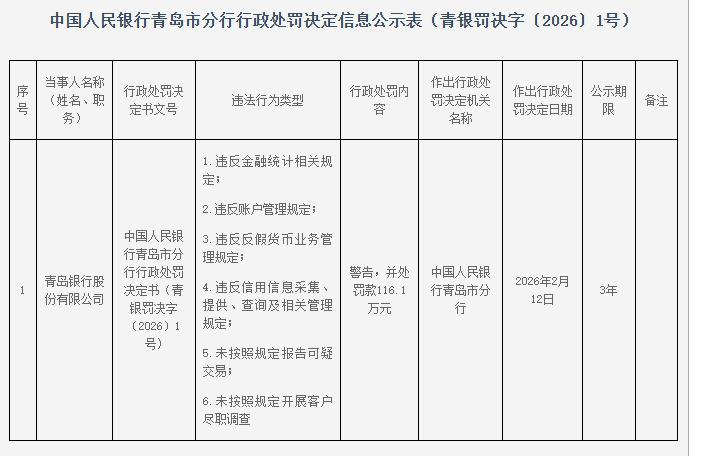
中国经济网北京2月17日讯 中国人民银行青岛市分行网站近日公布的行政处罚决定信息公示表(青 银罚决字〔2026〕1号)显示,青岛银行股份有限公司存在以下违法行为类型:1.违反金融统计相关规 定;2.违反账户管理规定;3.违反反假货币业务管理规定;4.违反信用信息采集、提供、查询及相关管 理规定;5.未按照规定报告可疑交易;6.未按照规定开展客户尽职调查。 | 店号 | 当事人名称 | 行政处罚决 | | 行政处罚内 | 作出行政处 | 作出行政处 | 公示期 | 备注 | | --- | --- | --- | --- | --- | --- | --- | --- | --- | | | (姓名、职 务) | 定书文号 | 违法行为类型 1. 违反金融统计相关规 | kin | 罚决定机关 名称 | 罚決定日期 | Re | | | | | | 定; 2. 违反账户管理规定; | | | | | | | | | 中国人民银 | 3. 违反反假货币业务管 | | | | | | | | | 行青岛市分 | 理规定; | | | | | | | 1 | 青岛银行股 | 行行政处罚 | 4. 违反信用信息采集、 ...
青岛银行被罚116.1万元:违反金融统计相关规定等
Xin Lang Cai Jing· 2026-02-14 13:56
Core Viewpoint - The Qingdao Bank Co., Ltd. has been penalized by the People's Bank of China, Qingdao Branch, for multiple regulatory violations, resulting in a warning and a fine of 1.161 million yuan [1]. Summary by Categories Regulatory Violations - The bank violated financial statistical regulations [2][3] - The bank breached account management regulations [2][3] - The bank did not comply with anti-counterfeit currency business management regulations [2][3] - The bank failed to adhere to regulations regarding the collection, provision, and inquiry of credit information [2][3] - The bank did not report suspicious transactions as required [2][3] - The bank did not conduct customer due diligence as mandated [2][3] Penalties - The bank received a warning and was fined 1.161 million yuan [1] - The penalty decision was made public on February 12, 2026 [1]
2026年1月金融数据点评:存款搬家加速,M1、M2增速大幅回升
GF SECURITIES· 2026-02-14 05:23
Investment Rating - The industry rating is "Buy" [6] Core Insights - The overall social financing growth slightly declined to 8.2% in January, while M1 and M2 growth rates significantly rebounded, with M1 growing by 4.9% and M2 by 9.0% [6][16] - Government net financing increased significantly by 2,831 billion yuan year-on-year, contributing to the overall social financing growth [6][17] - The report indicates a shift in deposit structure due to accelerated deposit migration, impacting M1 negatively while having limited effect on M2 [6][16] Summary by Sections Overall Situation - Social financing growth decreased slightly to 8.2%, while M1 and M2 growth rates increased significantly [15][16] - M1 and M2 growth rates rose by 1.1 percentage points and 0.5 percentage points respectively compared to the previous month [6][16] Government Sector - Fiscal strength showed a year-on-year decline, impacting overall financing dynamics [39] Household Sector - Demand remained stable year-on-year, with short-term loan demand increasing [39] Corporate Sector - Short-term loan demand increased year-on-year, while bill financing saw a significant reduction [39] Non-Bank Sector - The acceleration of deposit migration was noted, with non-bank deposits increasing by 1.45 trillion yuan year-on-year [6][39]



1月信贷社融点评:温和开门红
ZHESHANG SECURITIES· 2026-02-14 05:23
Investment Rating - The industry investment rating is "Positive" (maintained) [4] Core Insights - The report highlights a "strong deposit, weak loan" characteristic in the opening month of the year [4] - In January 2026, new social financing increased by 7.2 trillion yuan, a year-on-year increase of 166.2 billion yuan, with a balance growth of 8.2% [4][5] - New RMB loans in January 2026 amounted to 4.7 trillion yuan, a year-on-year decrease of 420 billion yuan, with a balance growth of 6.1% [4][5] - The report indicates that consumer demand has shown some recovery, particularly in short-term loans, but overall consumer credit demand may remain pessimistic throughout the year [1][2] Summary by Sections Credit Overview - Entity credit remained stable, with a significant reduction in bill financing [1] - Retail loans saw an increase of 456.5 billion yuan in January, with short-term loans contributing 109.7 billion yuan [1] - Corporate loans totaled 4.5 trillion yuan, a year-on-year decrease of 330 billion yuan, influenced by a substitution effect between short-term loans and bill financing [2] Social Financing - Government bonds contributed significantly to social financing, with new issuance of 976.4 billion yuan in January, a year-on-year increase of 283.1 billion yuan [5] - The report notes a trend of "deposit migration," with non-bank deposits reaching 36 trillion yuan, accounting for 10.7% of total deposits [5] Investment Recommendations - The report recommends a "New Momentum Portfolio" including banks like Nanjing Bank, Shanghai Bank, and others, highlighting their potential for value recovery [3][5] - It emphasizes the importance of high-dividend bank stocks in the current environment, suggesting that banks with new growth drivers may achieve greater value restoration [5]

银行1月信贷社融点评:温和开门红
ZHESHANG SECURITIES· 2026-02-14 03:24
Investment Rating - The industry investment rating is "Positive" (maintained) [4] Core Insights - The report highlights a "strong deposit, weak loan" characteristic in the opening month of the year [4] - In January 2026, new social financing increased by 7.2 trillion yuan, a year-on-year increase of 166.2 billion yuan, with a balance growth of 8.2% [4][5] - New RMB loans in January 2026 amounted to 4.7 trillion yuan, a year-on-year decrease of 420 billion yuan, with a balance growth of 6.1% [4][5] - The report indicates that consumer demand has shown some recovery, particularly in short-term loans, but overall consumer credit demand may remain pessimistic throughout the year [1][2] Summary by Sections Credit Overview - Entity credit remained stable, with a significant reduction in bill financing [1] - Retail loans added 456.5 billion yuan in January, a year-on-year increase of 12.7 billion yuan [1] - Corporate loans added 4.5 trillion yuan, a year-on-year decrease of 330 billion yuan, primarily due to a reduction in bill financing [2] Social Financing - Government bonds contributed significantly to social financing, with new issuance of 976.4 billion yuan, a year-on-year increase of 283.1 billion yuan [5] - The report notes a trend of "deposit migration," with non-bank deposits reaching 36 trillion yuan, accounting for 10.7% of total deposits [5] Investment Recommendations - The report recommends a "New Momentum Portfolio" including banks such as Nanjing Bank, Shanghai Bank, and Industrial and Commercial Bank of China, highlighting their potential for value recovery [3][5] - It emphasizes the importance of high-dividend bank stocks as having allocation value amid steady declines in credit growth [5]
蛇年收官!银行股14万亿市值背后几家欢喜几家愁
第一财经· 2026-02-13 14:17
Core Viewpoint - The A-share banking sector has shown significant performance in 2025, with a total market capitalization surpassing 10 trillion yuan, indicating a structural bull market despite a mixed performance among individual stocks [2][6]. Group 1: Market Performance - As of February 13, the total market capitalization of the banking sector reached approximately 13.72 trillion yuan, an increase of 1.45 trillion yuan from the end of the previous year [2][6]. - The A-share market capitalization grew by over 20 trillion yuan compared to the previous year, reaching nearly 114 trillion yuan [6]. - The banking sector's market capitalization as a proportion of the total A-share market decreased from 11.19% at the end of the previous year to around 9% [6]. Group 2: Stock Performance - In 2025, 32 banking stocks recorded gains, with Qingdao Bank, Xiamen Bank, and Agricultural Bank leading with increases of over 30% [2][3]. - The banking sector's overall performance was relatively weak, with a decline of 0.3% for the year, making it one of the lowest-performing sectors among 31 major industries [3][4]. - Notable individual stock performances included Qingdao Bank with a 39.37% increase, Xiamen Bank at 38.36%, and Agricultural Bank at 30.86% since February 5 [3][5]. Group 3: Structural Trends - The banking sector experienced a clear differentiation in performance, with large state-owned banks initially performing well, while smaller banks gained momentum later in the year [4][6]. - Despite the overall positive trend, 10 banking stocks ended the year in the red, with Everbright Bank showing the largest decline at 10.7% [4][5]. - The competition for market capitalization among major banks saw Agricultural Bank briefly surpass Industrial and Commercial Bank of China, although the latter regained its position as the market leader by year-end [6][7].