京东健康

Search documents
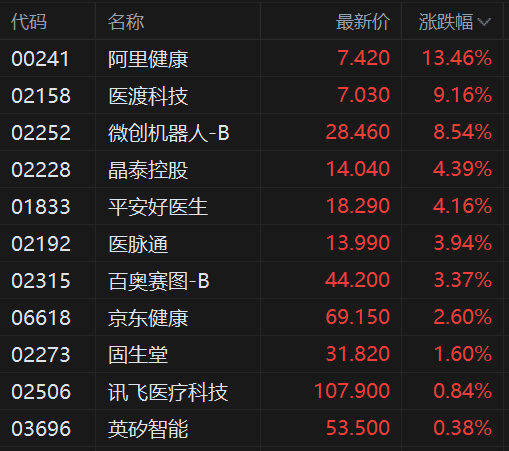
港股异动丨AI医疗概念股继续强势 阿里健康大涨超13% 医渡科技大涨超9%
Ge Long Hui· 2026-01-14 03:29
Core Viewpoint - The AI healthcare sector in Hong Kong is experiencing a strong bullish trend, driven by clear industry trends and significant market demand for AI health solutions [1] Group 1: Market Performance - Alibaba Health has surged over 13%, leading the market with a cumulative increase of over 46% this month [1] - Other notable performers include Yidu Tech with a rise of over 9%, MicroPort Robotics up by 8.9%, and Ping An Good Doctor increasing by over 4% [1] - Additional companies such as Yimaitong, JD Health, and Gushengtang also saw gains [1] Group 2: Industry Drivers - The launch of Ant Group's AI health assistant "Antifufu" has seen monthly active users exceed 30 million, with daily inquiries surpassing 10 million, indicating strong demand in the health AI sector [1] - OpenAI's introduction of "ChatGPT Health" on January 8 further emphasizes the confidence of leading AI companies in the health AI market [1] Group 3: Market Forecast - Frost & Sullivan predicts that China's "AI + healthcare" market will grow from 8.8 billion yuan in 2023 to 315.7 billion yuan by 2033, with a compound annual growth rate of 43.1% over the next decade [1] - Huafu Securities reports that the AI healthcare industry is entering a critical phase of commercialization, supported by national strategies and market demand [1] - The report highlights a closed-loop demand for AI applications, which will sustain the continuous development of the AI industry [1]


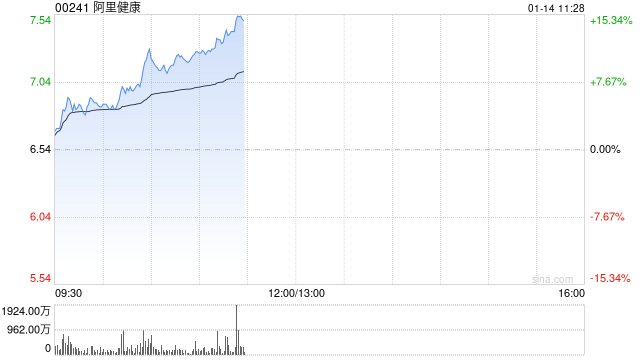
港股AI医疗概念股拉升 阿里健康大涨超15% 产业或将迎来蓬勃发展期
Xin Lang Cai Jing· 2026-01-14 03:29
Core Viewpoint - The recent surge in Hong Kong's AI healthcare stocks is driven by a clear confirmation of industry trends, with significant growth in user engagement and market potential for AI applications in healthcare [1][3][6] Group 1: Stock Performance - Alibaba Health has seen a rise of over 15%, with a cumulative increase of over 49% in January [1][6] - Other notable performers include Yidu Tech (up over 9%), MicroPort (up over 8%), Ping An Good Doctor (up over 5%), and JD Health (up over 2%) [1][6] Group 2: Market Analysis - The launch of Ant Group's AI health assistant "Antifufu" has resulted in over 30 million monthly active users and over 10 million daily inquiries, indicating strong demand in the health AI sector [3][8] - OpenAI's introduction of "ChatGPT Health" further emphasizes the confidence of leading AI companies in the health AI market [3][8] Group 3: Market Forecast - Frost & Sullivan predicts that China's "AI + healthcare" market will grow from 8.8 billion yuan in 2023 to 315.7 billion yuan by 2033, with a compound annual growth rate of 43.1% over the next decade [3][8] - Huafu Securities reports that the AI healthcare industry is entering a critical phase of commercialization, supported by national strategies and market demand [3][8] Group 4: Industry Innovation - Huachuang Securities anticipates that advancements in AI model capabilities will lead to comprehensive integration of AI in the healthcare industry, driving technological innovation [3][8] - The reduction in computing costs is expected to accelerate investments in AI capabilities by leading companies in various healthcare segments, potentially leading to a period of robust industry growth [3][8]
ETF盘中资讯 港股AI重振旗鼓!可灵AI营收强劲,快手-W领涨4%,阿里涨超3%,美联储降息预期再升温
Jin Rong Jie· 2026-01-14 02:22
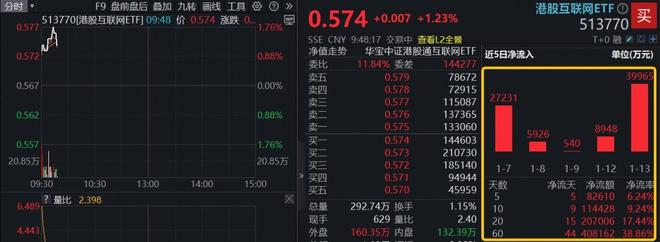
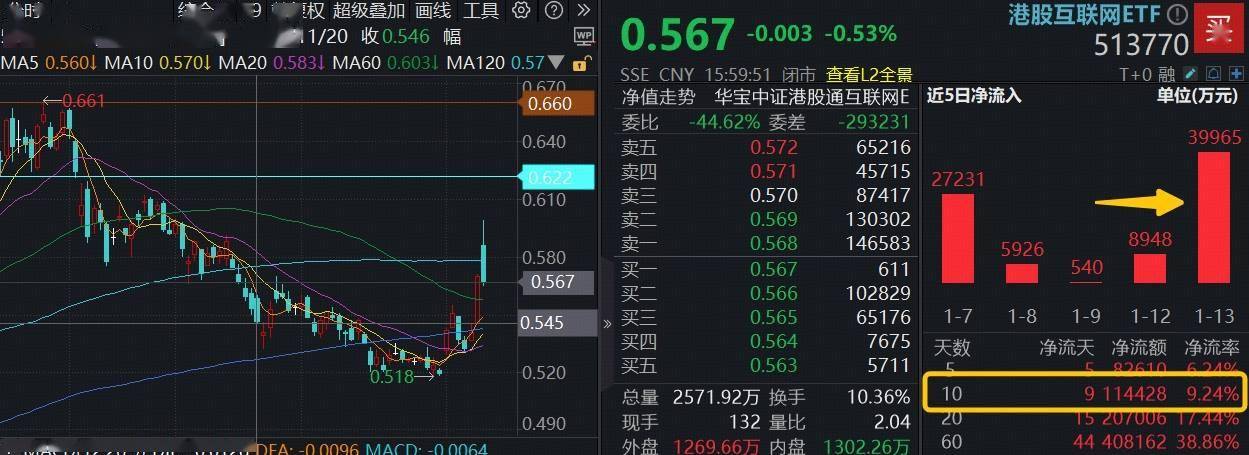
Core Viewpoint - The Hong Kong stock market is experiencing a resurgence in AI-related stocks, with major internet companies showing strong performance, particularly Kuaishou, Alibaba, Xiaomi, and Tencent, as well as the Hong Kong Internet ETF (513770) attracting significant capital inflow [1][3]. Group 1: Market Performance - Kuaishou-W shares rose over 4%, Alibaba-W increased by more than 2%, and both Xiaomi Group-W and Tencent Holdings also saw gains [1]. - The Hong Kong Internet ETF (513770) opened high and saw an intraday increase of 1.76%, currently up by 1.23%, with a total capital inflow of 1.144 billion yuan over the past 10 days [1][2]. Group 2: AI Developments - Kuaishou announced that its AI product, Keling, is expected to generate over $20 million in revenue by December 2025, with an annualized revenue run rate of $240 million [1]. - Kuaishou has launched the world's first unified multimodal video model, Keling O1, and the Keling 2.6 model, which features "audio-visual synchronization" capabilities, indicating rapid product iteration [1]. Group 3: Future Outlook - According to Guotai Junan Securities, AI applications are expected to transition from usable to user-friendly by 2026, with diverse business models emerging, positioning AI applications as a core theme in the 2026 AI industry market [3]. - The easing of external liquidity pressures is likely to support the valuation recovery of Hong Kong tech stocks, with expectations of a resonance in buying from both domestic and foreign investors in the AI sector [3]. Group 4: ETF Composition - The Hong Kong Internet ETF (513770) passively tracks the CSI Hong Kong Internet Index, with major holdings including Alibaba-W, Tencent Holdings, Xiaomi Group-W, Kuaishou-W, and Bilibili-W, where the top ten weighted stocks account for over 78% of the index [3].

ETF盘前资讯|港股AI歇脚,资金暴力抢筹!港股互联网ETF(513770)单日狂揽近4亿元,阿里云收入加速增长
Sou Hu Cai Jing· 2026-01-14 01:17
Group 1 - The core viewpoint of the news highlights the recent performance of the Hong Kong stock market, particularly the AI sector, with the Hong Kong Internet ETF (513770) experiencing a slight decline of 0.53% despite significant capital inflows [1][4] - The Hong Kong Internet ETF (513770) saw a net inflow of 400 million yuan in a single day and a total of 1.144 billion yuan over the past ten days, indicating strong investor interest [1][4] - Major internet companies in Hong Kong showed mixed performance, with Alibaba and Bilibili both rising over 3%, while Tencent, Meituan, Xiaomi, and Kuaishou experienced declines [2][4] Group 2 - According to Hugging Face, Alibaba Cloud's Tongyi Qianwen series models have surpassed 700 million downloads, making it the highest downloaded open-source AI series on the platform [3] - Morgan Stanley predicts that Alibaba Cloud's revenue growth will accelerate in the coming quarters due to the expansion of generative AI workloads, shifting investor focus towards sustainable growth [3] - Citic Securities anticipates a 36% year-on-year growth in Alibaba's cloud computing revenue for Q3 FY26, with external revenue expected to increase by 32% [3] Group 3 - Bank of America forecasts that the AI sector will outperform the market again in 2026, despite macroeconomic pressures affecting consumer and corporate spending [4] - The valuation of Chinese internet stocks is considered attractive, with a forecasted price-to-earnings ratio of 18, lower than the ten-year average of 23 [4] - The Hong Kong Internet ETF (513770) and its associated funds track the CSI Hong Kong Internet Index, which includes major players like Alibaba, Tencent, and Xiaomi, with the top ten stocks accounting for over 78% of the index [4][5]
趋势研判!2025年中国互联网医院行业发展历程、政策、医院数量、重点品牌及未来趋势:互联网医疗为互联网医院提供核心服务支撑,推动其数量达3756家[图]
Chan Ye Xin Xi Wang· 2026-01-14 01:13
Core Insights - The article discusses the emergence and growth of Internet hospitals in China, highlighting their role in providing convenient and efficient medical services, especially during the COVID-19 pandemic [1][14] - Internet hospitals are seen as a new model in the healthcare system, addressing issues like access to care and hospital transformation [1][14] Industry Overview - Internet hospitals are platforms that integrate online consultations, prescriptions, payments, and drug delivery, connecting patients with healthcare providers [4] - The services offered by Internet hospitals include remote diagnosis, post-hospital management, and health management [4] Industry Development History - The first Internet hospital in China was established in 2015, marking a significant milestone in the integration of healthcare and technology [9] - The COVID-19 pandemic accelerated the growth of Internet hospitals, with over 500 new hospitals established in 2020 alone [1][14] - By October 2022, there were over 2,700 Internet hospitals in China, serving more than 25.9 million patients [1][14] - Projections indicate that by the end of 2024, the number of Internet hospitals will reach 3,340, providing over 100 million consultations annually [1][14] Industry Policies - The Chinese government has increasingly recognized and supported Internet hospitals, leading to a period of policy benefits [11] - Recent policies aim to enhance the integration of artificial intelligence in healthcare, with a goal of widespread implementation by 2030 [11] Industry Value Chain - The upstream of the Internet hospital industry involves medical equipment and information technology, while the midstream consists of solution integrators [12] - The downstream primarily includes patients who utilize these services [12] User Scale and Usage Rate - As of December 2024, the user base for Internet healthcare in China reached 418 million, with a usage rate of 37.7% [13] - By June 2025, the user scale is expected to be 393 million, with a usage rate of 35% [13] Key Companies in the Industry - Notable companies in the Internet hospital sector include Ping An Good Doctor, JD Health, Alibaba Health, and WeDoctor, among others [2][15] - Ping An Good Doctor reported a revenue of 1.278 billion yuan in the first half of 2025, marking a year-on-year growth of 20.23% [15] - JD Health's revenue from health product sales reached 29.331 billion yuan in the first half of 2025, with a growth of 22.67% [17] Challenges Facing the Industry - Issues such as patient information sharing, cross-regional medical insurance reimbursement, and regulatory frameworks remain significant challenges for Internet hospitals [18][19][20] - The complexity of online diagnosis and potential medical risks also pose challenges that need to be addressed [21] Future Trends - The future of Internet hospitals is expected to focus on personalized health management driven by data and AI technologies [22] - Remote medical services will become standardized and integrated into the healthcare system, enhancing accessibility and efficiency [23] - A seamless integration of online and offline services will create a comprehensive healthcare ecosystem centered around patient needs [24]


申万宏源证券晨会报告-20260114
Shenwan Hongyuan Securities· 2026-01-14 00:45
Core Insights - The report highlights that Xinhecheng (002001) is positioned to become a global leader in the fine chemical industry by leveraging high-barrier core intermediates and focusing on domestic substitution [2][12] - The nutritional products segment is expected to recover, with methionine likely to see both volume and price increases as the impact of BASF's incident fades [12] - The flavor and fragrance segment is experiencing steady growth, with the company leading in domestic scale and continuously expanding its product offerings [12] - The new materials segment demonstrates synergy between industry and technology, with the company planning to enhance its production capacity for key intermediates like adiponitrile [12] Nutritional Products Segment - The nutritional products segment is at a turning point, with methionine demand expected to grow at 6% globally, supported by a strong cost curve and reduced overseas competition due to environmental pressures [12] - The company has a significant cost advantage by mastering core intermediates and integrating the vitamin A and E supply chain [12] - The anticipated completion of projects for 70,000 tons of solid methionine and 180,000 tons of liquid methionine in 2025 is expected to lead to volume and price increases in 2026 [12] Flavor and Fragrance Segment - The global flavor and fragrance market is dominated by a few players, with high barriers to entry, and the company is well-positioned to benefit from this concentration [12] - The segment is expected to grow as downstream manufacturers are less sensitive to price changes and seek comprehensive service offerings [12] New Materials Segment - The new materials segment is characterized by high-barrier processes and significant domestic substitution potential, with the company being the second-largest producer of PPS globally [12] - The company is planning a nylon integration project in Tianjin, with an initial capacity of 100,000 tons per year for adiponitrile and hexamethylenediamine [12] Financial Projections - Revenue projections for the company are estimated at 23.183 billion, 23.426 billion, and 24.478 billion yuan for 2025, 2026, and 2027 respectively, with net profit forecasts of 6.733 billion, 7.202 billion, and 8.058 billion yuan [12] - The expected EPS for the same years is 2.19, 2.34, and 2.62 yuan per share, indicating a compound annual growth rate (CAGR) of 11% for net profit [12] - The company's PE ratio for 2026 is projected to be around 11 times, which is below the average PE of comparable companies at 15 times [12]

2026年以来南向资金持续流入 机构人士:港股有望震荡上行
Zhong Guo Zheng Quan Bao· 2026-01-13 22:22
Core Viewpoint - The southbound capital flow into the Hong Kong stock market reached a record net inflow of 1,404.844 billion HKD in 2025, continuing into 2026 with a cumulative net inflow of 41.296 billion HKD as of January 13, 2026, indicating strong market performance driven by this influx [1][2]. Group 1: Southbound Capital Flow - In 2025, southbound capital became the largest source of incremental funds for the Hong Kong stock market, with a total net inflow of 1,404.844 billion HKD, setting a record for annual net inflow [2]. - As of January 13, 2026, there were 6 out of 7 trading days with net inflows, totaling 41.296 billion HKD since the beginning of the year [2]. - The number of shares held by southbound capital increased to 5,643.75 billion shares, with a market value of 6.33 trillion HKD, reflecting a growth of 0.19 trillion HKD since the start of 2026 [2]. Group 2: Market Performance - The Hang Seng Index rose over 4% and the Hang Seng Technology Index increased over 6% since the beginning of 2026, with more than 60% of stocks in the index with a market capitalization exceeding 1 trillion HKD showing an average increase of over 3% [1][5]. - The healthcare, materials, and conglomerates sectors led the market with increases of 15.46%, 12.86%, and 7.62% respectively, while only the telecommunications sector saw a decline of 0.49% [5][6]. - Major stocks such as Tencent Holdings and Alibaba-W saw significant increases, with Tencent rising 4.76% and Alibaba increasing 11.97% since the start of 2026 [6]. Group 3: Investment Outlook - Analysts predict that the southbound capital flow will continue to increase, driven by the low allocation of mainland investors in Hong Kong stocks and the trend of retail funds flowing into the market through ETFs [4]. - The market is expected to benefit from the "14th Five-Year Plan" and the dual easing of fiscal and monetary policies from major economies, with a focus on technology innovation and consumption themes [7][8]. - Five long-term investment directions are suggested: technology sectors including AI, healthcare, resource sectors benefiting from inflation, essential consumer sectors, and industries benefiting from RMB appreciation [8].
AI医疗行业点评:ChatGPTHealth、蚂蚁阿福等多个医疗医药AI行业边际催化
Shenwan Hongyuan Securities· 2026-01-13 13:42
Investment Rating - The report rates the AI healthcare industry as "Overweight," indicating a positive outlook for the sector compared to the overall market performance [2][19]. Core Insights - The launch of OpenAI's ChatGPT Health on January 8, 2026, marks a significant advancement in AI healthcare, integrating user health data for personalized health analysis and recommendations. The user base of Ant Group's AI tool, Antifufu, has also seen substantial growth, surpassing 30 million monthly active users [2][5]. - The report highlights the rapid penetration of AI health management in the consumer market, driven by advancements in technology and user engagement [2][5]. - Key areas of progress include AI consultations, brain-computer interfaces, and AI-driven drug development, with notable advancements from companies like Neuralink and Retro Biosciences [10][13][14]. Summary by Sections AI Health Management - OpenAI's ChatGPT Health integrates personal health data, offering features such as test report interpretation, health management, and personalized diet and fitness recommendations. The tool emphasizes user privacy and data security [4][7]. - Antifufu has integrated over 100 AI functions, connecting users with 300,000 real doctors and over 500 AI avatars, achieving a doubling in user engagement metrics within a month [8][9]. AI Consultation and Drug Development - The report notes significant improvements in AI consultation tools, with various companies like Weining Health and JD Health being highlighted for their contributions to AI health management [15]. - In drug development, OpenAI's collaboration with Retro Biosciences has led to the clinical advancement of a small molecule drug targeting aging, showcasing the potential of AI in pharmaceutical innovation [13][14]. Market Performance and Company Valuations - The report provides a valuation table for key companies in the AI healthcare sector, indicating projected net profits and market capitalizations for 2024 to 2027. For instance, Weining Health is projected to have a market cap of 31 billion with a net profit of 3.5 billion by 2026 [14].


抢占『AI医疗』新风口,关注两大投资利器!
Xin Lang Cai Jing· 2026-01-13 08:01
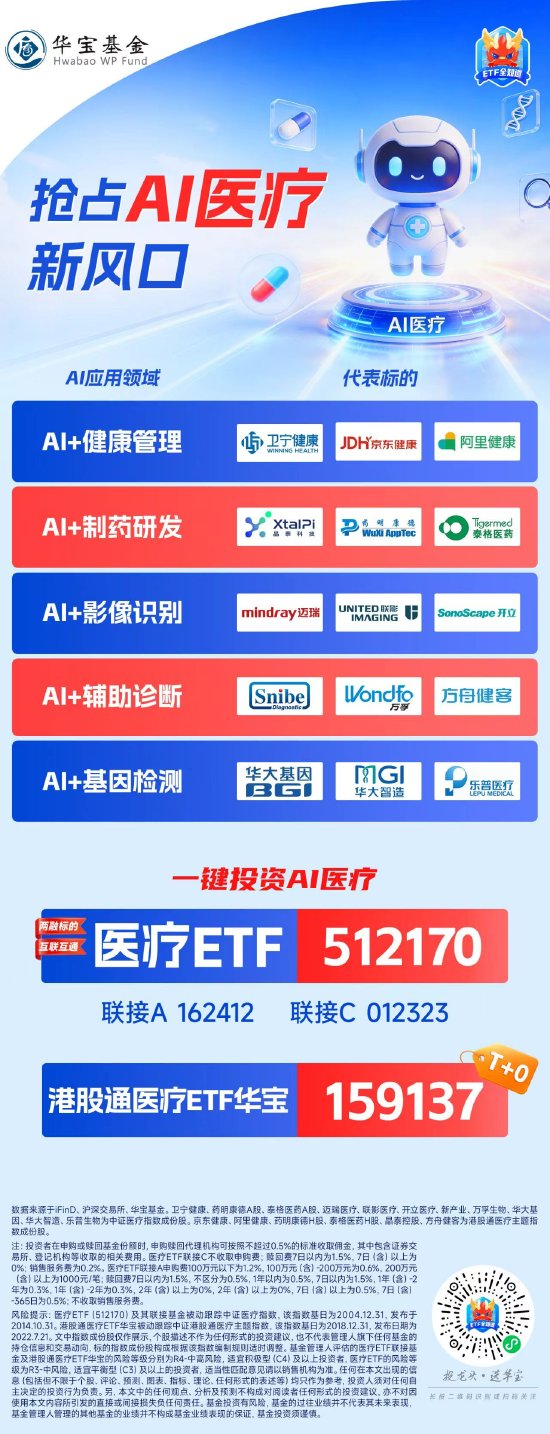
| 抢占AI天 | | | --- | --- | | FT X L | | | AI医疗 | | | AID #679 代表标的 | | | Al+健康管理 JDH京东健康 | 阿里娃康 | | Al+制药研发 Wull App | | | Al+影像识别 | | | Al+辅助诊断 | | | 华大基因 Al+基因检测 | | | 建设资AI国7 | | | 医疗ETF 512170 | | | 联接A 162412 联接C 012323 | | MACD金叉信号形成,这些股涨势不错! 责任编辑:杨赐 MACD金叉信号形成,这些股涨势不错! 责任编辑:杨赐 ...
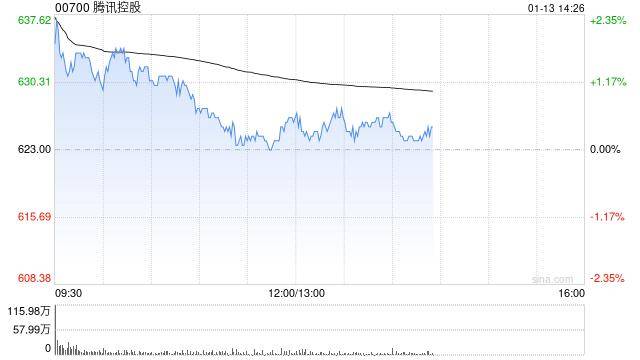
美银:AI仍为中国互联网最大增长亮点,腾讯控股为行业首选!阿里巴巴仍是中国人工智能领域的最佳投资标的,亦是中国电商股首选
Sou Hu Cai Jing· 2026-01-13 06:40
Core Viewpoint - The report from Bank of America Securities indicates that stock performance will continue to diverge this year, with the artificial intelligence sector expected to outperform the market again, while virtual consumption in entertainment and travel will continue to excel over physical e-commerce [2] Group 1: Market Trends - The macroeconomic environment remains weak, putting pressure on consumer spending (e-commerce) and corporate spending (advertising), which continues to be a drag on the industry [2] - Chinese internet stocks are seen as having attractive valuations, providing a buffer against downside risks, with a forecasted price-to-earnings ratio of 18 times, lower than the ten-year average of 23 times, the Nasdaq 100's 26 times, and the "Big Seven" of US stocks at 31 times [2] Group 2: Stock Preferences - The company prefers stocks in artificial intelligence and online gaming over e-commerce, with Tencent Holdings (00700) being the top choice due to its growth driven by AI applications, stable market competition, excellent shareholder returns, and attractive valuation [2] - Alibaba (09988) is identified as the best investment target in China's artificial intelligence sector and the preferred choice among Chinese e-commerce stocks [2] - Baidu Group-SW (09888) is considered attractive in the AI field, with value release on the right track [2] - In the digital entertainment sector, the company favors online gaming, recommending Bilibili-W (09626) and Tencent Music-SW (01698) [2] - Within specific segments, JD Health (06618) and Trip.com Group-S (09961) are viewed positively [2]