优必选科技

Search documents
开辟人形机器人赛道要警惕“虚火”
Zhong Guo Qi Che Bao Wang· 2025-07-04 01:21
Group 1 - The humanoid robot industry is experiencing rapid growth, with a significant increase in the number of related companies and production output in China [4][5] - In the past year, 230,000 robot-related companies were established in China, marking a 22.7% year-on-year increase [4] - The production of industrial robots in China surged by 35.5% year-on-year, reaching 69,056 units, while service robots increased by 13.8% to 1.2 million units [4] Group 2 - Morgan Stanley forecasts that the Chinese robot market will grow at an average annual rate of 23%, expanding from $47 billion in 2024 to $108 billion by 2028 [5] - The humanoid robot market is expected to grow at a staggering 63% annually, from $300 million this year to $3.4 billion by 2030 [5] - By 2030, China is projected to have 252,000 humanoid robots, increasing to 302 million by 2050, accounting for 30% of the global total [5] Group 3 - The automotive industry is actively engaging in the humanoid robot sector, with various companies exploring opportunities in this emerging market [6][10] - Companies are cautious about the potential "bubble" in the humanoid robot market, drawing parallels to the previous hype surrounding electric vehicles [7][11] - The industry is advised to focus on practical applications and technological advancements rather than getting caught up in the hype [10][12] Group 4 - Challenges such as high costs, inefficiency, and complexity in humanoid robot technology remain significant barriers to commercialization [9] - Key technological advancements are needed in areas like lightweight materials, battery efficiency, and coordination of robotic limbs [9] - The industry must address issues related to data, computing power, and hardware-software integration to achieve long-term success [9] Group 5 - The Ministry of Industry and Information Technology has set goals for the humanoid robot industry, aiming for a robust innovation system and international competitiveness by 2027 [12] - The industry is encouraged to establish a reliable supply chain and expand application scenarios to integrate more deeply into the economy [12] - Companies are urged to remain rational and focus on technology development and application rather than solely pursuing humanoid robots [11][12]


人工智能应用场景加速拓展
Jing Ji Ri Bao· 2025-07-02 22:03
Core Insights - Artificial intelligence (AI) is a strategic technology driving a new wave of technological revolution and industrial transformation, with vast application scenarios and market potential [1] - The emergence of large models like ChatGPT and DeepSeek has led to explosive growth in generative AI, becoming a powerful engine for economic and social development [2] Group 1: AI Development and Applications - The rapid development of AI is highlighted by the emergence of over 100 large models in China, which are deeply empowering various industries and creating hundreds of application models [2] - The launch of the Xunfei Spark X1 model, trained on a fully domestic computing power platform, marks a significant step in AI's application across sectors such as education, healthcare, automotive, finance, and energy [2][3] - The focus on multi-modal information integration in large models aims to enhance AI's understanding and generation of diverse data types, improving its intelligence level [3] Group 2: Robotics and Human-like Intelligence - Human-like robots, as ideal carriers of general AI, are gaining attention, with advancements in their design and capabilities, such as the Tian Gong Xing Zhe robot, which features 20 degrees of freedom and can run at 10 km/h [4] - The production of human-like robots is expected to ramp up significantly, with hundreds of units anticipated for delivery this year and a goal of reaching thousands in two years [4][5] - The establishment of innovation centers and supportive policies across various provinces in China aims to bolster the development of human-like robots as a key driver for high-quality economic growth [5] Group 3: Safety and Ethical Considerations - The rapid advancement of AI brings significant safety risks, including the potential for generating misleading information and ethical dilemmas related to privacy and data security [7] - Recommendations for governance include integrating ethical considerations into AI development, enhancing legal frameworks, and establishing clear human-machine collaboration norms to mitigate risks [7][8] - The emphasis on data security, privacy protection, and adherence to ethical standards is crucial for the sustainable development of AI technologies [8]
深圳70+人形机器人产业链企业一览
机器人圈· 2025-07-01 10:25
Core Insights - The article highlights the rapid evolution of humanoid robot technology, positioning it as a strategic focal point in global technological competition and a key driver of future industrial development and economic growth [1] - Shenzhen has emerged as a significant hub for the humanoid robot industry, benefiting from unique policy advantages, a complete industrial chain, and a vibrant innovation ecosystem [1] - The humanoid robot industry in Shenzhen is projected to reach a value of 1.98 billion yuan in 2024, marking a year-on-year growth of 113% [1] Industry Overview - The humanoid robot industry in Shenzhen has seen exponential growth, with over 50 companies in the sector as of February 2025, leading the nation [1] - Seven Shenzhen companies made it to Morgan Stanley's global top 100 humanoid robot public companies list, accounting for nearly a quarter of the mainland Chinese companies listed [2] Key Companies - **UBTECH Robotics**: Founded in 2012, it is the world's first publicly listed humanoid robot company, with over 2,450 patents related to robotics and AI, focusing on industrial, commercial, and home service applications [5] - **LimX Dynamics**: Established in 2022, it specializes in full-size humanoid robots and has made significant advancements in AI and hardware design [7] - **Leju Robotics**: Founded in 2016, it has developed various humanoid robots for education, healthcare, and industrial applications, with notable achievements in logistics efficiency [9][12] - **Paxini Technology**: Focuses on advanced tactile technology for humanoid robots, offering a range of products for various sectors including retail and healthcare [12][13] - **Zhongqing Robotics**: A new entrant in 2023, it specializes in general-purpose humanoid robots and has developed several high-performance models [16] - **Pudu Robotics**: A leader in service robots, it has launched a full-size humanoid robot with advanced capabilities for various industries [19][20] - **Digital Huaxia**: Established in 2024, it focuses on multimodal interaction algorithms for humanoid robots, with products aimed at service and interaction [22][25] - **Lumos Robotics**: Founded in 2024, it has developed a highly agile humanoid robot capable of rapid movements and precise operations [25][27] - **Dobot Technology**: Established in 2015, it focuses on intelligent robotic arms and humanoid robots, with innovative designs for industrial applications [27][28] Supply Chain and Ecosystem - Shenzhen boasts a dense network of suppliers for humanoid robot components, covering critical areas such as actuators, sensors, and control systems, supported by major tech companies like Tencent and Huawei in AI and algorithm development [30][31] - The supply chain includes numerous companies providing essential components like motors, sensors, and control systems, ensuring robust support for humanoid robot manufacturing [30][31][32] Application Scenarios - Shenzhen promotes the "city as a testing ground" concept, facilitating the deployment of humanoid robots in various sectors including governance, industry, education, and healthcare [34] - The diverse application scenarios provide valuable testing environments for humanoid robot technology, accelerating commercialization [34]
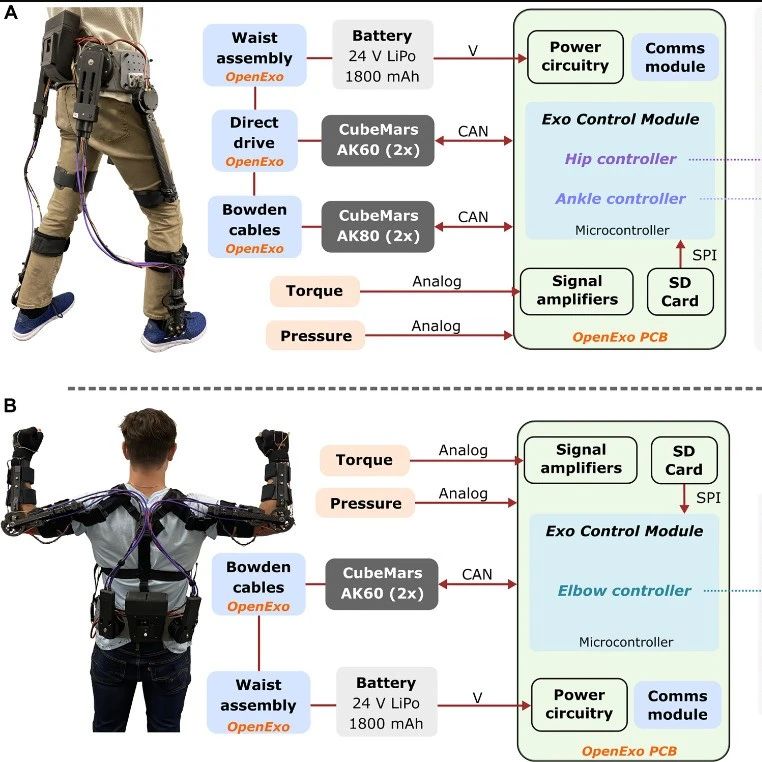
Science Robotics最新模块化开源外骨骼系统
机器人大讲堂· 2025-06-28 02:19
Core Viewpoint - The research team from Northern Arizona University has developed a modular exoskeleton system that is fully open-source, allowing more researchers to participate in this promising field [1][17]. Group 1: Challenges in Exoskeleton Development - Exoskeleton technology has faced high barriers to entry, requiring expertise in multiple disciplines such as mechanical engineering, electrical engineering, robotics, and biomechanics [4][5]. - Current exoskeleton systems are often specialized for specific applications, limiting their adaptability to new research questions and environments [5]. - The existing systems create technology silos, making it difficult to reproduce research results due to independent software and hardware systems [5]. Group 2: OpenExo's Modular Design - OpenExo addresses these challenges with a modular design, allowing users to easily swap hardware modules and modify configurations without extensive coding or redesign [6][8]. - The system consists of four main components: software system, electronic architecture, hardware interface, and control scheme [8]. - The software is developed using C++ and Arduino, emphasizing modularity and reducing code redundancy [9]. - The electronic architecture is designed to be simple and intuitive, using a single board to control up to four joints, which differs from other open-source projects [9]. - Hardware designs include direct-drive hip joints and Bowden cable-driven ankle joints, all compatible with the same belt interface for quick assembly [10]. Group 3: Performance Validation - The system demonstrates high torque tracking accuracy, with root mean square errors for hip, ankle, and elbow joints being 0.30 Nm, 2.00 Nm, and 0.84 Nm respectively [12]. - Battery tests show that the hip joint configuration can run for 35 minutes, while the ankle configuration lasts 25 minutes, indicating potential for extended use with improved battery capacity [12]. - Real-world tests show that the exoskeleton reduces transportation costs by 8% to 18% in various walking scenarios, highlighting its practical value [13][15]. Group 4: Open Source and Community Engagement - OpenExo's significant contribution lies in its open-source philosophy, providing complete software packages, electrical designs, and hardware instructions [17][18]. - The research team aims to create an open research community, inviting contributions from various disciplines to accelerate exoskeleton technology development [19]. - The unified open-source platform allows for large-scale collaborative research, improving the reproducibility of results across different institutions [20]. Group 5: Future Improvements - The research team acknowledges that battery life remains a key limitation, particularly in high-torque applications, and is exploring ways to enhance battery efficiency [21]. - Continuous optimization of the Python application is planned, with features like deep learning and human-machine collaboration being considered for future updates [21].
快讯|马斯克透露特斯拉Optimus V3将集成Grok语音助手;乐动机器人冲刺IPO;优必选谴责第三方魔改旗下机器人
机器人大讲堂· 2025-06-27 02:20
Group 1: Company Developments - Ledong Robotics has submitted its IPO application to the Hong Kong Stock Exchange, primarily known for its lidar supply business, with a focus on the lawn mower robot market for new growth opportunities [1] - UBTECH Technology condemned third-party modifications of its robots, highlighting concerns over data security and consumer rights due to unauthorized alterations of its discontinued products [4] - Tesla's CEO Elon Musk announced that the Optimus V3 humanoid robot will integrate the Grok voice assistant, aiming for significant improvements and a public launch in 2026 [6] Group 2: Market Trends and Insights - The lawn mower robot market has low penetration and intense competition, with Ledong Robotics adopting a low-price strategy to capture the low-end market, facing challenges such as brand recognition and limited R&D investment [1] - Haier is developing cost-effective, specialized home robots, predicting that households will have multiple robots integrated into daily life, emphasizing the importance of innovation over price wars in the appliance industry [9] - A report from Maimai Gaohire indicates a dramatic increase in talent demand in the autonomous driving and robotics sectors, with a projected 28-fold increase in job postings by April 2025 compared to January 2024 [13]



BubblePal不到一年卖出1个亿,AI玩具的风吹到哪了?
3 6 Ke· 2025-06-27 00:49
Core Insights - The AI toy market is experiencing significant growth, with companies like Haivivi and FoloToy reporting impressive sales figures, indicating a shift from skepticism to acceptance of AI toys as a legitimate market segment [1][4][5] - The industry is witnessing a surge in investment, with at least 27 financing events recorded in 2024, including several multi-million dollar rounds, highlighting the increasing interest from investors [3][4] - AI toys are characterized by their ability to provide personalized interactions through advanced technologies such as multi-modal interaction and emotional analysis, setting them apart from traditional toys [5][6] Company Highlights - Haivivi's BubblePal has sold over 250,000 units since its launch, generating sales exceeding 100 million yuan [1] - FoloToy aims to sell 300,000 units this year, significantly increasing its sales target compared to the previous year [1] - Companies like Lobo Intelligent and Bepei Technology have also secured significant funding, indicating a robust investment landscape in the AI toy sector [2][3] Market Dynamics - The AI toy market is categorized into various segments, including smart pendants, interactive dolls, and robotic toys, each offering unique features and price points [5][10] - The price range for AI toys varies widely, with simpler models priced under 500 yuan and advanced robotic toys reaching several thousand yuan [10][11] - The market is primarily driven by children's products, but there is growing potential in emotional companionship toys targeting adults and seniors [11][14] Investment Trends - The AI toy sector has seen a mix of traditional toy manufacturers and tech startups entering the market, with established companies leveraging their IP to create AI-enhanced products [6][16] - Notable investments include Haivivi's partnerships with various venture capital firms and the strategic collaborations between traditional toy companies and tech firms [4][6][16] - The trend of integrating popular IPs into AI toys is gaining traction, with companies like FoloToy and Haivivi exploring collaborations with well-known brands to enhance market appeal [15][16] Future Outlook - The development of AI toys is expected to accelerate as technology costs decrease, allowing for more innovative products that can engage users on a deeper emotional level [14][21] - The potential for creating new IPs within the AI toy space is significant, with companies exploring unique designs and narratives to attract consumers [18][21] - As the market matures, the emergence of iconic brands similar to LABUBU is anticipated, driven by the intersection of technology and creative product design [21]







国防科技大学放“大招”:蚊子仿生机器人首次曝光,外网网友“炸锅”
机器人大讲堂· 2025-06-24 09:42
Core Viewpoint - The emergence of biomimetic robots, such as the mosquito-sized robot developed by the National University of Defense Technology, signifies a shift towards new combat methods, including swarm tactics, in response to escalating global tensions [1]. Group 1: International Reactions - The biomimetic mosquito robot has garnered attention from international audiences, particularly on social media platforms like X, where discussions about its potential applications and implications are ongoing [2]. - Some users humorously speculate about the robot's capabilities if equipped with GPS or GSM technology, while others express skepticism regarding the technical feasibility of such advancements [3]. - Positive comments highlight the robot's innovative nature, with comparisons made to science fiction scenarios, indicating a blend of excitement and caution in public perception [5]. Group 2: Technological Context - The concept of robotic bees, as depicted in the British series "Black Mirror," reflects societal concerns about technology's role in ecological and ethical dilemmas, suggesting a growing interest in the implications of such innovations [6][8]. - Harvard University's RoboBees project, which has evolved since its introduction in 2012, showcases advancements in micro-robotics, including capabilities for flight and swimming, emphasizing the rapid development in this field [12][14]. - Both the National University of Defense Technology's mosquito robot and Harvard's RoboBees face challenges related to miniaturized visual systems, indicating ongoing technical hurdles in the development of effective biomimetic robots [17]. Group 3: Future Outlook - Military experts predict that intelligent unmanned systems will increasingly dominate modern warfare, with capabilities for self-organization and adaptive operations becoming more prevalent [18]. - The anticipated proliferation of biomimetic robots like the mosquito model suggests a future where such technologies are routinely deployed in combat scenarios, blurring the lines between science fiction and reality [18].
浅谈,「华为」在具身智能赛道布局
Robot猎场备忘录· 2025-06-22 16:23
Core Insights - The article discusses the entry of major global tech companies into the embodied intelligence sector, highlighting Nvidia and Tesla as key players, with Tesla leading in humanoid robotics through its Optimus model, while Nvidia focuses on building a foundational development ecosystem [1] - Huawei is identified as a leading domestic player in the humanoid robotics space, following Nvidia's approach, while XPeng Motors aims to commercialize humanoid robots, taking inspiration from Tesla [1][2] Group 1: Industry Landscape - Major global tech giants like Google, Microsoft, Meta, and OpenAI are entering the humanoid robotics market, with Nvidia and Tesla being prominent examples [1] - Morgan Stanley's report indicates that original equipment manufacturers (OEMs) with integrated humanoid robot capabilities hold the highest value in the humanoid robotics value chain [2] - The report emphasizes that the development of large models, particularly visual-language-action (VLA) models, is crucial for the generalization capabilities of humanoid robots, with data and computational costs being significant barriers [2] Group 2: Huawei's Developments - Huawei launched its CloudRobo platform at the HDC 2025, focusing on cloud-based intelligence rather than directly manufacturing robots [3][6] - The CloudRobo platform integrates various capabilities, including data synthesis, model development, and security oversight, to accelerate innovation in embodied intelligence [11] - Huawei's collaboration with 16 companies in the humanoid robotics sector was formalized during the launch of its global innovation center [6][26] Group 3: Technological Advancements - The CloudRobo platform features three core models: embodied multimodal generation, planning, and execution models, enhancing the training efficiency of humanoid robots [11][14] - The platform allows for a significant portion of training data to be generated rather than collected, improving data acquisition efficiency [11] - Huawei's humanoid robot "Kuafu" was showcased, demonstrating enhanced intelligence and generalization capabilities through the integration of the Pangu model [23] Group 4: Investment and Strategic Partnerships - Huawei has made strategic investments in humanoid robotics, including a stake in Qianxun Intelligent and a partnership with UBTECH Robotics to develop humanoid robots for various applications [18][19] - The company has been actively expanding its partnerships with leading robotics firms to foster innovation and development in the humanoid robotics space [18][26] - The article notes that domestic tech giants are increasingly investing in humanoid robotics, with companies like Meituan and Tencent leading funding rounds for startups in this sector [19]

中国机器人将爆发式增长!大摩预测:市场规模四年内翻倍 占据全球统治地位
财联社· 2025-06-18 12:30
Group 1 - The core viewpoint of the article is that China's robot market is expected to grow rapidly, with a projected annual growth rate of 23%, leading to a doubling of market size from $47 billion in 2024 to $108 billion by 2028, solidifying China's dominance in the global robotics sector [2][3]. - By 2024, China is anticipated to hold approximately 40% of the global robot market share, reinforcing its position as the largest market and innovation center for robotics [2][3]. - The production of industrial robots in China surged by 35.5% year-on-year in May, reaching 69,056 units, while service robot production increased by 13.8% to 1.2 million units, indicating robust growth in the robotics industry [3]. Group 2 - The humanoid robot market in China is projected to expand at an impressive annual rate of 63%, growing from $300 million this year to $34 billion by 2030 [4]. - By 2030, China is expected to have 252,000 humanoid robots, increasing to 30.2 million by 2050, which will account for 30% of the global total [5]. - Analysts from Morgan Stanley highlight that this year marks a significant milestone for humanoid robots, indicating the beginning of large-scale production, which will enhance productivity and quality in China's manufacturing sector [5].

“智启未来·共筑机器人新生态” 2025中国机器人智能大会在海淀区成功举办
机器人大讲堂· 2025-06-16 08:17
2025年6月13日至15日, 由北京市经济和信息化局、中关村科学城管委会指导,中国自动化学会机器人智 能专业委员会主办,中国科学院自动化研究所、北京唯实具身智能研究院、清华大学、北京信息科技大学联合 承办的 2025中国机器人智能大会暨CAA机器人智能专业委员会年会 在北京市海淀区西郊宾馆隆重举行。 本届大会以 "智启未来·共筑机器人新生态"为主题,聚焦机器人智能领域前沿技术、热点问题及产业应用, 吸引超过200名行业精英参会,其中包括60余位国家级人才及多位院士专家,呈现30余场高水平学术报告与 产业对话,打造一场跨学科、跨领域的学术盛宴。 ▍ 北京海淀区力争打造全国 具身智能原始创新策源地 中国科学院院士乔红 开幕式致辞环节,中国科学院院士乔红代表中国自动化协会机器人智能专委会,对出席大会的嘉宾表示热烈欢 迎,并向指导单位、承办单位及合作单位表示衷心感谢。她提到中国自动化学会机器人智能专业委员会汇聚了 众多专家学者,致力于机器人智能技术探索和自主创新,并希望本次大会能促进相关领域的交流合作,共同推 动机器人智能领域的前沿科技进步,为国家和社会的智能制造、生活服务、国防等领域做出贡献。 海淀区委副书记、区 ...