
三星

Search documents
面板收入暴涨150%,被苹果抛弃的Micro LED,终于被「AI眼镜」救活了
3 6 Ke· 2026-02-12 02:51
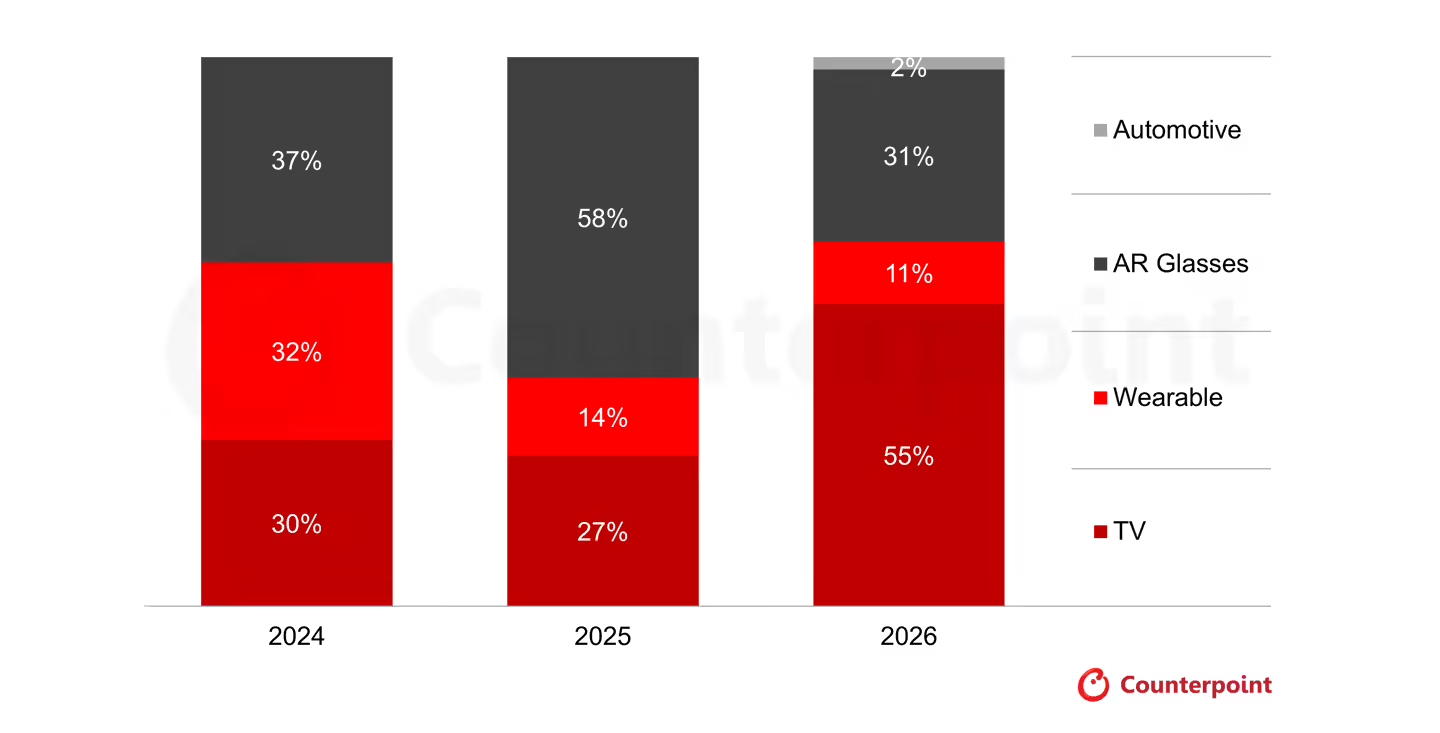
Core Insights - Apple has abandoned its long-term investment in Micro LED technology due to challenges in mass production, but recent developments indicate a resurgence in the Micro LED market driven by the explosive growth of AR smart glasses, with a reported revenue increase of 150% year-over-year [1][20]. Group 1: Market Trends - The AI smart glasses market is rapidly expanding, with most current models featuring AI capabilities, benefiting the Micro LED industry [3]. - Major brands are launching AI glasses in 2025, with a notable trend of using Micro LED technology, indicating its status as a standard for high-end smart glasses [4][21]. Group 2: Product Highlights - The Thunder X3 Pro, set to launch in May 2025, features dual full-color Micro LED technology, achieving an eye brightness of 3500 nits and peak brightness of 6000 nits, targeting the high-end market with a price near 10,000 yuan [4]. - Lenovo's AI glasses V1 utilize a monochrome Micro LED solution with a peak brightness of 2000 nits, priced at 3999 yuan, showcasing a more affordable option [6]. Group 3: Technical Advantages - Micro LED technology is distinguished from traditional LED screens, as it consists of tiny micro-displays that project images through optical systems, making it suitable for compact devices like AI glasses [10]. - Micro LED is seen as the next-generation display technology following Mini LED, offering significant brightness advantages crucial for outdoor use [11]. Group 4: Competitive Landscape - JBD, a key player in the Micro LED space, supplies micro-displays and optical modules for many AI glasses, indicating its strong market position and technological edge [21][25]. - JBD's micro-displays have high pixel density and brightness, making them ideal for AR applications, and the company has attracted investments from major firms like Alibaba and BYD [25]. Group 5: Future Outlook - The Micro LED technology is expected to find broader applications beyond AI glasses, potentially impacting sectors like smart automotive and robotics, suggesting a promising growth trajectory for JBD and the Micro LED market [25].

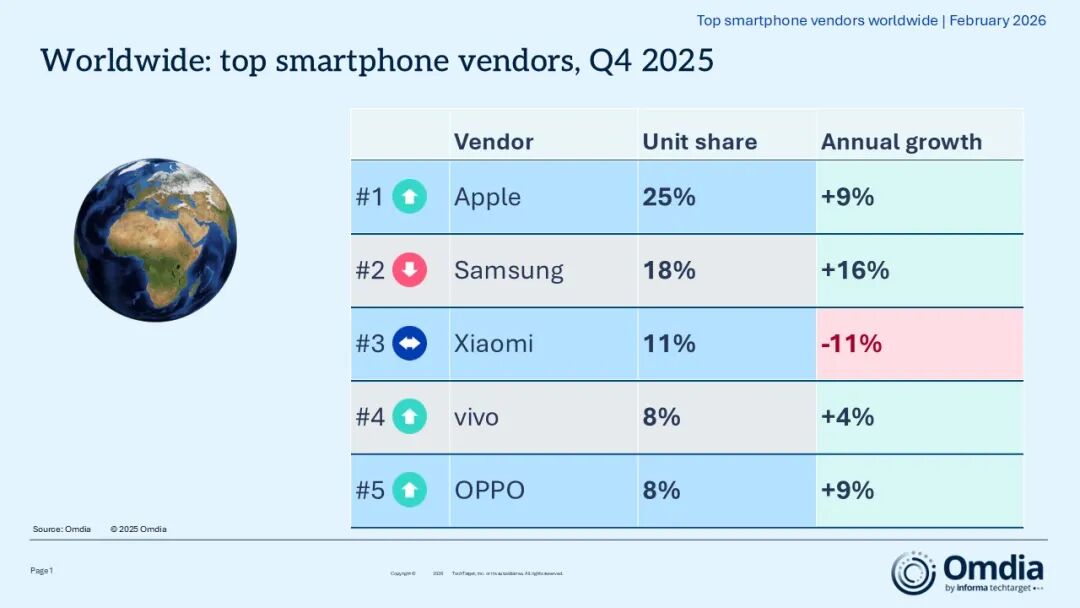
Omdia:2025年Q4全球智能手机市场同比增长4% 苹果以25%市场份额领跑
智通财经网· 2026-02-12 01:33
Core Insights - The global smartphone market is expected to grow by 4% year-on-year in Q4 2025, driven by seasonal demand recovery and improved inventory management, despite some manufacturers facing rising component costs [1] - Apple leads the market with a 25% share, benefiting from strong demand for the iPhone 17 series, achieving record quarterly shipments and maintaining its position as the largest smartphone manufacturer for three consecutive years, slightly ahead of Samsung [1] - Samsung holds the second position with an 18% market share, primarily driven by strong sales of models priced below $300, particularly the Galaxy A17 4G and 5G series [1] Global Market Rankings - In Q4 2025, the top smartphone vendors by unit share are: - Apple: 25% (+9% growth) - Samsung: 18% (+16% growth) - Xiaomi: 11% (-11% growth) - Vivo: 8% (+4% growth) - OPPO: 8% (+9% growth) [2] Regional Performance - In the APAC region (excluding Greater China), the top vendors are: - Samsung: 19% (+18% growth) - Apple: 18% (+4% growth) - Vivo: 15% (+11% growth) - OPPO: 11% (+6% growth) - Xiaomi: 10% (-23% growth) [4] - In Latin America, the rankings are: - Samsung: 33% (+21% growth) - Lenovo: 16% (+14% growth) - Xiaomi: 15% (+6% growth) - HONOR: 9% (+64% growth) - Apple: 7% (-8% growth) [4] - In India, the top vendors are: - Vivo: 25% (+16% growth) - OPPO: 16% (+4% growth) - Samsung: 14% (-11% growth) - Xiaomi: 12% (-26% growth) - Apple: 11% (-1% growth) [6] - In the United States, the rankings are: - Apple: 69% (+8% growth) - Samsung: 14% (-3% growth) - Lenovo: 9% (+13% growth) - Google: 3% (-15% growth) - TCL: 2% (-7% growth) [6] - In Brazil, the top vendors are: - Samsung: 39% (-1% growth) - Lenovo: 23% (+12% growth) - Xiaomi: 15% (+12% growth) - Apple: 11% (+10% growth) - realme: 5% (-7% growth) [7]


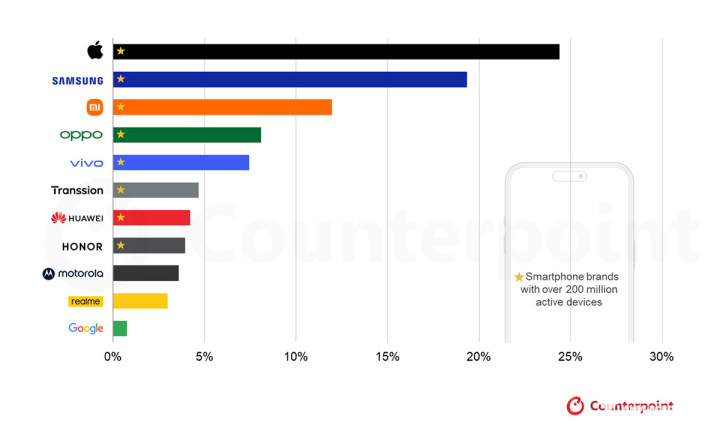
2025手机活跃存量增2% 苹果三星小米位列前三
Xin Lang Cai Jing· 2026-02-12 01:30
Core Insights - The report by Counterpoint Research indicates that eight smartphone manufacturers have surpassed 200 million active devices globally, collectively accounting for over 80% of the active device market share [1][6][8] - By 2025, the global active smartphone device stock is expected to grow by 2% year-on-year, with the average replacement cycle extending to nearly four years, marking a new phase of competition focused on existing users [1][5] Market Share Distribution - Apple and Samsung demonstrate a significant lead, being the only two brands with active devices exceeding 1 billion, together holding 44% of the global market share, with Apple at approximately 25% and Samsung at around 20% [5][8] - Xiaomi is the only other brand in the "200 million club" with a market share exceeding 10%, holding about 12%, while OPPO and vivo form the second tier [5][8] - The remaining brands, including Transsion, Huawei, and Honor, have closely matched market shares, with Honor making its debut in this club, while Motorola and realme are approaching the 200 million mark, indicating potential growth [5][8] Industry Challenges - The report highlights that due to soaring memory prices and extended replacement cycles, simple hardware upgrades are no longer sufficient to drive frequent device replacements among users [5][8] - The core challenge for smartphone brands moving forward will be to extract value from existing users and expand revenue through software and services [5][8]
Omdia数据快闪:2025年第四季度,全球智能手机重点市场厂商排名
Canalys· 2026-02-12 01:03
Core Insights - The global smartphone market experienced a year-on-year growth of 4% in Q4 2025, driven by seasonal demand recovery and improved inventory management, despite some manufacturers facing rising component costs [2] - Apple led the global smartphone market with a 25% market share, attributed to strong demand for the iPhone 17 series, achieving record quarterly shipments and maintaining its position as the largest smartphone manufacturer for three consecutive years, slightly ahead of Samsung [2] - Samsung ranked second with an 18% market share, boosted by strong sales of models priced below $300, particularly the Galaxy A17 4G and 5G series [2] - Xiaomi maintained its position as the third-largest manufacturer, although its market share declined to 11% due to shipment challenges in key markets [2] - Vivo achieved an 8% market share, benefiting from its leading position in the Indian market, while OPPO returned to growth, re-entering the global top five [2] Regional Summaries Global Key Regions - In Q4 2025, Apple held a 25% market share globally with a 9% annual growth, while Samsung had an 18% share with a 16% growth. Xiaomi's share fell to 11% with an 11% decline, Vivo and OPPO both held 8% shares with growth rates of 4% and 9% respectively [2] Europe - In Europe, Apple captured a 30% market share with a 6% growth, while Samsung followed closely with 28% and a 10% growth. Xiaomi's share was 17%, down by 3%, and Lenovo achieved a 6% share with a 13% growth [3] APAC (Excluding Greater China) - In the APAC region, Samsung led with a 19% market share and an 18% growth, followed by Apple at 18% with a 4% growth. Vivo and OPPO held 15% and 11% shares with growth rates of 11% and 6% respectively, while Xiaomi's share dropped to 10% with a 23% decline [3] Mainland China - In Mainland China, Apple ranked first with a 22% market share and a significant 26% growth. Vivo and OPPO followed with 16% and 15% shares, experiencing declines of 8% and growth of 9% respectively [7] India - In India, Vivo led with a 25% market share and a 16% growth, followed by OPPO at 16% with a 4% growth. Samsung's share was 14%, down by 11%, while Xiaomi's share fell to 12% with a 26% decline [7] United States - In the United States, Apple dominated with a 69% market share and an 8% growth, while Samsung held 14% with a 3% decline. Lenovo captured 9% with a 13% growth [9] Brazil - In Brazil, Samsung led with a 39% market share, experiencing a slight decline of 1%. Lenovo and Xiaomi both held 23% and 15% shares with 12% growth, while Apple had an 11% share with a 10% growth [10]

日韩股市创历史新高,资生堂大涨15%
2 1 Shi Ji Jing Ji Bao Dao· 2026-02-12 01:00
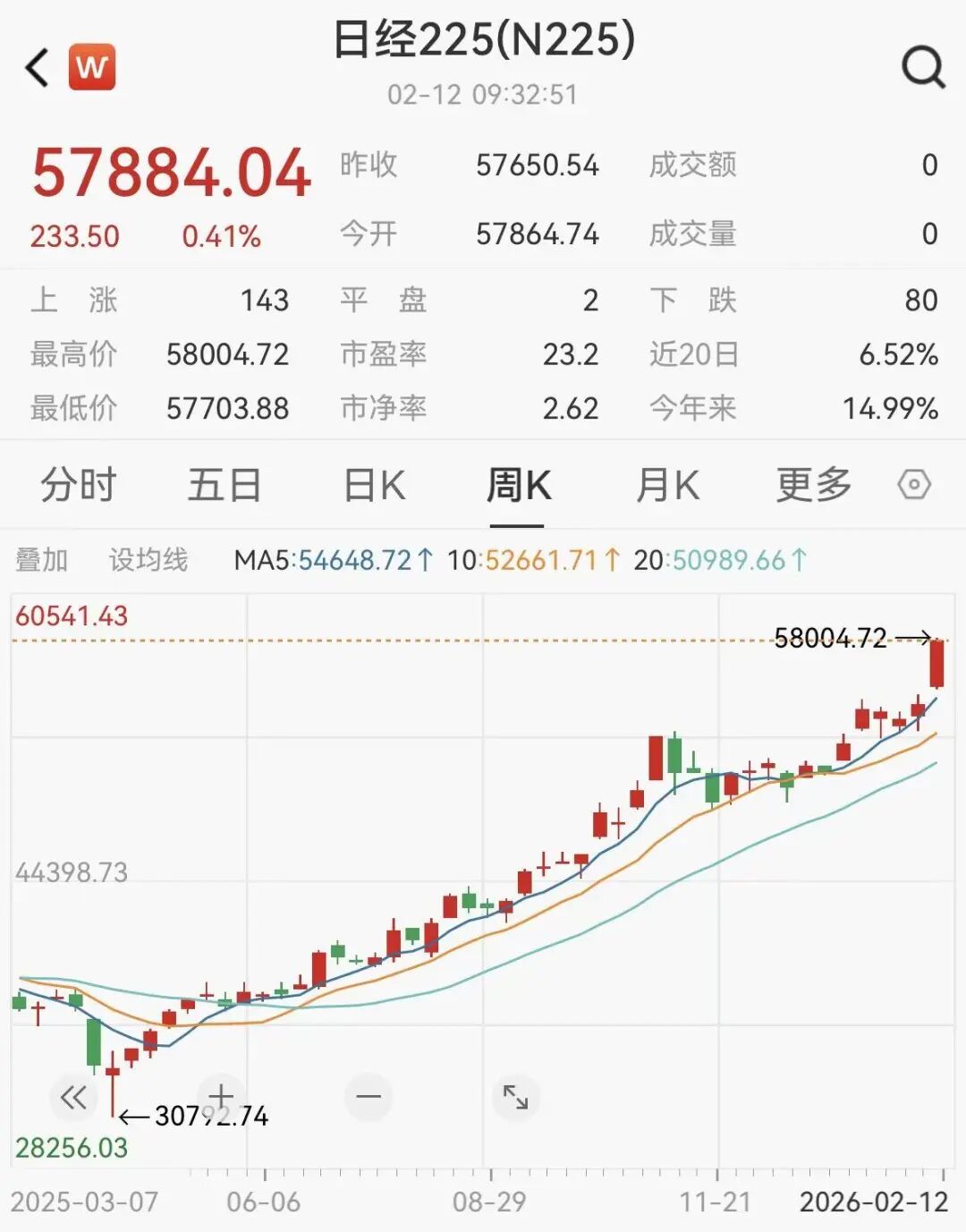
2月12日,日韩股市高开,盘初均创历史新高。 其中,日经225指数升破58000点,创纪录高位。热门个股方面,资生堂大涨15%,据其最新财报,资生堂全年核心营业利润预期超出市场预期。 | W | | | 日经225(N225) | | | | --- | --- | --- | --- | --- | --- | | 02-12 09:32:51 | | | | | | | 57884.04 昨收 57650.54 | | | | 成交额 | 0 | | 233.50 0.41% | | 今开 | 57864.74 | 成交量 | 0 | | 上 涨 | 143 | 中 替 | 2 | 下 跌 | 80 | | 最高价 | 58004.72 | 市閣率 | 23.2 | 近20日 | 6.52% | | 最低价 | 57703.88 | 市净率 | 2.62 | 今年来 | 14.99% | | 分时 | 五日 | 日K | 間K | 月K 更多 © | | | 叠加 设均线 MA5:54648.72↑ 10:52661.71↑ 20:50989.66↑ | | | | | | | 60541.43 | | ...
拥抱Chiplet,大芯片的必经之路
半导体行业观察· 2026-02-12 00:56
Core Viewpoint - The article discusses the emergence of Chiplet architecture as a transformative solution for high-performance computing (HPC) and artificial intelligence (AI), offering significant advantages in performance, cost, and energy efficiency compared to traditional single-chip processors [2][4]. Group 1: Chiplet Architecture Advantages - Chiplet architecture can provide higher performance at lower costs while reducing energy consumption by up to 10 times compared to traditional single-chip processors [2]. - This architecture allows for better integration of components, reducing the need for data to be transferred off-chip, which in turn lowers power consumption and heat generation [4][5]. - The use of UCIe (Universal Chiplet Interconnect Express) enables a layered architecture that is compatible with other interconnect standards, facilitating tighter chip arrangements and improved performance [4][6]. Group 2: Manufacturing and Scalability - Chiplet architecture improves manufacturing efficiency by allowing for the replacement of defective components without affecting the entire system, thus enhancing yield rates [4][5]. - The scalability of chiplets is achieved through packaging-level scaling, which overcomes limitations of traditional photolithography, enabling systems that exceed the capacity of single chips [5][6]. - The architecture supports 3D designs, allowing for stacked components that enhance computational density and reduce data latency, although this introduces higher costs and complexity [7][8]. Group 3: Market Trends and Future Outlook - The demand for AI and HPC capabilities is driving the adoption of chiplet technology, with companies like NVIDIA pushing the boundaries of traditional chip design [6][7]. - The Chiplet community is still in its early stages but shows strong momentum, with key industry players gathering to discuss advancements and standards [8][9]. - The adoption of UCIe is seen as crucial for establishing chiplet standards and expanding the chiplet community, although some suppliers express caution regarding their investments in UCIe [8][9].
日韩股市创历史新高,资生堂大涨15%
21世纪经济报道· 2026-02-12 00:55
日债收益率全面下跌, 日本10年期国债收益率下跌4.5个基点至2.190%。 30年期日本国债收益率下跌7.5个基点,至3.420%。 2月12日,日韩股市高开,盘初均创历史新高。 其中,日经225指数 升破58000点 ,创纪录高位。热门个股方面,资生堂大涨15%,据其最新财报,资生堂全年核心营业利润预期超出市场预 期。 | W | | 日经225(N225) | | | | --- | --- | --- | --- | --- | | | | 02-12 09:32:51 | | | | 57884.04 | | 昨收 | 成交额 | 0 | | 233.50 0.41% | | 今开 57864.74 | 成交量 | 0 | | 上 涨 | 143 | 中 智 2 | 下 跌 | 80 | | 最高价 | 58004.72 | 市图率 23.2 | 近20日 | 6.52% | | 最低价 | 57703.88 | 市净率 2.62 | 今年来 | 14.99% | | 分时 | 五日 | 園K | 目K | 更名 ◎ | | 叠加 设均线 MA5:54648.72↑ 10:52661.71↑ 20: ...

苹果发布VSSFlow模型:让无声视频「开口说话」,加速为国行版AI铺路?
3 6 Ke· 2026-02-12 00:31
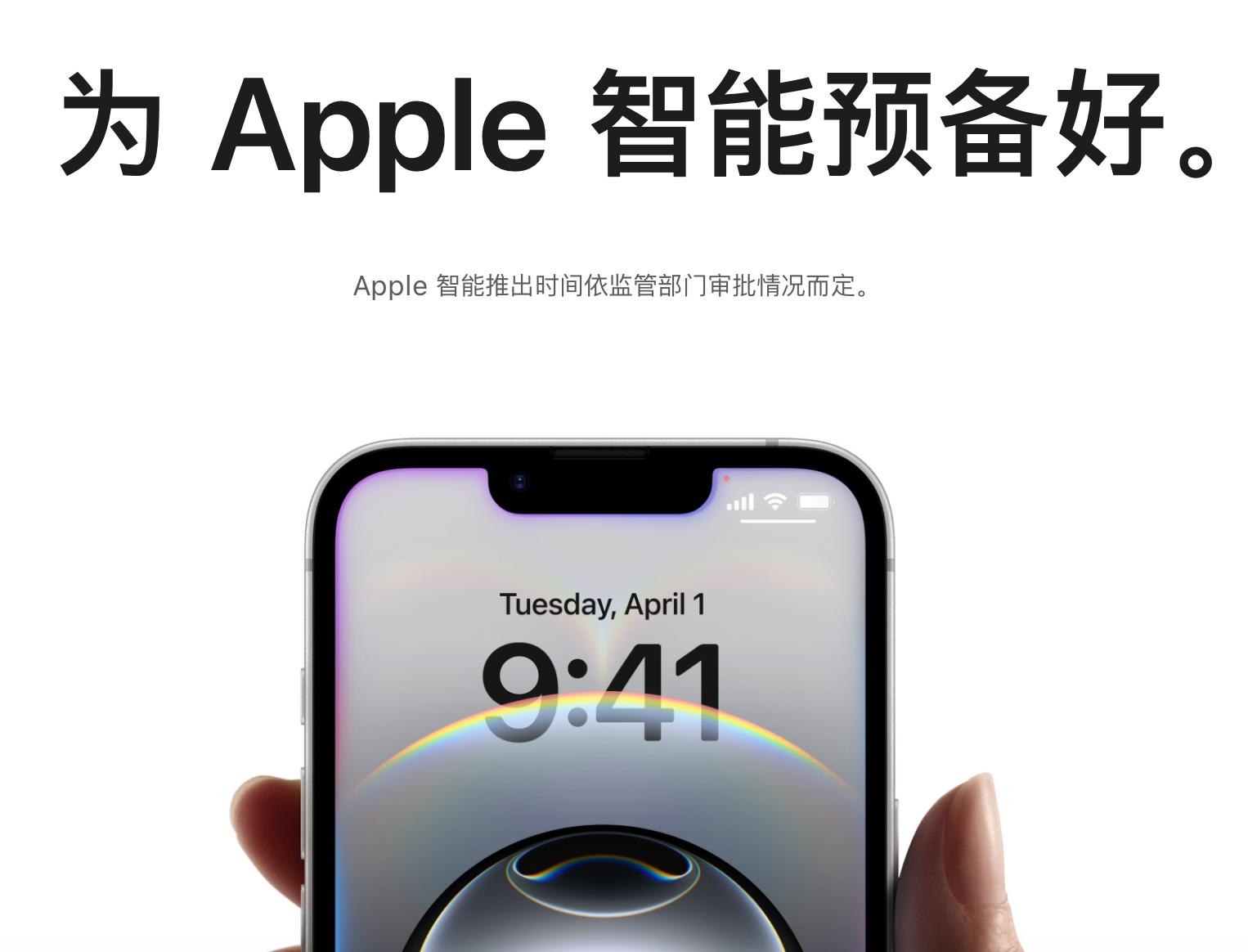
Core Insights - Apple announced its artificial intelligence platform, Apple Intelligence, at WWDC 2024, with testing set to begin in the U.S. in fall 2024, but the Chinese version has not yet launched due to regulatory approvals [1] - Apple, in collaboration with Renmin University of China, introduced the VSSFlow AI model, showcasing advancements in audio generation technology, which may signal positive developments for the Chinese version of Apple Intelligence [3][15] Group 1: Apple Intelligence and VSSFlow - Apple Intelligence is expected to expand its testing beyond the U.S. after initial trials, but its launch in China is contingent on regulatory approval [1] - VSSFlow is designed to generate both environmental sounds and dialogue simultaneously, overcoming previous limitations of separate audio generation for background noise and speech [3][6] - The VSSFlow model utilizes a technique called Flow-matching, which allows the AI to infer sounds based on video frames and contextual cues, enhancing audio quality and generation efficiency [6][8] Group 2: Applications and Market Position - VSSFlow's capabilities could be applied in various scenarios, including audio restoration for old films, assisting individuals with speech impairments, and dubbing for film and television [9][13] - Compared to existing models like Google's Deepmind V2A, VSSFlow aims to create a more integrated audio experience by mapping visual and auditory information [9][14] - The collaboration with Chinese universities indicates Apple's commitment to deepening its presence in the Chinese market and advancing the development of its AI technologies [15][18] Group 3: Challenges and Competitive Landscape - The rollout of the Chinese version of Apple Intelligence has faced delays due to engineering challenges and subpar performance compared to competitors [18][22] - Apple's AI capabilities have been criticized for lacking innovation and effectiveness, especially when compared to competitors like Samsung, which has successfully localized its AI offerings in China [20][22] - Despite the slow progress, the development of VSSFlow suggests that Apple is making strides in AI research, which could enhance its hardware capabilities in the future [22]
拉夫罗夫突然发出警告,美国前所未有的举动,不只是冲着中国来的
Sou Hu Cai Jing· 2026-02-11 23:49
Group 1: Semiconductor Tariffs - The U.S. has initiated a "tariff war" in the semiconductor sector, which is not solely aimed at China but reflects broader ambitions [3][10] - Starting from August 2025, the U.S. plans to impose nearly 100% tariffs on all imported semiconductors, with exemptions for companies that build factories in the U.S. [3][5] - By January 2026, tariffs of 25% will be applied to advanced computing chips from companies like NVIDIA and AMD, with a 100% tariff threat on storage chips unless produced domestically [5][10] Group 2: Impact on Allies and Global Market - Major South Korean companies, Samsung and SK Hynix, controlling nearly 70% of the DRAM market, face existential threats from U.S. tariffs [5][12] - Taiwan's semiconductor firms are pressured to invest at least $250 billion in the U.S. to secure trade benefits, totaling $500 billion in commitments [7][8] - The U.S. semiconductor tariff strategy is causing significant financial strain on European and Asian semiconductor companies, with losses linked to the loss of the Chinese market [12][22] Group 3: Energy Control and Geopolitical Maneuvering - The U.S. aims to control global energy transport routes, with recent actions including claims over the Panama Canal and aggressive moves in the Caribbean [14][16] - The U.S. has been seizing Venezuelan oil tankers, disregarding national sovereignty, and is focused on controlling critical energy pipelines in Europe [16][18] - The U.S. is leveraging energy supply chains to force countries like India and European nations to purchase American liquefied natural gas at higher prices [20][22] Group 4: Humanitarian Aid and Global Order - The U.S. has dismantled key humanitarian aid institutions, leading to a significant loss of support for millions globally, particularly in impoverished regions [24][26] - The closure of the U.S. Agency for International Development has resulted in a predicted additional 9.4 million deaths by 2030 due to reduced aid [26][28] - The U.S. is criticized for undermining global humanitarian efforts while simultaneously promoting a "rules-based international order" that serves its interests [30][32] Group 5: Long-term Consequences - The U.S. strategy of imposing tariffs and controlling energy routes is seen as a short-term gain that could lead to long-term global instability [35][37] - The actions taken by the U.S. are not only affecting China but also harming its allies and many other countries, leading to a potential backlash against American policies [35][37]


天工股份20260211
2026-02-11 15:40
Summary of Conference Call on Tiangong Co., Ltd. Company Overview - **Company Name**: Tiangong Co., Ltd. - **Industry**: Titanium processing and manufacturing - **Core Products**: Titanium alloys, including titanium plates, pipes, ingots, and rods - **Market Position**: Leading supplier of titanium materials for the consumer electronics sector, particularly for major clients like Apple and Samsung [3][20] Key Points and Arguments Industry Focus - The conference is part of a series aimed at highlighting key companies in the Beijing Stock Exchange (北交所), particularly those with significant market capitalization and unique assets not found in the Shanghai and Shenzhen markets [1][2] - The focus is on companies with high growth potential, scarcity barriers, and internationalization potential [2] Tiangong Co., Ltd. Specifics - Tiangong specializes in titanium processing, transitioning from rough processing to precision and deep processing [3] - The company is a critical supplier in the consumer electronics supply chain, particularly for high-end products like smartphones and watches [4][5] - Tiangong is also expanding into 3D printing applications and aerospace sectors, which are expected to drive future growth [5][6] Market Trends and Demand - Anticipated demand for titanium materials is expected to rise with the introduction of next-generation products in the consumer electronics sector [6][7] - The company is positioned to benefit from the increasing use of titanium alloys in high-end consumer electronics, with a focus on 3D printing technologies [7][8] Financial Performance - Tiangong's revenue for 2024 is projected to be around 800 million, with a net profit of approximately 170 million [13] - The company has a healthy balance sheet with a low debt ratio and strong cash flow [15] - The gross margin for titanium wire is expected to reach 41.19% in 2024, while the margins for plates and pipes are significantly lower [12][13] Competitive Advantages - Tiangong has established significant technical barriers, including advanced production techniques like electron beam melting and plasma atomization, which enhance material recovery and reduce waste [9][10] - The company has a strong customer base, with major clients accounting for a significant portion of its revenue [14][15] - Tiangong's products are positioned in the high-end market, with a focus on high-performance applications in consumer electronics and aerospace [17][18] Future Growth Potential - The company is expanding its production capacity, with plans to increase output to over 10,000 tons, focusing on high-end titanium products [23][24] - The growth in the 3D printing sector and the increasing penetration of titanium in consumer electronics are expected to drive future revenue growth [21][22] - Tiangong is also exploring opportunities in the medical device sector, further diversifying its application areas [9][10] Market Outlook - The titanium processing industry in China is experiencing a structural shift towards high-end applications, with increasing demand from sectors like aerospace and consumer electronics [30][31] - The global market for titanium materials is expected to grow, particularly in high-end consumer electronics, with a projected increase in the use of titanium alloys in products like foldable smartphones [35][36] Additional Important Insights - The company is actively working on enhancing its ESG (Environmental, Social, and Governance) profile by investing in sustainable production technologies [9][10] - Tiangong's strategic partnerships and joint ventures, such as with Jiangsu Tiangong Titanium Crystal, are aimed at expanding its capabilities in 3D printing materials [8][11] - The competitive landscape shows that Tiangong is well-positioned against peers, with a focus on high-margin products and innovative applications [17][18] This summary encapsulates the key points discussed during the conference call regarding Tiangong Co., Ltd., highlighting its market position, growth potential, and strategic initiatives within the titanium processing industry.