东北证券

Search documents
研报掘金丨东北证券:首予德赛西威“增持”评级,无人物流和机器人构建业绩增长新引擎
Ge Long Hui A P P· 2025-12-22 08:12
Core Viewpoint - The profitability of Desay SV Automotive is under short-term pressure due to declining sales from major clients, but is expected to improve with the launch of new models in Q4, such as the Ideal i6 and Xpeng X9 [1] Group 1: Financial Performance - Q3 profitability is temporarily constrained due to a drop in sales from key customers [1] - The gross margin for overseas products is projected to be 25.9% in 2024 and 28.9% in the first half of 2025, significantly higher than the domestic products' gross margin of 19.5% and 19.7% respectively [1] Group 2: Strategic Developments - The internationalization strategy is progressing steadily, with expectations for gross margin improvements [1] - The company has successfully secured new project allocations from clients such as VW and TOYOTA, and has made breakthroughs with previously untapped clients like RENAULT and HONDA [1] Group 3: Capacity Expansion - Production capacity contributions began in Indonesia in May, with the first mass production project in Monterrey, Mexico launched in June [1] - The smart factory in Spain is expected to be completed by the end of the year and will start mass production in 2026 [1] Group 4: Future Growth Drivers - The successful completion of a private placement will support the development of low-speed unmanned vehicles and robotic domain control, which are anticipated to become new engines for performance growth [1] - The initial coverage has been established with a rating of "Accumulate" [1]


吉林省推动政银企合作高效落地
Xin Lang Cai Jing· 2025-12-21 21:43
Core Viewpoint - The meeting organized by Jilin Provincial United Front Work Department, Financial Office, and Federation of Industry and Commerce aims to enhance financial support for private enterprises, addressing their financing challenges and needs through tailored solutions from financial institutions [1][2]. Group 1: Meeting Overview - The meeting was attended by key representatives from seven major private enterprises in Jilin Province and six financial institutions, focusing on identifying financing bottlenecks and funding requirements [1]. - Financial institutions provided customized financing solutions and professional guidance based on the actual operations and industry characteristics of the enterprises [2]. Group 2: Future Initiatives - Jilin Provincial authorities plan to optimize the bank-enterprise connection mechanism through specific measures such as face-to-face consultations and regular high-level meetings [3]. - A systematic approach will be established to ensure that the financing needs of key enterprises are accurately matched with the services provided by financial institutions, including a detailed tracking system for the entire cooperation process [3].
专访东北证券上海证券研究咨询分公司总经理李冠英:锚定战略之举 解锁扩大内需深层密码
Zheng Quan Ri Bao Wang· 2025-12-21 13:51
Core Viewpoint - The expansion of domestic demand is crucial for economic stability and security, representing a long-term strategic initiative for China as it transitions towards modernization during the "14th Five-Year Plan" period [1] Group 1: Strategic Importance of Domestic Demand - Expanding domestic demand is not merely a short-term economic stimulus but a fundamental strategic adjustment in response to changing external environments and a shift from reliance on exports and investment to a demand-driven growth model [1][2] - The current focus on domestic demand is essential for ensuring the long-term stability and sustainability of China's economy, acting as a "bulwark" against external economic fluctuations [2] Group 2: Market Resource Utilization - The market resources in China, which include not only the large population but also various industrial and digital resources, must be fully leveraged to support the new development pattern [2] - Breaking down barriers and establishing a unified national market is critical for the efficient allocation and flow of resources, which will drive the internal circulation of the economy [2] Group 3: Consumer Market Expansion - The contribution of final consumption to GDP growth reached 53.5% in the first three quarters of 2025, indicating a significant shift towards a domestic demand-driven growth model [3] - The middle-income group is identified as the most active segment in the consumer market, driving demand for services, green products, and smart technologies, which are essential for high-quality economic development [3] Group 4: Income Distribution and Policy Impact - Expanding domestic demand is fundamentally linked to income distribution reform and social security upgrades, with policies aimed at increasing the size of the middle-income group [4] - The national subsidy policy has effectively stimulated the consumption market, with 1.5 billion yuan issued in 2024, doubling to 3 billion yuan in 2025, and projected to exceed 5 billion yuan in 2026, significantly impacting consumer spending and benefiting over 360 million people [4]
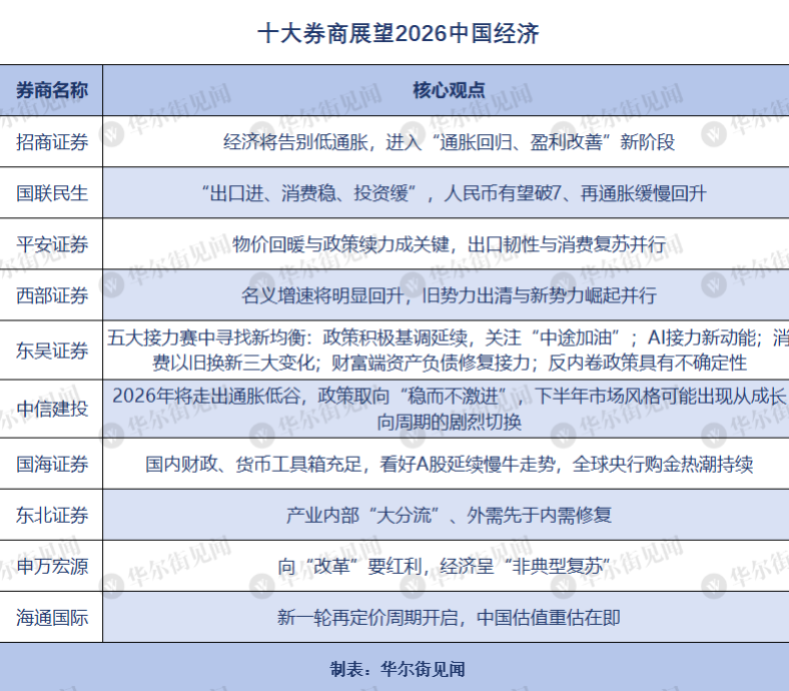
告别低通胀、AI接力新需求叙事,改革红利提振消费率......十大券商一文展望2026中国经济
Hua Er Jie Jian Wen· 2025-12-21 01:13
Core Viewpoint - The year 2026 is projected to be a turning point for China's economy, moving away from low inflation and establishing a "new equilibrium" as per the consensus among major securities firms [1]. Group 1: Macroeconomic Growth and Price Recovery - Major securities firms, including China Merchants, Ping An, and West Securities, agree that the Chinese economy will emerge from the low inflation phase, with expectations of nominal GDP growth recovery driven by price factor improvements [1][5]. - The "anti-involution" policy is expected to limit supply, combined with the pig cycle bottoming out and PPI turning positive, which will be key in improving corporate profitability and nominal GDP [1][5][6]. Group 2: Structural Transition and New Growth Drivers - 2026 is seen as a critical juncture for the transition between old and new growth drivers, with real estate investment entering a bottoming phase while AI, data center energy demand, and high-end manufacturing are expected to become substantial growth engines [1][5][21]. - The consensus is that the economy will experience a "new-old relay" with significant changes in investment structures, particularly in manufacturing and real estate [1][21]. Group 3: Demand-Side Drivers - There is a divergence in views regarding demand-side drivers; some firms like Minsheng and Northeast Securities believe external demand will outperform internal demand, while others like West Securities and Shenwan Hongyuan predict a shift towards internal demand dominance [1][5][21]. Group 4: Asset Allocation and Market Style Predictions - Opinions on asset allocation and market style are highly varied, with Haitong International being the most optimistic, predicting a 40% increase in the Shanghai Composite Index based on "value re-evaluation" logic [2][50]. - China Merchants Securities anticipates a shift from "policy-driven" to "profit-driven" market dynamics, while others suggest a more balanced focus on both growth and cyclical opportunities [2][21]. Group 5: Key Predictions from Securities Firms - China Merchants Securities predicts a recovery in corporate profits and a shift in policy focus towards enhancing development quality, with manufacturing investment expected to grow by 5% and real estate investment's decline narrowing to -8% [5][10]. - Ping An Securities emphasizes the importance of price recovery, forecasting CPI to rise to 0.6% and PPI to narrow its decline significantly [16][18]. - West Securities expects nominal GDP growth to accelerate, driven by inflation recovery and the emergence of new growth forces [21][23]. Group 6: External Environment and Trade Dynamics - The external environment is expected to improve, with strong export performance contributing significantly to GDP growth, projected to be around 40%-50% from actual export growth [11][44]. - The report from Northeast Securities highlights that external demand will recover before internal demand, with exports expected to grow by approximately 7% [44][45].






密集落子!券商海外战略升级 抢占国际赛道
2 1 Shi Ji Jing Ji Bao Dao· 2025-12-19 13:40
券商国际业务成为新的增长点 中资券商"出海"再提速。 近日,招商证券(600999)发布公告称,同意全资子公司招商证券国际有限公司(以下简称招证国 际),向其全资子公司分次增资不超过90亿港元,其中首次增资对象为招商证券(香港)有限公司,增 资规模不超过40亿港元。 此前一月,国泰海通(601211)证券董事会审议通过境外子公司收购印尼证券公司的议案,这意味着完 成合并后,公司将进军印尼市场。 事实上,伴随国内金融开放持续深化,叠加跨境投融资需求稳步攀升,中资券商正加快境外业务的落子 布局。据不完全统计,今年以来,已有近十家上市券商披露公告,宣布出资设立或增资国际子公司,全 球化扩张步伐明显加快。 "中资券商出海目前已经进入深化布局阶段。"国海证券分析师董栋梁认为,海外业务发展有很多有利因 素,目前我国大量券商海外业务占比非常小,未来依然大有可为。 开源证券研究数据印证了这一趋势,其选取14家券商作为样本进行统计,结果显示,2024年样本券商海 外业务收入合计达401亿元,创下历史新高。经测算,2018年至2024年的六年间,上述券商海外业务收 入的复合增长率高达 20%。开源证券分析认为,供给侧、需求侧以及 ...
港股异动 | 吉宏股份(02603)涨超6% 公司在全国经营11个大型包装生产基地
智通财经网· 2025-12-19 07:45
消息面上,近日,吉宏股份在互动平台回答投资者提问时表示,公司在全国经营11个大型包装生产基 地,与国内外食品、饮料、餐饮、日化等多个快消品细分领域行业龙头企业包括旺旺集团均建立长期稳 定的合作关系。东北证券此前指,作为国内纸制快消品销售包装龙头,公司深度绑定伊利、瑞幸、麦当 劳等头部客户。海外拓展方面,2024年与VENUSTRADINGFZCO在阿联酋、阿曼建设生产基地及贸易 平台,虽仍处建设期,但已推动包装业务在2025年上半年实稳健增长,打破此前三年停滞态势,为未来 业绩增添加长期稳定性。 智通财经APP获悉,吉宏股份(02603)涨超6%,截至发稿,涨6.05%,报13.15港元,成交额3520.45万港 元。 ...

近八成券商多次分红 券商打响“季度分红赛
2 1 Shi Ji Jing Ji Bao Dao· 2025-12-19 07:35
Core Viewpoint - The Chinese securities industry is undergoing a significant transformation towards more frequent and substantial dividend distributions, moving from annual to multiple distributions per year, reflecting a shift in focus from financing to shareholder returns [2][3][10]. Group 1: Dividend Frequency and Trends - In 2025, 35 securities firms have implemented or planned to distribute dividends two times or more, accounting for 79.55% of all listed securities firms, indicating a shift towards a "multiple dividends, timely sharing" norm [4][7]. - The practice of mid-term dividends (including interim and third-quarter dividends) has become a new standard, with 29 firms implementing mid-term dividends in 2025, a significant increase from previous years [3][4]. - The introduction of third-quarter dividends marks a notable change, with 8 firms planning such distributions in 2025, compared to only 9 firms in the same period of 2024 [3][6]. Group 2: Dividend Amount and Quality - The "quality" of dividends, measured by the actual cash distributed per share, has become a key indicator of a firm's commitment to shareholder returns, with leading firms setting high benchmarks [5][6]. - In 2025, major firms like CITIC Securities have distributed dividends exceeding 40 billion yuan, with CITIC Securities leading at 84.48 billion yuan [7][8]. - The competition among leading firms has intensified, with CITIC Securities paying 29 yuan per hand (100 shares), followed by CITIC Jiantou at 16.5 yuan, and Huatai Securities and Guotai Junan at 15 yuan each [6][7]. Group 3: Regulatory and Market Influences - The increase in dividend frequency and amounts is driven by regulatory encouragement and an improved market environment, with policies promoting multiple dividends and requiring reasonable shareholder return plans [7][10]. - The new "National Nine Articles" and regulations on strengthening the supervision of listed securities firms have prompted firms to internalize dividend distribution as a necessary responsibility rather than an optional practice [7][10]. Group 4: Diversification of Shareholder Return Tools - In addition to cash dividends, share buybacks are becoming a key tool for firms to return value to shareholders, enhancing earnings per share (EPS) and net asset value per share [8][9]. - As of December 18, 2025, several firms have implemented share buybacks, with Guotai Junan leading with over 1.2 billion yuan in buybacks, indicating a trend towards a combined approach of cash dividends and buybacks [8][9]. Group 5: Long-term Shareholder Engagement - Firms are increasingly focusing on establishing long-term, stable, and predictable dividend policies to enhance investor confidence and attract long-term capital [9][10]. - Some leading firms have begun to disclose long-term shareholder return plans, committing to distribute at least 50% of their distributable profits in cash from 2025 to 2027, which helps stabilize market expectations [9][10].


11月份证券类App月活人数达1.72亿 环比增长2.06%
Cai Jing Wang· 2025-12-19 01:46
Core Insights - The securities industry is experiencing a significant increase in monthly active users (MAU) for trading apps, reaching 172 million in November, a month-on-month growth of 2.06% [1] - Brokerages are leveraging AI tools to enhance service models and improve user experience amid increasing competition for customer acquisition [1][4] Group 1: User Growth and App Performance - In November, the total number of new accounts opened in the market was 2.5506 million, reflecting a month-on-month increase of 3.38% [2] - Eleven brokerage apps had monthly active users exceeding 6 million, with Huatai Securities and Guotai Junan leading at 11.8149 million and 10.1848 million respectively, both showing month-on-month growth of over 2% [2] - Smaller brokerages are also seeing significant growth in MAU, with Guojin Securities' app achieving the highest month-on-month growth rate of 9.58% [3] Group 2: Competitive Landscape and Innovation - The competition among brokerages is intensifying, prompting rapid updates and innovations in mobile app functionalities [4] - AI has become a central focus for app updates, with features like AI dashboards and intelligent assistants being introduced to enhance user engagement and investment management [4][5] - The application of smart technology is expected to improve response efficiency and personalized service levels, aiding brokerages in transitioning to comprehensive wealth management service providers [5] Group 3: Future Trends and Strategic Directions - The integration of intelligent technology is becoming a standard in the securities industry, with a focus on enhancing professional service levels and creating value for investors [6] - Brokerages are encouraged to deepen the application of AI tools across core business functions to improve user retention and service quality [6] - Large institutions can leverage their resources to build comprehensive smart wealth management platforms, while smaller firms should focus on niche markets to establish competitive advantages [6]
11月份证券类App月活环比增长2.06%
Zheng Quan Ri Bao Zhi Sheng· 2025-12-18 15:38
Core Insights - The securities industry is experiencing a significant increase in monthly active users (MAU) for trading apps, reaching 172 million in November, a month-on-month growth of 2.06% [1] - Brokerages are leveraging AI tools to enhance service models and improve user experience amid a competitive landscape for customer acquisition [4][5] Group 1: Monthly Active Users and Account Growth - In November, the total number of new accounts opened in the market was 2.5506 million, reflecting a month-on-month increase of 3.38% [2] - Eleven brokerage apps had monthly active users exceeding 6 million, with Huatai Securities and Guotai Junan leading at 11.8149 million and 10.1848 million respectively, both showing month-on-month growth of over 2% [2] - Smaller brokerages like Guojin Securities and Chengtong Securities achieved significant month-on-month growth rates of 9.58% and 4.61% respectively, despite having lower user volumes [3] Group 2: Competitive Landscape and AI Integration - The competition among brokerages is intensifying, with a focus on mobile app functionality and service innovation, particularly through the integration of AI [4] - AI has become a central element in app updates, with features like "AI Dashboard" and AI-driven investment assistants being introduced to enhance user engagement and provide real-time market insights [4][5] - The application of intelligent technology is expected to improve response efficiency and personalized service levels, aiding brokerages in transitioning to comprehensive wealth management service providers [5][6] Group 3: Future Outlook and Strategic Directions - The ongoing evolution of financial technology positions intelligent solutions as a standard in the securities industry, with a focus on enhancing professional service levels and creating value for investors [6] - Large institutions are expected to leverage their resources to build comprehensive intelligent wealth management platforms, while smaller brokerages can focus on niche markets to establish competitive advantages [6]





近八成券商多次分红!券商打响“季度分红赛”
2 1 Shi Ji Jing Ji Bao Dao· 2025-12-18 11:17
Core Viewpoint - The Chinese securities industry is experiencing a significant shift towards frequent dividend distributions, with many firms adopting a practice of multiple dividends per year, reflecting a deeper transformation from a focus on financing to prioritizing shareholder returns [1][3][10]. Group 1: Dividend Frequency and Trends - In 2025, 35 securities firms have distributed dividends two times or more, accounting for 79.55% of the total listed firms, indicating a shift to a normalized practice of multiple dividends [1][4]. - The trend of mid-term dividends (including interim and quarterly reports) has become the new norm, with a notable increase in firms participating in this practice from just one in 2023 to a significant number in 2025 [3][4]. - The introduction of quarterly dividends marks a significant change, with 8 firms announcing plans for quarterly dividends in 2025, compared to only 9 in the previous year [3][4]. Group 2: Dividend Amount and Quality - The "quality" of dividends, measured by the actual cash distributed per share, has increased, with leading firms like CITIC Securities distributing 29 yuan per hand (100 shares), setting a high benchmark [6][7]. - Major firms such as Guotai Junan, Huatai Securities, and others have also significantly increased their dividend payouts, with several firms exceeding 40 billion yuan in total dividends for the year [6][7]. Group 3: Regulatory Influence and Market Environment - The shift towards more frequent dividends is driven by regulatory encouragement and an improved market environment, with policies like the new "National Nine Articles" promoting multiple dividends [7][8]. - The regulatory framework has transformed dividend distribution from a flexible option to a rigid responsibility, compelling firms to enhance their shareholder return strategies [7][8]. Group 4: Diversification of Return Mechanisms - In addition to cash dividends, share buybacks are becoming a key tool for firms to manage capital structure and return value to shareholders, with Guotai Junan leading the industry in buyback amounts [8][9]. - A combination of cash dividends and share buybacks is being increasingly adopted, providing firms with flexible capital management options and offering investors diverse value realization paths [8][9]. Group 5: Long-term Shareholder Engagement - Enhancing investor satisfaction is viewed as a systematic project that requires improving governance, optimizing return tools, and ensuring transparency in decision-making [9][10]. - Some leading firms are proactively disclosing long-term shareholder return plans, which helps stabilize market expectations and attract long-term investors [9][10].