北京文化

Search documents
双版块展现文旅新魅力,首项国际标准填补空白
Zhong Guo Fa Zhan Wang· 2025-09-10 12:59
Group 1: Event Overview - The World Tourism Cities Federation hosted the 2025 World Tourism Cities Resource Promotion Conference in Beijing, aimed at promoting international tourism resource display, experience exchange, and practical cooperation [1] - The event featured three segments: "Meet a Different World," "Meet a Different Beijing," and the introduction of the "International Standard for Tourism City Brand Evaluation" [1] Group 2: Global Tourism Insights - The World Tourism Cities Federation has 257 members and focuses on building efficient platforms for international collaboration [2] - Representatives from various cities shared their tourism resources, cultural characteristics, and development strategies, highlighting the importance of enhancing tourism facilities and service quality [2] Group 3: Cultural Heritage and Sustainable Development - Athens is enhancing social cohesion through infrastructure investment and cultural innovation while addressing climate challenges [3] - Kathmandu is balancing cultural heritage protection with tourism development through sustainable practices [3] - Belgrade is improving tourism experiences in preparation for the 2027 World Expo, showcasing its multicultural appeal [3] Group 4: Domestic Tourism Development - Jilin City hosts nearly 100 cultural tourism events annually and offers over 10,000 cultural products to invigorate its tourism sector [4] - Linzhi City combines ecological tourism with ethnic culture through events like the Peach Blossom Festival [4] Group 5: International Standard for Tourism City Brand Evaluation - The "International Standard for Tourism City Brand Evaluation" was developed over three years and approved by the International Organization for Standardization (ISO) [5] - The standard includes 8 primary indicators and 53 secondary indicators, covering various aspects such as tourism resources, infrastructure, and visitor experience [5] - Its implementation is expected to guide cities in brand building and enhance the quality of global tourism development [5] Group 6: Beijing's Tourism Landscape - Beijing's tourism industry is evolving through the integration of digital innovations, showcasing its cultural charm as a modern international city [6] - The city emphasizes the organic integration of historical heritage with contemporary life, enhancing its cultural vitality [6] - Beijing is also focusing on creating diverse consumer experiences through its traditional and modern cultural offerings [7]


北京常住老年人口首破500万,“银发经济”加速转向品质生活
Xin Jing Bao· 2025-09-09 13:16
Core Insights - The number of elderly residents in Beijing has surpassed 5.14 million, accounting for 23.5% of the total population, indicating a significant aging trend [2][3] - The elderly population is expected to peak by the middle of this century, with a notable increase in the elderly dependency ratio, which has risen to 36.5% [3] Demographic Trends - By the end of 2024, the elderly population in Beijing is projected to reach 514 million, an increase of 192,000 from 2023, representing a growth rate of 3.9% [2] - The districts with the highest populations of residents aged 60 and above are Chaoyang, Haidian, and Fengtai, while the highest proportions of elderly residents are found in Xicheng, Mentougou, and Dongcheng [2] Elderly Care Services - Beijing has established a comprehensive elderly care service system, including 608 registered care institutions with 109,000 beds, all providing integrated medical and nursing services [4] - The city has developed 105 regional elderly care centers and over 1,500 community service stations, promoting diverse elderly care options [4] Consumer Demand in Silver Economy - The demand for elderly food, education, and health services is prominent, with a strong emphasis on health, spirit, and quality in silver consumption [6][7] - Elderly residents in Beijing spend an average of 1,033 yuan monthly on food, which is 16.8% higher than the national average [7] Technological Advancements in Elderly Care - The elderly industry in Beijing benefits from strong policy support, a solid development foundation, and significant technological innovation potential [9][10] - The consumption scale of the elderly population has grown from 55.8 billion yuan in 2010 to 291.4 billion yuan in 2023, with an annual growth rate of 14.76% [9] Future Outlook - The elderly care sector is expected to continue evolving, with a focus on enhancing institutional care capabilities and expanding home-based care services [5] - The upcoming Beijing Elderly Expo aims to promote the adoption of smart home and assistive technologies among elderly residents [10]
北京文化消费新场景活力持续迸发
Bei Jing Ri Bao Ke Hu Duan· 2025-09-06 23:54
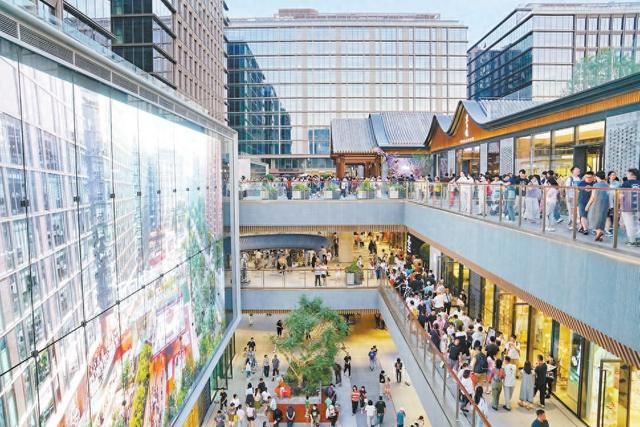
Group 1 - The core idea of the articles revolves around the integration of historical architecture with modern commercial activities, creating a "cultural reception hall" that attracts citizens and tourists as a new cultural consumption landmark in Beijing [2][3][5] - The Dajixiang project, a significant urban renewal initiative, has transformed a historical area into a vibrant commercial space, featuring a mix of cultural, leisure, and shopping experiences, with a commercial space of 80,000 square meters and a 96% occupancy rate [3][5] - Since its opening on May 25, the Dajixiang has seen over 6 million visitors and sales exceeding 207 million yuan, with a peak daily foot traffic of 220,100 [3][5] Group 2 - The Longfu Temple, another cultural consumption landmark, is set to open on September 17, featuring a diverse range of new stores aimed at attracting younger audiences, including performance venues and outdoor activities [6][8] - The integration of cultural and tourism sectors has led to significant growth in cultural consumption, with 102 large-scale performances generating 1.5 billion yuan in ticket sales in the first half of the year, marking a year-on-year increase of approximately 13% and 35% respectively [8] - New tourism products and themed travel routes have been launched, enhancing the cultural experience for visitors, with 105 new themed travel routes introduced this year [8]

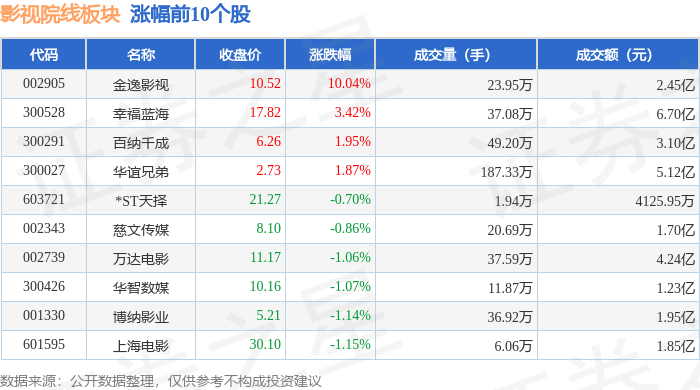
影视院线板块9月3日跌1.63%,中视传媒领跌,主力资金净流出1.43亿元
Zheng Xing Xing Ye Ri Bao· 2025-09-03 08:46
Market Overview - The film and theater sector experienced a decline of 1.63% on September 3, with China Vision Media leading the drop [1] - The Shanghai Composite Index closed at 3813.56, down 1.16%, while the Shenzhen Component Index closed at 12472.0, down 0.65% [1] Stock Performance - Notable gainers included: - Qianyi Film (002905) with a closing price of 10.52, up 10.04% and a trading volume of 239,500 shares [1] - Xingfu Blue Ocean (300528) closed at 17.82, up 3.42% with a trading volume of 370,800 shares [1] - Major decliners included: - China Vision Media (600088) closed at 17.45, down 4.23% with a trading volume of 111,300 shares [2] - Huayi Brothers (300027) closed at 2.73, down 1.87% with a trading volume of 1,873,300 shares [1] Capital Flow - The film and theater sector saw a net outflow of 143 million yuan from institutional investors, while retail investors contributed a net inflow of 60.24 million yuan [2] - The overall capital flow indicates a mixed sentiment, with institutional investors withdrawing funds while retail investors showed some interest [2] Individual Stock Capital Flow - Key stocks with significant capital flow include: - Qianyi Film (002905) with a net outflow of 85.17 million yuan from institutional investors [3] - Huayi Brothers (300027) saw a net inflow of 78.87 million yuan from institutional investors [3] - The data reflects varying levels of investor confidence across different companies within the sector [3]


光线传媒上半年净赚22亿领跑影视股,万达电影净利增3.7倍
Mei Ri Jing Ji Xin Wen· 2025-09-03 08:01
Group 1 - The core viewpoint of the article highlights the significant performance disparity among A-share film and cinema companies in the first half of 2025, with Light Media leading the sector by earning a net profit of 2.229 billion yuan, surpassing the combined net profit of the other nine companies [1] - Light Media and Wanda Film both reported net profit increases exceeding 370%, showcasing their strong recovery in the film market [1] - In contrast, companies like China Film and Huayi Brothers reported losses during the same period, with Bona Film's net loss expanding to over 1 billion yuan, marking it as the largest loss in the sector [1] Group 2 - The overall performance of the film and cinema sector in the first half of 2025 indicates a clear divide, with some companies thriving while others struggle significantly [1] - The financial results reveal that Light Media's net profit alone exceeds the total net profit of the other nine companies combined, indicating its dominant position in the market [1] - The report underscores the challenges faced by certain companies, such as Beijing Culture, which also reported an expanded net loss of 233 million yuan [1]

狂买49亿股!险资二季度重仓买了这些 投资者能“抄作业”吗
Xin Jing Bao· 2025-09-02 14:30
Core Viewpoint - Insurance companies are increasingly investing in equity assets, particularly high-dividend stocks, to enhance returns amid a declining interest rate environment and to better match the duration of their assets and liabilities [1][4][5]. Group 1: Insurance Companies' Stock Holdings - As of the end of Q2, insurance companies held a total of 926.99 billion shares across 731 stocks, an increase of 49.24 billion shares from the previous quarter [2][3]. - The total balance of funds utilized by insurance companies exceeded 36 trillion yuan, a year-on-year increase of 17.4%, with stock investments reaching 3.07 trillion yuan, marking a significant rise in allocation to equities [2][4]. - The top ten stocks heavily held by insurance companies include Minsheng Bank, Shanghai Pudong Development Bank, and China Unicom, with each holding over 10 billion shares [2][3]. Group 2: Investment Trends and Strategies - Insurance companies are focusing on high-dividend, low-volatility stocks, reflecting a shift from traditional fixed-income investments due to the low yield environment [4][6]. - The recent trend shows a significant increase in equity investments, with 174 new stocks added to their portfolios by the end of Q2 [2][3]. - The insurance sector is also experiencing a wave of shareholding increases, with nearly 30 instances of shareholding increases reported by mid-August [3][4]. Group 3: Market Outlook and Future Investments - Most insurance institutions maintain an optimistic outlook for the A-share market in the second half of the year, expecting the Shanghai Composite Index to remain between 3200 and 3800 points [7][8]. - Key sectors of interest include pharmaceuticals, electronics, banking, and communication, with a focus on new productive forces and high-dividend assets [7][8]. - Major insurance companies plan to enhance their equity investment strategies, emphasizing the importance of investment capabilities in their competitive positioning [6][8].
影视公司上半年盈利不只靠《哪吒》
Bei Jing Shang Bao· 2025-09-01 16:31
Core Insights - The film industry has shown significant profitability in the first half of the year, with major companies like Wanda Film and Light Media reporting substantial net profit increases of 372.55% and 371.55% respectively [1][3] - The growth in profits is attributed not only to blockbuster films but also to optimized non-ticket business operations, cost control, and improved operational efficiency [1][5] - The competition in the film industry has evolved from content-based competition to a focus on comprehensive operational capabilities, with companies that can integrate industry chains and innovate business models expected to have a competitive edge in the future [9] Group 1: Box Office Performance - The total box office revenue for the first half of the year reached 29.231 billion yuan, with 641 million moviegoers, marking year-on-year increases of 22.91% and 16.89% respectively [3] - Domestic films accounted for 91.2% of the box office, with the film "Nezha: Birth of the Demon Child" contributing over 15.4 billion yuan, representing a significant portion of the total box office [3] - Wanda Film reported a domestic box office of 4.21 billion yuan, a year-on-year increase of 19.2%, with 82.39 million attendees, up 9.6% [3] Group 2: Business Optimization - Companies are enhancing their business models by optimizing consumption scenarios, improving sales conversion rates, and expanding external channels [6] - Wanda Film has upgraded its sales strategies through social media and live streaming, while also focusing on self-developed products and eliminating underperforming items [6] - Golden Screen Cinemas reported a 48% increase in sales of new beverage products and a 178% increase in light food sales, indicating a successful expansion of their product line [6][8] Group 3: Cost Control - Cost control measures have been crucial for maintaining profitability, with Golden Screen Cinemas reporting reductions in various operational costs, including travel and marketing expenses [8] - The company has optimized energy usage and maintenance costs, leading to a 5.82% decrease in overall operating costs [8] - The focus on innovative business models, such as "Cinema+" and "Space+", aims to enhance operational efficiency and revenue generation [8] Group 4: Future Outlook - The market is expected to experience a slowdown post-summer, but the upcoming National Day holiday may drive new growth [8] - Major companies like Wanda Film and Light Media are likely to maintain strong performance through participation in key projects, while less competitive firms may continue to face challenges [8][9]



光线传媒净利大涨、中国儒意扭亏为盈 上半年影视上市公司盈利不只靠《哪吒》
Bei Jing Shang Bao· 2025-09-01 06:05
Core Insights - The film industry has seen significant profitability in the first half of the year, driven primarily by blockbuster films and improved operational efficiencies [1][2][8] - Companies that can integrate their operations and innovate their business models are expected to have a competitive advantage in the evolving market landscape [1][8] Group 1: Financial Performance - Wanda Film and Light Media reported substantial increases in net profit, with year-on-year growth of 372.55% and 371.55% respectively [1] - Jin Yi Film and Happiness Blue Sea turned losses into profits, with net profit growth of 146.73% and 128.99% respectively [1] - Beijing Culture reported a revenue of 1.58 billion yuan, a year-on-year increase of 1944.24%, but a net loss of 233 million yuan, a decline of 610.29% [8] Group 2: Box Office and Audience Engagement - The total box office for the first half of 2025 reached 29.231 billion yuan, with a year-on-year growth of 22.91%, and domestic films accounted for 91.2% of the box office [2] - The film "Nezha: The Devil's Child" generated over 15.4 billion yuan, contributing significantly to the overall box office [2] - Companies are increasingly focusing on audience engagement through diversified offerings, such as food and beverage pairings with movie experiences [5][6] Group 3: Operational Strategies - Companies are optimizing their business models by enhancing consumer experiences and diversifying product offerings, such as introducing new food and beverage items [4][5] - Cost control measures have been implemented, with Jin Yi Film reporting reductions in various operational costs, including travel and marketing expenses [7] - The trend of integrating retail and service offerings in cinemas is becoming more prevalent, with companies transforming concession stands into mini-supermarkets [6][7] Group 4: Future Outlook - The competition in the film industry is shifting from content creation to comprehensive operational capabilities, indicating that companies with strong integration and innovation will thrive [3][8] - The upcoming National Day holiday is expected to drive a new wave of growth in the film market, particularly for leading companies like Wanda Film and Light Media [7]
北京文化消费焕发新动能 地标撑起消费“新骨架”
Bei Jing Qing Nian Bao· 2025-09-01 00:54
Group 1: Overview of Cultural Consumption in Beijing - The cultural consumption market in Beijing has shown a "dual increase" in both quantity and quality in 2023, with 180 million tourists received in the first half of the year, a year-on-year increase of 7.1%, and total tourism expenditure reaching 338.17 billion yuan, up 8.8% [1] - The integration of cultural and tourism sectors, urban renewal, and the emergence of new economic drivers have contributed to a vibrant cultural consumption landscape in Beijing [1] Group 2: New Business Models and Consumer Engagement - The "performance + tourism" model has become a highlight of cultural consumption in Beijing, with 102 large-scale performances held in the first half of the year, generating ticket sales of 1.5 billion yuan, representing year-on-year growth of approximately 13% and 35% respectively [2] - The deep integration of intangible cultural heritage (ICH) with tourism has created new experiences for visitors, with 365 ICH projects along the central axis of Beijing becoming a key attraction [2] - The launch of the "music map" and over 400 outdoor music events has extended music consumption into urban spaces, enhancing cultural engagement for both residents and tourists [2] Group 3: Diverse Cultural Tourism Products - Beijing has introduced a variety of cultural tourism products, including 105 themed travel routes and 25 rural tourism routes, enhancing the "Wander Beijing" brand [3] - The Beijing International Cultural Tourism Consumption Expo achieved sales of 211 million yuan, showcasing successful integration of culture, commerce, and tourism [3] Group 4: Urban Renewal Projects - Urban renewal projects like Zhonghai Dajixiang and Longfu Temple have transformed historical areas into cultural consumption landmarks, preserving historical context while injecting modern commercial vitality [4][6] - Zhonghai Dajixiang, a 360,000 square meter complex, has become a model for urban renewal, combining cultural preservation with commercial operations [4] - Longfu Temple, which has undergone extensive renovation since 2012, focuses on cultural heritage and innovation, featuring immersive experiences and unique retail offerings [6][7] Group 5: Consumer Engagement and Foot Traffic - Zhonghai Dajixiang attracted over 500 million visitors since its opening, with daily foot traffic exceeding 60,000, indicating strong market acceptance of this urban renewal model [5] - Longfu Temple is set to open on September 17, 2023, with plans for promotional events and collaborations with major platforms to enhance its role as a new cultural consumption landmark in Beijing [7]
暑期档将结束:115亿票房背后的资本暗战 谁在操控暑期档“票房神话”
Quan Jing Wang· 2025-08-31 08:14
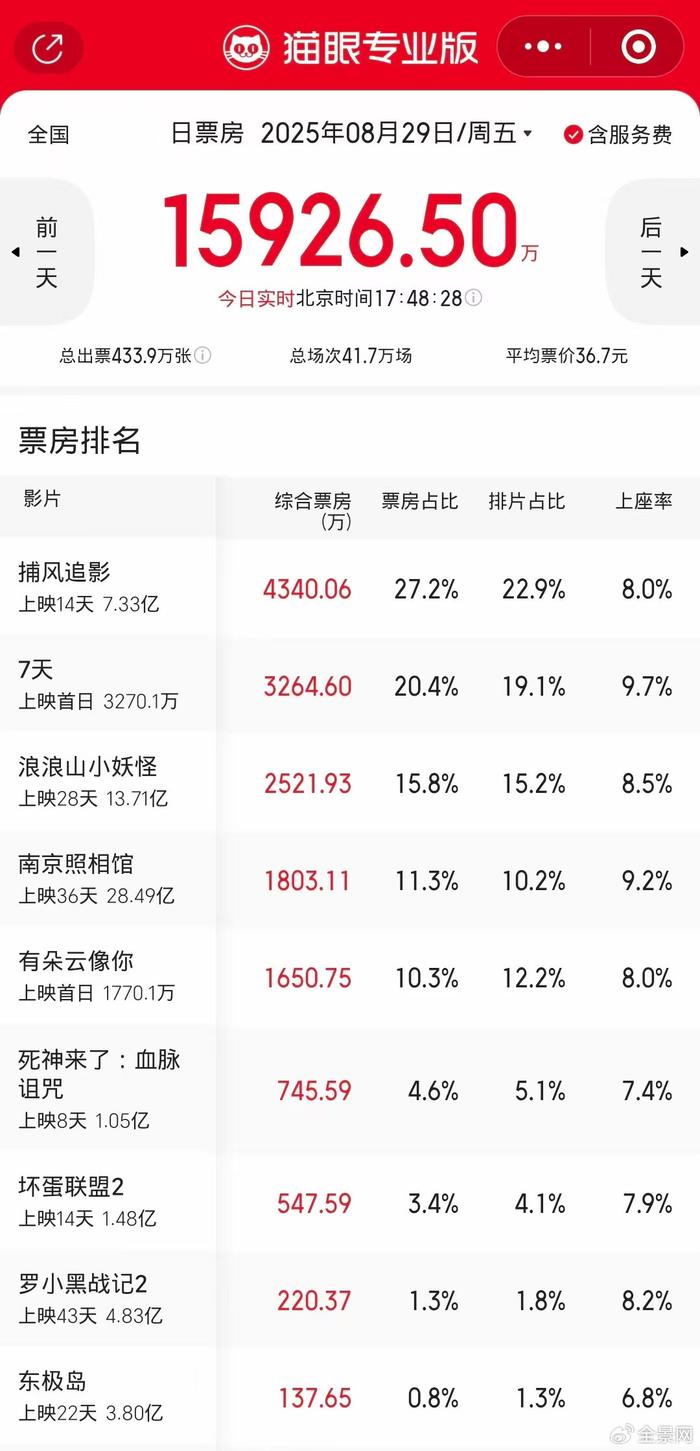
Core Insights - The total box office for the summer film season in 2025 has surpassed 11.5 billion yuan, with over 300 million viewers, indicating a strong performance in the domestic film market [1][2] - "Nanjing Photo Studio" has emerged as the biggest winner, grossing over 2.8 billion yuan, setting a record for historical films in China's summer box office [1][2] - The dominance of domestic films is evident, with a 91.2% market share in the first half of 2025, reflecting a shift towards diverse and culturally resonant storytelling [2] Box Office Performance - As of August 29, 2025, the daily box office reached approximately 1.59 billion yuan, with a total of 4.34 million tickets sold [1] - "Nanjing Photo Studio" has grossed 2.849 billion yuan over 36 days, while "Wang Wang Mountain Little Monster" has surpassed 1.3 billion yuan [2] - Other notable films include "Ro Xiao Hei Battle 2" with approximately 480 million yuan and "Dong Ji Island" with around 380 million yuan [1][2] Industry Trends - The summer box office for 2025 is approximately 8.74 billion yuan, close to the previous year's 9.22 billion yuan, but still lower than 2023 and 2019 [2] - The rise of domestic films is attributed to their focus on Chinese narratives and diverse genres, enhancing cultural confidence [2] - The film industry is exploring innovative business models to reduce reliance on box office revenue, aiming to increase non-ticket income [2] Company Responses - Wanda Film reported that the current summer box office is nearing last year's levels, with a strong lineup of domestic films driving audience engagement [2] - Jiecheng Co. has secured rights for "Wang Wang Mountain Little Monster" merchandise, indicating a strategic focus on IP development and consumer engagement [4] - Beijing Culture and Huayi Brothers have clarified their investment positions in "Dong Ji Island," indicating limited financial impact from the film's performance [6][8]