爱美客

Search documents
医疗美容板块12月1日涨0.08%,爱美客领涨,主力资金净流出1575.4万元
Sou Hu Cai Jing· 2025-12-01 09:10
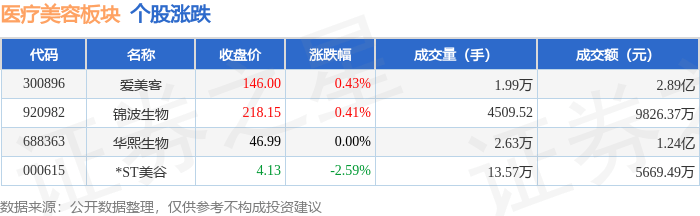
Core Viewpoint - The medical beauty sector experienced a slight increase of 0.08% on December 1, with Ai Meike leading the gains, while the overall market indices also showed positive performance [1] Group 1: Market Performance - The Shanghai Composite Index closed at 3914.01, up by 0.65% [1] - The Shenzhen Component Index closed at 13146.72, up by 1.25% [1] Group 2: Medical Beauty Sector Stocks - Ai Meike (300896) closed at 146.00, with a gain of 0.43% and a trading volume of 19,900 lots, amounting to a transaction value of 289 million yuan [1] - Jinbo Biological (920982) closed at 218.15, with a gain of 0.41% and a trading volume of 4,509.52 lots, amounting to a transaction value of 98.26 million yuan [1] - Huaxi Biological (688363) closed at 66.99, remaining unchanged with a trading volume of 26,300 lots, amounting to a transaction value of 124 million yuan [1] - *ST Meigu (000615) closed at 4.13, down by 2.59% with a trading volume of 135,700 lots, amounting to a transaction value of 56.69 million yuan [1] Group 3: Capital Flow - The medical beauty sector saw a net outflow of 15.754 million yuan from institutional funds and a net outflow of 7.922 million yuan from speculative funds, while retail investors contributed a net inflow of 23.676 million yuan [1]


新氧又上“黑名单”,医美再现定价权之争
经济观察报· 2025-12-01 07:36
Core Viewpoint - The conflict between medical beauty institutions and the upstream company Puli Yan is fundamentally rooted in pricing discrepancies, with institutions selling Puli Yan's products at significantly lower prices than the official guidance, disrupting the pricing structure [1][2][6]. Pricing Dispute - The dispute escalated as Puli Yan announced a blacklist of 79 non-official cooperating medical institutions, including 46 clinics under Xinyang, labeling them as non-cooperative [2]. - Xinyang's pricing strategy exemplifies the issue, with its clinics selling Puli Yan's products at 5999 yuan per unit, approximately 60% lower than the official guidance price [3][6]. Market Dynamics - The conflict highlights a broader challenge in the medical beauty industry regarding the redistribution of interests between upstream manufacturers and downstream institutions [3]. - Puli Yan's concerns include the lack of formal cooperation and training for medical staff at these institutions, which it claims undermines product integrity [5]. New Pricing Strategies - Xinyang has introduced products like "Miracle Youth 3.0" at 2999 yuan per unit, significantly undercutting market prices, which typically exceed 10,000 yuan [8]. - The high profit margins in the medical beauty industry, with some products having gross margins as high as 90%, provide room for Xinyang to implement its low-price strategy [8][9]. Industry Challenges - The prevalence of counterfeit and substandard products in the market, with nearly two-thirds being non-compliant, has created a demand for more affordable options [9]. - Xinyang aims to democratize medical beauty consumption by reducing costs through direct partnerships with manufacturers and streamlining operations [9]. Competitive Landscape - Xinyang's approach has faced criticism from other manufacturers, who argue that its pricing undermines the market and raises concerns about product authenticity and safety [11][12]. - Despite the challenges, Xinyang continues to assert its right to set prices independently, likening its product usage to a restaurant's choice of ingredients [12]. Financial Performance - Xinyang has reported ongoing financial losses, particularly in its brand medical center expansion, indicating the difficulties of transitioning to a self-operated model while maintaining profitability [12].


医美界最大忽悠,栽了
3 6 Ke· 2025-12-01 01:37
Core Viewpoint - The article discusses the exposure of a major fraud involving Jiangsu Wuzhong (*ST Suwu), a company that misled investors and engaged in long-term deception, leading to its forced delisting from the stock market [1][2]. Group 1: Company Background - Jiangsu Wuzhong, originally established in 1994, has undergone multiple transformations, including ventures into textiles, real estate, and chemicals, before entering the medical aesthetics industry [4][6]. - The company gained attention in the medical aesthetics sector through its subsidiary, Wuzhong Aesthetics, which marketed the popular "AestheFill" product [3][4]. Group 2: Fraudulent Activities - Jiangsu Wuzhong has been involved in systematic fraud, including false disclosures about its actual controllers and inflated financial figures, with a significant amount of funds misappropriated [9][10]. - The company engaged in a "hot potato" scheme, where different controllers participated in the deception, ultimately leaving investors to bear the losses [2][9]. Group 3: Regulatory Actions - Regulatory authorities have initiated major illegal delisting procedures against Jiangsu Wuzhong due to severe violations, including a fine of 15 million yuan for its actual controller, Qian Qunshan, and a ten-year ban from the securities market [10][12]. - The company is now facing legal challenges, including a lawsuit against Aimeike for trademark infringement, as it seeks to recover 1.6 billion yuan in damages [11][12].
化妆品医美行业周报:多品牌全球化+AI赋能,化妆品年会指明未来发展-20251130
Shenwan Hongyuan Securities· 2025-11-30 13:43
Investment Rating - The report gives a "Buy" rating for the cosmetics and medical beauty industry, highlighting potential growth opportunities in the sector [4][13]. Core Insights - The cosmetics and medical beauty sector is currently underperforming compared to the market, with the Shenwan Beauty Care Index rising by only 0.5% from November 21 to November 28, 2025, which is lower than the overall market performance [5][4]. - The sixth China Cosmetics Annual Conference emphasized the importance of multi-brand globalization and AI empowerment for future development, with industry leaders discussing strategies for growth and market adaptation [10][4]. - The report anticipates that domestic brands will thrive during the industry's consolidation phase, leveraging innovation and consumer demand to drive growth [11][4]. Summary by Sections Industry Performance - The cosmetics and medical beauty sector has shown weak performance, with the Shenwan Cosmetics Index increasing by 1.4%, which is 1.6 percentage points lower than the Shenwan A Index [5][4]. - Key stocks in the sector include Yanjiang Co. (+22.0%), Mingchen Health (+17.9%), and Lihe Technology (+9.9%) [6][4]. Market Trends - The report identifies trends such as the need for brands to localize when expanding internationally, the role of AI in upgrading the industry, and the focus on men's skincare and body care segments [10][4]. - The medical beauty market is expected to see growth driven by new products and consumer demand, despite some economic pressures [12][4]. Company Analysis - Qingmu Technology is highlighted as a leading player in the full-service e-commerce operation sector, with a strong focus on data and technology to drive growth [16][4]. - The report notes that the company has shown significant revenue growth, with projected revenues of 15.1 billion, 19.0 billion, and 23.4 billion yuan for 2025-2027, respectively [19][4]. Investment Recommendations - Recommended stocks include brands with strong channel and brand matrices such as Maogeping, Shuangmei, and Proya, as well as companies in the medical beauty sector like Aimeike [13][4]. - The report suggests focusing on companies with strong R&D capabilities and a broad product pipeline, particularly in the medical beauty segment [13][4].
商贸零售行业周报:品牌建设+科技美学,谱写国货美妆增长答案-20251130
KAIYUAN SECURITIES· 2025-11-30 07:11
Investment Rating - The investment rating for the retail industry is "Positive" (maintained) [1] Core Views - The retail industry is experiencing a shift towards quality growth and long-term strategies, moving away from reliance on traffic bonuses [25][26] - The industry is focusing on emotional consumption themes, with high-quality companies in sectors like gold jewelry, offline retail, cosmetics, and medical aesthetics being highlighted as investment opportunities [5][29][30] Summary by Sections Retail Market Review - The retail industry index rose by 3.45% during the week of November 24-28, 2025, outperforming the Shanghai Composite Index by 2.05 percentage points [4][13] - The multi-format retail sector showed the highest growth this week, with a 6.18% increase, while the jewelry sector led the year-to-date performance with a 22.11% increase [18][19] Retail Insights: Brand Building and Technological Aesthetics - The 2025 Cosmetics Annual Conference highlighted the importance of brand building and technological aesthetics for domestic beauty brands to achieve growth [25][26] - Companies like Shiseido and Shanghai Jahwa are focusing on quality and profitability, while Elysian Group is transitioning from operational to technological drivers [26][27] Investment Recommendations - **Gold Jewelry**: Focus on brands with differentiated product offerings and consumer insights, recommending companies like Chow Tai Fook and Lao Pu Gold [5][29] - **Offline Retail**: Highlighting companies adapting to trends and exploring AI-enabled cross-border e-commerce, with recommendations for Yonghui Supermarket and Aiyingshi [5][30] - **Cosmetics**: Emphasizing brands that meet emotional value and safety innovation, recommending companies like Maogeping and Proya [5][30] - **Medical Aesthetics**: Targeting differentiated product manufacturers and expanding medical chains, recommending companies like Aimeike and Kedi-B [5][30] Company-Specific Insights - **Chow Tai Fook**: Achieved revenue of HKD 38.986 billion in FY2026H1, with a slight decline in revenue but a stable profit margin [36][37] - **潮宏基 (Chao Hong Ji)**: Reported a revenue increase of 28.4% in Q1-Q3 2025, with a strong performance in Q3 [39][40] - **永辉超市 (Yonghui Supermarket)**: Experienced a revenue decline of 22.2% in Q1-Q3 2025, but is undergoing a transformation towards quality retail [43][44]


医疗美容板块11月28日跌0.93%,华熙生物领跌,主力资金净流出4013.66万元
Zheng Xing Xing Ye Ri Bao· 2025-11-28 09:15
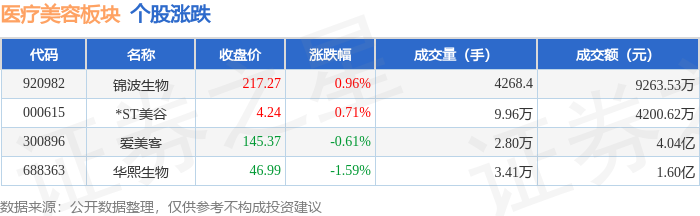
Core Insights - The medical beauty sector experienced a decline of 0.93% on November 28, with Huaxi Biological leading the drop [1] - The Shanghai Composite Index closed at 3888.6, up 0.34%, while the Shenzhen Component Index closed at 12984.08, up 0.85% [1] Sector Performance - The closing prices and performance of key stocks in the medical beauty sector are as follows: - Jinbo Biological: Closed at 217.27, up 0.96%, with a trading volume of 4268.4 hands and a transaction amount of 92.6353 million yuan [1] - *ST Meigu: Closed at 4.24, up 0.71%, with a trading volume of 99,600 hands and a transaction amount of 42.0062 million yuan [1] - Aimeike: Closed at 145.37, down 0.61%, with a trading volume of 28,000 hands and a transaction amount of 404 million yuan [1] - Huaxi Biological: Closed at 66.99, down 1.59%, with a trading volume of 34,100 hands and a transaction amount of 160 million yuan [1] Capital Flow - The medical beauty sector saw a net outflow of 40.1366 million yuan from main funds, while retail investors contributed a net inflow of 36.3282 million yuan [1] - Detailed capital flow for key stocks: - Jinbo Biological: Main funds net outflow of 3.9024 million yuan, retail net inflow of 389,400 yuan [2] - *ST Meigu: Main funds net outflow of 5.1476 million yuan, retail net inflow of 978,500 yuan [2] - Huaxi Biological: Main funds net outflow of 11.3095 million yuan, retail net inflow of 3.3006 million yuan [2] - Aimeike: Main funds net outflow of 23.6796 million yuan, retail net inflow of 32.0491 million yuan [2]
万元童颜针价格被打至4999元,医美巨头遭上游厂商拉黑
2 1 Shi Ji Jing Ji Bao Dao· 2025-11-28 06:31
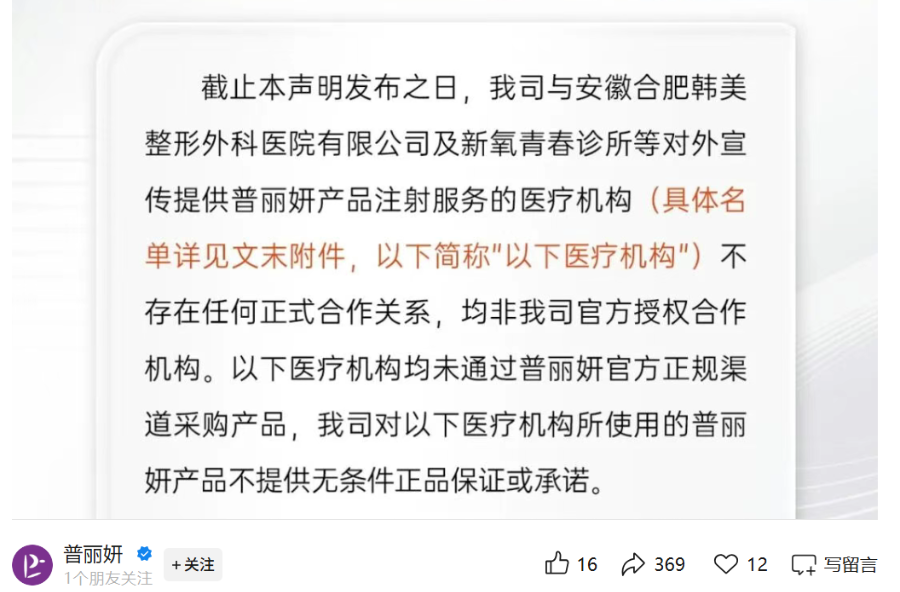
Core Viewpoint - The ongoing conflict between upstream manufacturers and downstream medical beauty institutions highlights issues of product authorization and market competition in the rapidly expanding medical beauty industry in China [2][5][12]. Group 1: Conflict Overview - Puli Yan accused several medical institutions, including Anhui Hefei Hanmei Plastic Surgery Hospital and Xinyang Youth Clinic, of being "unauthorized cooperation institutions," warning of potential health risks for consumers due to unverified product sourcing [1][2]. - Xinyang responded by asserting that all Puli Yan products used are sourced from legally qualified suppliers and emphasized compliance with ISO 37301 management standards [1][2]. Group 2: Market Dynamics - The medical beauty market, particularly the "童颜针" (youthful needle) segment, has seen rapid growth, with market size increasing from over 1 billion yuan in 2021 to an estimated 30 billion yuan last year, projected to reach 100 billion yuan in five years [5][6]. - Xinyang's introduction of lower-priced products, such as the "奇迹童颜" series, has disrupted the pricing structure established by upstream manufacturers, leading to tensions and demands for product removal from the market [5][6]. Group 3: Compliance and Regulation - Concerns have been raised regarding Xinyang's compliance with regulations, as some manufacturers claim that Xinyang has used products without proper authorization, potentially jeopardizing consumer safety [8][9]. - Legal experts emphasize that medical institutions must procure products from authorized sources to ensure traceability and compliance with regulations, highlighting the risks associated with unauthorized procurement [9][12]. Group 4: Industry Challenges - The medical beauty industry faces significant challenges, including the prevalence of unauthorized sales and counterfeit products, which threaten consumer safety and complicate regulatory enforcement [12][13]. - The need for a collaborative approach among manufacturers, medical institutions, and regulatory bodies is critical to establish a sustainable and compliant industry ecosystem [14].
普丽妍“拉黑”新氧 新氧反告“造谣”:谁在破坏医美规则?
2 1 Shi Ji Jing Ji Bao Dao· 2025-11-28 06:22
Core Viewpoint - The medical beauty industry is experiencing a tug-of-war between upstream manufacturers and terminal institutions regarding product authorization and pricing, highlighting the need for regulatory compliance and market order [1][2]. Group 1: Industry Dynamics - The conflict centers around product authorization and compliance channels, reflecting a struggle for pricing power between upstream manufacturers and terminal medical beauty institutions [2]. - The medical beauty market in China is expanding, with unauthorized sales of related products becoming increasingly common, indicating a shift from "wild growth" to "regulated development" in the industry [2]. Group 2: Pricing Strategies - The market for "童颜针" (youthful beauty injections) has seen rapid growth, with its market size exceeding 30 billion yuan last year and projected to reach 100 billion yuan in five years [4]. - New Oxygen's introduction of low-priced "童颜针" projects has disrupted the pricing structure of upstream manufacturers, with prices significantly lower than official guidance [5]. - New Oxygen's pricing strategy aims to make medical beauty services more affordable, addressing the issue of consumers turning to unregulated "black medical beauty" services due to high prices [6]. Group 3: Compliance and Regulation - Concerns have been raised regarding New Oxygen's compliance, as it has been accused of using products without proper authorization, which could jeopardize consumer safety [7][8]. - Legal experts emphasize that medical institutions must procure medical devices from authorized sources to ensure traceability and compliance with regulations [8]. - The ongoing issues of counterfeit products and unauthorized sales highlight the urgent need for effective governance in the medical beauty industry [10][11]. Group 4: Consumer Protection - Consumers are advised to verify product authenticity through official channels and request proper documentation from medical institutions to safeguard their rights [12]. - The responsibility for ensuring compliance should not solely rest on consumers; a collaborative effort among manufacturers, institutions, and regulatory bodies is essential for sustainable development in the medical beauty sector [13].
万元童颜针价格被打至4999元,医美巨头遭上游厂商拉黑
21世纪经济报道· 2025-11-28 06:18
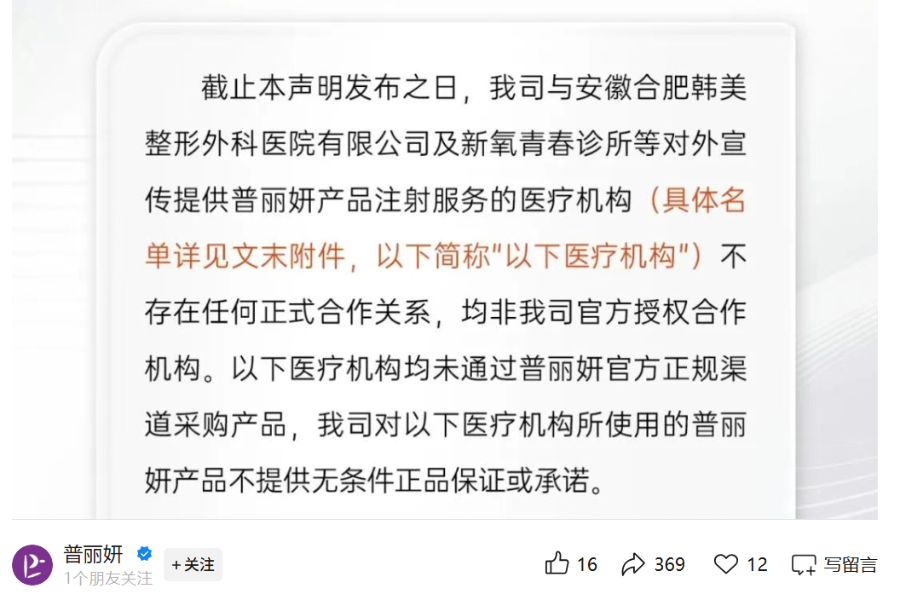
Core Viewpoint - The ongoing conflict between upstream manufacturers and downstream medical beauty institutions highlights the challenges in product authorization and market pricing within the medical aesthetics industry, indicating a shift from "wild growth" to "regulated development" in China’s medical beauty market [4][5]. Group 1: Industry Dynamics - The medical beauty industry is experiencing a tug-of-war over product pricing and authorization, with companies like Purity and New Oxygen at the forefront of this conflict [4][5]. - New Oxygen's low pricing strategies for products like "Miracle Youth 3.0" have disrupted traditional pricing structures, leading to tensions with upstream manufacturers [8][9]. - The market for youth-enhancing products, such as the "童颜针" (youth needle), has seen rapid growth, with estimates suggesting it will reach a scale of 100 billion in five years, up from over 30 billion last year [7]. Group 2: Compliance and Regulation - There are significant compliance concerns regarding the sourcing of medical products, with allegations that New Oxygen has used products without proper authorization, raising questions about product safety and traceability [11][12]. - Legal experts emphasize the importance of purchasing medical devices from authorized sources to ensure compliance with regulations, highlighting the potential penalties for non-compliance [12]. - The medical beauty industry faces challenges with counterfeit products and unauthorized sales, necessitating stronger regulatory measures and consumer awareness [15][16]. Group 3: Consumer Safety and Market Integrity - The prevalence of unauthorized medical beauty institutions and counterfeit products poses a significant risk to consumer safety, with only 35% of products in circulation being genuine [9][15]. - Industry leaders argue that lowering prices for legitimate medical beauty services is essential to combat the prevalence of "black medical beauty" practices, which thrive on high prices in the legitimate market [9][10]. - There is a call for a collaborative approach among manufacturers, medical institutions, and regulatory bodies to ensure consumer rights and product quality are prioritized in the evolving medical beauty landscape [17].

11月27日深港通医疗(983035)指数涨0.15%,成份股医脉通(02192)领涨
Sou Hu Cai Jing· 2025-11-27 11:10
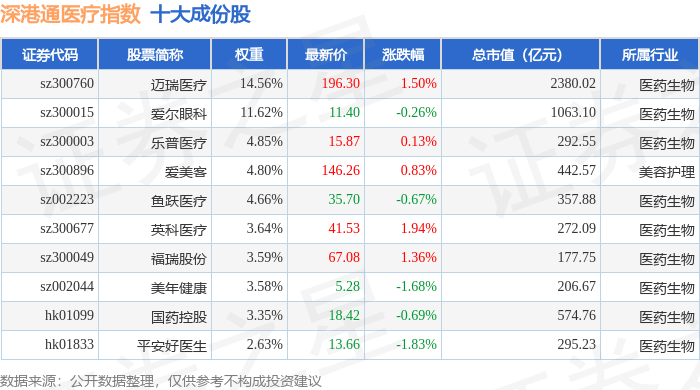
Core Points - The Shenzhen-Hong Kong Medical Index (983035) closed at 4494.42 points, up 0.15%, with a trading volume of 7.52 billion yuan and a turnover rate of 0.75% [1] - Among the index constituents, 32 stocks rose while 24 fell, with Medical Pulse leading the gainers at 3.65% and Health Road leading the decliners at 3.41% [1] Index Constituents Summary - The top ten constituents of the Shenzhen-Hong Kong Medical Index include: - Mindray Medical (14.56% weight, latest price 196.30 yuan, market cap 238 billion yuan, up 1.50%) [1] - Yier Eye Hospital (11.62% weight, latest price 11.40 yuan, market cap 106.31 billion yuan, down 0.26%) [1] - Lejin Medical (4.85% weight, latest price 15.87 yuan, market cap 29.26 billion yuan, up 0.13%) [1] - Aimeike (4.80% weight, latest price 146.26 yuan, market cap 44.26 billion yuan, up 0.83%) [1] - Yuyue Medical (4.66% weight, latest price 35.70 yuan, market cap 35.79 billion yuan, down 0.67%) [1] - Yingke Medical (3.64% weight, latest price 41.53 yuan, market cap 27.21 billion yuan, up 1.94%) [1] - Furuide (3.59% weight, latest price 67.08 yuan, market cap 17.78 billion yuan, up 1.36%) [1] - Meinian Health (3.58% weight, latest price 5.28 yuan, market cap 20.67 billion yuan, down 1.68%) [1] - Sinopharm (3.35% weight, latest price 18.42 yuan, market cap 57.48 billion yuan, down 0.69%) [1] - Ping An Good Doctor (2.63% weight, latest price 13.66 yuan, market cap 29.52 billion yuan, down 1.83%) [1] Capital Flow Analysis - The net outflow of main funds from the index constituents totaled 58.83 million yuan, while retail investors saw a net inflow of 78.07 million yuan [1] - Specific stock capital flows include: - Aimeike: Main fund net inflow of 46.99 million yuan, retail net outflow of 30.07 million yuan [2] - Mindray Medical: Main fund net inflow of 33.08 million yuan, retail net outflow of 17.11 million yuan [2] - Furuide: Main fund net inflow of 13.68 million yuan, retail net outflow of 19.08 million yuan [2] Recent Adjustments - The Shenzhen-Hong Kong Medical Index has undergone adjustments in the last 10 days, with one new stock added [2]