米哈游

Search documents
米哈游投资的独角兽拟上市:4年研发烧掉35亿,员工平均95后
创业邦· 2025-12-22 03:11
Core Viewpoint - MiniMax, a rapidly growing AI technology company in China, is preparing for an IPO on the Hong Kong Stock Exchange, showcasing significant revenue growth and a strong product matrix in AI applications [2][4]. Group 1: Company Overview - MiniMax was established on June 30, 2021, and has quickly become one of the fastest-growing AI companies in China, focusing on a full-modal AI product matrix that serves both B-end and C-end users [2]. - The company has received investments from major players like Tencent, miHoYo, Alibaba, and Sequoia, indicating strong market confidence [4]. Group 2: Team Composition - The R&D team consists of approximately 385 members, with nearly 74% dedicated to research, divided into specialized groups focusing on text, vision, audio, AI infrastructure, and product development [8]. - The average age of the R&D team is under 30, with key executives also being relatively young, including the CEO at 36 and the COO at 31 [10]. Group 3: Revenue Growth - MiniMax's revenue skyrocketed from $346,000 in 2023 to $30.52 million in 2024, marking a staggering year-on-year growth of 782.2% [12]. - By the first nine months of 2025, revenue further increased to $53.44 million, reflecting a year-on-year growth of over 174% [12][20]. Group 4: Product Performance - The AI-native product revenue reached over $38 million in the first nine months of 2025, accounting for 71.1% of total revenue, a significant increase from approximately $76,000 in 2023 [14]. - Core products like Talkie and Hailuo AI have contributed significantly to user engagement, with Talkie achieving an average monthly active user count of over 20 million [15][17]. Group 5: Financial Metrics - Despite the revenue growth, MiniMax reported an adjusted net loss of $186.28 million in the first nine months of 2025, although this represents a significant improvement from previous years [20]. - The company's gross margin improved from -24.7% in 2023 to 23.3% in the first nine months of 2025, attributed to enhanced efficiency in model inference [19]. Group 6: R&D Investment - MiniMax has invested approximately $138 million in R&D in the same period, with total R&D spending since inception reaching around $500 million [20][22]. - The company aims to leverage China's talent advantage to achieve significant breakthroughs in AI technology, focusing on multi-modal integration [22]. Group 7: Strategic Partnerships - MiniMax has established a strategic relationship with miHoYo, which is both an investor and a client, indicating a strong alignment in the gaming and AI sectors [26][27]. - The collaboration aims to enhance AI capabilities in gaming, particularly in creating intelligent NPC dialogues and emotional interactions [27].

超越娱乐:游戏产业的社会价值新探索
2 1 Shi Ji Jing Ji Bao Dao· 2025-12-22 03:09
Core Insights - The Chinese gaming industry is undergoing a significant value shift, moving towards a "game+" model that integrates quality content, advanced technology, and social responsibility [1] - The industry is exploring ways to expand its social, economic, and cultural value through deeper integration with real-world sectors such as urban tourism, economic consumption, and education [1] Group 1: Game and Social Responsibility - Game content combined with public welfare themes can subtly shape public awareness and values [2] - Ku Luo's collaboration with the China Green Foundation exemplifies how game IP can enhance public recognition of environmental issues through character-driven campaigns [2] - The gaming experience should extend beyond screens to create stronger connections with players' lives, enhancing their sense of presence and immersion [2] Group 2: Bridging Digital and Real Worlds - The gaming industry has the potential to bridge the digital divide and empower society through technology [3] - Century Huatong's "Going Far" project provides digital education to children in rural areas, demonstrating the impact of gaming on real-world educational opportunities [3] - Games can serve as cultural carriers, allowing individuals to express themselves and share their perspectives with the world [3][4] Group 3: Value Extension and Cultural Integration - The gaming industry is evolving to create a cultural ecosystem that extends beyond traditional gaming products [6] - Research indicates that tabletop games can effectively address mental health issues, particularly for youth and special groups [6] - The integration of intangible cultural heritage elements into popular games enhances cultural depth and broadens audience engagement [7] Group 4: IP and Urban Integration - High-quality digital IP is becoming a new type of urban infrastructure, driving cultural and economic activity while injecting innovation into public spaces [8] - Collaborations between gaming companies and urban initiatives can transform IP from a commercial tool into a part of the urban narrative, enhancing community engagement [8]
从扩内需犒赏经济到AI赋能应用 传媒如何看?
2025-12-22 01:45
Summary of Conference Call Industry Overview - The discussion primarily revolves around the media industry, focusing on the cinema sector and the impact of AI on various applications within the industry [1][8]. Key Points on Cinema Sector - **Expansion of Domestic Demand**: The government has emphasized the importance of expanding domestic demand as a strategic initiative, with the media sector being a significant component of this strategy [1][4]. - **Cinema Box Office Performance**: The box office for the year is projected to reach approximately 46 billion, reflecting a year-on-year growth of around 20% [4]. - **Upcoming Film Releases**: Anticipation for the upcoming Chinese New Year film season is high, with several domestic films scheduled for release, which could drive box office performance [2][4]. - **Key Players in Cinema**: The leading cinema chains identified for investment include Wanda Film, Hengdian Film, and Shanghai Film, with Wanda Film being highlighted for its proactive capital investments and strategic initiatives [3][4][6]. Financial Projections - **Market Potential**: The total number of cinema screens in China is expected to reach 100,000 by the end of 2024, with a potential market size of 80 billion based on current screen counts [5][6]. - **IP and Derivative Markets**: The market for IP derivatives is projected to grow from 1.742 trillion in 2024 to over 3.3 trillion by 2029, indicating significant growth potential in this sector [5][6]. AI Sector Insights - **AI Applications in Media**: The AI sector is experiencing rapid growth, with significant advancements showcased at recent conferences, including new models for content creation and digital marketing [8][9]. - **Company Performance**: Zhiyu's financials indicate a revenue growth of 130% from 2022 to 2024, with a projected revenue of over 300 million by 2024 [9][10]. - **Investment Opportunities**: Companies like Huace Film and BlueFocus are highlighted as key players benefiting from AI advancements, particularly in digital marketing and content production [12][13]. Market Trends and Future Outlook - **Long-term AI Growth**: The AI sector is expected to drive significant changes in the media landscape over the next decade, with both foundational infrastructure and application development being critical areas of focus [14][15]. - **Investment Recommendations**: Investors are encouraged to monitor companies involved in cinema, IP development, and AI applications, particularly those that are leveraging new technologies to enhance their offerings [16][18]. Additional Considerations - **Risks and Challenges**: The potential risks associated with companies like ByteDance and their international operations are noted, but the overall sentiment remains optimistic regarding the growth of the media and AI sectors [17][18]. This summary encapsulates the key insights and projections discussed during the conference call, providing a comprehensive overview of the current state and future potential of the media and AI industries.
早报|MiniMax已通过港交所聆讯;山西宣布废止全省烟花爆竹禁令;官方通报独居女子离世遗产处置进展;乐乐茶致歉
虎嗅APP· 2025-12-22 00:11
Group 1 - OpenAI has improved its "Compute Margin" to 70% as of October 2023, indicating a significant increase in profitability after deducting costs for running models for paid users [5] - This margin is expected to decrease to 52% by the end of 2024, suggesting a potential decline in profitability in the coming year [6] - OpenAI's Compute Margin is higher than that of its competitor Anthropic, although Anthropic is noted to have better efficiency in overall server spending [7] Group 2 - MiniMax, a general artificial intelligence company, is set to become the fastest AI company to go public, with over 2.12 million users across more than 200 countries and regions, and a revenue growth of over 170% year-on-year for the first nine months of 2025 [9] - The company has received investments from top institutions including MiHoYo, Alibaba, Tencent, and Sequoia, positioning it as one of the fastest-growing and highest-valued AI tech companies [9] Group 3 - Xiaomi's president, Lu Weibing, announced that the price of the Xiaomi 17 Ultra will increase due to rising costs of core components, including processors, cameras, and memory [28] - The cost of the Leica APO certified telephoto lens for the new model is reported to be twice that of the previous generation, making the price hike unavoidable under current cost pressures [30] Group 4 - He Xiaopeng, chairman of XPeng Motors, stated that AI technology is transitioning from the digital world to the physical world, predicting that robots, autonomous vehicles, and low-flying drones will become standard in the lives of young people over the next decade [31]

人均29岁的AI公司要IPO了,用户超2亿,米哈游阿里腾讯小红书持股
3 6 Ke· 2025-12-21 23:49
Core Viewpoint - MiniMax, a leading AI model company in China, is set to become the first AI company to go public in Hong Kong, aiming to break records for the shortest time from establishment to IPO [1][4]. Company Overview - MiniMax was founded in early 2022 and focuses on developing general artificial intelligence (AGI) with a strong emphasis on multimodal model research [3]. - The company has a young team of 385 employees with an average age of 29, showcasing high efficiency in operations [25]. - MiniMax has developed a product matrix that includes AI-native products like Hailuo AI, Talkie, and others, serving over 2.12 million users across more than 200 countries [3][19]. Financial Performance - As of September 30, 2025, MiniMax reported a revenue growth of over 170% year-on-year, with international revenue contributing over 70% [3][18]. - The company has incurred approximately $500 million (about 3.5 billion RMB) in expenses since its inception, which is less than 1% of OpenAI's expenditures [13][16]. - Revenue figures for 2023, 2024, and the first nine months of 2025 were $3.46 million, $30.52 million, and $53.44 million, respectively [10][22]. Product and Market Strategy - MiniMax's product offerings include a range of AI-native applications and an open platform for developers, with a focus on monetization strategies that include subscription services and in-app purchases [18][20]. - The company has a diversified revenue model, with AI-native products contributing over 71% of total revenue in 2024 and 2025 [20][22]. Research and Development - MiniMax has a strong focus on R&D, with significant investments in developing advanced models, including the MiniMax M2, Hailuo-02, and Speech-02, which support various applications across text, video, and audio [8][39]. - The company employs a high percentage of R&D personnel, with nearly 74% of its workforce dedicated to research and development [25][26]. Competitive Position - MiniMax is recognized as one of the top four pure-play large model technology companies globally, emphasizing its competitive edge in the AGI market [32]. - The company has achieved significant milestones in model development, including the release of the first Chinese open-source large model that ranks among the top five globally [39]. Future Outlook - MiniMax anticipates continued growth in sales costs and R&D expenses as it enhances its foundational AI model capabilities [17]. - The company has a robust cash reserve of over $1.1 billion, sufficient to support operations for more than 50 months [17].
火线解析MiniMax招股书,全球领先大模型成本只有OpenAI 1%,果然拳怕少壮
3 6 Ke· 2025-12-21 23:31
Core Viewpoint - MiniMax, a leading AI model unicorn, has officially passed the Hong Kong Stock Exchange hearing, signaling its IPO ambitions amidst discussions of a bubble in the AI sector, particularly concerning OpenAI and other major players [1][3]. Group 1: Company Overview - MiniMax has raised over $1.5 billion in funding within four years, attracting investments from notable firms such as MiHoYo, Alibaba, Tencent, and others [3][26]. - The company aims to develop a global general artificial intelligence (AGI) and has a presence in over 200 countries, with 70% of its revenue coming from international markets [3][29]. - MiniMax's total expenditure has been approximately $500 million, significantly less than competitors like OpenAI, which has spent between $40 billion to $55 billion [29][30]. Group 2: Technological Advancements - MiniMax is one of the few companies that have focused on multimodal model development since its inception [4]. - The company has released several models, including the M1 and M2 text models, achieving top rankings in performance metrics [8][9]. - MiniMax's speech model, Speech 01, and its subsequent versions have been recognized for their comprehensive capabilities, supporting over 40 languages and generating over 2.2 billion hours of speech [11][12]. - The video model Hailuo has also achieved high rankings in independent tests, demonstrating its advanced capabilities in video generation [13]. Group 3: Business Model and Financial Performance - MiniMax employs a "model-as-product" strategy, focusing on subscription services and cloud API sales, which contribute to a sustainable revenue model [15][18]. - The company reported revenues of $3.46 million in 2023, projected to soar to $30.52 million in 2024, marking a year-on-year increase of 782.2% [17]. - By the first nine months of 2025, MiniMax's revenue reached $53.44 million, reflecting a 175% increase compared to the previous year [17]. - The gross margin improved from -24.7% in 2023 to 23.3% in the first nine months of 2025, indicating enhanced profitability [19][20]. Group 4: Research and Development Efficiency - MiniMax's R&D expenses have increased significantly, with cloud computing costs for training rising from $4.15 million in 2022 to $142.4 million in the first nine months of 2025 [22][23]. - Despite ongoing losses, the adjusted net loss has been decreasing relative to revenue growth, suggesting a successful business model [24]. - The company has a cash reserve of $1.102 billion, sufficient to sustain operations for over 53 months without additional funding [24]. Group 5: Team Composition and Culture - Founded in 2022, MiniMax has a young team with an average age of 29, and 73.8% of its 385 employees are in R&D roles [25][28]. - The leadership team includes experienced individuals from SenseTime, contributing to the company's strong technical foundation and operational efficiency [26][27]. - The organizational structure is highly flat, promoting rapid decision-making and efficiency, with over 80% of the code being generated by AI [28][29].
“游戏+”跨界融合打开产业新空间
Zhong Guo Zheng Quan Bao· 2025-12-21 20:12
Core Insights - The gaming industry is evolving from being primarily an entertainment product to a flexible tool that drives digital transformation in traditional sectors such as healthcare, education, and manufacturing, creating new growth opportunities [1][2] Group 1: Technological Integration - The evolution of game engines is crucial as they transition from tools for game development to universal platforms supporting digital transformation across various industries [1] - Unity has expanded its engine capabilities to serve industries like automotive and smart cities, enhancing traditional sectors' R&D and operational efficiency while also creating new opportunities for game developers [1][2] Group 2: AI Integration - AI has transformed from a cost-reduction tool to a creative engine for game experiences, influencing the entire game lifecycle from planning to operation [2] - The integration of AI in gaming is leading to applications in education and healthcare, promoting a new model of "technological equity and enhanced experiences" [2] Group 3: Application in Healthcare - Games are being utilized in healthcare to address psychological and cognitive issues, showing effectiveness in alleviating anxiety and improving attention [2] - Approximately ten gamified digital therapy products have been approved globally for treating conditions like ADHD and depression [2] Group 4: Cultural and Social Impact - The design thinking and immersive experiences from gaming are being applied in non-entertainment fields, providing innovative solutions to social issues [3] - Tencent's "Cognitive Training" product has been clinically tested and is now being prescribed in hospitals, marking a significant step for gamified digital therapy in mainstream healthcare [3] Group 5: Cultural Consumption and Ecosystem Building - Successful game IPs are evolving into ecological nodes that deeply connect with urban spaces, the real economy, and cultural life [4] - High-quality digital IPs are becoming new types of "urban infrastructure," enhancing public services and injecting innovation into cities [4] Group 6: Long-term Cultural Value - Companies are focusing on long-term strategies to deepen cultural narratives within historical-themed IPs, creating a competitive edge through meticulous cultural research [4][5] - The integration of gaming IPs into physical spaces and cultural values reflects a shift from superficial interactions to deep integration, offering imaginative possibilities for industry and societal development [5]
MiniMax冲刺IPO:收入增长近8倍、年亏损32亿,如何突围大厂围剿?
Di Yi Cai Jing Zi Xun· 2025-12-21 20:01
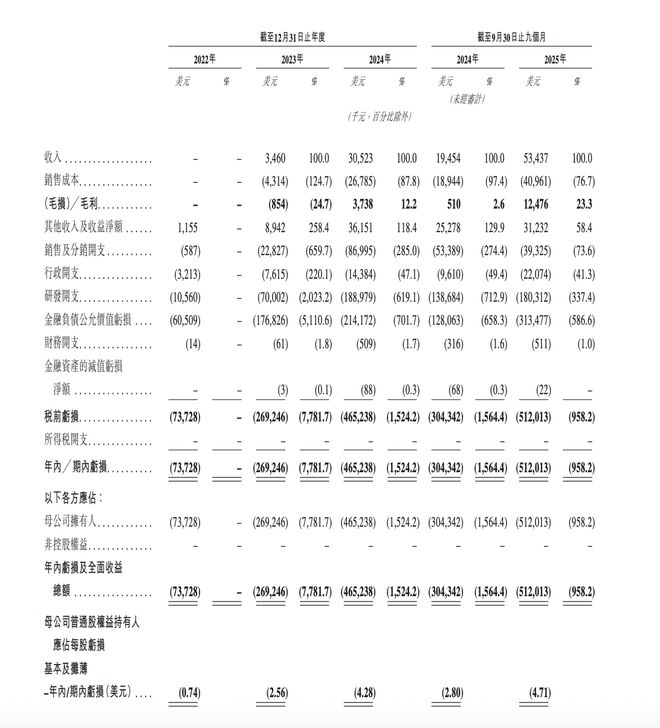
Core Insights - MiniMax is set to become the fastest AI company to go public from inception, following its IPO application on December 21, 2023 [1] - The company anticipates a revenue growth of 782% in 2024, reaching $30.5 million, while projecting a net loss of $465 million [1][5] - The competitive landscape for AI companies is intensifying, with MiniMax and its peers facing significant financial pressures due to high operational costs and ongoing investments in technology [3][11] Financial Performance - MiniMax's revenue for 2023 was $3.5 million, with a projected increase to $30.5 million in 2024, and $53.4 million by the end of 2025 [5][6] - The company reported a net loss of $73.7 million in 2022, escalating to $269.2 million in 2023, and expected to reach $465.2 million in 2024 [7][8] - Cumulative losses over four years are estimated at approximately $1.32 billion [7] Revenue Sources - MiniMax's primary revenue streams include subscription services, token-based in-app purchases, online marketing services, and usage-based enterprise API services [5][6] - The Talkie product is expected to contribute nearly 64% of revenue in 2024, with other AI services also playing significant roles [7] Investment and Cash Flow - The company has raised approximately $390 million in its latest funding round, achieving a valuation of over $4.2 billion [9] - Monthly cash burn is projected to be around $280 million, with cash reserves of $1.05 billion as of September 30, 2025 [9] Market Outlook - The global AI market is projected to exceed $300 billion by 2030, with significant contributions to global GDP growth [11] - MiniMax aims to differentiate itself by focusing on specific niches rather than competing directly with larger firms like Alibaba and Tencent [11][12]
火线解析MiniMax招股书!全球领先大模型成本只有OpenAI 1%,果然拳怕少壮
Sou Hu Cai Jing· 2025-12-21 18:29
Core Insights - MiniMax, a Shanghai-based AI unicorn, has officially passed the Hong Kong Stock Exchange hearing, signaling its IPO ambitions amidst discussions of a bubble in the AI sector [1][3] - The company has raised over $1.5 billion in funding from notable investors like MiHoYo, Alibaba, Tencent, and others, with a total expenditure of only $500 million, less than 1% of what OpenAI has spent [3][43] Company Overview - MiniMax positions itself as a global artificial general intelligence (AGI) technology company, with services covering over 200 countries and regions, and 70% of its revenue coming from international markets [3] - The company emphasizes scalability as a core driver towards achieving AGI, focusing on multi-modal capabilities [3] Technological Achievements - MiniMax has been a pioneer in developing multi-modal models since its inception, with significant advancements in text, voice, music, and video models [4][12][13][14] - The MiniMax M2 text model achieved a top-five global ranking and is the most popular Chinese model on the OpenRouter platform [11] - The company has also launched the first domestic Transformer-based speech model, Speech 01, and has iterated to version 2.6, supporting over 40 languages [12] Financial Performance - MiniMax began commercializing in 2023, achieving revenues of $3.46 million, which skyrocketed to $30.52 million in 2024, marking a 782.2% year-on-year increase [20] - By the first nine months of 2025, revenue reached $53.44 million, with a 175% increase compared to the previous year [21] - The company's gross margin improved from -24.7% in 2023 to 23.3% in the first nine months of 2025, indicating a strengthening core profitability [22] Cost Management - MiniMax's spending on cloud computing services for training has increased significantly, but the efficiency of these expenditures has improved, with the ratio of training costs to revenue decreasing from over 1365% in 2023 to 266.5% in the first nine months of 2025 [26] - The company maintains a strong cash reserve of $1.102 billion, sufficient to support operations for over 53 months without additional fundraising [29] Team and Leadership - Founded in 2022, MiniMax has a young and dynamic team, with an average employee age of 29 and 73.8% of its workforce in R&D [32][40] - The leadership team includes experienced individuals from SenseTime, contributing to the company's efficient execution and strategic direction [36][38] Conclusion - MiniMax's rapid growth, innovative technology, and strong financial backing position it as a formidable player in the AI landscape, with a focus on achieving AGI through scalable, multi-modal solutions [3][43]
火线解析MiniMax招股书!全球领先大模型成本只有OpenAI 1%,果然拳怕少壮
量子位· 2025-12-21 15:10
Core Viewpoint - MiniMax, a leading AI model unicorn, has successfully passed the Hong Kong Stock Exchange hearing, signaling its IPO ambitions amidst discussions about the bubble in large AI models like OpenAI [1][3]. Group 1: Company Overview - MiniMax has raised over $1.5 billion in funding within four years, attracting investments from notable firms such as MiHoYo, Alibaba, Tencent, and others [3][62]. - The company has a global presence, serving over 200 countries, with 70% of its revenue coming from international markets [6][42]. - MiniMax aims to achieve Artificial General Intelligence (AGI) and views scalability as a core driver towards this goal [8][7]. Group 2: Technological Advancements - MiniMax is one of the few companies that invested in multimodal model development from its inception [10]. - The company has released several models, including the M1 and M2 text models, with M2 achieving top rankings in performance and cost efficiency [16][17]. - MiniMax has also developed leading models in voice, music, and video, with its video model Hailuo ranking in the top tier of international tests [20][25][26]. Group 3: Financial Performance - MiniMax's revenue surged from $346,000 in 2023 to $30.52 million in 2024, marking a 782.2% increase [39]. - By the first nine months of 2025, revenue reached $53.44 million, significantly surpassing the previous year's total [40]. - The company has achieved a gross margin improvement from -24.7% in 2023 to 23.3% in the first nine months of 2025 [45][46]. Group 4: Operational Efficiency - MiniMax's R&D expenses have increased significantly, but the efficiency of these investments has improved, with training-related cloud computing costs as a percentage of revenue decreasing from over 1365% in 2023 to 266.5% in 2025 [52][54]. - The company has a cash reserve of $1.102 billion, sufficient to sustain operations for over 53 months without additional fundraising [58][59]. - MiniMax's team is young, with an average age of 29, and a high proportion of R&D personnel, which contributes to its innovative and efficient operational model [70][71].