妙可蓝多

Search documents
中信建投:食饮板块处市场预期低位 重点看好四大板块
智通财经网· 2025-11-17 02:10
Group 1: Core Insights - The food and beverage sector is experiencing a long-term correction, with low domestic demand and significantly reduced valuations, creating a clear bottom logic for quality assets like liquor [1][2] - The report highlights four key sectors: liquor, snacks and health products, dairy, and restaurant chains, with a focus on potential recovery in demand and investment opportunities [1] Group 2: Liquor Sector - The liquor market is facing weak demand, with consumer confidence remaining low and a negative year-on-year CPI for liquor products, leading to price declines in mainstream products [2] - High-end and mid-high-end liquor are performing relatively well, while the industry is entering a competitive era with significant internal differentiation among listed companies [2] - Companies are focusing on market order control, product iteration, and consumer engagement to improve market share, although profit margin growth is slowing [1][2] Group 3: Restaurant Chains - The overall restaurant market remains weak, but companies are showing signs of improvement due to strategic adjustments over the past two years [3] - The shift from price competition to quality-price ratio competition is expected to optimize the competitive environment [3] - Companies are embracing new retail channels and enhancing supply chain efficiency, with international expansion becoming a key growth direction [3] Group 4: Snacks - The trend towards healthier and low-calorie snacks is driving sales, particularly in the konjac product category, with brands like Salted Fish and Yanjin achieving strong sales [4] - The transformation of bulk snack retail formats and the growth of discount stores are contributing to market opportunities [4] - The sector is expected to benefit from channel growth and new product launches in 2026, with recommendations for specific brands [4] Group 5: Beverages - The beverage sector is witnessing a trend towards health and functionality, with high demand in specific subcategories [5][6] - Companies like Dongpeng Beverage are expanding nationally, with strong growth prospects and new product lines [6] Group 6: Health Products - The health product sector is being driven by new consumer trends, with brands that embrace new consumption patterns expected to benefit significantly [7] - Companies like Xianle Health are well-positioned to capitalize on high-demand channels and new product categories [7] Group 7: Dairy Products - The dairy market is expected to enter an upward price cycle, with raw milk prices stabilizing and deep processing capacity increasing [8] - Major dairy companies are improving their market share and profitability through strategic initiatives and government support [8] Group 8: Beer - The beer industry is facing rising raw material costs, which may lead to adjustments in product pricing and promotional strategies [9] - Companies like Yanjing Beer and Qingdao Beer are highlighted for their growth potential and strong dividend attributes [9]

从三季报看中国经济:新消费潜力迸发
Jing Ji Ri Bao· 2025-11-17 00:03
Core Viewpoint - The third-quarter reports of listed companies reflect the resilience and vitality of China's consumer market, indicating a structural adjustment period in the consumption sector with both challenges and opportunities [1] Overall Recovery - The consumer sector shows a steady recovery overall, but there is uneven performance across different segments. Essential consumption remains stable, while discretionary consumption is experiencing a divide [2] - Essential consumption sectors like food and beverages are performing well due to their necessity, with leading companies showing stable revenue and profit growth [2] - The liquor industry, representing traditional high-end consumption, is under pressure, with major companies like Wuliangye and Luzhou Laojiao reporting significant declines in revenue and profit [2] - In contrast, the new energy vehicle industry is thriving, benefiting from policy support and product upgrades, becoming a key growth driver in the consumer sector [2] Channel Transformation - Traditional retail companies are accelerating their online transformation, integrating online and offline channels to capture market changes, with those embracing digitalization seeing growth [3] Cost Pressures - Global commodity prices remain high, putting pressure on raw material and logistics costs, which challenges the gross margins of mid-to-low-end consumer companies [4] - Companies that optimize product structures and improve supply chain efficiency are demonstrating stronger profitability and market competitiveness [4] Structural Highlights - A number of structural highlights are emerging, driving high-quality development in consumer-related listed companies through innovation in technology, business models, and consumer scenarios [5] - In the smart home sector, companies like Ecovacs and Haier are experiencing significant profit growth, with Ecovacs reporting a 131% increase in net profit [5] - The traditional consumption sector is exploring new business models, with companies like Kweichow Moutai and Mercury Home Textiles achieving double-digit growth through innovative product offerings [6] New Consumption Scenarios - Companies are actively transforming to capture new consumption trends, with firms like Golden Dragon Fish and Miaokelando reporting substantial profit increases due to cost improvements and channel optimization [8] - The consumer market is becoming increasingly segmented, with new brands focusing on specific demographics and scenarios, such as new-style tea drinks and pet economy products [8] - Domestic brands are gaining market share and showing strong performance in sectors like sportswear and beauty products, driven by cultural confidence and supply chain advantages [8] Market Dynamics - The consumer market is undergoing structural upgrades, with recovery being uneven due to factors like income expectations and regional disparities [9] - Companies with strong brand barriers and unique market advantages are favored by capital, while those embracing new trends and product iterations can still find growth opportunities [9] - The competition is shifting from traditional versus new consumption to the operational efficiency and strategic vision of different companies within the same industry [9] High-Quality Development - The recovery trend in China's consumer market is moving from total growth to structural optimization, with companies encouraged to focus on high-quality development through innovation [10]





新消费潜力迸发
Jing Ji Ri Bao· 2025-11-16 21:52
Core Insights - The third-quarter reports of listed companies reflect the resilience and vitality of China's consumer market, indicating a structural adjustment period with both challenges and opportunities [1] Overall Recovery - The consumer sector shows a steady recovery overall, but there is uneven performance across different segments. Essential consumption remains stable, while discretionary consumption is experiencing a divide [2] - Essential consumption sectors like food and beverages are performing well due to their necessity, with leading companies showing stable revenue and profit growth. For instance, Wuliangye reported a 52.66% year-on-year decline in Q3 revenue to 8.174 billion yuan, and a 65.62% drop in net profit to 2.019 billion yuan [2] - In contrast, the new energy vehicle industry is thriving, benefiting from policy support and product upgrades, becoming a key growth driver in the consumer sector [2] Channel Transformation - Traditional retail companies are accelerating their online transformation, integrating online and offline channels. Companies that embrace digitalization are capturing the benefits of this channel transformation [3] Cost Pressures - Global commodity prices remain high, putting pressure on raw material and logistics costs, which challenges the gross margins of mid-to-low-end consumer companies. Companies that optimize product structures and improve supply chain efficiency are showing stronger profitability [4] Structural Highlights - A number of structural highlights are emerging, driving high-quality development in consumer-related listed companies through innovation in technology, business models, and consumer scenarios [5] - In the smart home sector, companies like Ecovacs and Haier are experiencing significant profit growth, with Ecovacs reporting a 131% year-on-year increase in net profit [5] Innovation in Business Models - Traditional consumption sectors are exploring new business models, with companies like Kweichow Moutai and Water Mercury Home Textiles achieving double-digit growth through innovative product offerings and marketing strategies [6] New Consumption Scenarios - Companies are actively transforming to capture new consumption trends, with firms like Golden Dragon Fish and Miaokelando reporting significant profit increases due to cost improvements and channel optimization [8] - The rise of domestic brands is notable, with many achieving excellent performance in revenue growth and market share, particularly in sectors like sportswear and beauty products [8] Market Dynamics - The consumer market is undergoing structural upgrades, with disparities in recovery driven by factors such as income expectations and consumer confidence. Companies with strong brand barriers and unique market advantages are favored by capital [9] - The competition is intensifying among quality sectors, with a focus on operational efficiency and strategic vision. Companies that adapt to new trends and innovate their product offerings are likely to find growth opportunities [10]
食品饮料月月谈电话会
2025-11-16 15:36
Summary of Conference Call on Dairy and Beverage Industry Industry Overview - The dairy industry is experiencing a continuous capacity reduction, with expectations for supply-demand balance improvement by mid to late 2026, leading to potential stabilization in milk prices. As of October, milk prices remained stable at 2.94 yuan per kilogram, with a production loss of approximately 0.2 yuan per kilogram and a loss rate of about 5% [2][2][2]. Key Points on Dairy Companies New Dairy Industry - New Dairy reported a strong performance in October, continuing the trend from Q3, with double-digit growth in low-temperature fresh milk and yogurt. The company is expanding into new channels, achieving significant revenue from collaborations, and is expected to meet its profit margin targets ahead of schedule by 2026 [4][4][4]. Mengniu Dairy - Mengniu's Q3 results met expectations, with stable market share following price reductions on its flagship product. The company anticipates stable revenue and profit margin growth through 2026, with a relatively low valuation providing investment flexibility [5][5][5]. Yili Group - Despite weak overall demand, Yili's low-temperature milk and other segments showed positive growth, with low-temperature white milk exceeding 20% growth. The company is expected to stabilize its liquid milk business by 2026, benefiting from diversified product offerings and channels [6][7][6][7]. Miao Ke Lan Duo and Youran Dairy - Miao Ke Lan Duo is experiencing rapid growth in the B-end market, with significant C-end product launches. The company is expanding its deep processing of dairy products, which is expected to improve profitability. Youran Dairy is increasing fresh milk supply with stable prices, supporting profits, and is projected to enhance profitability further with a reduction in livestock numbers [8][8][8]. Beverage Industry Insights Master Kong - Master Kong's beverage business saw a slight decline in Q3, but the drop has narrowed in October. The company expects to stabilize its beverage business next year, with a focus on promotional activities and potential price adjustments for its one-liter products [9][10][9][10]. Nongfu Spring - Nongfu Spring's water business experienced double-digit growth in October, with its sugar-free tea brand capturing nearly 80% market share. The company is expected to maintain steady revenue and profit growth, making it a strong long-term investment choice [10][10][10]. Dongpeng Beverage - Dongpeng Beverage reported a nearly 30% growth rate, with ambitious annual targets. The company shows significant growth potential from a valuation perspective [10][10][10]. Investment Recommendations - The dairy sector is recommended for investment due to expected improvements in profitability and market conditions by 2026. Companies like Mengniu, Yili, and New Dairy are highlighted for their growth potential and stable valuations [5][7][4][4]. - In the beverage sector, Master Kong and Nongfu Spring are noted for their resilience and growth prospects, making them attractive investment options [9][10][10].




食品饮料2026:大年,起点
Orient Securities· 2025-11-16 15:35
Investment Rating - The investment rating for the food and beverage industry is "Positive" (maintained) [5] Core Viewpoints - The food and beverage sector is expected to experience a "difficult to decline" phase starting in 2026, with a clear bottom and upward potential. The growth will shift from valuation recovery to performance-driven [8] - The report emphasizes the importance of "individual stock improvement" and "structural dividends," suggesting that the sector is currently in a performance bottoming phase, with short-term trading opportunities focused on stocks showing significant performance recovery [8] - The report anticipates that the overall performance of the food and beverage sector will improve in 2026, driven by supply-side adjustments and a gradual recovery in consumer demand [8] Summary by Sections Investment Recommendations and Targets - Short-term strategy focuses on trading "individual stock improvement" and "turnaround" themes, recommending stocks such as Miaokelando (600882, Buy), Jinshiyuan (603369, Buy), Gujinggongjiu (000596, Buy), and Shede Liquor (600702, Buy) [4] - Structural dividends are expected to continue, with recommendations for Dongpeng Beverage (605499, Buy) and Yanjinpuzi (002847, Buy) [4] - On the demand side, stability or market share themes are highlighted, recommending stocks like Kweichow Moutai (600519, Buy), Shanxi Fenjiu (600809, Buy), Luzhou Laojiao (000568, Buy), Qingdao Beer (600600, Buy), and Yili Group (600887, Buy) [4]




顶级资本正在“抄底”消费
Xin Lang Cai Jing· 2025-11-16 02:14
Core Insights - The recent surge in mergers and acquisitions in the consumer sector contrasts with the sluggish growth of the consumption market, raising questions about the underlying investment logic of top-tier capital [1][4]. Group 1: Current Market Conditions - The retail sales of consumer goods in China reached 36.59 trillion yuan in the first three quarters, growing by 4.5% year-on-year, which is still below the 8% growth rate seen in 2019 [1]. - The performance of listed consumer companies shows significant divergence, with major players like Kweichow Moutai and Yum China experiencing slowed growth compared to previous years [2]. - Smaller food and beverage companies are facing considerable operational pressure, with many reporting declines in both revenue and net profit [2]. Group 2: Investment Logic Behind Mergers - The first logic is that target companies possess strong cash flow and a solid foundation, making them attractive despite slower growth rates [4]. - The second logic highlights the brand influence of the target companies, which have established networks and consumer loyalty, making them appealing for capital investment [5]. - The third logic suggests that the current market downturn presents a "buying opportunity" for capital, allowing for acquisitions at reasonable prices [5]. - The fourth logic emphasizes the ongoing opportunities in the consumer sector, as the majority of production activities ultimately cater to consumer needs [5]. Group 3: Future Trends in the Consumer Market - Companies face challenges in understanding new consumer demographics, adapting to new marketing methods, and embracing innovative organizational structures [6]. - Three key trends to watch include a focus on cost-effective innovation, the rise of niche products that provide immediate satisfaction, and growth in self-improvement sectors such as health investments and knowledge-based services [6]. - The exit strategies for capital in the consumer market are evolving, with a shift towards long-term investment approaches rather than relying solely on rapid growth and IPOs [7].



2025年1-9月酒、饮料和精制茶制造业企业有5906个,同比下降0.97%
Chan Ye Xin Xi Wang· 2025-11-16 01:57
Core Insights - The report highlights a slight decline in the number of enterprises in the liquor, beverage, and refined tea manufacturing industry, with a total of 5,906 companies reported for the period from January to September 2025, representing a decrease of 58 companies or 0.97% year-on-year [1]. Industry Overview - The number of large-scale industrial enterprises in the liquor, beverage, and refined tea manufacturing sector has been adjusted from a minimum annual main business income of 5 million yuan to 20 million yuan since 2011, indicating a shift in industry standards [1]. - The proportion of liquor, beverage, and refined tea manufacturing enterprises within the total industrial enterprises stands at 1.13% [1]. Market Research - The report titled "2026-2032 China Beverage Industry Market Operation Pattern and Future Prospects Analysis Report" was published by Zhiyan Consulting, a leading industry consulting firm in China, which has been engaged in industry research for over a decade [1]. - Zhiyan Consulting provides comprehensive industry research reports, business plans, feasibility studies, and customized services, focusing on delivering complete industry solutions to empower investment decisions [1].


重要信号!顶级资本正在“抄底”消费
证券时报· 2025-11-15 00:14
Core Viewpoint - The article discusses the recent surge in mergers and acquisitions (M&A) in the consumer sector, highlighting the contrast between significant capital investments by top firms and the sluggish growth of the consumer market in China. It explores the underlying investment logic driving this trend. Group 1: M&A Activity - Recent strategic partnerships and acquisitions include CPE Yuanfeng's collaboration with Burger King, Dazhang Capital's potential bid for Costa Coffee, and Boyu Capital acquiring a 60% stake in Starbucks China. KKR also completed the acquisition of the national soda brand, Diao Soda [1][2]. - The consumer market is experiencing a slowdown, with retail sales growth at 4.5% year-on-year for the first three quarters, which is below the 8% growth seen in 2019 [2][3]. Group 2: Financial Performance of Companies - Major companies like KFC China reported a 4% increase in revenue to $3.2 billion, while Yili's revenue grew by 1.71% to 90.564 billion yuan, but its net profit fell by 4.07% [3]. - Smaller food and beverage companies are facing significant operational pressures, with many reporting declines in both revenue and net profit [3]. Group 3: Investment Logic - Four key investment rationales are identified: 1. Target companies have strong cash flows and solid foundations, with examples like Starbucks maintaining over $6 billion in cash flow [5]. 2. The brands involved possess significant brand equity and established networks, making them attractive to investors [6]. 3. The current market downturn presents a "buying opportunity" for capital, allowing for acquisitions at lower prices [6]. 4. The consumer sector remains promising, with potential for growth despite current challenges [6]. Group 4: Future Trends in Consumer Market - The article identifies three trends in the consumer market: 1. Emphasis on cost-performance innovation as consumers prioritize practical value [8]. 2. Increased interest in niche products that provide immediate satisfaction [8]. 3. Growth in self-improvement sectors, including health investments and knowledge-based spending [8]. Group 5: Exit Strategies for Capital - The challenges of exiting investments in the consumer sector are noted, with a shift towards long-term strategies rather than quick exits through IPOs. This includes designing preferential dividend clauses to ensure returns even without an IPO [9].

重要信号!顶级资本正在“抄底”消费
Zheng Quan Shi Bao· 2025-11-14 17:47
Core Viewpoint - The recent surge in mergers and acquisitions in the consumer sector contrasts with the sluggish growth of the consumption market, raising questions about the underlying investment logic of top-tier capital entering this space [1][4]. Group 1: Mergers and Acquisitions Activity - Major capital firms are actively acquiring well-known consumer brands despite a weak consumption market, indicating a strategic move to capitalize on perceived undervaluation [1][4]. - Recent notable transactions include CPE Yuanfeng's partnership with Burger King, Hillhouse Capital's potential bid for Costa Coffee, and Boyu Capital's acquisition of a 60% stake in Starbucks China [1][2]. Group 2: Market Performance and Company Earnings - The retail sales growth in China for the first three quarters was 36.59 trillion yuan, reflecting a year-on-year increase of 4.5%, which is still below the 8% growth rate of 2019 [1]. - A significant performance disparity exists among consumer companies, with leading firms like Kweichow Moutai and Yum China showing slowed growth compared to previous years [2]. - Smaller food and beverage companies are facing greater operational pressures, with many reporting declines in both revenue and net profit [2]. Group 3: Investment Logic Behind Acquisitions - Four key investment rationales support the trend of capital entering the consumer sector: 1. Target companies possess strong cash flow and stable foundations, making them attractive despite slower growth [4]. 2. The brands being targeted have significant market influence and established networks, providing a solid base for future growth [5]. 3. The current market downturn presents a favorable opportunity for capital to acquire these brands at lower prices, allowing for potential value enhancement through improved governance [6]. 4. The consumer sector remains promising, with a large market potential and a low concentration of major brands, indicating future growth opportunities [6]. Group 4: Future Trends in the Consumer Market - The consumer market is expected to face challenges due to slowing income growth and increased savings, which will test the resilience of companies [7]. - Key trends to watch include a focus on cost-effective innovations, the rise of niche products that provide immediate satisfaction, and growth in self-improvement sectors such as health investments and knowledge-based services [7]. - Companies are increasingly optimizing their business structures by divesting non-core assets and consolidating resources to enhance operational quality [7][8].

饮料乳品板块11月13日跌0.08%,东鹏饮料领跌,主力资金净流出3.89亿元
Zheng Xing Xing Ye Ri Bao· 2025-11-13 08:44
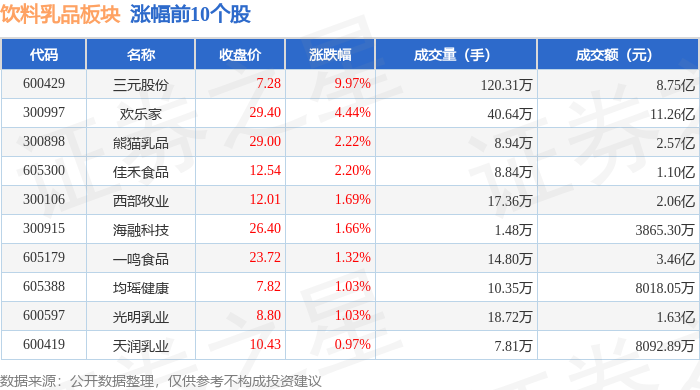
Market Overview - The beverage and dairy sector experienced a slight decline of 0.08% on November 13, with Dongpeng Beverage leading the drop [1] - The Shanghai Composite Index closed at 4029.5, up 0.73%, while the Shenzhen Component Index closed at 13476.52, up 1.78% [1] Stock Performance - Notable gainers in the beverage and dairy sector included: - Sanyuan Foods (600429) with a closing price of 7.28, up 9.97% [1] - Huanlejia (300997) at 29.40, up 4.44% [1] - Panda Dairy (300898) at 29.00, up 2.22% [1] - Dongpeng Beverage (605499) saw a decline of 2.35%, closing at 272.65 [2] Trading Volume and Capital Flow - The beverage and dairy sector recorded a net outflow of 389 million yuan from institutional investors, while retail investors saw a net inflow of 390 million yuan [2] - The trading volume for Sanyuan Foods reached 1.2031 million shares, while Huanlejia had a trading volume of 406,400 shares [1][2] Individual Stock Capital Flow - Huanlejia had a net inflow of 16.0031 million yuan from institutional investors, while it faced a net outflow of 15.1679 million yuan from speculative funds [3] - Panda Dairy experienced a net inflow of 13.6274 million yuan from institutional investors, with a net outflow of 14.8995 million yuan from speculative funds [3] - Light Dairy (600597) had a net outflow of 1.3279 million yuan from institutional investors, but a net inflow of 19.4394 million yuan from retail investors [3]