
西式快餐

Search documents
CPI专题报告:服务消费CPI能否重启上行?
Zhong Guo Yin He Zheng Quan· 2026-02-13 00:45
Investment Rating - The report maintains a positive investment rating for the service CPI sector [2] Core Insights - The service consumption CPI is expected to restart its upward trend, driven by stronger performance compared to overall consumption [7] - The demand for service consumption is resilient, particularly in sectors like tourism and entertainment, which are currently in a phase where prices are more likely to rise than fall [15] - The report highlights the importance of government policies aimed at boosting consumption, including various initiatives to enhance service quality and expand domestic demand [12] Summary by Sections 1. Overview of Service CPI - Service consumption CPI is performing better than overall consumption CPI, indicating a potential for price increases in the service sector [7] 2. Price Increases in Service Sectors - Hotel prices are expected to show elasticity due to supply-demand convergence and anti-monopoly measures [7] - The restaurant sector's ability to pass on costs to consumers is under observation, with Western fast food and tea drinks showing relative advantages [7] 3. Investment Recommendations - The report suggests focusing on sectors with strong demand resilience and potential for price increases, particularly in tourism and hospitality [7] 4. Policy Support - Various government policies are outlined, including actions to stimulate consumption and improve service quality, which are expected to support the service sector's growth [12]
消费赛道格外热闹!顶级资本正在大手笔“抄底”
Zheng Quan Shi Bao· 2025-11-27 00:57
Core Insights - The recent surge in mergers and acquisitions in the consumer sector contrasts with the sluggish growth of the consumption market, raising questions about the underlying investment logic of top-tier capital [1][4]. Group 1: Current Market Conditions - The retail sales of consumer goods in China reached 36.59 trillion yuan in the first three quarters, showing a year-on-year growth of 4.5%, which is still below the 8% growth rate of 2019 [1]. - The performance of listed companies in the consumer sector reveals significant disparities, with major players like Kweichow Moutai and Yum China experiencing slowed growth compared to previous years [2]. - Smaller food and beverage companies are facing considerable operational pressures, with many reporting declines in both revenue and net profit [2]. Group 2: Investment Logic Behind Mergers - The cash flow of target companies is robust, providing a solid foundation for investment despite the slowdown in revenue and profit growth [4]. - The brands being targeted possess strong brand influence and established networks, which are seen as critical for future growth [5]. - The current market downturn presents a favorable opportunity for capital to acquire these brands at lower prices, allowing for potential value enhancement through improved governance and operational efficiency [5]. Group 3: Future Trends in the Consumer Market - The consumer market is expected to face challenges due to slowing income growth and increased savings, which will test the resilience of companies [6]. - Companies are increasingly optimizing their business structures by divesting non-core assets and focusing on high-quality resource integration [6]. - Three key trends are emerging: innovation in cost-performance, the rise of niche products that provide immediate satisfaction, and growth in self-improvement sectors such as health investments and knowledge-based services [6]. Group 4: Capital Market Dynamics - The challenges of exiting investments in the domestic capital market are influencing the selection of investment targets and strategies [7]. - Capital is shifting towards a "long-term battle" approach, favoring structures that allow for continuous returns through dividends rather than relying solely on IPOs for exits [7].
纠结的外卖大战:瑞幸净利润下滑丨咖啡财报观察
2 1 Shi Ji Jing Ji Bao Dao· 2025-11-20 02:05
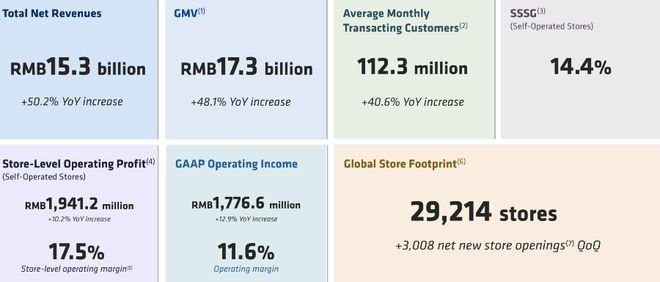
Core Insights - Luckin Coffee's revenue increased by 50.2% year-on-year to RMB 15.287 billion in Q3 2025, while net profit attributable to shareholders decreased by 2.7% to RMB 1.278 billion, primarily due to the impact of the delivery battle [1][6]. Financial Performance - Total net revenues reached RMB 15.3 billion, with a year-on-year increase of 50.2% [2]. - The company's gross merchandise volume (GMV) grew by 48.1% year-on-year to RMB 17.3 billion [2]. - Average monthly transacting customers increased by 40.6% year-on-year to 112.3 million [2]. - Store-level operating profit rose by 10.2% to RMB 1.941 billion, with a store-level operating margin of 17.5% [2]. - GAAP operating income increased by 12.9% to RMB 1.777 billion [2]. Store Expansion - In Q3, Luckin Coffee added 3,008 new stores, reaching a total of 29,214 stores, marking an 11.5% quarter-on-quarter growth [3]. - The number of self-operated stores is 18,882, while franchise stores account for 10,332 [3]. Cost Structure - The proportion of raw material costs to total net revenue decreased from 39% in 2024 to 36% in 2025, despite a 41% year-on-year increase in absolute value to RMB 5.5 billion [3][4]. - Rent and other operating costs as a percentage of total net revenue fell from 22% to 20%, with absolute costs rising by 36% to RMB 3.1 billion [4]. - Sales and marketing expenses decreased from 6% to 5% of total net revenue, with absolute expenses growing by 28% to RMB 751 million [4]. - General and administrative expenses also decreased from 6% to 5% of total net revenue, with absolute expenses increasing by 25% to RMB 793 million [5]. Delivery Costs and Profitability - Delivery costs surged by 211.4% year-on-year to RMB 2.89 billion, accounting for 18.9% of total net revenue, which negatively impacted operating profit margin, reducing it to 11.6% [6]. - The increase in delivery costs is attributed to the competitive delivery battle, contrasting with Yum China, which reported a 7.8% increase in operating profit [6][8]. Market Dynamics - The coffee and tea beverage sector is characterized by high-frequency consumption, necessitating competitive pricing strategies to maintain market share [7]. - Luckin Coffee is exploring structural solutions, emphasizing in-store pickup as a primary consumption method, while delivery serves as a supplementary channel [9].


重要信号!顶级资本正在“抄底”消费
Zheng Quan Shi Bao· 2025-11-14 17:47
Core Viewpoint - The recent surge in mergers and acquisitions in the consumer sector contrasts with the sluggish growth of the consumption market, raising questions about the underlying investment logic of top-tier capital entering this space [1][4]. Group 1: Mergers and Acquisitions Activity - Major capital firms are actively acquiring well-known consumer brands despite a weak consumption market, indicating a strategic move to capitalize on perceived undervaluation [1][4]. - Recent notable transactions include CPE Yuanfeng's partnership with Burger King, Hillhouse Capital's potential bid for Costa Coffee, and Boyu Capital's acquisition of a 60% stake in Starbucks China [1][2]. Group 2: Market Performance and Company Earnings - The retail sales growth in China for the first three quarters was 36.59 trillion yuan, reflecting a year-on-year increase of 4.5%, which is still below the 8% growth rate of 2019 [1]. - A significant performance disparity exists among consumer companies, with leading firms like Kweichow Moutai and Yum China showing slowed growth compared to previous years [2]. - Smaller food and beverage companies are facing greater operational pressures, with many reporting declines in both revenue and net profit [2]. Group 3: Investment Logic Behind Acquisitions - Four key investment rationales support the trend of capital entering the consumer sector: 1. Target companies possess strong cash flow and stable foundations, making them attractive despite slower growth [4]. 2. The brands being targeted have significant market influence and established networks, providing a solid base for future growth [5]. 3. The current market downturn presents a favorable opportunity for capital to acquire these brands at lower prices, allowing for potential value enhancement through improved governance [6]. 4. The consumer sector remains promising, with a large market potential and a low concentration of major brands, indicating future growth opportunities [6]. Group 4: Future Trends in the Consumer Market - The consumer market is expected to face challenges due to slowing income growth and increased savings, which will test the resilience of companies [7]. - Key trends to watch include a focus on cost-effective innovations, the rise of niche products that provide immediate satisfaction, and growth in self-improvement sectors such as health investments and knowledge-based services [7]. - Companies are increasingly optimizing their business structures by divesting non-core assets and consolidating resources to enhance operational quality [7][8].

大消费组九月消费金股:PPI触底,全面进攻
CMS· 2025-09-01 13:02
Investment Rating - The industry maintains a "Recommended" investment rating, indicating a positive outlook for the sector's fundamentals and expected performance relative to the benchmark index [2]. Core Insights - The report highlights a recovery in consumer demand as PPI reaches a bottom, with expectations for improvement in various sectors, particularly in food and beverage, retail, and healthcare [4][19]. - The report emphasizes the importance of strong operational capabilities in brands and manufacturers, particularly in the textile and apparel sector, as inventory levels stabilize [6][8]. - The healthcare sector is noted for its innovation potential, with a focus on domestic companies gaining recognition globally, particularly in the pharmaceutical and medical device industries [16][17]. Summary by Relevant Sections Food and Beverage - The liquor industry is experiencing a clearing phase, with major brands like Moutai and Wuliangye seeing profit growth slow down, while demand is expected to improve as PPI stabilizes [4]. - The snack food sector, particularly companies like Wei Long, is benefiting from seasonal demand increases, with sales expected to rise significantly [4][5]. Textile and Apparel - The sportswear segment is seeing inventory levels stabilize, with a focus on leading brands like Anta and Li Ning, which are expected to perform well due to their strong market positions [6][8]. - The textile manufacturing sector is projected to recover as overseas demand stabilizes, with leading manufacturers expected to see improved profitability [8]. Retail - The retail sector, particularly discount supermarkets and snack chains, is expanding rapidly, with significant net store openings reported [15]. - Wanchen Group's Q2 performance exceeded expectations, with a notable increase in net profit margins, indicating strong operational efficiency [15]. Healthcare - The report identifies opportunities in the innovative drug sector, with companies like United Imaging and Heptagon Pharmaceuticals highlighted for their growth potential [16][17]. - The medical device market is expected to grow as domestic companies enhance their product offerings and market presence [17]. Agriculture - The report emphasizes the importance of high-quality livestock enterprises and food security, with a focus on companies like Muyuan and DeKang [22]. - The planting sector is under scrutiny due to extreme weather conditions affecting crop yields, with a recommendation for companies involved in seed development and agricultural technology [22]. New Consumption Trends - The new-style tea beverage market continues to show high growth, with leading brands like Mixue and Gu Ming achieving significant revenue increases [19]. - The report suggests that the competitive landscape in the food and beverage sector is evolving, with a focus on brands that can leverage online and offline sales channels effectively [19].
餐饮月度专题:茶饮扩张强劲,西式快餐扩张活跃,客单价环比企稳-20250818
ZHESHANG SECURITIES· 2025-08-18 13:05
Investment Rating - The industry investment rating is "Positive" [4] Core Insights - The report highlights strong expansion in tea beverage brands and active growth in Western fast food, with average transaction prices stabilizing month-on-month [5][8][10] Summary by Sections Western Fast Food - The expansion of Western fast food is active, with average transaction prices remaining stable, indicating market resilience [8] - Notable trends in net store openings for major brands include: - KFC: -0.4% in August 2024 - McDonald's: 0.2% in August 2024 - Pizza Hut: -1.8% in August 2024 - Domino's: 0.0% in August 2024 [8] Tea Beverage - Leading brands in the tea beverage sector are expanding significantly, while overall average transaction prices are fluctuating as they seek balance [10] - Key trends in net store openings for major tea brands include: - Mixue Ice Cream: -2.3% in August 2024 - Heytea: -1.1% in August 2024 - Naixue's Tea: -0.3% in August 2024 [10] Coffee & Hot Pot - The coffee segment shows strong expansion momentum, with notable net store openings: - Luckin Coffee: 1,812 new stores, 8% increase - Kudi Coffee: 2,495 new stores, 25% increase [12] - The hot pot industry is facing adjustments, with several brands showing negative net openings [14] Other Food Segments - The overall opening of stores in segments like pickled fish, snacks, and small pubs is cautious, with average transaction prices stabilizing [15] - Key trends in net store openings for snack brands include: - Zuiyan Zhiwei Chicken: -463 stores, 8% decrease - Juewei Duck Neck: -1,127 stores, 9% decrease [17]
餐饮月度专题:西式快餐与咖啡拓店强劲,茶饮分化加剧
ZHESHANG SECURITIES· 2025-05-19 10:45
Investment Rating - The industry investment rating is "Positive" [1] Core Insights - The report highlights strong growth in the number of coffee and Western fast-food outlets, while the tea beverage segment is experiencing increasing differentiation [2] - The net opening numbers for various brands indicate a competitive landscape, with some brands expanding rapidly while others are contracting [3][4] Summary by Sections Net Opening Trends - In the first four months of 2025, the net opening numbers show significant growth for brands like KFC (+777), McDonald's (+52), and Luckin Coffee (+1474), while brands like Huaiyang and others are seeing declines [6][10] - The tea beverage segment shows mixed results, with brands like Mixue Ice Cream and Tea (+3123) expanding, while others like Heytea and Nayuki are facing contractions [8] Average Transaction Price Trends - The average transaction prices for major fast-food brands have shown a downward trend, with KFC and McDonald's experiencing declines of -3.9% and -2.1% respectively in recent months [7] - In the tea beverage sector, brands like Mixue and Heytea are also facing pressure on average transaction prices, with some brands showing significant declines [14] Coffee and Hot Pot Segment - The coffee segment is witnessing strong growth, with brands like Luckin Coffee and Manner showing net opening increases of 7% and 9% respectively [10] - The hot pot segment, however, is facing challenges, with brands like Haidilao and others showing minimal growth or declines in net openings [11] Other Food Categories - The report indicates a noticeable contraction in the number of outlets for categories like pickled fish and snacks, with brands like Tai Er and Yu Ni Zai Yi Qi showing negative net openings [13] - Average transaction prices in these categories are also under pressure, reflecting broader challenges in consumer spending [14]




餐饮月度专题:西式快餐与咖啡拓店强劲,茶饮分化加剧-20250519
ZHESHANG SECURITIES· 2025-05-19 08:59
Investment Rating - The industry investment rating is "Positive" [1] Core Insights - The report highlights strong growth in the number of coffee and Western fast-food outlets, while the tea beverage sector is experiencing increasing differentiation [2][3] - The net opening numbers for various brands indicate a competitive landscape, with some brands expanding rapidly while others are contracting [4][8] Summary by Sections Net Opening Trends - In the first four months of 2025, the net opening numbers for various sectors are as follows: - Coffee: 1,921 net openings, a 9% increase - Western fast food: 585 net openings, a 5% increase - Tea: -359 net openings, a 7% decrease [3][4] Customer Price Trends - Customer price trends for major brands show varying performance: - KFC: -1.6% in August 2023, worsening to -3.9% by December 2024 - McDonald's: -1.1% in August 2023, worsening to -0.1% by December 2024 - Starbucks: -1.1% in August 2023, worsening to -2.3% by December 2024 [7][12] Coffee and Hot Pot Sector - The coffee sector shows strong growth with notable net openings: - Luckin Coffee: 1,474 net openings, a 7% increase - Starbucks: 49 net openings, a 1% increase [10] - The hot pot sector shows mixed results with some brands experiencing declines in net openings [11] Tea Sector - The tea sector is characterized by a rapid expansion of certain brands like Mixue Ice Cream and Tea, which saw 3,123 net openings, a 9% increase, while others like Heytea and Nayuki are facing challenges with negative net openings [8][9] Other Food Categories - The report indicates a contraction in the number of outlets for categories like pickled fish and snacks, with brands like Tai Er and Yu Ni Zai Yi Qi showing negative net openings [13][14]
