拓普集团

Search documents
智能汽车ETF汇添富(159795)开盘跌0.87%
Xin Lang Cai Jing· 2026-01-08 01:38
Core Viewpoint - The smart car ETF Huatai Fu (159795) opened with a decline of 0.87%, indicating a slight downturn in the smart automotive sector on January 8 [1] Group 1: ETF Performance - The smart car ETF Huatai Fu (159795) opened at 1.141 yuan [1] - Since its establishment on January 27, 2022, the fund has achieved a return of 15.13% [1] - The fund's return over the past month is reported at 10.84% [1] Group 2: Major Holdings Performance - Major stocks in the ETF include: - Luxshare Precision opened down 0.92% [1] - Chipone Technology rose by 0.50% [1] - Top Group fell by 0.40% [1] - OmniVision Technologies decreased by 0.48% [1] - iFlytek increased by 1.34% [1] - Desay SV fell by 3.00% [1] - Wingtech Technology dropped by 0.29% [1] - OFILM fell by 0.28% [1] - Joyson Electronics decreased by 0.85% [1] - STMicroelectronics fell by 1.10% [1]
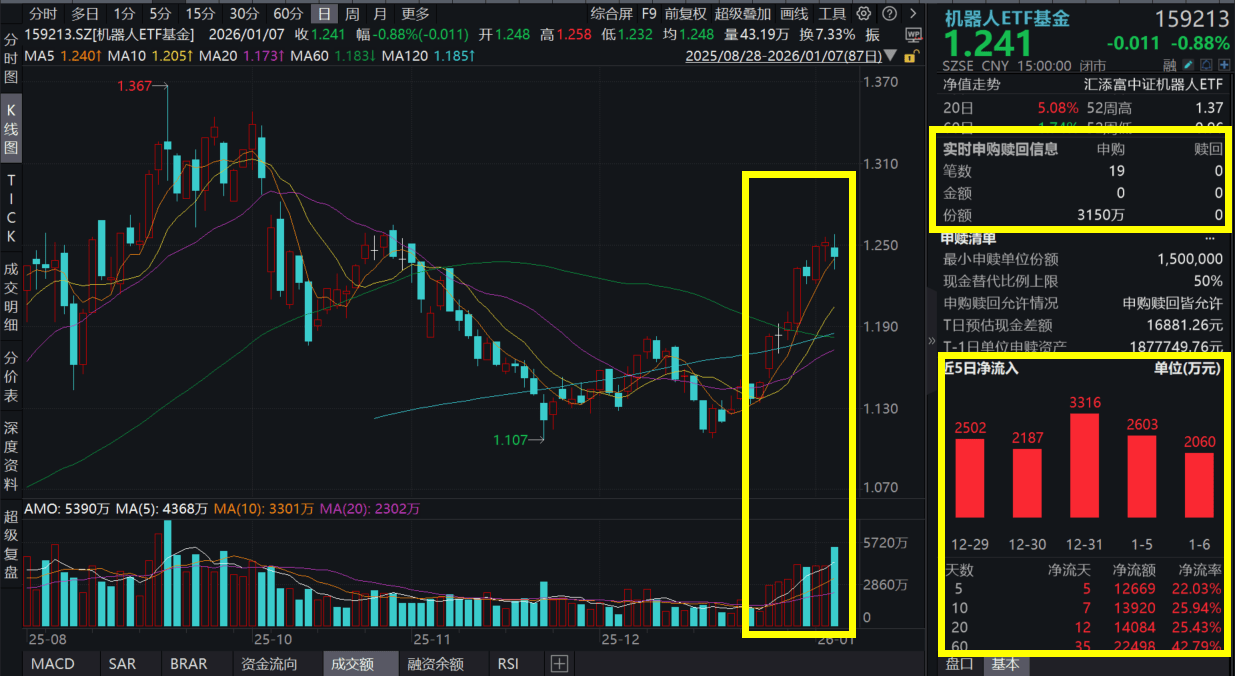
沪指坚韧翻红,喜提14连阳!机器人回调,机器人ETF基金(159213)逆势吸金,连续7日揽金超1.8亿元!石头科技首发爬楼机器人,官宣赴港上市
Sou Hu Cai Jing· 2026-01-07 08:45
Core Viewpoint - The Shanghai Composite Index has achieved a 14-day consecutive rise, setting a new record, while the Robot ETF Fund (159213) experienced a slight decline but attracted significant capital inflow, totaling over 390 million yuan in the last seven days [1][3]. Group 1: Market Performance - The Robot ETF Fund (159213) saw a decline of 0.88% in the afternoon session, despite attracting over 39 million yuan in capital inflow throughout the day, and a total of over 180 million yuan over the past seven days [1]. - The component stocks of the Robot ETF Fund exhibited mixed performance, with Dazhu Laser rising over 3%, while companies like Greening Harmony and Top Group fell over 4% and 2%, respectively [3][4]. Group 2: Industry Developments - The CES 2026 event in Las Vegas highlighted humanoid robots, with NVIDIA's CEO announcing a significant moment for the robotics field, akin to the "ChatGPT moment" [6][7]. - Numerous Chinese companies specializing in embodied intelligence showcased their innovations at CES, aiming for brand exposure and securing overseas orders [7]. - The humanoid robot industry is projected to grow at a compound annual growth rate (CAGR) of 50% or more over the next decade, with the market size expected to approach 3 trillion yuan by 2040 [7][10]. Group 3: Future Outlook - The industry is anticipated to experience a "flywheel effect" by 2026, driven by advancements in application, computing power, and capital investment [10]. - Major contracts have been secured by industry leaders, validating the commercial value of humanoid robots, with significant projects already underway [10]. - The capital market is actively engaging with the humanoid robot sector, accelerating the commercialization process [10].


拓普集团跌2.02%,成交额15.86亿元,主力资金净流出1.57亿元
Xin Lang Zheng Quan· 2026-01-07 05:11
Group 1 - The core viewpoint of the news is that Top Group's stock has experienced fluctuations, with a recent decline of 2.02% and a total market capitalization of 130.09 billion yuan [1] - As of January 7, 2025, Top Group's stock price has decreased by 3.01% year-to-date, but has shown gains of 4.04% over the last five trading days, 8.97% over the last 20 days, and 8.21% over the last 60 days [1] - The company's main business involves the research, production, and sales of automotive parts and components, with revenue contributions from interior functional parts (33.76%), chassis systems (28.66%), shock absorbers (15.77%), automotive electronics (8.31%), thermal management systems (7.58%), and others (5.86%) [1] Group 2 - As of September 30, 2025, Top Group reported a total revenue of 20.93 billion yuan, representing a year-on-year growth of 8.14%, while the net profit attributable to shareholders decreased by 11.97% to 1.97 billion yuan [2] - The company has distributed a total of 3.57 billion yuan in dividends since its A-share listing, with 2.06 billion yuan distributed over the past three years [3] - The number of shareholders increased by 30.02% to 143,700, while the average circulating shares per person decreased by 23.09% to 12,092 shares [2]

小米官宣新一代SU7! 已开启小订,预计4月份上市
Zhong Guo Zheng Quan Bao· 2026-01-07 04:41
Core Viewpoint - Xiaomi is set to launch its next-generation SU7 model in April, with significant enhancements in safety, design, and technology, including full laser radar support and improved battery life [1] Group 1: Sales and Delivery - Xiaomi has delivered over 360,000 SU7 vehicles in 1 year and 9 months, averaging more than 17,000 units per month [3] - The company aims to exceed 410,000 vehicle deliveries by 2025 and has set a target of 550,000 deliveries for the year 2026 [3] Group 2: Supply Chain and Technology - Xiaomi's automotive success is supported by a robust supply chain, utilizing a "self-research + cooperation" model for core technologies [3] - The company has developed its own super motor and battery pack factory, while also partnering with industry leaders like CATL for high-voltage batteries and NVIDIA for smart driving components [3] Group 3: Financial Performance - Xiaomi's automotive business has achieved profitability, with revenue from automotive and AI innovation reaching 29 billion yuan in Q3 2025, a year-on-year increase of over 199% [3] - Automotive revenue alone was 28.3 billion yuan, marking the first quarter of operational profit with earnings of 700 million yuan [3] Group 4: Future Challenges - Despite current success, Xiaomi anticipates challenges in 2026, including a potential decline in gross margin due to reduced purchase tax subsidies and increased competition in the automotive sector [4]

汽车行业深度报告:EMB线控制动是发展智能底盘、实现主动安全的关键基础,2026有望迎来量产元年
LIANCHU SECURITIES· 2026-01-06 12:18
Investment Rating - The report maintains a "Positive" investment rating for the industry [6] Core Insights - The EMB (Electro-Mechanical Brake) system is identified as a key foundation for developing intelligent chassis and achieving active safety in vehicles, with mass production expected to begin in 2026 [1][3] - The EMB system features a decoupled hardware and software architecture, eliminating components like the iBooster and hydraulic lines, allowing for direct control of braking force at the wheel hub, which meets the rapid and precise braking demands of Advanced Driver Assistance Systems (ADAS) [3][4] - The domestic EMB market is projected to grow at a CAGR of over 70% from 2026 to 2030, with an expected market size exceeding 11.5 billion yuan by 2030 [4][48] Summary by Sections 1. Overview of Brake Technology Development - Traditional fuel vehicles used vacuum boosters for braking, which are expected to be phased out due to their complexity and slow response times [10] - The transition to electric vehicles has led to the adoption of electric vacuum pumps, but they have not been widely accepted due to issues like noise and short lifespan [11] - In the era of intelligent and connected vehicles, both EHB (Electro-Hydraulic Brake) and EMB systems are expected to develop concurrently, with EMB being more suitable for future intelligent chassis technology [13][14] 2. Introduction to EMB Line Control Braking - EMB achieves soft and hard decoupling by directly controlling the braking force at each wheel through electrical signals, enhancing response time and efficiency [27] - The EMB system includes electronic brake calipers, controllers, and various sensors, making it the control center for multiple safety algorithms [27] - The commercial application of EMB in commercial vehicles is anticipated to be faster than in passenger vehicles due to higher demands for braking performance and safety [37] 3. Market Size and Growth Potential - The EMB market is expected to see significant growth, with projections indicating a market size of over 11.5 billion yuan by 2030, driven by the rapid development of intelligent connected vehicles [48][51] - The report outlines a detailed forecast for EMB penetration rates, estimating a market size of approximately 1.42 billion yuan in 2026, with a projected CAGR of over 70% from 2026 to 2030 [51][52] 4. Participating Companies - Several domestic companies are accelerating their layout in the EMB market, with mass production timelines generally targeting 2025-2026 [52] - Key players include traditional brake system manufacturers like Bosch and Continental, as well as domestic firms such as Berteli and Asia-Pacific Co., which are preparing for mass production [52][54] - Startups like Coordinate Systems and Huasheng Ruili are also making strides, with some already achieving prototype development and testing [53][54]
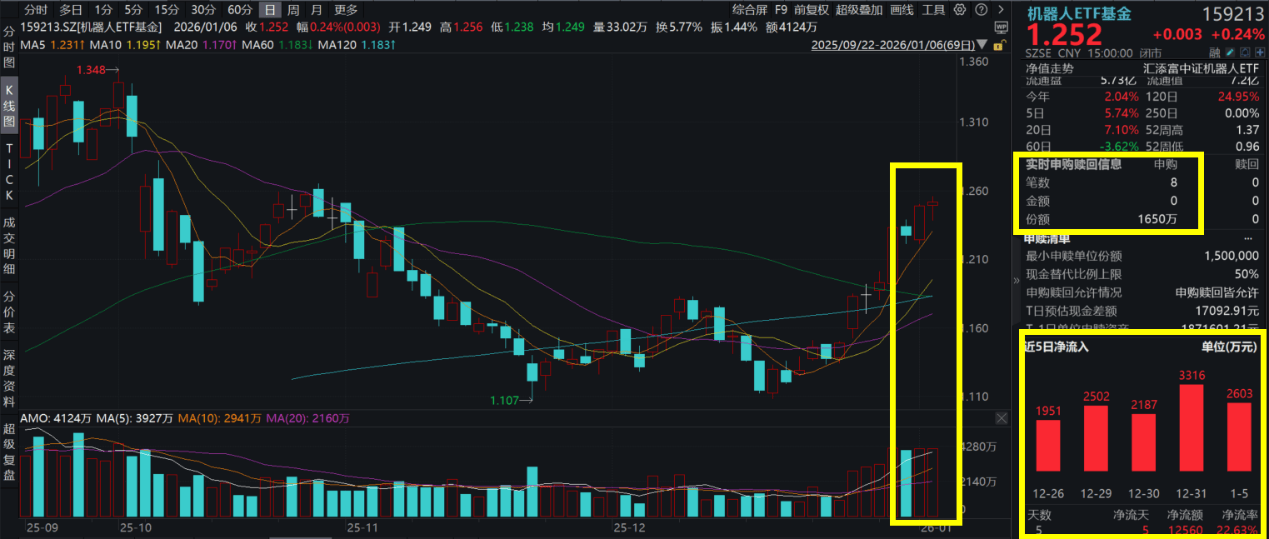
全球科技春晚CES召开:机器人稳站C位!机器人ETF基金(159213)喜提两连阳,连续6日强势吸金超1.46亿元!黄仁勋:机器人迎“ChatGPT时刻”
Sou Hu Cai Jing· 2026-01-06 09:40
Market Performance - The A-share market experienced a strong upward trend on January 6, with the Shanghai Composite Index rising over 1%, marking a 13-day consecutive increase and reaching a ten-year high [1] - The Robot ETF Fund (159213) saw a slight increase of 0.24%, achieving a two-day consecutive rise, with over 20 million yuan in inflows for the day and a total of over 146 million yuan in inflows over the past six days [1] ETF Fund Composition - The index components of the Robot ETF Fund showed mixed performance, with Green's Harmony rising over 4% and Stone Technology increasing over 3%, while companies like Double Ring Transmission and Top Group experienced declines [3] - The top ten components of the Robot ETF Fund include companies such as iFlytek, Huichuan Technology, and Dahua Technology, with varying weightings and performance [4] Industry Trends - The CES 2023 showcased over 4,000 companies, with a dedicated exhibition area for embodied intelligent robots, highlighting the growing importance of robotics in the tech industry [5] - NVIDIA's CEO stated that the robotics industry is experiencing its own "ChatGPT moment," indicating a significant shift in the sector [6] Future Outlook - Dongwu Securities noted that the mass production of humanoid robots is approaching, with key events expected in early 2026, which will catalyze the industry [7] - Zheshang Securities highlighted three critical catalysts for the humanoid robot sector: application, computing power, and capital, anticipating a significant acceleration in 2026 [8] - The humanoid robot industry is seeing increased capital activity and commercialization efforts, with major companies actively pursuing market opportunities [9]

汽车行业1月6日资金流向日报
Zheng Quan Shi Bao Wang· 2026-01-06 09:15
Market Overview - The Shanghai Composite Index rose by 1.50% on January 6, with 30 out of the 31 sectors experiencing gains, led by the non-ferrous metals and non-bank financial sectors, which increased by 4.26% and 3.73% respectively [1] - The automotive sector also saw an increase of 1.43% [1] - The communication sector was the only one to decline, with a drop of 0.77% [1] Capital Flow Analysis - The main capital flow showed a net outflow of 1.033 billion yuan across the two markets, with 17 sectors experiencing net inflows [1] - The non-bank financial sector had the highest net inflow, totaling 6.961 billion yuan, coinciding with its 3.73% increase [1] - The non-ferrous metals sector followed, with a net inflow of 5.885 billion yuan and a daily increase of 4.26% [1] - Conversely, 14 sectors experienced net outflows, with the communication sector leading at a net outflow of 10.507 billion yuan, followed by the media sector with 4.144 billion yuan [1] Automotive Sector Performance - The automotive sector saw a net inflow of 2.469 billion yuan, with 283 stocks in the sector, of which 209 rose and 71 fell [2] - Notably, 8 stocks hit the daily limit up, while 1 stock hit the limit down [2] - The top three stocks with the highest net inflow were Shanzigaoke with 1.555 billion yuan, BYD with 451 million yuan, and Zhejiang Sebao with 360 million yuan [2] - The sector also had 6 stocks with net outflows exceeding 100 million yuan, led by Top Group with 289 million yuan, followed by Jianghuai Automobile and Shuanghuan Transmission [2][3] Automotive Sector Capital Inflow Rankings - The top stocks by capital inflow included: - Shanzigaoke: +10.12%, 12.69% turnover, 1.555 billion yuan inflow - BYD: +1.92%, 1.50% turnover, 451 million yuan inflow - Zhejiang Sebao: +10.01%, 8.86% turnover, 360 million yuan inflow [2] Automotive Sector Capital Outflow Rankings - The top stocks by capital outflow included: - Top Group: -0.79%, 2.30% turnover, -289 million yuan outflow - Jianghuai Automobile: -0.26%, 2.38% turnover, -283 million yuan outflow - Shuanghuan Transmission: -1.47%, 4.50% turnover, -183 million yuan outflow [3]




人形机器人火爆出圈 高增长潜力股名单揭晓
Zheng Quan Shi Bao Wang· 2026-01-06 05:45
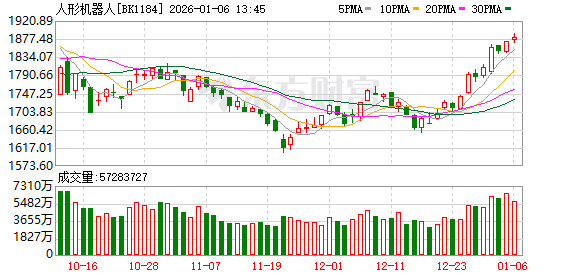
Group 1: Humanoid Robots Industry - Humanoid robots are emerging as one of the most promising frontier fields, attracting attention from global tech giants and investors [2] - The 2026 CES will showcase a significant number of humanoid robots, with companies like Boston Dynamics and others presenting their latest advancements [7] - The market for humanoid robots is expected to grow substantially, with projections indicating a market size of $5 trillion by 2050 and a deployment of 1 billion units [10] Group 2: Market Trends and Developments - The storage chip sector saw a notable rise, with companies like Liyuan Co., Chang Aluminum, and others hitting their daily price limits [3] - A significant price increase for DRAM is anticipated, with Samsung and SK Hynix proposing a 60%-70% price hike for the first quarter of 2026 compared to Q4 2025 [6] - The humanoid robot production year is approaching, with several companies announcing plans for mass production and strategic collaborations to enhance their capabilities [9] Group 3: Investment Opportunities - There are 31 humanoid robot concept stocks predicted to have a net profit growth rate exceeding 20% in 2026 and 2027 [11] - Five stocks, including Zhiwei Intelligent and Softcom Power, show an upside potential of over 30% based on the latest closing prices compared to target prices [12] - Zhiwei Intelligent leads with a projected upside of 46.17%, focusing on embodied intelligence and various robotic applications [12]
机器人2026年度策略:行业跨越0-1,坚守核心供应链
Zhong Guo Neng Yuan Wang· 2026-01-06 02:25
Core Insights - Tesla is leading the commercialization of humanoid robots, with significant advancements expected in 2026, while domestic companies are accelerating their development and production capabilities [2][3] Group 1: Commercialization and Market Trends - Tesla's first-generation humanoid robot is expected to enter mass production in Q1 2026, with supply chain ramp-up in H1 2026 [2] - Domestic humanoid robot manufacturers are projected to increase their output from thousands to tens of thousands of units, focusing on applications in navigation, inspection, and collaboration [2][3] - The upcoming commercialization wave in China is anticipated to be driven by major players like Yushun and Leju entering the capital market [3] Group 2: Technological Advancements - The hardware development of humanoid robots is shifting from functionality to durability, with a focus on new electric drive systems, dexterous hands, and advanced bearing technologies [5] - New electric drive technologies with high power density and precision control are being highlighted, including harmonic field motors and GaN control systems [5] - Tesla's GEN2.5 dexterous hand model features an upgrade from fingertip sensors to full-hand electronic glove solutions [5] Group 3: Supply Chain Developments - The supply chain for humanoid robots is approaching a convergence point, with the first-generation V3 product expected to be released soon [5] - Key suppliers in the supply chain are being monitored for their technological advancements and production capabilities [6][7] Group 4: Investment Opportunities - Key investment opportunities are identified in companies involved in the supply chain, such as Top Group, Sanhua Intelligent Control, and others, as the hardware supply chain converges [6] - The focus is also on new technologies in electric drives, dexterous hands, and high-end bearings, with companies like Ningbo Huaxiang and InnoScience highlighted as potential investments [6] - Domestic humanoid robot companies and their supply chains are expected to present significant investment opportunities as they prepare for public listings [7]

【汽车零部件&机器人周度跟踪】本周交易热度上升,人形板块持续贡献超额收益
东吴汽车黄细里团队· 2026-01-05 13:30
Investment Highlights - The SW Auto Parts Index increased by 2.91% this week, ranking first in the SW automotive sector, with a year-to-date increase of 42.58% [2][12] - The latest trading day saw the SW Auto Parts PE (TTM) at the 79.44% historical percentile and PB (LF) at the 75.50% historical percentile [12][33] Robotics Sector Review - The Wande Robotics Index rose by 3.73% this week, with a year-to-date increase of 62.08%, outperforming the SW Auto Parts sector by 0.83% [3][12] - The latest trading day recorded the Wande Robotics PE (TTM) at the 68.31% percentile for the year 2025, and PB (LF) at the 79.42% percentile [3][44] Core Coverage Changes - Yinchuan Co. increased its investment in Sichuan Yinchuan by 380 million yuan for capacity construction of water-cooled plates and front-end modules, expected to reach production by 2029 [4][12] - Huada Technology announced a mid-term dividend plan for 2025, proposing a cash dividend of 0.15 yuan per share, totaling 70.46 million yuan [4][12] - Fuda Co. completed the transfer of 25% equity in Guilin Fuda Alfin for 48 million yuan [4][12] Weekly Performance of Core Coverage Stocks - The top five performing stocks this week were: Xinquan Co. +14.05%, Beite Technology +11.64%, Top Group +8.26%, Daimai Co. +8.01%, and Xinz坐标 +7.97% [5][12] Investment Recommendations - For auto parts, focus on structural opportunities by selecting product-oriented companies and those entering high-value sectors to increase ASP, with a priority on companies expanding capacity in Europe, North America, and Southeast Asia [7][12] - In robotics, look for certainty opportunities with the expected release of Optimus V3 in Q1 2026, and monitor the order timeline and application deployment by domestic companies like Xiaopeng and Yuzhu [7][12] - Recommended stocks based on EPS include Fuyao Glass, Xingyu Co., Minshi Group, Junsheng Electronics, and Xingyuan Zhuomei, with a focus on Xinquan Co. [7][12] - Recommended stocks based on PE include Top Group, Junsheng Electronics, Shuanghuan Transmission, Minshi Group, Yinchuan Co., and Feilong Co., with a focus on Yap Co. and Daimai Co. [7][12]