
贵州茅台

Search documents
跟踪-地产酒经销商电话会
2026-02-13 02:17
Summary of the Conference Call on Real Estate Wine Distributors Industry Overview - The conference call focused on the real estate wine distribution industry, particularly the performance of various brands during the January 2026 period and the impact of the economic environment on sales. Key Points and Arguments Company Performance - **Jinhui Wine**: January order volume exceeded expectations, with the soft series growing approximately 10% year-on-year, while the star series showed weak performance, leading to an expected annual sales decline [2][5] - **Sales Trends**: High-end products like Jinhui 18 and 28 years performed well, while lower-tier products like Hongchuan faced significant declines [6][19] - **Sales Environment**: Overall white wine sales during the Spring Festival were lower than the previous year, attributed to a poor economic environment rather than the impact of alcohol bans [11][12] Competitive Landscape - **Price Adjustments**: Moutai and Wuliangye reduced prices, stimulating sales, while Jinhui maintained stable pricing despite market fluctuations [7][10] - **Market Share**: Competitors like Hongchuan and Jinxiu Longnan did not significantly capture market share, while Binhai saw an increase in sales due to enhanced user engagement and promotional efforts [15] Regional Insights - **Gansu Region**: The impact of the alcohol ban has diminished, but economic conditions remain a significant factor affecting sales [11][22] - **Jiangsu Region**: Distributors reported high inventory levels and a 20% decline in overall signing volume compared to the previous year, indicating a lack of market confidence [27][32] Consumer Behavior - **Purchasing Trends**: Consumers showed reduced purchasing enthusiasm, with many opting for lower quantities of high-end products compared to previous years [12][30] - **Profit Margins**: Low channel profits are leading to decreased willingness to stock products, with some distributors only making around 5 yuan profit per bottle [31] Future Outlook - **Market Recovery**: Expectations for a market recovery are set for April 2026, with potential growth in high-end brands like Moutai and Wuliangye, although overall economic conditions may limit growth potential [42][44] - **Brand Performance**: Jinhui and Binhai are expected to have growth potential, but they must navigate challenges posed by the economic environment [19][40] Additional Insights - **Promotional Strategies**: Manufacturers have reduced promotional spending but continue to hold tasting events, indicating a shift in marketing strategy [14] - **Inventory Management**: Distributors are managing inventory carefully, with a current cycle of 4-5 months compared to 3 months last year, reflecting cautious purchasing behavior [25] Conclusion The conference highlighted the challenges faced by the real estate wine distribution industry, including economic pressures, competitive pricing strategies, and changing consumer behaviors. While some brands show potential for growth, the overall market remains cautious, with expectations for recovery in the coming months.


新消费研究-即时零售应需而生-酒类品牌或迎新机遇
2026-02-13 02:17
Summary of Conference Call on Instant Retail and Alcohol Industry Industry Overview - The instant retail market in China is projected to reach 1 trillion yuan by 2025 and 2 trillion yuan by 2030, with the alcohol category experiencing rapid growth, particularly after increased investment from internet platforms [2][3][20] - Instant retail is divided into platform models and self-operated models, with the platform model integrating supermarkets and chain stores, while the self-operated model is controlled by the platform [2][5] Key Insights - The rapid expansion of Meituan's Yaimasongjiu, which adopts a franchise model, aims to cover third-tier cities, although most stores are still in the ramp-up phase [2][5] - Beer accounts for the highest sales proportion in Yaimasongjiu's store structure, with profits mainly derived from craft products, while profits from white liquor are thinner [2][6] - The average monthly revenue per store is approximately 200,000 yuan, with a net profit margin of 10%, benefiting from a low-cost operational model [2][6] Market Dynamics - The shift in consumer behavior towards instant consumption, increased subsidies from e-commerce platforms, and innovative marketing strategies from emerging brands are driving the rapid development of instant drinking, especially for white beer [3][7] - The white liquor industry has seen a channel model adjustment since 2022, with accelerated development of online and instant retail channels [8][9] Sales and Revenue Projections - By 2030, the market size for alcohol in instant retail is expected to exceed 90 billion yuan, maintaining a double-digit compound annual growth rate [4] - The penetration rate of instant retail in the white liquor market is currently low at 2%, compared to 15%-20% for online channels, indicating significant growth potential [4] Operational Insights - Yaimasongjiu's sales structure shows that white liquor accounts for 15%-20% of sales, while beer SKUs make up 60%-70% [6] - The gross margin for craft beer products is around 50%, while white liquor operates on a consignment model with lower margins [6] Competitive Landscape - The white liquor market is becoming increasingly concentrated, with the top 10 brands accounting for nearly 60% of revenue by 2024 [9] - Major brands like Moutai and Wuliangye have established strong consumer recognition, reducing the need for extensive channel education [9][19] Impact of Instant Retail - Instant retail is enhancing the operational efficiency of white liquor chain stores, allowing for a lighter asset operation model [11] - The collaboration between alcohol companies and instant retail platforms is crucial for brand strength and market penetration [17][19] Future Outlook - The overall online channel currently accounts for 15%-20% of the total distribution scale, with instant retail being a smaller fraction [20] - Companies that strategically position themselves in this evolving market are expected to enjoy longer operational cycles and brand longevity [20] Investment Recommendations - Positive outlook on companies such as Luzhou Laojiao, Shanxi Fenjiu, Guizhou Moutai, and Yanjing Beer due to their proactive strategies in the instant retail space [20]
上证180指数上涨0.20%,上证180ETF指数基金(530280)交投活跃
Sou Hu Cai Jing· 2026-02-13 01:47
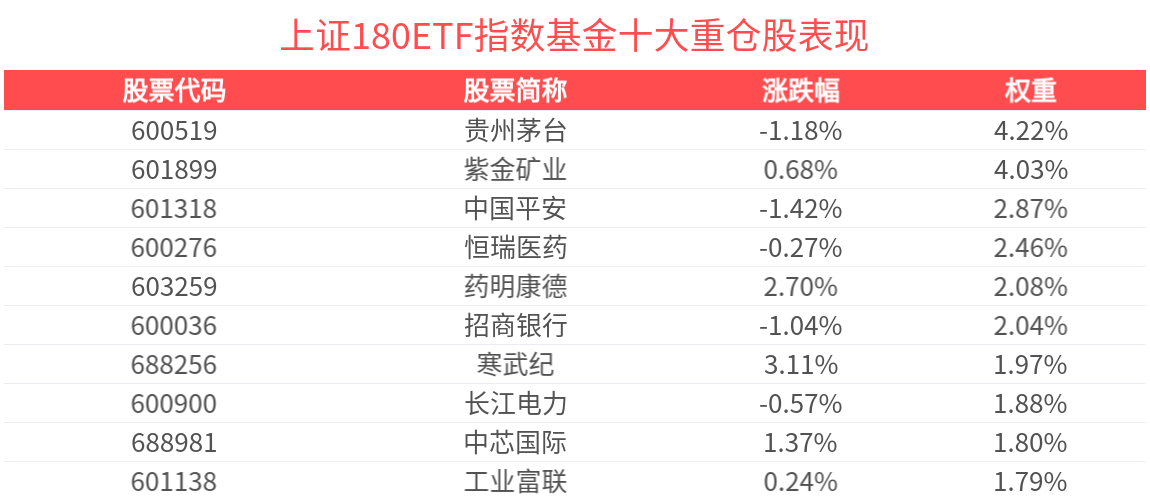
Core Insights - The Shanghai 180 Index (000010) has shown a slight increase of 0.20% as of February 12, 2026, with notable gains from stocks such as Dongfang Electric (+10.00%) and China National Offshore Oil Corporation (+9.98%) [1] - The Shanghai 180 ETF (530280) has experienced a minor decline of 0.16%, currently priced at 1.26 yuan, but has seen a cumulative increase of 1.04% over the past week [1] - The ETF has a Sharpe ratio of 1.91 since its inception, indicating a favorable risk-adjusted return [1] Performance Metrics - The Shanghai 180 ETF has a maximum drawdown of 4.28% year-to-date, with a relative benchmark drawdown of 0.06% [1] - The management fee for the ETF is set at 0.15%, while the custody fee is 0.05% [1] - The tracking error for the ETF over the past three months is 0.019%, reflecting its close alignment with the underlying index [1] Index Composition - The Shanghai 180 Index comprises 180 securities selected for their large market capitalization and liquidity, representing the core performance of Shanghai's listed companies [2] - As of January 30, 2026, the top ten weighted stocks in the index account for 24.85% of the total index weight, including major companies like Zijin Mining and Kweichow Moutai [2] - The top ten stocks by weight include: - Zijin Mining (4.03%) - Kweichow Moutai (4.22%) - China Ping An (2.87%) - Others include Hengrui Medicine, WuXi AppTec, and China Merchants Bank [3]

沪深300ETF嘉实(159919)开盘跌0.22%
Xin Lang Cai Jing· 2026-02-13 01:35
Core Viewpoint - The article discusses the performance of the HuShen 300 ETF managed by Harvest Fund Management, highlighting its recent market movements and key holdings [1] Group 1: ETF Performance - The HuShen 300 ETF (159919) opened at 4.918 yuan, experiencing a decline of 0.22% [1] - Since its establishment on May 7, 2012, the fund has achieved a return of 129.33%, while its return over the past month is -1.31% [1] Group 2: Key Holdings Performance - Notable stocks within the ETF include: - CATL (宁德时代) down 0.07% - Kweichow Moutai (贵州茅台) unchanged at 0.00% - Ping An Insurance (中国平安) down 0.59% - Zhongji Xuchuang (中际旭创) down 0.66% - Zijin Mining (紫金矿业) down 3.75% - China Merchants Bank (招商银行) down 0.10% - Xinyi Technology (新易盛) down 1.02% - Midea Group (美的集团) down 0.36% - Industrial Bank (兴业银行) up 0.05% - Yangtze Power (长江电力) up 0.04% [1] Group 3: Management Information - The ETF is managed by Harvest Fund Management Co., Ltd., with Liu Jiayin as the fund manager [1]





酒价内参2月13日价格发布 洋河梦之蓝M6小幅回落2元/瓶
Xin Lang Cai Jing· 2026-02-13 01:30
Core Viewpoint - The "Wine Price Reference" by Sina Finance has launched, providing real-time data on the retail prices of major Chinese liquor brands, indicating a structurally differentiated price trend in the market as of February 13, 2026 [1][8]. Price Trends - The average retail price of the top ten liquor products is 9,189 yuan, showing a slight increase of 3 yuan from the previous day [1][8]. - Among the top ten products, four saw price increases while six experienced declines, highlighting significant price differentiation [4][10]. Specific Product Price Changes - Guizhou Moutai (Flying Moutai) increased by 32 yuan to 1,790 yuan per bottle, reaching a one-month high due to tight supply and limited availability [4][10]. - Other products with price increases include: - Ancient Well Tribute Wine 20: up 3 yuan to 538 yuan [4][10] - Crystal Jian Nan Chun: up 3 yuan to 406 yuan [3][10] - Qinghua Fen 20: up 1 yuan to 384 yuan [4][10] - Products with price declines include: - Qinghua Lang: down 12 yuan to 698 yuan [4][10] - Boutique Moutai: down 9 yuan to 2,415 yuan [4][10] - Wuliangye Pu 58: down 7 yuan to 808 yuan [4][10] - Guojiao 1573: down 5 yuan to 885 yuan [4][10] - Yanghe Dream Blue M6+: down 2 yuan to 613 yuan [4][10] - Xijiu Junpin: down 1 yuan to 652 yuan [4][10] Market Analysis - The data for "Wine Price Reference" is sourced from approximately 200 collection points across major regions, including designated distributors and retail outlets, ensuring objective and traceable pricing information [5][11]. - A recent report from招商证券 indicates a double-digit decline in liquor sales before the Spring Festival, aligning with expectations. Guizhou Moutai shows strong performance with a price recovery to the range of 1,600 to 1,700 yuan, while other brands like Luzhou Laojiao and Shanxi Fenjiu are experiencing varying degrees of sales decline [6][11].



酒价内参2月13日价格发布 习酒君品小幅回落1元/瓶
Xin Lang Cai Jing· 2026-02-13 01:30
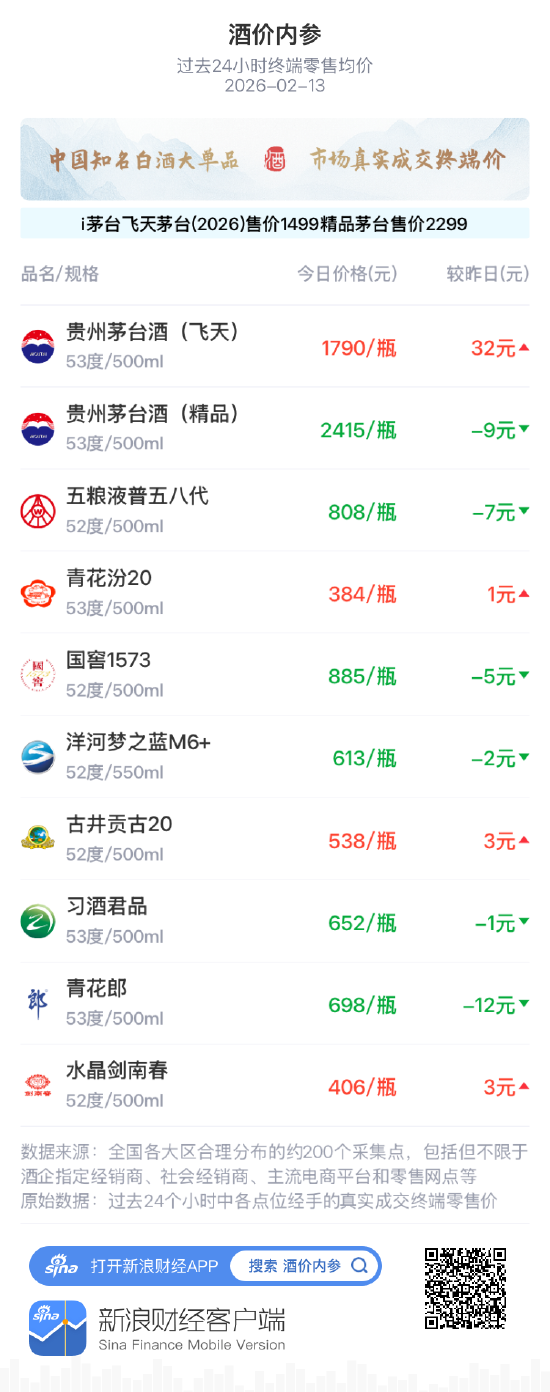
Core Viewpoint - The "Wine Price Reference" by Sina Finance has launched, providing real-time data on the retail prices of major Chinese liquor brands, indicating a structurally differentiated price trend in the market as of February 13, 2026 [1][8]. Price Trends - The average retail price of the top ten liquor products is 9,189 yuan, showing a slight increase of 3 yuan from the previous day [1][8]. - Among the top ten products, four saw price increases while six experienced declines, highlighting significant price differentiation [4][10]. Specific Product Price Changes - Guizhou Moutai (Flying Moutai) increased by 32 yuan to 1,790 yuan per bottle, reaching a one-month high due to tight supply and limited availability [4][10]. - Other products with price increases include: - Ancient Well Tribute Wine 20: up 3 yuan to 538 yuan [4][10] - Crystal Jian Nan Chun: up 3 yuan to 406 yuan [4][10] - Qinghua Fen 20: up 1 yuan to 384 yuan [4][10] - Products with price declines include: - Qinghua Lang: down 12 yuan to 698 yuan [4][10] - Boutique Moutai: down 9 yuan to 2,415 yuan [4][10] - Wuliangye Pu 58: down 7 yuan to 808 yuan [4][10] - Guojiao 1573: down 5 yuan to 885 yuan [4][10] - Yanghe Dream Blue M6+: down 2 yuan to 613 yuan [4][10] - Xijiu Junpin: down 1 yuan to 652 yuan [4][10]. Market Analysis - A recent report from招商证券 indicates that the liquor industry is experiencing a double-digit decline in sales leading up to the Spring Festival, which aligns with expectations [6][11]. - Guizhou Moutai is showing strong performance with a significant increase in sales volume and price recovery, while other brands like Luzhou Laojiao and Shanxi Fenjiu are facing varying degrees of decline [6][11]. - The report suggests that the liquor sector may see a recovery in both performance and valuation as cyclical constraints gradually diminish [6][11].
酒价内参2月13日价格发布 青花汾20小幅上涨1元/瓶
Xin Lang Cai Jing· 2026-02-13 01:24
Core Insights - The article highlights the launch of "Wine Price Reference" by Sina Finance, which provides real-time data on the retail prices of major Chinese liquor brands, indicating a structurally differentiated price trend in the market as of February 13, 2026 [1][8]. Price Trends - The average retail price of the top ten liquor products in China is reported at 9,189 yuan, showing a slight increase of 3 yuan from the previous day [1][8]. - Among the top ten products, four saw price increases while six experienced declines, indicating a clear price differentiation [4][10]. Specific Product Price Changes - Notable price changes include: - Guizhou Moutai (Flying Moutai) increased by 32 yuan to 1,790 yuan per bottle, reaching a one-month high due to tight supply and limited availability [4][10]. - Other products that increased include: - Gujing Gongjiu 20: up 3 yuan to 538 yuan [4][10]. - Shuijing Jian Nan Chun: up 3 yuan to 406 yuan [10]. - Qinghua Fen 20: up 1 yuan to 384 yuan [4][10]. - Products that decreased include: - Qinghua Lang: down 12 yuan to 698 yuan, marking a significant drop over three consecutive days [4][10]. - Boutique Moutai: down 9 yuan to 2,415 yuan [4][10]. - Wuliangye and Guojiao 1573: down 7 yuan to 808 yuan and 5 yuan to 885 yuan respectively [4][10]. Market Analysis - The data for "Wine Price Reference" is sourced from approximately 200 collection points across various regions, including designated distributors and major retail platforms, ensuring a comprehensive and objective price tracking [5][11]. - A recent report from招商证券 indicates a double-digit decline in liquor sales leading up to the Spring Festival, with Guizhou Moutai showing strong performance and a price recovery in the range of 1,600 to 1,700 yuan [6][11]. - The report also notes that the proportion of mass consumption has increased to 20%, and a supply-demand imbalance is expected to persist in the first quarter [6][11].
酒价内参2月13日价格发布 贵州茅台飞天大涨逼近1800元
Xin Lang Cai Jing· 2026-02-13 01:19
Core Viewpoint - The "Wine Price Reference" by Sina Finance has launched, providing real-time data on the retail prices of major Chinese liquor brands, indicating a structurally differentiated price trend in the market as of February 13, 2026, with a slight overall increase in prices [1][8]. Price Trends - The average retail price of the top ten liquor products is 9,189 yuan, reflecting a minor increase of 3 yuan from the previous day [1][8]. - Among the top ten products, four saw price increases while six experienced declines, showcasing significant price differentiation [4][10]. Specific Product Price Changes - Notable price increases include: - Guizhou Moutai (Flying Moutai) rose by 32 yuan to 1,790 yuan per bottle, reaching a one-month high due to tight supply and limited availability [4][10]. - Ancient Well Tribute Wine and Crystal Jian Nan Chun both increased by 3 yuan, while Qinghua Fen 20 saw a slight rise of 1 yuan [4][10]. - Price declines were observed in: - Qinghua Lang dropped by 12 yuan, marking a significant three-day decline [4][10]. - Boutique Moutai decreased by 9 yuan, following a peak price in the previous 30 days [4][10]. - Other declines included Wuliangye and Guojiao 1573, which fell by 7 yuan and 5 yuan respectively, while Yanghe Dream Blue M6+ and Xijiu Junpin decreased by 2 yuan and 1 yuan [4][10]. Market Analysis - The data for "Wine Price Reference" is sourced from approximately 200 collection points across various regions, including designated distributors and major retail platforms, aiming to provide an objective and traceable market price reference [5][11]. - A recent report from招商证券 indicates a double-digit decline in liquor sales leading up to the Spring Festival, with Guizhou Moutai showing strong performance and a price rebound in the 1,600 to 1,700 yuan range, while other brands like Luzhou Laojiao and Shanxi Fenjiu experienced varying degrees of sales decline [6][11].
中信证券A股2025年报预告全景透视:预喜公司占比达37% 大市值龙头盈利修复显著
Zhi Tong Cai Jing· 2026-02-13 01:17
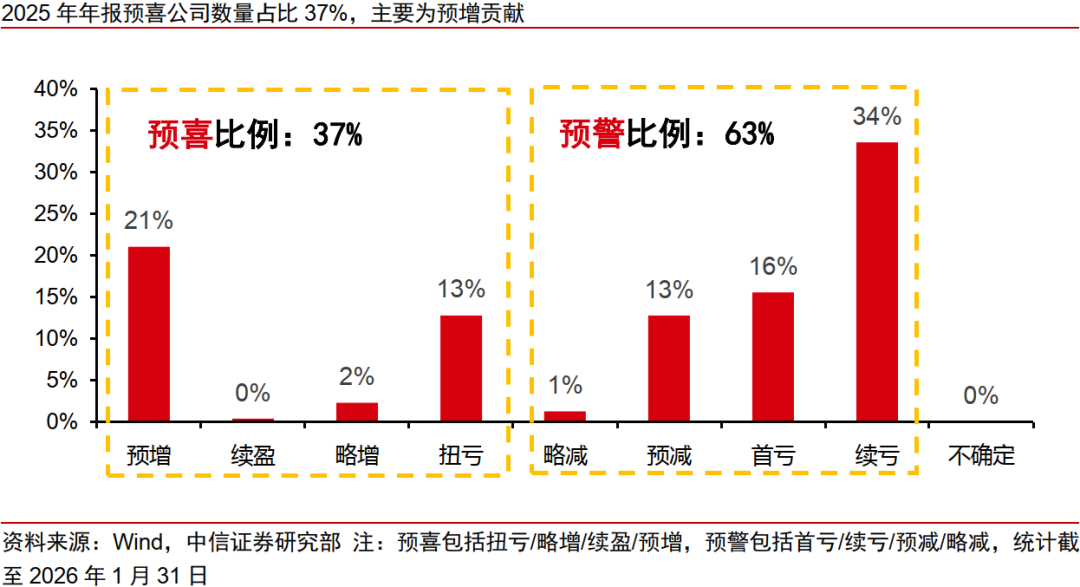
Core Viewpoint - As of January 31, 2026, 2,976 A-share companies have disclosed their 2025 annual performance forecasts, with a total disclosure rate of 54.0%. The proportion of companies with positive forecasts has increased to 37% from 33% in 2024, indicating a structural recovery driven by technology, supported by external demand, while financial sectors face pressure [1][9]. Group 1: Performance Forecast Overview - The number of companies with positive forecasts has expanded, with technology, finance, and cyclical sectors being the highlights. The overall disclosure rate is 54.0%, with 37% of companies forecasting positive results, up from 33% in 2024. Key sectors showing growth include communication, basic chemicals, non-ferrous metals, non-bank finance, electronics, and utilities [1][5]. - The performance forecast reveals significant improvements among large-cap leaders, while small-cap companies continue to face substantial pressure. The positive forecast ratio is highly correlated with market capitalization, with the Shanghai Stock Exchange 50 index showing a 75% positive forecast ratio [9][12]. Group 2: Sector-Specific Insights - The current performance forecasts exhibit structural characteristics of "technology-driven, externally supported, and financial pressure." Notably, 9 companies from the Shanghai Stock Exchange 50 have released forecasts, with 6 showing growth, particularly in machinery, non-ferrous, pharmaceuticals, and electronics [12]. - The technology sector shows high resilience due to global AI infrastructure and semiconductor demand growth, while industries like non-ferrous metals and chemicals are experiencing performance releases due to improved pricing power [12][22]. Group 3: Institutional Investment Strategies - Fund companies focus on clear growth sectors, with the top three heavy investment industries being electronics (20.1%), pharmaceuticals (10.1%), and power equipment & new energy (9.3%). The top 20% of holdings have a forecasted net profit of 3,976.3 billion yuan, reflecting a 46.4% year-on-year growth [16][21]. - Insurance companies prioritize cash flow and defensive attributes, with a significant portion of their holdings in banking and non-bank financial sectors. The top 20% of holdings forecast a net profit of 814.7 billion yuan, with limited growth elasticity [16][20]. Group 4: Analyst Expectations and Market Reactions - Analyst expectations are generally optimistic, with 537 companies forecasting below market consensus and only 160 exceeding expectations, indicating a significant bias towards optimism in earnings predictions [22][27]. - The analysis of market reactions shows that 658 stocks experienced a gap down on the day following their forecasts, while only 230 saw a gap up, suggesting that overall earnings expectations were overly optimistic prior to announcements [27][33].

i茅台上线月余依然“一瓶难求”,线下客流明显增加
Shen Zhen Shang Bao· 2026-02-13 00:56
Core Viewpoint - The traditional peak season for Chinese liquor consumption during the Spring Festival has led to a significant increase in demand for Moutai, with the iMoutai platform experiencing a surge in user engagement and sales, indicating a shift in the market dynamics of the liquor industry [2][4][5]. Group 1: Market Demand and Sales Performance - The only self-operated Moutai store in Shenzhen has reported a noticeable increase in customer traffic, with inquiries for Moutai products up by 20-30% compared to usual [2][3]. - iMoutai has gained 6.28 million new users since its launch on January 1, with over 2.12 million orders placed, reflecting a strong consumer interest in Moutai products [2][3]. - The sales volume of the 500ml Moutai liquor is estimated to be between 143,000 to 942,000 bottles for the month, translating to approximately 670 to 4,400 tons of liquor sold [3]. Group 2: Market Transformation and Strategy - Moutai's market transformation is characterized by a shift from a traditional sales model to a multi-faceted marketing system, aiming to regain pricing power and adapt to market demands [5][6]. - The iMoutai platform has significantly contributed to Moutai's direct sales revenue, which accounted for over 43% of total direct sales in the first three quarters of 2025 [5]. - Analysts suggest that Moutai's market-oriented approach will allow it to better align with consumer needs and market dynamics, potentially reshaping the competitive landscape of the liquor industry [6][10]. Group 3: Industry Implications and Adjustments - Moutai's reforms may trigger a deep adjustment within the liquor industry, challenging the existing pricing structures and prompting other companies to adopt similar strategies [9][10]. - The shift towards a more transparent and consumer-focused distribution model could lead to increased competition and a re-evaluation of profit distribution among manufacturers, distributors, and consumers [9]. - The industry may face a period of differentiation and concentration, where brands lacking market power will struggle, while Moutai strengthens its market position through direct sales and data control [9][10].