中信保诚基金

Search documents
ETF资金流向,释放新信号
Zhong Guo Zheng Quan Bao· 2025-08-10 23:58
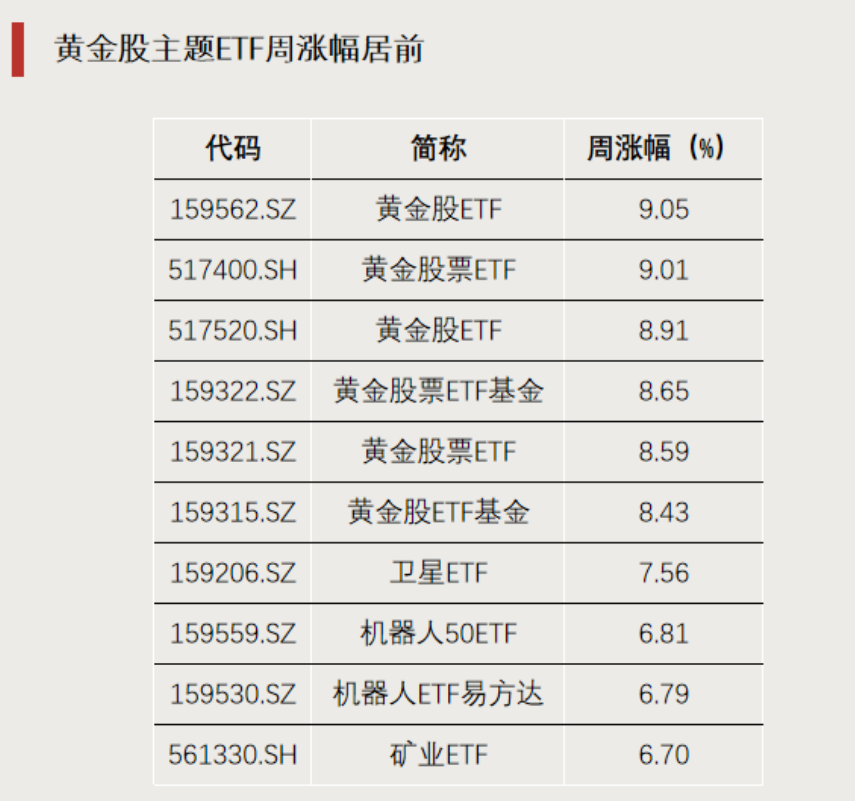
Group 1 - The A-share market experienced an increase last week, with gold-related ETFs leading the gains, and the robotics sector also showing significant growth [1][4] - The A500 ETF from E Fund (159361) and the Sci-Tech 50 ETF (588080) were among the most actively traded ETFs, with a total trading volume of nearly 120 billion yuan [2][6] - The Hong Kong stock market saw substantial capital inflow into the technology sector, indicating a bullish sentiment towards Hong Kong stocks [3][9] Group 2 - Gold-related ETFs had the highest weekly growth, with several products increasing by over 8%, including the Gold Stock ETF (159562) which rose by 9.05% [5][4] - The trading volume for the Hong Kong Securities ETF (513090) exceeded 62 billion yuan, maintaining its position as the top traded equity ETF for five consecutive weeks [8] - The Hong Kong Innovation Drug ETF (159316) is the only product tracking the newly revised Hong Kong Stock Connect Innovation Drug Index, which will have a 100% purity after the removal of five CXO companies [7] Group 3 - The market is expected to continue structural opportunities, supported by a stable economic recovery and policy measures aimed at boosting fiscal spending and major project construction [11] - The Growth ETF (159259) is set to launch, focusing on A-share growth stocks, providing investors with an easy way to access quality growth assets [12]

小众策略基金破圈逆袭 华夏新锦绣、金元顺安元启等业绩亮眼但长大不易
Zheng Quan Shi Bao· 2025-08-10 23:46
Core Insights - The public fund industry is highly competitive, with mainstream sectors like technology, consumer goods, and pharmaceuticals attracting significant attention and capital from fund managers [1][2] - Niche strategy funds have emerged successfully by avoiding mainstream trends and focusing on overlooked areas, yielding excess returns and gaining market recognition [2][4] Niche Strategy Funds Performance - Niche strategy funds have seen a resurgence in performance this year, with equity funds experiencing significant gains as the market recovers [2] - Only about 10 equity funds have maintained positive returns for five consecutive years, including several niche strategy funds like Huaxia New Brocade and Jinyuan Shun'an Yuanqi, achieving at least 5 years of positive returns [2] - Zhang Chengyuan's Huaxia New Brocade fund has achieved a 40.5% return this year and a cumulative return of 171.90% since 2020, utilizing a targeted investment strategy in private placements [2][3] Investment Strategies - Niche strategy funds employ various methods such as participating in private placements, quantitative stock selection, and tracking Smart Beta indices to uncover excess returns [2][3] - The Gold Yuan Shun'an Yuanqi fund, managed by Miao Weibin, has achieved a cumulative return of 389.56% since its inception in 2017, focusing on micro-cap stocks [3] - The Guojin Quantitative Multi-Strategy fund, managed by Yao Jiahong and Ma Fang, has consistently delivered positive returns since 2019, with a return of 16.69% this year [3] Market Dynamics - Niche strategies allow funds to avoid competition in mainstream sectors, presenting a new avenue for differentiated development [4] - Smaller fund companies can quickly adapt and allocate resources to niche strategies, as seen with Guojin Fund's growth from under 3 billion to nearly 13 billion [5] - Larger fund companies leverage their research platforms and brand influence to successfully launch niche products, such as Huatai Baichuan's low-volatility ETF, which grew from 258 million to 22.14 billion [5] Challenges Faced - Despite their success, niche strategy funds face challenges such as "scale traps," where initial performance pressures can lead to significant fluctuations in fund size [7][8] - The effectiveness of niche strategies often requires a longer validation period, and funds may be prematurely terminated during their development phase [8] - Some niche strategies are highly dependent on market conditions, making them vulnerable to changes in trends or policies [8]
积极因素不断涌现 公募基金掀起自购潮
Zhong Guo Zheng Quan Bao· 2025-08-10 21:05
Group 1 - Public funds are experiencing a renewed wave of self-purchase, with institutions like ICBC Credit Suisse Fund, Taikang Fund, and Founder Fubon Fund announcing plans to use proprietary funds to buy their equity public funds, reflecting confidence in the long-term stability and health of the capital market [1][2] - The Shanghai Composite Index has recently surpassed 3600 points, boosting investor confidence in the market, and industry insiders suggest that a new round of self-purchase by public funds has begun, signaling positive market sentiment [1][3] - As of August 10, 2025, a total of 137 public fund companies have initiated self-purchases, with 56 companies focusing on stock funds and 73 on mixed funds, indicating a strong preference for equity assets [3] Group 2 - ICBC Credit Suisse Fund announced a self-purchase of at least 10 million yuan for its "ICBC Credit Suisse Selected Return Mixed Fund," with a commitment to hold for at least one year [1][2] - Taikang Fund has utilized 1.55 million yuan of its proprietary funds to invest in its "Taikang Hong Kong Stock Connect Index Fund," while Founder Fubon Fund plans to self-purchase at least 25 million yuan in equity public funds, marking its second self-purchase this year [2][3] - The self-purchase actions by fund companies are expected to enhance performance stability, instill confidence in investors, and encourage a focus on long-term performance rather than short-term gains [3]
黄金股主题ETF领涨 资金密集涌向港股
Zhong Guo Zheng Quan Bao· 2025-08-10 21:05
Group 1 - The A-share market experienced a surge in sentiment last week, with gold-related ETFs leading the gains, many rising over 8% [1] - The A500 ETF and the Sci-Tech 50 ETF were among the most actively traded products, with total trading volume nearing 120 billion yuan [1] - The Hong Kong stock market saw significant interest in technology and internet sectors, with several ETFs receiving substantial net inflows [2] Group 2 - The Hang Seng Technology ETF was notably active, and the Hong Kong securities ETF had a trading volume exceeding 62 billion yuan, maintaining its position as the top equity ETF for five consecutive weeks [2] - The short-term bond ETF attracted over 4 billion yuan in net inflows, marking it as the most popular ETF in the market [2] - The innovation drug sector in Hong Kong is undergoing changes, with a new index composition that will enhance the purity of the innovation drug index [2] Group 3 - Looking ahead, the economic fundamentals are expected to continue their mild recovery, with structural opportunities in the market likely to persist [3] - The policy support is gradually becoming evident, with fiscal spending accelerating and major project construction maintaining a steady pace [3] - The manufacturing sector is optimizing, and consumer spending is showing moderate recovery, providing a stable foundation for economic performance [4] Group 4 - The market is anticipated to remain in a volatile state, presenting opportunities for low-position allocations amid increased fluctuations [4] - The current credit cycle is stabilizing, with a trend of marginal improvement in credit conditions expected to continue throughout the year [4] - There is a focus on selective participation in themes such as AI applications and "anti-involution" under the current risk appetite [4]
中小盘指数创阶段新高相关主题基金限购或调仓
Zheng Quan Shi Bao· 2025-08-10 17:41
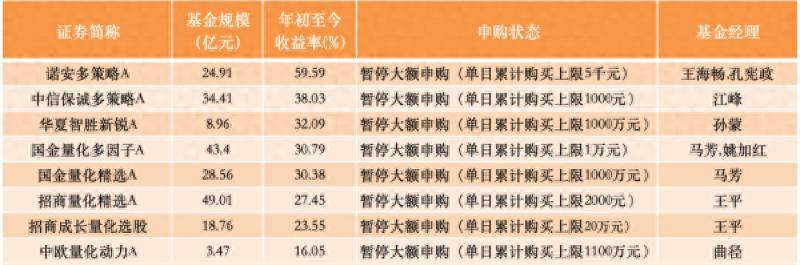
Core Viewpoint - The recent surge in small and micro-cap indices has led to significant gains, prompting many funds to implement purchase limits to protect investors and manage stock price impacts [1][2][3] Group 1: Performance of Small and Micro-Cap Indices - Small and micro-cap indices, such as the CSI 2000 and Guozheng 2000, have outperformed major indices, with increases of 34.04% and 29.29% respectively since April 7 [2] - The "micro-cap stock" index has surged over 56%, indicating a strong upward trend in small-cap stocks [2] - Funds focused on small-cap stocks have shown impressive year-to-date performance, with some funds like Nuoan Multi-Strategy Fund rising over 60% [2] Group 2: Fund Purchase Limits - Due to limited capacity for small-cap stocks to absorb large amounts of capital, several funds have implemented purchase limits to prevent significant price impacts [2][3] - Notable funds such as Nuoan Multi-Strategy and CITIC Prudential Multi-Strategy have announced multiple purchase limit measures in recent months [2][3] Group 3: Strategy Adjustments by Funds - In response to increasing fund sizes, some fund managers are reducing their holdings in small-cap stocks and reallocating funds to larger-cap stocks [3][4] - For instance, CITIC Prudential Multi-Strategy Fund's assets grew from under 700 million to 1.199 billion, leading to a decrease in individual stock weightings [3] - Other funds, like the招商量化精选, have shifted their focus from small-cap stocks to larger companies, reflecting a broader strategy change [4] Group 4: Risks and Concerns - Fund managers have expressed concerns about liquidity risks associated with micro-cap stocks, emphasizing the need for caution [5][6] - The reliance on capital inflows and momentum effects in micro-cap stocks has raised alarms about potential rapid adjustments and tail risks [6]
中小盘指数创阶段新高 相关主题基金限购或调仓
Zheng Quan Shi Bao· 2025-08-10 17:37
Core Insights - Recent performance of small and micro-cap indices has significantly outpaced major broad-based indices, with notable gains in related thematic funds [1][2] - Due to limited capacity for small-cap stocks to absorb capital, several funds have implemented purchase restrictions to protect investors [2][3] - Fund managers are adjusting strategies by diversifying investments and shifting capital towards larger-cap stocks to manage increased fund sizes [3][4] Group 1: Market Performance - Small-cap indices such as the CSI 2000 and Guozheng 2000 have seen substantial increases of 34.04% and 29.29% respectively since April 7, with micro-cap indices rising over 56% [2] - The performance of thematic funds focused on small-cap stocks has been impressive, with funds like Nuoan Multi-Strategy Fund gaining over 60% and Jianxin Flexible Allocation Fund nearly 50% year-to-date [2] Group 2: Fund Purchase Restrictions - Several funds have announced purchase limits due to the rapid increase in fund sizes and the need to protect investor interests, including Nuoan Multi-Strategy and CITIC Prudential Multi-Strategy [2][3] - Specific limits include the suspension of large purchases over 5,000 yuan for Nuoan Multi-Strategy and 1,000 yuan for CITIC Prudential Multi-Strategy, marking multiple announcements of such restrictions this year [2] Group 3: Strategy Adjustments - Fund managers are reducing their holdings in small-cap stocks to mitigate the impact on stock prices, with some funds shifting to larger-cap stocks as their assets under management grow [3][4] - For instance, CITIC Prudential Multi-Strategy Fund's assets increased from under 700 million yuan to 1.199 billion yuan, leading to a decrease in individual stock weightings [3] - Other funds, like the招商量化精选, have shifted focus from small-cap stocks to larger companies, reflecting a broader trend among funds adapting to market conditions [4]
小众策略基金破圈逆袭 业绩亮眼但长大不易
Zheng Quan Shi Bao· 2025-08-10 17:37
Core Viewpoint - The public fund industry is witnessing a shift where niche strategy funds are gaining recognition and outperforming traditional funds by exploring overlooked market segments [1][2]. Group 1: Performance of Niche Strategy Funds - Niche strategy funds have seen significant performance improvements, with some achieving continuous positive returns over five years, such as 华夏新锦绣 and 金元顺安元启 [2][3]. - 华夏新锦绣 fund, managed by 张城源, achieved a 40.5% return this year and a cumulative return of 171.90% since 2020 [2]. - 金元顺安元启 fund, managed by 缪玮彬, has delivered a 29.41% return this year and a cumulative return of 389.56% since its inception in 2017 [3]. Group 2: Strategies Employed - Niche strategy funds utilize various strategies such as private placements, quantitative stock selection, and tracking Smart Beta indices to generate excess returns [2][3]. - The 定增 strategy, employed by 张城源, allows funds to acquire stocks at a discount through targeted placements, leading to significant gains post-lockup [2]. - Quantitative strategies, as seen in 国金量化多策略, have also shown consistent positive returns, with a 16.69% return this year [3]. Group 3: Market Dynamics and Company Strategies - Smaller fund companies are leveraging their flexibility to quickly adapt and invest in niche strategies, allowing them to capture market opportunities [4]. - 国金基金's assets grew from under 3 billion to nearly 13 billion due to its successful quantitative strategy [5]. - 华泰柏瑞基金's 红利低波ETF has seen its scale increase from 258 million to 22.14 billion, becoming the largest in its category due to strong performance [5]. Group 4: Challenges Faced by Niche Strategy Funds - Niche strategy funds often face challenges such as "scale traps," where initial performance pressures can lead to significant volatility and potential liquidation risks [7][8]. - The effectiveness of niche strategies may require extended validation periods, and funds may be prematurely terminated during their development phase [8]. - Some niche strategies are highly dependent on market conditions, making them vulnerable to changes in trends or policies [8].
机构最新研判!继续看好大盘上行趋势
Zhong Guo Zheng Quan Bao· 2025-08-10 15:36
Market Overview - The A-share market indices collectively rose this week, with the Shanghai Composite Index reaching a new high for the year, increasing over 2% [1] - The Shenzhen Component and ChiNext indices saw weekly gains of 1.25% and 0.49%, respectively [1] - The upward trend of the market is supported by liquidity and ongoing policy measures, which are expected to optimize supply and demand dynamics [1] Economic Indicators - In July, the Consumer Price Index (CPI) rose by 0.4% month-on-month, reversing a previous decline of 0.1% [2] - The core CPI, excluding food and energy, increased by 0.8% year-on-year, marking a continuous expansion for three months [2] - The Producer Price Index (PPI) decreased by 0.2% month-on-month, with a year-on-year decline of 3.6% [2] Investment Insights - Dongwu Securities indicates a solid upward trend in the market, with expectations for overall profitability and return on equity (ROE) to stabilize and improve [4] - The market is shifting from traditional cyclical sectors to technology sectors, with a focus on high-quality technology assets that may yield significant excess returns in Q3 [5][9] - Open-source Securities highlights a "dual-driven" market theme, with increasing margin financing balances and a clearer market direction driven by technology and PPI trading [6] Sector Focus - Investment opportunities are emerging in technology sectors such as AI, robotics, and high-end manufacturing, as well as in defensive high-dividend sectors [7][8] - Allianz Fund anticipates significant excess returns for quality technology assets in Q3, driven by a new cycle of value reassessment in the A-share market [9] - Citic Prudential Fund emphasizes the certainty of opportunities in manufacturing companies, particularly those with improving profitability and relatively low valuations [10]
葛兰,重启限购
Zhong Guo Zheng Quan Bao· 2025-08-09 13:57
Group 1 - On August 9, China Europe Fund announced purchase limits for its funds managed by renowned fund managers, with a limit of 100,000 yuan for the China Europe Medical Innovation Fund and 1,000,000 yuan for the China Europe Science and Technology Theme Fund [1][3] - Approximately 50 actively managed equity funds have issued purchase limit announcements since July, including several high-performing products with significant returns over the past year [1][3][4] - The China Europe Medical Innovation Fund has achieved a return of over 80% in the past year, while the China Europe Science and Technology Theme Fund has seen a return of 84% as of August 8 [3][4] Group 2 - Industry experts suggest that the A-share market is expected to experience a gradual upward trend in the medium to long term, driven by increasing potential catalysts [6][5] - Allianz Fund's research department anticipates that the market will continue its upward trend in the third quarter, with a new cycle of value reassessment in the A-share market [6][5] - The third quarter is expected to see accelerated fundamentals in the technology sector, with high-quality technology assets likely to yield significant excess returns [6][5][7]
公募量化基金年内大涨超30%后纷纷限购,市场见顶了?
Sou Hu Cai Jing· 2025-08-08 15:12
Core Insights - The article highlights the performance of quantitative funds in the A-share market, with several funds achieving over 30% returns year-to-date, particularly noting the exceptional performance of the Nuon Multi-Strategy Mixed Fund with a return of 59.59% [2][3] - In response to the strong market performance, many fund managers have implemented purchase limits to manage inflows and protect existing investors, indicating a cautious approach amidst market enthusiasm [3][4] Fund Performance and Limits - As of August 7, several leading quantitative funds have reported significant year-to-date returns, with the top performers including Nuon Multi-Strategy Mixed Fund (59.59%), CITIC Prudential Multi-Strategy A (38.03%), and Guojin Quantitative Multi-Factor A (30.79%) [2][3] - The purchase limits for these funds have been set between 1,000 to 5,000 yuan per day, reflecting a strategy to control fund size and mitigate potential risks associated with large inflows [3][4] Market Dynamics and Strategy - The article discusses the delicate balance between fund size and performance, emphasizing that excessive inflows can lead to increased trading costs and reduced strategy effectiveness, particularly in small-cap stocks [3][4] - Experts suggest that limiting purchases is a common practice among quantitative strategies to prevent capacity issues and protect the interests of existing investors [3][4] Long-term Viability of Quantitative Funds - The long-term performance of quantitative funds is highlighted, with several funds showing substantial growth since inception, such as Morgan Alpha A with a return of 386.88% [5][7] - Despite the current purchase limits, the article suggests that the underlying market conditions remain favorable for quantitative strategies, as active trading and price volatility continue to provide opportunities for capturing mispriced assets [8][9] Investment Strategies and Recommendations - The article outlines various quantitative investment strategies tailored to different risk appetites, including index-enhanced products, quantitative selection strategies, and thematic investments focused on sectors like technology and AI [9][10] - Investors are advised to dynamically rebalance their strategy combinations based on market conditions, with suggested allocations for conservative, balanced, and aggressive investors [10]