
中简科技

Search documents
2025年中国加固材料行业发展历程、产业链、市场规模、竞争格局及未来趋势研判:建筑加固改造的需求增加,加固材料市场规模近千亿元[图]
Chan Ye Xin Xi Wang· 2025-07-29 01:24
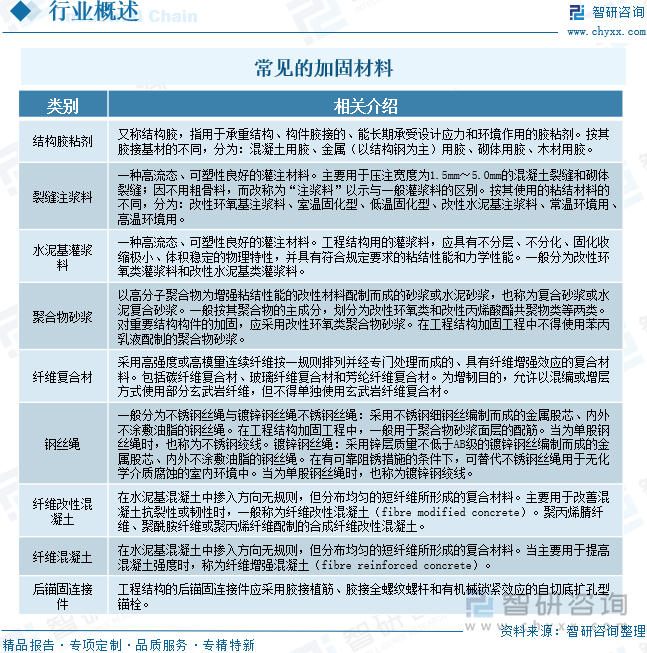
Core Viewpoint - The reinforcement materials industry in China is experiencing significant growth driven by urbanization, aging infrastructure, and increasing safety standards, with the market expected to reach approximately 914.2 billion yuan in 2024, reflecting a year-on-year growth of 7.7% [1][13]. Industry Overview - Reinforcement materials are essential in civil engineering, used to strengthen existing structures to meet new safety and usage requirements. Common types include structural adhesives, crack injection materials, cement-based grouting materials, polymer mortars, and fiber-reinforced composites [3][4]. Industry Development History - The reinforcement materials industry has evolved through three stages: early development, growth, and modern development, with significant advancements in carbon fiber cloth technology and chemical grouting materials [5]. Industry Chain - The reinforcement materials industry chain consists of upstream raw materials and production equipment, midstream manufacturing, and downstream application fields, including building reinforcement, bridge engineering, and water conservancy projects [7]. Key Application Areas - The bridge engineering sector is a major application area for reinforcement materials, addressing issues like structural aging and damage. The total length of roads and bridges in China is projected to grow from 5.756 million kilometers in 2019 to 6.466 million kilometers by 2024, with a compound annual growth rate of 2.35% [11]. Market Dynamics - The carbon fiber cloth market is expected to reach approximately 7.713 billion yuan in 2024, driven by its high strength, lightweight, and ease of application in various structural reinforcement projects [14]. Competitive Landscape - The global reinforcement materials industry features a diverse competitive landscape, with international brands like Sika, Hilti, and Toray competing alongside domestic companies such as Hanma and Guterbang, which leverage technological innovation to gain market share [17][20]. Future Trends - The industry is moving towards smart technology integration, with IoT and big data enhancing monitoring and predictive maintenance capabilities. Additionally, there is a shift towards green materials, with a focus on low-carbon and recyclable options, and a trend towards comprehensive service models that integrate design, construction, and maintenance [25][27][28].





握紧产业链发展“金钥匙” 新材料喜迎空天时代
Zheng Quan Ri Bao· 2025-07-28 17:09
Core Insights - The aerospace industry is experiencing a significant transformation driven by advancements in new materials, particularly composite materials, which are essential for meeting the demands of weight reduction, increased range, and cost efficiency in aerospace applications [1][2][5]. Group 1: Aerospace Material Innovations - The shift from traditional metal materials to advanced composite materials is crucial for the aerospace sector, with carbon fiber composites being highlighted for their lightweight and high-strength properties [2][3]. - The global aerospace composite materials market is projected to reach approximately 428.54 billion yuan by 2029, indicating a robust growth trajectory [1]. - Carbon fiber composites are becoming increasingly important in the aerospace field, with applications in both manned and unmanned aerial vehicles, significantly enhancing performance metrics such as range and fuel efficiency [2][3]. Group 2: Low-altitude Economy and eVTOL Development - The eVTOL (electric Vertical Take-Off and Landing) industry is expected to see a dramatic increase in demand for composite materials, with projections indicating a rise from approximately 500 tons in 2024 to 11,750 tons by 2030, reflecting a growth rate of about 22.5 times [3]. - Companies are forming partnerships to advance the lightweighting of aircraft, which is essential for the development of a comprehensive transportation network that integrates ground and air travel [3]. Group 3: Domestic Innovation and Market Growth - China's aerospace materials sector is in a phase of self-innovation, with increasing domestic production rates of high-end composite and alloy materials, supporting the mass application of domestic aircraft and low-altitude vehicles [4][5]. - The aerospace equipment industry is transitioning from a scale of hundreds of billions to trillions, with new materials playing a pivotal role in this evolution [5]. Group 4: Additive Manufacturing and Future Prospects - The commercial space industry is demanding more complex materials, particularly for reusable rocket technologies, which require materials that can withstand extreme temperatures and conditions [6][7]. - Additive manufacturing (3D printing) is emerging as a key technology in the aerospace sector, enabling the production of complex components while reducing costs and production times [6][7]. - The domestic market for additive manufacturing in the commercial space sector is expected to range between 10.5 billion yuan and 24 billion yuan from 2025 to 2030, highlighting significant growth potential [7].
公告精选︱惠城环保:上半年净利润502.04万元 同比降低85.63%;居然智家:实际控制人、董事长兼CEO汪林朋逝世




Sou Hu Cai Jing· 2025-07-28 14:14
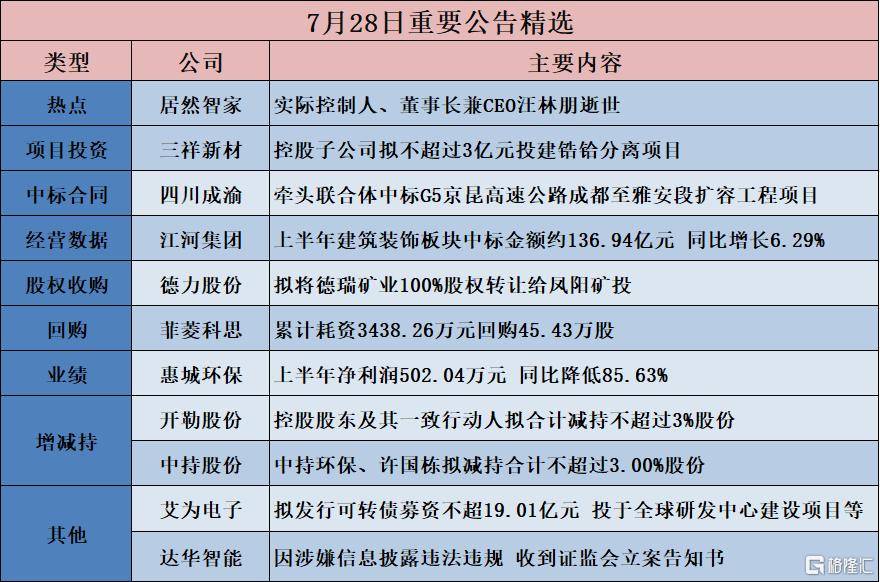
Key Points - The actual controller, chairman, and CEO of Juran Smart Home, Wang Linpeng, has passed away [1] - Jianghe Group's construction and decoration segment won contracts worth approximately 13.694 billion yuan in the first half of the year, representing a year-on-year increase of 6.29% [2] - Dele Shares plans to transfer 100% equity of Derui Mining to Fengyang Mining Investment [2] - Sichuan Chengyu led a consortium that won the bid for the G5 Jingkun Expressway expansion project from Chengdu to Ya'an [1] - Huai City Environmental Protection reported a net profit of 5.0204 million yuan in the first half of the year, a year-on-year decrease of 85.63% [2] - Awei Electronics intends to issue convertible bonds to raise no more than 1.901 billion yuan for the construction of a global R&D center [3] - The company Tianyi plans to participate in the e-enterprise network terminal production procurement project [1]
中简科技(300777) - 关于公司董事减持股份的预披露公告
2025-07-28 12:55
证券代码:300777 证券简称:中简科技 公告编号:2025-054 中简科技股份有限公司 关于公司董事减持股份的预披露公告 公司董事温月芳保证向本公司提供的信息内容真实、准确、完整,没有虚假记载、误 导性陈述或重大遗漏。本公司及董事会全体成员保证公告内容与信息披露义务人提供的 信息一致。 特别提示: 近日,中简科技股份有限公司(以下简称"公司"、"本公司")收 到董事温月芳女士的书面通知,其直接持有公司股份 9,443,180 股,占 公司总股本(剔除公司回购专用证券账户中股份数量)比例 2.1649%, 计划在公司公告发布之日起 15 个交易日后的 3 个月内(2025 年 8 月 19 日至 2025 年 11 月 18 日),以集中竞价或大宗交易方式,合计减 持本公司股份 2,360,795 股,占公司总股本(剔除公司回购专用证券 账户中股份数量)比例 0.5412%。 一、股东的基本情况 1、股东名称:温月芳 2、股东持有股份的总数量、占公司总股本的比例:截至本公告 日,公司董事温月芳女士直接持有公司股份 9,443,180 股,占公司总 股本(剔除公司回购专用证券账户中股份数量)比例 2.164 ...
股市必读:中简科技(300777)7月25日董秘有最新回复
Sou Hu Cai Jing· 2025-07-27 19:22
Core Viewpoint - The company is actively managing its market value and addressing shareholder concerns while navigating recent challenges related to information disclosure and investment activities. Group 1: Company Performance and Market Activity - As of July 25, 2025, Zhongjian Technology (300777) closed at 36.16 yuan, down 0.52%, with a turnover rate of 1.77% and a trading volume of 74,800 shares, amounting to a transaction value of 270 million yuan [1] - On July 25, the net outflow of main funds was 12.72 million yuan, while speculative funds saw a net inflow of 27.21 million yuan, and retail investors experienced a net outflow of 14.49 million yuan [12] Group 2: Corporate Governance and Shareholder Communication - The company emphasized that any statements made by board member Wen Yuefang on other platforms were personal actions and not officially sanctioned, and the company has fulfilled its disclosure obligations [2] - The company is focused on enhancing investor communication and optimizing information disclosure to stabilize market expectations, indicating that the company's performance has not been materially affected [2] - The company is actively working on the share transfer process related to Sinopec's investment and is committed to improving operational efficiency [3][4] Group 3: Strategic Investments and Business Development - The company is in the process of acquiring a 6.03% stake in Sanqiang Composite Materials, which operates in a similar field, but the company asserts that there is no direct competition due to differences in product offerings [5] - The establishment of Jiangsu Changhong Functional Materials Co., Ltd. aims to advance the research and production of carbon fiber prepregs, expanding the application of carbon fiber materials [6] - The company is committed to maintaining a robust governance structure to prevent conflicts of interest and ensure shareholder rights are protected [10]
风格变了!中石化,2亿入局又一“小巨人”
DT新材料· 2025-07-27 14:32
Core Viewpoint - China Petrochemical Corporation (Sinopec) has changed its investment strategy, focusing on established companies and sectors with lower risk, such as waste resource utilization and hydrogen energy, as evidenced by its recent investment in Zhejiang Fengdeng Green Energy Environmental Protection Co., Ltd. [1][6][8] Group 1: Investment Details - Sinopec Capital has invested 200 million RMB in Fengdeng Green Energy, becoming the second-largest shareholder with approximately 9.7% ownership. The funds will be used for the construction of "waste-free parks" in Zhejiang and Shandong [1]. - Fengdeng Green Energy, originally established in 1965, specializes in the efficient resource utilization of waste, successfully converting hazardous waste into high-purity hydrogen and lithium battery materials [1][2]. Group 2: Investment Strategy Shift - Sinopec's investment style has shifted significantly since mid-2024, moving away from early-stage projects to focus on established companies in the new materials sector, such as XCMG Group and Wanrun Co., Ltd. [3][4]. - The change in investment strategy is attributed to the cooling of the capital market and the high failure rate of early-stage projects, leading Sinopec to prefer industry leaders and "little giant" enterprises recognized by the state [6][7]. Group 3: Market Context - The capital market has seen a slowdown in IPOs since last year, with a notable recovery only around June 2024, which has extended the timeline for exit and monetization for investors [6]. - Sinopec's investments in mature companies allow for quicker returns, as demonstrated by the comparable net profits of Sinopec and leading companies like CATL, despite significant differences in revenue [7]. Group 4: Strategic Alignment - Sinopec's investments align with national strategies, particularly in emerging sectors like hydrogen energy and resource recycling, as seen with its establishment of a hydrogen fund and participation in the China Resource Recycling Group [8].

石化化工反内卷稳增长系列之七:碳纤维:当前行业处周期底部,需求持续向好景气度有望改善
EBSCN· 2025-07-25 07:48
Investment Rating - The report maintains an "Overweight" rating for the carbon fiber industry [1] Core Viewpoints - The carbon fiber industry is currently at the bottom of its cycle, with demand expected to improve, leading to a potential increase in industry prosperity [4] - Domestic carbon fiber prices have been declining since 2022, but are now stabilizing, with a current price of 83.75 RMB/kg, down 8.2% year-on-year [4] - The average gross profit margin for the carbon fiber industry is currently -0.83 thousand RMB/ton, but has improved by 1.25 thousand RMB/ton since the beginning of the year [4] - The total carbon fiber production capacity in China is 159,500 tons, with expected new capacities of approximately 46,530 tons from 2025 to 2028 [5] - The "anti-involution" policy is expected to help reduce supply and increase industry concentration, improving overall industry conditions [5] Summary by Sections Demand Trends - Global carbon fiber demand is projected to reach 156,100 tons in 2024, a year-on-year increase of 35.7%, with significant growth in the wind power sector (120% increase) [6] - In China, total carbon fiber demand is expected to be 84,000 tons in 2024, up 21.7% year-on-year, with domestic supply increasing by 27.6% [6] Domestic Production and Technology - The domestic carbon fiber industry has accelerated its localization process since the 21st century, overcoming previous technological barriers [7] - A complete industrial system for carbon fiber production has been established in China, with capabilities for high-performance carbon fiber production [7] Investment Recommendations - The report suggests focusing on leading companies such as Jilin Chemical Fiber, Jilin Carbon Valley, Zhongfu Shenying, Shanghai Petrochemical, Zhongjian Technology, and Jinggong Technology, as they are expected to benefit from improved supply-demand dynamics [8]
北化潘凯教授:尼龙弹性体分子设计制备及应用
DT新材料· 2025-07-24 15:41
Core Viewpoint - The article discusses the development and application of thermoplastic elastomers based on polyamide (TPAE), highlighting their mechanical properties, temperature resistance, and versatility in various industries such as footwear, medical devices, and consumer electronics [1]. Group 1: TPAE Characteristics and Applications - TPAE is composed of hard segments made from polyamide, which provide high mechanical strength and melting point, and soft segments from polyether or polyester, which offer elasticity [1]. - The material can be tailored for different performance characteristics by adjusting the ratio of hard to soft segments, making it suitable for diverse environments [1]. - TPAE is widely used in industries including footwear, medical devices, and consumer electronics, and can also serve as a permanent antistatic agent in other engineering plastics [1]. Group 2: Production and Market Landscape - The production of polyamide elastomers has a high technical barrier, with major types including PA6, PA66, PA1012, PA11, and PA12 elastomers [1]. - Key international manufacturers include Arkema, Evonik, and Ube Industries, while domestic producers in China include Wanhua Chemical, Xinyuan Chemical, and others [1]. - Many companies are collaborating with universities to achieve breakthroughs in the independent research and large-scale production of nylon elastomers [1]. Group 3: Research and Development - Professor Pan Kai from Beijing University of Chemical Technology has been actively involved in the design, preparation, and application of new polyamide materials, successfully developing a series of nylon elastomers that break foreign monopolies [2]. - His research includes optimizing key technologies such as polymerization methods and segment ratio adjustments to enhance the performance of nylon elastomers [2]. - The development of composite materials based on nylon elastomers has also been pursued, including applications in foaming, elastic fibers, and 3D printing [2]. Group 4: Upcoming Events - The 2025 Polymer Industry Annual Conference will be held in Hefei from September 10-12, focusing on the theme "The Rise of China's Emerging Industries Leading the Next Decade of Polymers" [8]. - The conference will feature thematic industry meetings, innovation exhibitions, and awards, providing a platform for collaboration and technological innovation in the polymer sector [8].
化工行业新材料周报(20250714-20250720):KimiK2模型发布,本周金属硅、PBAT、缬氨酸价格上涨-20250721
Huachuang Securities· 2025-07-21 10:16
Investment Rating - The report maintains a recommendation for metals silicon, PBAT, and valine, indicating a positive outlook for these materials in the chemical industry [1]. Core Insights - The new materials sector outperformed the broader market and the basic chemical sector, with a weekly change of 1.37% for the new materials index compared to 1.17% for the basic chemical index and 1.09% for the CSI 300 index [8]. - Price increases were noted for metals silicon (+3.16%), PBAT (+0.51%), and valine (+0.35%), while significant declines were observed in electronic-grade hydrogen peroxide (-3.86%), 6F (-1.01%), and epoxy resin (-0.88%) [8][21]. - The report highlights the importance of the new materials sector, particularly in semiconductor materials, which showed significant gains [8][25]. Industry Updates - The Ministry of Industry and Information Technology held a meeting with photovoltaic companies to address low-price competition and promote the exit of outdated production capacity, aiming for sustainable development in the solar industry [9]. - The easing of trade tensions between China and the U.S. has led to a recovery in trade inquiries and shipping prices, positively impacting chemical prices [10]. - The report emphasizes the potential for growth in the new materials sector, particularly in areas that require domestic production capabilities and have been historically reliant on imports [11]. Trading Data - The Huachuang Chemical Industry Index stood at 73.06, reflecting a decrease of 0.22% week-on-week and a year-on-year decline of 25.03% [17]. - The industry inventory percentile is at 91.12%, indicating a high level of stock relative to the past five years [17].
市场形态周报(20250714-20250718):本周指数普遍上涨-20250721
Huachuang Securities· 2025-07-21 07:12
Quantitative Models and Construction Methods 1. Model Name: Heston Model - **Model Construction Idea**: The Heston model is used to calculate the implied volatility of near-month at-the-money options, serving as a market fear index. It reflects market participants' expectations of future volatility [7] - **Model Construction Process**: The Heston model is a stochastic volatility model where the variance of the asset price follows a mean-reverting square-root process. The model is defined by the following equations: $$ dS_t = \mu S_t dt + \sqrt{v_t} S_t dW_t^S $$ $$ dv_t = \kappa (\theta - v_t) dt + \sigma \sqrt{v_t} dW_t^v $$ where: - \( S_t \): Asset price - \( v_t \): Variance of the asset price - \( \mu \): Drift term - \( \kappa \): Speed of mean reversion - \( \theta \): Long-term variance - \( \sigma \): Volatility of variance - \( W_t^S, W_t^v \): Two Wiener processes with correlation \(\rho\) [7] - **Model Evaluation**: The Heston model is widely recognized for its ability to capture the stochastic nature of volatility, making it suitable for modeling market fear indices [7] --- Quantitative Factors and Construction Methods 1. Factor Name: Multi-Industry Timing Factor (Scissors Difference) - **Factor Construction Idea**: This factor is based on the difference in the number of stocks with bullish and bearish signals within an industry. It aims to identify timing opportunities by analyzing the divergence between bullish and bearish signals [14] - **Factor Construction Process**: - Define the number of stocks with bullish signals (\(N_{bullish}\)) and bearish signals (\(N_{bearish}\)) in an industry on a given day - If no bullish or bearish signals are present, set the respective count to 0 - Calculate the scissors difference as: $$ \text{Scissors Difference} = N_{bullish} - N_{bearish} $$ - Normalize the scissors difference to obtain a ratio: $$ \text{Scissors Ratio} = \frac{N_{bullish} - N_{bearish}}{N_{bullish} + N_{bearish}} $$ - Use this ratio to construct an industry timing strategy [14] - **Factor Evaluation**: The backtesting results show that the scissors difference timing model outperforms the respective industry indices in all cases, demonstrating excellent historical performance [14] --- Model Backtesting Results 1. Heston Model - Implied volatility for major indices: - **Shanghai 50**: 13.5% (down 0.91% from last week) - **Shanghai 500**: 15.29% (down 0.11% from last week) - **CSI 1000**: 16.79% (down 1.3% from last week) - **CSI 300**: 13.65% (down 0.83% from last week) [9] --- Factor Backtesting Results 1. Multi-Industry Timing Factor (Scissors Difference) - Backtesting results for selected industries: - **Real Estate**: Strategy annualized return 13.18%, maximum drawdown -34.3%; Index annualized return -1.21%, maximum drawdown -75.09% - **Light Manufacturing**: Strategy annualized return 21.84%, maximum drawdown -37.91%; Index annualized return 2.76%, maximum drawdown -67.79% - **Coal**: Strategy annualized return 28.73%, maximum drawdown -24.76%; Index annualized return -0.1%, maximum drawdown -69.7% - **Pharmaceuticals**: Strategy annualized return 19.22%, maximum drawdown -42.71%; Index annualized return 6.69%, maximum drawdown -55.37% [15][16]