
中海油服

Search documents
大行评级|摩根大通:列中石化炼化工程为行业首选 目标价上调至8.4港元
Ge Long Hui A P P· 2025-09-19 02:59
Core Viewpoint - Morgan Stanley's research report indicates that certain stocks in China's oil service and oil engineering sector have outperformed the industry average and Brent crude price increases over the past six months, driven by record-high new order volumes, stable backlog, strong delivery capabilities, and positive outlooks for capital expenditures from Chinese oil companies and new orders in overseas markets [1] Group 1: Company Recommendations - Sinopec Engineering is identified as the top pick in the industry, expected to achieve steady revenue and profit growth due to strong order growth momentum, with a projected dividend yield of 6% to 7%. The target price has been raised from HKD 7.1 to HKD 8.4, maintaining an "Overweight" rating [1] - CNOOC Services is expected to see a 20% year-on-year profit growth in FY2025 due to improved capacity utilization and order terms, with its H-share target price adjusted down from HKD 11 to HKD 10.4, also rated "Overweight" [1] - Sinopec Oilfield Services is noted for effective cost control and improved shareholder returns, with its H-share target price increased from HKD 0.92 to HKD 1.0. Meanwhile, CNOOC Engineering's target price has been raised from HKD 6.4 to HKD 7.1 following a new contract with Qatar Energy [1]
2025年1-4月天津市能源生产情况:天津市发电量239.6亿千瓦时,同比下滑15.8%
Chan Ye Xin Xi Wang· 2025-09-19 01:20
Group 1 - The core viewpoint of the article highlights the decline in electricity generation in Tianjin, with a significant drop of 23.3% in April 2025 compared to the previous year, and a 15.8% decrease in the first four months of 2025 [1] - In terms of electricity generation by type, thermal power accounted for 88.2% of the total generation in the first four months of 2025, with a year-on-year decline of 18.6%, while wind power saw a growth of 34.8%, contributing 6.4% to the total generation [1] - Solar power generation in Tianjin also experienced a decline of 4.1%, making up 5.4% of the total generation in the same period [1] Group 2 - The report referenced is the "2025-2031 China Energy Industry Market Research Analysis and Investment Prospect Assessment Report" published by Zhiyan Consulting, indicating a focus on the energy sector's future trends and investment opportunities [1] - The statistical data presented is based on large-scale industrial enterprises, defined as those with annual main business revenues of 20 million yuan or more, ensuring consistency in year-on-year comparisons [2]


OPEC+8月已按计划上限实施增产 | 投研报告
Zhong Guo Neng Yuan Wang· 2025-09-18 01:43
Oil Price Sector - As of September 16, 2025, the prices for Brent crude, WTI crude, Russian EPSO crude, and Russian Urals crude are $68.47, $64.52, $63.69, and $65.49 per barrel respectively [1][2] - The month-on-month price changes for major oil products are as follows: Brent crude (+2.81%), WTI crude (+2.90%), Russian EPSO (+3.02%), and Russian Urals (0.00%) [1][2] - Year-to-date price changes from the beginning of 2025 to September 16, 2025, show Brent crude (-9.82%), WTI crude (-11.77%), Russian EPSO (-11.48%), and Russian Urals (-4.41%) [2] Oil Inventory Sector - The IEA, EIA, and OPEC predict global oil inventory changes for 2025 to be +195.06, +171.83, and -53.06 thousand barrels per day respectively, with adjustments from August predictions being +17.80, +9.25, and -17.83 thousand barrels per day [2] - The average forecast for global oil inventory changes in 2025 is +104.61 thousand barrels per day, an increase of +3.07 thousand barrels per day from the previous month [2] Oil Supply Sector - For September 2025, the IEA, EIA, and OPEC predict global oil supply to be 10,582.51, 10,552.82, and 10,460.46 million barrels per day respectively, with increases from 2024 supply being +267.18, +233.92, and +200.88 million barrels per day [3][4] - The 2026 oil supply predictions are 10,787.62, 10,664.34, and 10,618.42 million barrels per day, reflecting increases of +205.12, +111.53, and +157.96 million barrels per day from 2025 [3] Oil Demand Sector - The IEA, EIA, and OPEC forecast global oil demand for 2025 to be 10,387.45, 10,380.99, and 10,513.52 million barrels per day respectively, with year-on-year increases of +73.68, +89.62, and +129.47 million barrels per day [5] - For Q3 2025, the demand predictions are +93.54, +116.34, and +156.83 million barrels per day, with adjustments from August predictions being +40.99, +12.22, and -0.07 million barrels per day [5] Related Companies - Relevant listed companies include China National Offshore Oil Corporation (CNOOC), China Petroleum & Chemical Corporation (Sinopec), and China National Petroleum Corporation (PetroChina) among others [6]
原油月报:OPEC+8月已按计划上限实施增产-20250917
Xinda Securities· 2025-09-17 09:18
Investment Rating - The report maintains a "Positive" investment rating for the oil processing industry [1] Core Insights - The report highlights that OPEC+ has implemented production increases as planned in August 2025, indicating a recovery in oil supply [1] - Predictions for global oil supply and demand are optimistic, with significant increases expected in 2025 and 2026 [2][32] - The report emphasizes the importance of geopolitical factors and OPEC+ production policies in influencing oil prices and market stability [4] Supply and Demand Overview - IEA, EIA, and OPEC predict global oil supply for 2025 to be 10582.51, 10552.82, and 10460.46 million barrels per day respectively, showing increases from 2024 [2][32] - For 2026, the predicted supply is 10787.62, 10664.34, and 10618.42 million barrels per day, indicating continued growth [2][32] - Global oil demand predictions for 2025 are 10387.45, 10380.99, and 10513.52 million barrels per day, with increases from 2024 [2][32] Price Trends - As of September 16, 2025, Brent crude oil is priced at $68.47, WTI at $64.52, and Russian ESPO at $63.69, with recent price changes showing slight increases [9][10] - Year-to-date price changes show Brent down by 9.82%, WTI down by 11.77%, and Russian ESPO down by 11.48% [9][10] Inventory Insights - Global oil inventory changes are predicted to be +195.06, +171.83, and -53.06 thousand barrels per day for 2025, with an average increase of +104.61 thousand barrels per day [27] - For 2026, the average inventory change is expected to be +150.95 thousand barrels per day [27] Related Companies - Key companies in the industry include China National Offshore Oil Corporation (CNOOC), China Petroleum & Chemical Corporation (Sinopec), and China National Petroleum Corporation (PetroChina) [4]
趋势研判!2025年中国深海资源开发行业政策、发展现状、细分市场、企业布局及战略前景分析:深海资源开发技术迭代加速,万亿产业蓝海正待深度掘金[图]
Chan Ye Xin Xi Wang· 2025-09-17 01:11
Core Insights - Deep-sea resource development focuses on areas deeper than 200 meters, encompassing strategic resources such as minerals, energy, and biological resources, which are crucial for overcoming land resource limitations and ensuring national security [1][2] - The Chinese government has integrated deep-sea development into its national security strategy, designating it as a strategic emerging industry in the 2025 government work report, supported by a special fund of 50 billion yuan for marine economy [1][5] - The industry is projected to reach a scale of 3.25 trillion yuan by 2025 and exceed 5 trillion yuan by 2030, driven by significant growth in oil and gas development, mining, and biopharmaceutical sectors [1][9] Industry Overview - Deep-sea resource development involves exploration, extraction, and utilization of resources in deep-sea areas, aiming to acquire strategic resources through advanced technologies [2][3] - The sector is categorized into five main types: deep-sea mineral resources, oil and gas resources, biological resources, energy resources, and spatial resources [3] Development Drivers - National strategy and policy support are key drivers, with deep-sea development included in China's national security framework and significant funding allocated to support technological advancements [5][6] - The high dependency on foreign oil and gas, with over 70% reliance, necessitates deep-sea oil and gas development as a strategic solution to energy security [5][6] - Technological breakthroughs and domestic equipment manufacturing have positioned China to lead in deep-sea resource development, enhancing its global competitiveness [6][7] Current Industry Status - The deep-sea economy is rapidly growing, with the marine economy reaching 10.54 trillion yuan in 2024, driven by significant demand in deep-sea oil and gas and biological resource development [8][9] - The deep-sea oil and gas sector has seen substantial advancements, with the first ultra-deepwater gas field "Deep Sea No. 1" entering production, marking China's entry into the global first tier of deep-sea oil and gas development [10][11] Corporate Landscape - Major companies in the deep-sea resource development sector include China National Offshore Oil Corporation, China Shipbuilding Industry Corporation, and others, forming a comprehensive ecosystem from resource development to equipment manufacturing [13][14] - The industry is characterized by a full-chain ecosystem that integrates resource development, equipment manufacturing, technological innovation, and regional collaboration [13][14] Future Trends - The industry is expected to evolve towards technological integration and intelligence, with AI and quantum sensing driving automation and efficiency in exploration and extraction processes [15][16] - Environmental sustainability will become a core focus, with the adoption of eco-friendly technologies and the establishment of monitoring systems to minimize ecological impact [16][17] - Expansion into ultra-deepwater and polar regions will reshape the competitive landscape, necessitating international cooperation and standard-setting to address high costs and technical challenges [17][18]







Equinor obtains two drilling permits in North Sea
Yahoo Finance· 2025-09-16 09:44
Core Insights - Norwegian energy company Equinor has obtained two permits from the Norwegian Offshore Directorate to drill wildcat wells in the North Sea, specifically wellbore 34/4-19 S and wellbore 34/6-9 S, with planned spud dates in September 2025 and October 2025 respectively [1][3] Group 1: Drilling Permits and Licenses - The permits cover wellbore 34/4-19 S in production licence 057, which was awarded in 1979, and wellbore 34/6-9 S in production licence 554, awarded in 2010 [1][3] - Equinor operates production licence 057 with a 31% stake, while other partners include Petoro (30%), Harbour Energy Norge (24.5%), INPEX Idemitsu Norge (9.6%), and Vår Energi (4.9%) [2][3] - For production licence 554, Equinor holds a 40% interest, with Aker BP and Vår Energi each holding a 30% interest [3] Group 2: Drilling Equipment and Contracts - The 34/4-19 S well will be drilled using Odfjell Drilling's Deepsea Atlantic rig, a sixth-generation semi-submersible rig capable of operating in water depths up to 3,000 meters [2] - The Deepsea Atlantic rig is contracted to Equinor until Q2 2027, with options to extend the contract until 2030 [3] - The 34/6-9 S well will be drilled using the COSL Innovator rig, which can operate in water depths up to 750 meters, and is contracted for two years starting in Q2 2025, with options to extend until the second half of 2030 [4] Group 3: Recent Discoveries - Last month, Equinor and its partners announced an oil and gas discovery in the Fram area of the North Sea [4]

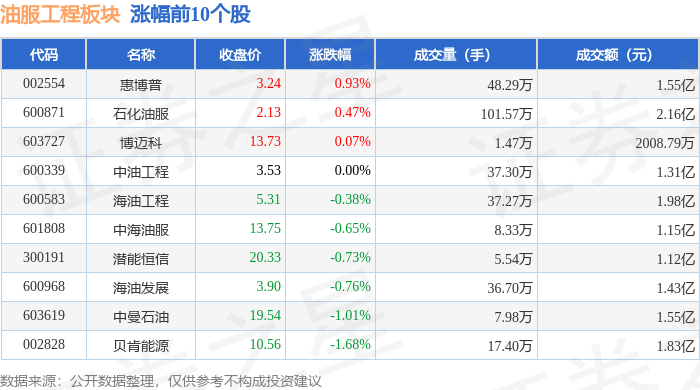
油服工程板块9月16日跌0.46%,通源石油领跌,主力资金净流出1.98亿元
Zheng Xing Xing Ye Ri Bao· 2025-09-16 08:52
Market Overview - The oil service engineering sector experienced a decline of 0.46% on September 16, with Tongyuan Petroleum leading the drop [1] - The Shanghai Composite Index closed at 3861.87, up 0.04%, while the Shenzhen Component Index closed at 13063.97, up 0.45% [1] Individual Stock Performance - Key stocks in the oil service engineering sector showed mixed performance, with Huibo Yin closing at 3.24, up 0.93%, and Beiken Energy closing at 10.56, down 1.68% [1][2] - The trading volume and turnover for notable stocks included: - Huibo Yin: 482,900 shares, turnover of 155 million yuan - Shihua Oil Service: 1,015,700 shares, turnover of 216 million yuan - Potential Energy: 55,400 shares, turnover of 112 million yuan [1][2] Capital Flow Analysis - The oil service engineering sector saw a net outflow of 198 million yuan from institutional investors, while retail investors contributed a net inflow of 153 million yuan [2][3] - Notable capital flows for specific stocks included: - Zhongyou Engineering: Institutional net inflow of 499,300 yuan, retail net inflow of 2,545,200 yuan - Beiken Energy: Institutional net outflow of 17,508,300 yuan, retail net inflow of 24,413,100 yuan [3]



地缘冲突升温,国际油价上涨 | 投研报告
Zhong Guo Neng Yuan Wang· 2025-09-15 00:52
Group 1 - The core viewpoint of the report indicates that international oil prices have risen due to a slowdown in OPEC+ production increases, compensatory cuts by member countries, and geopolitical tensions involving the U.S. and Russia, as well as ongoing conflicts in the Middle East and Ukraine [1][2]. Group 2 - As of September 12, 2025, Brent crude oil futures settled at $66.99 per barrel, an increase of $1.49 per barrel (+2.27%) from the previous week, while WTI crude oil futures settled at $62.69 per barrel, up $0.82 per barrel (+1.33%) [2]. - The price of Russian Urals crude remained stable at $65.49 per barrel, and Russian ESPO crude also held steady at $62.78 per barrel [2]. Group 3 - As of September 1, 2025, the number of global offshore self-elevating drilling rigs was 372, a decrease of 1 rig from the previous week, while the number of floating drilling rigs increased by 2 to a total of 133 [2]. Group 4 - As of September 5, 2025, U.S. crude oil production was 13.495 million barrels per day, an increase of 72,000 barrels per day from the previous week, with active drilling rigs rising to 416 [3]. - U.S. crude oil total inventory reached 830 million barrels, an increase of 4.453 million barrels (+0.54%) from the previous week, with strategic reserves at 405 million barrels, up 514,000 barrels (+0.13%) [3]. Group 5 - As of September 5, 2025, U.S. gasoline and diesel inventories increased by 145,800 barrels (+0.67%) and 471,500 barrels (+4.07%) respectively, while aviation kerosene inventory rose by 47,400 barrels (+1.11%) [4].
【石油化工】油气实现重大找矿突破,油服行业有望维持景气——行业周报第420期(0908—0914)(赵乃迪/蔡嘉豪/王礼沫)
光大证券研究· 2025-09-14 23:03
Core Viewpoint - The oil and gas industry has achieved significant exploration breakthroughs, with domestic oil and gas reserves expected to increase, benefiting oil service companies as the country deepens its reserve and production strategies [4]. Group 1: Exploration and Production Breakthroughs - The Ministry of Natural Resources announced major breakthroughs in energy mineral exploration, discovering 10 large oil fields and 19 large gas fields during the "14th Five-Year Plan" period [4]. - New oil and gas reserves have significantly increased, supporting stable oil production of 200 million tons and natural gas production exceeding 240 billion cubic meters [4]. - From 2019 to 2024, China's crude oil production is expected to grow at a CAGR of 2.2%, while natural gas production is projected to grow at a CAGR of 7.3% [4]. Group 2: Capital Expenditure Trends - Global upstream capital expenditure is projected to decline slightly to around $600 billion in 2025, a year-on-year decrease of 4%, with deepwater investments expected to drop by 6% [5]. - As of July 2025, the average day rate for jack-up rigs is $109,700, a 5.9% increase year-on-year, while semi-submersible rigs average $279,600, up 11.5% year-on-year, both at their highest levels since 2022 [5]. Group 3: Oil Service Companies' Performance - In the first half of 2025, major oil service companies benefited from the ongoing domestic "reserve and production increase" strategy and the gradual release of overseas business performance [6]. - CNOOC's oil service subsidiary reported a 23.3% year-on-year increase in net profit, while other companies like CNOOC Engineering and CNOOC Development saw net profit increases of 13.1% and a 27% rise in gross profit, respectively [6]. - The gross profit margins for CNOOC's oil service companies improved year-on-year, indicating a continuous enhancement in operational quality [6]. Group 4: International Competitiveness - In the first half of 2025, the gross profit margins of international oil service giants Schlumberger, Halliburton, and Baker Hughes decreased compared to their 2024 annual levels, while CNOOC's subsidiaries showed improvements [8]. - The annualized ROE for CNOOC's oil service companies remained resilient, with slight increases compared to 2024, indicating a potential enhancement in international competitiveness [8].



石油化工行业周报第420期:油气实现重大找矿突破,油服行业有望维持景气-20250914
EBSCN· 2025-09-14 12:32
Investment Rating - The report maintains an "Accumulate" rating for the oil and gas industry [6] Core Viewpoints - The oil and gas industry has achieved significant exploration breakthroughs, with the oil service sector expected to benefit from the ongoing domestic reserve increase and production actions [10][11] - The "Three Barrel Oil" companies have significantly increased capital expenditures from 2020 to 2023, and are expected to maintain high levels in 2024 and 2025, which will benefit their affiliated oil service companies [11][12] - Global upstream capital expenditures are projected to decline slightly in 2025, but domestic investment is expected to remain high due to supportive policies [12] - The oil service sector's performance has improved, with major companies showing resilience in profitability despite falling oil prices [21][26] Summary by Sections Oil and Gas Breakthroughs - The Ministry of Natural Resources announced major breakthroughs in energy mineral exploration, including the discovery of 10 large oil fields and 19 large gas fields during the 14th Five-Year Plan period [10] - New geological reserves of over 300 billion cubic meters have been confirmed in the Ordos Basin alone, supporting stable oil production of 200 million tons and natural gas production exceeding 240 billion cubic meters [10][11] Capital Expenditure Trends - The "Three Barrel Oil" companies plan to invest approximately 210 billion, 72.9 billion, and 130 billion yuan in upstream capital expenditures for 2025, reflecting a 6% decrease from 2024 but still maintaining high levels [11][12] - Global upstream exploration and development spending is expected to be around 600 billion USD in 2025, a 4% year-on-year decline, with deepwater investments projected to decrease by 6% [12] Oil Service Sector Performance - In the first half of 2025, major oil service companies reported significant profit increases, with CNOOC Services' net profit rising by 23.3% and CNOOC Development's by 13.1% [21] - The gross profit margins of key oil service companies have improved, with CNOOC Services, CNOOC Engineering, and CNOOC Development showing increases compared to the previous year [21][26] International Competitiveness - The international competitiveness of domestic oil service companies is expected to improve, as their return on equity (ROE) has shown resilience compared to major international competitors [26] - The gross profit margins of domestic oil service companies have increased, while international competitors have experienced declines in their margins [26] Investment Recommendations - The report suggests a positive outlook for the "Three Barrel Oil" companies and the oil service sector, as well as for leading companies in the refining and chemical sectors [5]


