爱美客

Search documents
医疗美容板块11月21日跌2.01%,*ST美谷领跌,主力资金净流出8764.51万元
Sou Hu Cai Jing· 2025-11-21 09:52
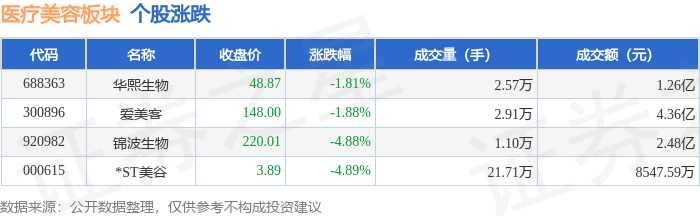
Market Overview - The medical beauty sector experienced a decline of 2.01% on November 21, with *ST Meigu leading the drop [1] - The Shanghai Composite Index closed at 3834.89, down 2.45%, while the Shenzhen Component Index closed at 12538.07, down 3.41% [1] Stock Performance - Key stocks in the medical beauty sector showed the following performance: - Huaxi Biological (688363) closed at 48.87, down 1.81% with a trading volume of 25,700 shares and a turnover of 126 million yuan [1] - Aimeike (300896) closed at 148.00, down 1.88% with a trading volume of 29,100 shares [1] - Jinbo Biological (920982) closed at 220.01, down 4.88% with a trading volume of 11,000 shares [1] - *ST Meigu (000615) closed at 3.89, down 4.89% with a trading volume of 217,100 shares and a turnover of 85.48 million yuan [1] Capital Flow - The medical beauty sector saw a net outflow of 87.65 million yuan from main funds, while retail investors contributed a net inflow of 83.50 million yuan [1] - Detailed capital flow for key stocks includes: - *ST Meigu: Main funds net outflow of 12.38 million yuan, retail net inflow of 9.03 million yuan [2] - Huaxi Biological: Main funds net outflow of 24.09 million yuan, retail net inflow of 26.09 million yuan [2] - Jinbo Biological: Main funds net outflow of 32.71 million yuan, retail net inflow of 340,200 yuan [2] - Aimeike: Main funds net outflow of 51.18 million yuan, retail net inflow of 48.38 million yuan [2]



医药生物行业双周报(2025、11、7-2025、11、20)-20251121
Dongguan Securities· 2025-11-21 07:26
Investment Rating - The report maintains an "overweight" rating for the pharmaceutical and biotechnology industry, expecting the industry index to outperform the market index by more than 10% in the next six months [4][25]. Core Insights - The SW pharmaceutical and biotechnology industry outperformed the CSI 300 index during the period from November 7 to November 20, 2025, with a decline of 1.51%, which is approximately 1.23 percentage points better than the CSI 300 index [11]. - Most sub-sectors within the industry recorded negative returns, with in vitro diagnostics and pharmaceutical distribution showing the highest gains of 2.37% and 2.27%, respectively, while medical R&D outsourcing and medical consumables experienced declines of 3.67% and 2.93% [12]. - Approximately 43% of stocks in the industry recorded positive returns during the same period, with the top performer, Hezhong China, seeing a weekly increase of 82.57% [16]. - The overall price-to-earnings (PE) ratio for the SW pharmaceutical and biotechnology industry as of November 20, 2025, was approximately 51.84 times, indicating a decrease in industry valuation [19]. Summary by Sections 1. Market Review - The SW pharmaceutical and biotechnology industry outperformed the CSI 300 index, with a decline of 1.51% compared to the index's performance [11]. - Most sub-sectors recorded negative returns, with in vitro diagnostics and pharmaceutical distribution leading in gains [12]. - About 43% of stocks in the industry had positive returns, with significant variations in individual stock performance [16]. 2. Industry News - The report highlights the announcement from the Hebei Provincial Medical Products Procurement Center regarding the centralized procurement of 25 types of medical consumables, including biopsy needles and infusion ports [23]. 3. Company Announcements - Ningbo Tianyi Medical Devices Co., Ltd. received a medical device registration certificate for its blood dialysis concentrate products [24]. 4. Industry Outlook - The report suggests focusing on investment opportunities in the flu-related sector due to the onset of the flu season, recommending several companies across various segments, including medical devices, pharmaceutical commerce, and innovative drugs [25][27].




“医美茅”跌落 简军如何续写爱美客千亿传奇?
2 1 Shi Ji Jing Ji Bao Dao· 2025-11-21 03:28
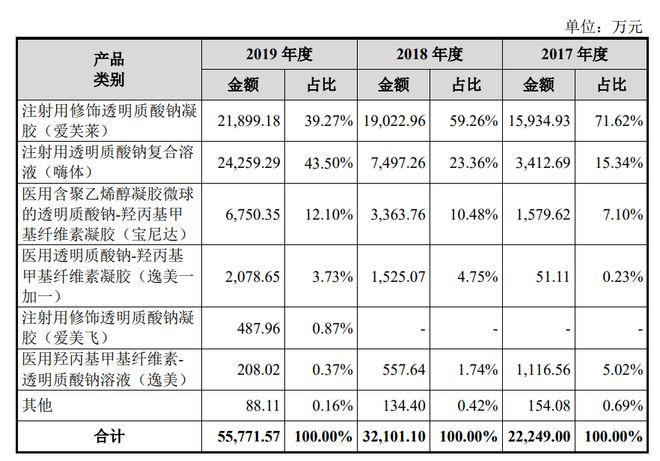
Core Viewpoint - Aimeike, once a leading player in the medical beauty industry, is facing significant challenges with declining performance and ongoing disputes over product agency rights, prompting a recent board reshuffle to address these issues [1][2][6]. Company Overview - Aimeike's actual controller, Jian Jun, was re-elected as chairman, while the management team remains stable, with Li Dongmei being promoted to a key role amid the company's current challenges [1][2]. - The company has seen a drastic decline in stock price and market capitalization, dropping from a peak of over 150 billion yuan to around 45 billion yuan [2][6]. Financial Performance - In the first half of 2025, Aimeike reported a revenue of 5.66 billion yuan and a net profit of 3.04 billion yuan, marking declines of 21.27% and 34.61% year-on-year, respectively [2][6]. - The company experienced its first negative growth in 2025, with revenue and net profit both declining over 20% [6][7]. Product Development and Market Position - Aimeike's growth has been closely tied to its innovative product development, with key products like "HiTi" and "Luhua Tianzi" driving significant revenue [3][5]. - The company has expanded its product matrix, with "HiTi" achieving a revenue share increase from 15.34% in 2017 to 43.5% in 2019 [4]. Competitive Landscape - The medical beauty industry is undergoing rapid changes, with increased competition leading to a dilution of Aimeike's product advantages, particularly for "HiTi" and "Luhua Tianzi" [7][8]. - New entrants in the market have intensified competition, with the number of approved "童颜针" products increasing to seven, further squeezing Aimeike's growth potential [8][9]. Strategic Initiatives - Aimeike is diversifying its product offerings, including the launch of new products like "Kela" and expanding into biopharmaceuticals and chemical drugs [9][10]. - The company has also pursued acquisitions, such as the purchase of a majority stake in REGEN, to enhance its product portfolio and market competitiveness [10][11]. Legal and Regulatory Challenges - Aimeike is embroiled in a significant dispute over the agency rights for its product "AestheFill," which could impact its market performance and brand partnerships [11][12]. - The ongoing arbitration with Jiangsu Wuzhong over the exclusive distribution rights of "AestheFill" highlights the complexities of brand ownership and distribution in the medical beauty sector [12][15].

医疗美容板块11月20日跌2.32%,爱美客领跌,主力资金净流出1.04亿元
Zheng Xing Xing Ye Ri Bao· 2025-11-20 09:16
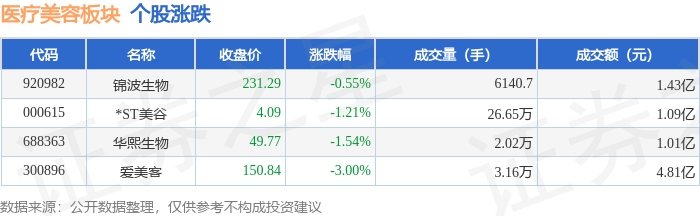
证券之星消息,11月20日医疗美容板块较上一交易日下跌2.32%,爱美客领跌。当日上证指数报收于 3931.05,下跌0.4%。深证成指报收于12980.82,下跌0.76%。医疗美容板块个股涨跌见下表: | 代码 | 名称 | 收盘价 | 涨跌幅 | 成交量(手) | 成交额(元) | | | --- | --- | --- | --- | --- | --- | --- | | 920982 | 锦波生物 | 231.29 | -0.55% | 6140.7 | | 1.43 Z | | 000615 | *ST美谷 | 4.09 | -1.21% | 26.65万 | | 1.09亿 | | 688363 | 华熙生物 | 49.77 | -1.54% | 2.02万 | | 1.01亿 | | 300896 | 爱美客 | 150.84 | -3.00% | 3.16万 | | 4.81亿 | 从资金流向上来看,当日医疗美容板块主力资金净流出1.04亿元,游资资金净流入1721.0万元,散户资金 净流入8685.88万元。医疗美容板块个股资金流向见下表: | 代码 | 名称 | 主力净流入 (元) | ...
美容护理行业资金流出榜:爱美客、水羊股份等净流出资金居前
Zheng Quan Shi Bao Wang· 2025-11-20 09:01
Market Overview - The Shanghai Composite Index fell by 0.40% on November 20, with 7 industries experiencing gains, led by construction materials and comprehensive sectors, which rose by 1.40% and 0.87% respectively [1] - The beauty and personal care industry had the largest decline, dropping by 2.39%, followed by the coal industry with a decrease of 2.10% [1] Capital Flow Analysis - The net outflow of capital from the two markets reached 47.655 billion yuan, with only 4 industries seeing net inflows [1] - The banking sector led the net inflow with 2.188 billion yuan and a daily increase of 0.86%, followed by the telecommunications sector with a net inflow of 1.000 billion yuan and a rise of 0.51% [1] Beauty and Personal Care Industry - The beauty and personal care industry saw a net outflow of 507 million yuan, with 29 stocks in the sector; only 2 stocks increased while 26 stocks declined [2] - The top net inflow stock in this sector was Jiaheng Jiahua, with an inflow of 7.3004 million yuan, followed by Yiyi Co., which had an inflow of 3.7708 million yuan [2] - Six stocks in the beauty and personal care sector experienced net outflows exceeding 30 million yuan, with the largest outflows from Aimeike (67.368 million yuan), Shuiyang Co. (60.040 million yuan), and Qingsong Co. (44.6899 million yuan) [2][3] Individual Stock Performance - Aimeike had a decline of 3.00% with a net outflow of 67.368 million yuan [2] - Shuiyang Co. dropped by 8.32% with a net outflow of 60.0396 million yuan [2] - Qingsong Co. fell by 3.78% with a net outflow of 44.6899 million yuan [2]

申万宏源证券晨会报告-20251120
Shenwan Hongyuan Securities· 2025-11-20 00:42
| 指数 | 收盘 | | 涨跌(%) | | | --- | --- | --- | --- | --- | | 名称 | (点) | 1 日 | 5 日 | 1 月 | | 上证指数 | 3947 | 0.18 | 2.79 | -1.33 | | 深证综指 | 2473 | -0.5 | 3.19 | -1.38 | | 风格指数 (%) | 昨日 | 近 1 个月 | 近 6 个月 | | --- | --- | --- | --- | | 大盘指数 | 0.47 | 1.62 | 18.44 | | 中盘指数 | -0.23 | 1.21 | 25.86 | | 小盘指数 | -0.65 | 3.59 | 22.81 | | 涨幅居前 行业(%) | 昨日 | 近 1 个月 | 近 6 个月 | | --- | --- | --- | --- | | 渔业 | 12.77 | 36.28 | 40.33 | | 贵金属 | 6.19 | -8.7 | 33.26 | | 航海装备Ⅱ | 4.22 | 3.11 | 11.04 | | 地面兵装Ⅱ | 3.33 | 3.69 | 44.5 | | 能源 ...
11月19日生物经济(970038)指数跌0.94%,成份股华兰疫苗(301207)领跌
Sou Hu Cai Jing· 2025-11-19 10:23
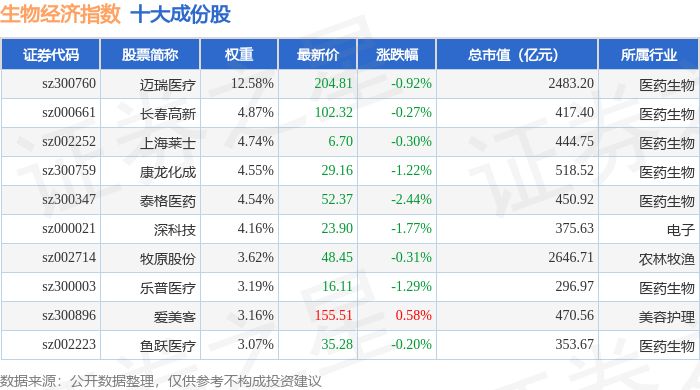
Core Insights - The Biotech Index (970038) closed at 2182.31 points, down 0.94%, with a trading volume of 13.462 billion yuan and a turnover rate of 1.08% [1] - Among the index constituents, 7 stocks rose while 42 stocks fell, with Xinlitai leading the gainers at 0.83% and Hualan Biological leading the decliners at 5.98% [1] Index Constituents Summary - The top ten constituents of the Biotech Index include: - Mindray Medical (sz300760) with a weight of 12.58%, latest price at 204.81, and a decline of 0.92% [1] - Changchun High-tech (sz000661) with a weight of 4.87%, latest price at 102.32, and a decline of 0.27% [1] - Shimeiao (sz002252) with a weight of 4.74%, latest price at 6.70, and a decline of 0.30% [1] - Kanglong Chemical (sz300759) with a weight of 4.55%, latest price at 29.16, and a decline of 1.22% [1] - Tigermed (sz300347) with a weight of 4.54%, latest price at 52.37, and a decline of 2.44% [1] - Shenzhen Technology (sz000021) with a weight of 4.16%, latest price at 23.90, and a decline of 1.77% [1] - Muyuan Foods (sz002714) with a weight of 3.62%, latest price at 48.45, and a decline of 0.31% [1] - Lepu Medical (sz300003) with a weight of 3.19%, latest price at 16.11, and a decline of 1.29% [1] - Aimeike (sz300896) with a weight of 3.16%, latest price at 155.51, and an increase of 0.58% [1] - Yuyue Medical (sz002223) with a weight of 3.07%, latest price at 35.28, and a decline of 0.20% [1] Capital Flow Analysis - The Biotech Index constituents experienced a net outflow of 1.382 billion yuan from major funds, while retail investors saw a net inflow of 1.358 billion yuan [1] - Notable capital flows include: - Aimeike (sz300896) had a net inflow of 26.5772 million yuan from major funds, but a net outflow from retail investors of 20.4422 million yuan [2] - Changchun High-tech (sz000661) saw a net inflow of 8.8418 million yuan from major funds, with a slight net inflow from retail investors of 186.25 thousand yuan [2] - Other stocks like Furuisi (sz300049) and Yuyue Medical (sz002223) also showed mixed capital flows with significant net outflows from retail investors [2]




爱美客增速从引领到落后:连续4个季度业绩双降 溢价1344%收购童颜针巨头卷入16亿元代理权仲裁案
Xin Lang Zheng Quan· 2025-11-19 09:04
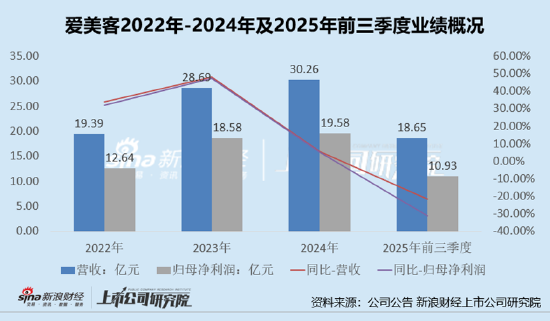
Core Viewpoint - Aimeike, once hailed as the "beauty medical leader," is facing severe challenges since its IPO, with continuous declines in both revenue and net profit over four consecutive quarters, reflecting deeper operational crises amid intensified market competition [1][2][4]. Financial Performance - In Q3 2025, Aimeike's revenue decreased by 21.27% year-on-year to 1.865 billion yuan, while net profit attributable to shareholders fell by 34.61% to 1.093 billion yuan [2][4]. - The company has experienced a downward trend in revenue and net profit since Q4 2024, with respective declines of 7%, 17.9%, 25.11%, and 21.27% for revenue, and 15.47%, 15.87%, 41.75%, and 34.61% for net profit in the last four quarters [4][6]. Inventory and Efficiency - Aimeike's inventory scale has been increasing, with a 41.66% year-on-year growth in inventory size to 96 million yuan in the first three quarters of 2025, while inventory turnover efficiency has significantly declined, with turnover days extending to 185 days, an increase of 56 days compared to the previous year [6][7]. Product Performance - The decline in Aimeike's performance is primarily attributed to the poor sales of its two core products: solution and gel injection products, which saw revenue drops of 23.79% and 23.99% respectively in the first half of 2025 [6][7]. Strategic Acquisitions - To seek growth, Aimeike has engaged in high-premium acquisitions, including a notable acquisition of REGEN Biotech for approximately 1.9 billion USD, which resulted in a significant increase in goodwill to about 1.651 billion yuan [7][10]. - The acquisition has led to legal complications, including a 1.6 billion yuan arbitration case related to the exclusive distribution rights of AestheFill, a key product from REGEN [10][11]. Market Dynamics - The injection beauty market in China is characterized by high competition and increasing numbers of approved products, which has diminished Aimeike's first-mover advantage in the hyaluronic acid injection sector [7][8]. - The company has been actively expanding its product line through mergers and acquisitions to maintain its competitive edge in the injection beauty field [8][9].
医疗美容板块11月19日涨0.23%,爱美客领涨,主力资金净流入194.42万元
Zheng Xing Xing Ye Ri Bao· 2025-11-19 08:58
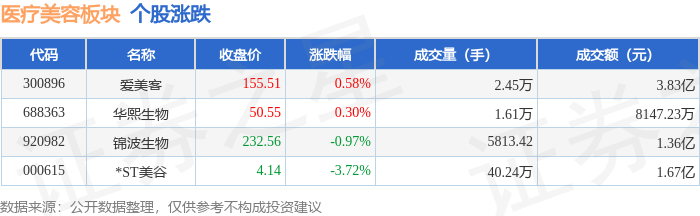
Core Insights - The medical beauty sector experienced a slight increase of 0.23% on November 19, with Ai Meike leading the gains [1] - The Shanghai Composite Index closed at 3946.74, up 0.18%, while the Shenzhen Component Index closed at 13080.09, unchanged [1] Sector Performance - Ai Meike (300896) closed at 155.51, up 0.58% with a trading volume of 24,500 and a transaction value of 3.83 billion [1] - Huaxi Biological (688363) closed at 50.55, up 0.30% with a trading volume of 16,100 and a transaction value of 81.47 million [1] - Jinbo Biological (920982) closed at 232.56, down 0.97% with a trading volume of 5,813.42 and a transaction value of 136 million [1] - *ST Meigu (000615) closed at 4.14, down 3.72% with a trading volume of 402,400 and a transaction value of 1.671 billion [1] Capital Flow - The medical beauty sector saw a net inflow of 1.9441 million from institutional investors, while retail investors experienced a net outflow of 12.0117 million [1] - Detailed capital flow for individual stocks shows Ai Meike with a net inflow of 26.5772 million from institutional investors, while *ST Meigu had a significant net outflow of 24.8225 million [2]
全球与中国滴漏咖啡机市场现状及未来发展趋势
QYResearch· 2025-11-19 01:47
Core Viewpoint - The article discusses the evolution, current status, and future trends of the drip coffee machine industry, highlighting the growing demand driven by consumer preferences for home brewing and the impact of technological advancements on product features and market dynamics [6][11][16]. Product Definition and Scope - Drip coffee machines are defined as classic devices that utilize gravity to filter coffee through a funnel with a filter paper and coffee grounds, making them user-friendly for the general public [2]. Types of Drip Coffee Machines - Automatic drip coffee machines offer convenience and consistency, requiring users to add water and coffee grounds, while the machine handles the rest, including heating water and brewing [4]. - Manual drip coffee machines rely entirely on user operation, requiring manual control of water temperature and pouring techniques [5]. Industry Background and Development - The drip coffee machine industry has evolved alongside global coffee culture and home appliance technology, with its origins tracing back to the early 20th century and significant advancements post-World War II [6]. - The introduction of electric drip coffee machines in the 1950s marked a turning point, leading to widespread adoption in households, particularly in the U.S. during the 1970s [6]. Current Industry Status - The industry exhibits a dual-track growth pattern, with mature markets focusing on brand premiumization and feature upgrades, while emerging markets like China and Southeast Asia experience rapid growth due to rising middle-class consumers [7]. - Key characteristics of the current market include technological micro-innovations, market segmentation, and heightened focus on environmental issues [8]. Future Trends - The industry is expected to see trends such as premiumization, smart technology integration, sustainability, and multifunctional designs that cater to diverse consumer needs [10]. - The global market for drip coffee machines is projected to reach $2.08 billion in sales by 2024, with an expected CAGR of 3.67% from 2025 to 2031 [11]. Market Opportunities and Drivers - Factors driving demand include the expansion of coffee culture, increased home and office consumption due to remote work trends, technological advancements improving user experience, and a growing emphasis on health and sustainability [17]. - The Chinese market is anticipated to grow from $206.17 million in 2024 to $285.71 million by 2031, reflecting a rising share of the global market [15]. Policy Analysis - Recent policies aim to promote smart and green home appliances, enhance after-sales service, and encourage foreign investment in advanced manufacturing, which will benefit the drip coffee machine sector [21].