朗新集团

Search documents
行业周报:世界机器人大会超1500款机器人产品展出,光伏产业链价格持稳-20250812
Shanxi Securities· 2025-08-12 09:02
Investment Rating - The report maintains an investment rating of "Synchronize with the market - A" for the electric equipment and new energy industry [1]. Core Viewpoints - The World Robot Conference showcased over 1,500 robot products, indicating a growing interest and innovation in robotics [3]. - The photovoltaic industry chain prices remain stable, with expectations for continued price stability in the near term [6][7][8][9]. Summary by Relevant Sections Investment Recommendations - Preferred stocks include: - Aishuo Co., Ltd. (600732.SH) - Buy - B - Longi Green Energy (601012.SH) - Buy - B - Daqian Energy (688303.SH) - Buy - B - Fulete (601865.SH) - Buy - A - Hengdian East Magnetic (002056.SZ) - Buy - A - Sungrow Power Supply (300274.SZ) - Buy - A - Canadian Solar (688472.SH) - Buy - A - Deyang Co., Ltd. (605117.SH) - Buy - A - Langxin Group (300682.SZ) - Buy - B - Quartz Co., Ltd. (603688.SH) - Buy - A [2]. Market Trends - The multi-crystalline silicon price is stable at 44.0 CNY/kg, with a slight decrease in transaction volume compared to the previous week [6]. - The silicon wafer prices remain unchanged, with N-type silicon wafers priced at 1.20 CNY/piece for 182-183.75mm and 1.35 CNY/piece for 182*210mm [7]. - Battery cell prices are stable, with N-type battery cells priced at 0.290 CNY/W for 182-183.75mm and 0.285 CNY/W for 182*210mm [8]. - Module prices are also stable, with TOPCon double-glass modules priced at 0.685 CNY/W and N-type HJT modules at 0.830 CNY/W [9]. Policy and Regulatory Developments - The National Energy Administration is establishing a "green channel" for large-scale wind and photovoltaic bases to better meet the needs of new energy development [5]. - The China Photovoltaic Industry Association is soliciting opinions on the draft amendment to the Price Law, focusing on price behavior norms and regulatory mechanisms [4].





IT服务板块8月12日涨0.21%,*ST云创领涨,主力资金净流出12.56亿元
Zheng Xing Xing Ye Ri Bao· 2025-08-12 08:28
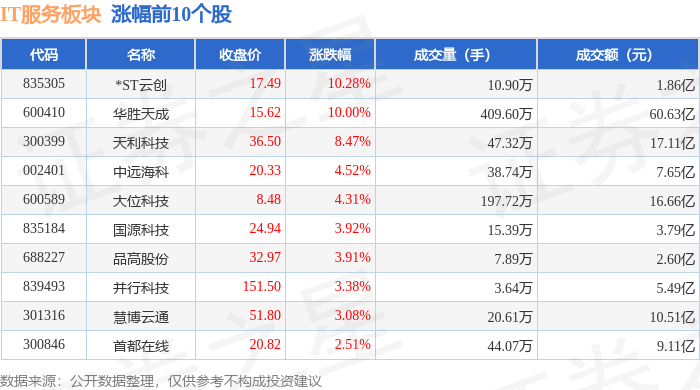
Market Performance - On August 12, the IT services sector rose by 0.21% compared to the previous trading day, with *ST Yunchuang leading the gains [1] - The Shanghai Composite Index closed at 3665.92, up 0.5%, while the Shenzhen Component Index closed at 11351.63, up 0.53% [1] Top Gainers in IT Services - *ST Yunchuang (code: 835305) closed at 17.49, up 10.28% with a trading volume of 109,000 shares and a transaction value of 186 million [1] - Huasheng Tiancai (code: 600410) closed at 15.62, up 10.00% with a trading volume of 4.096 million shares and a transaction value of 6.063 billion [1] - Tianli Technology (code: 300399) closed at 36.50, up 8.47% with a trading volume of 473,200 shares and a transaction value of 1.711 billion [1] Top Losers in IT Services - Desheng Technology (code: 002908) closed at 11.97, down 9.93% with a trading volume of 1.0512 million shares and a transaction value of 1.303 billion [2] - Zhuoyi Information (code: 688258) closed at 67.41, down 4.73% with a trading volume of 66,300 shares and a transaction value of 449 million [2] - Aerospace Hongtu (code: 688066) closed at 23.15, down 4.18% with a trading volume of 209,700 shares and a transaction value of 488 million [2] Capital Flow in IT Services - On the same day, the IT services sector experienced a net outflow of 1.256 billion from institutional investors, while retail investors saw a net inflow of 1.046 billion [2][3] - The top stocks by net inflow from retail investors included Dazhi Technology (code: 600589) with a net inflow of 225 million [3] - The top stocks by net outflow from institutional investors included Dazhi Technology (code: 600589) with a net outflow of 1.14 billion [3]


首个大模型工业互联网平台将发布 机构扎堆关注35股
Xin Hua Wang· 2025-08-12 05:48
Group 1: Industrial Internet Development - The 2023 World Manufacturing Conference will introduce the "Antelope 3.0" platform, the first industrial internet platform with large model capabilities, along with industrial large models and "digital craftsman" application scenarios [1] - In 2022, the added value of China's industrial internet industry accounted for 3.64% of GDP [1] - The industrial internet industry in China has surpassed 1.2 trillion yuan, with over 240 influential platforms and services provided to more than 260,000 enterprises [2] Group 2: Market Growth and Projections - IDC projects that by 2025, the market for industrial internet platforms and application solutions in China will reach approximately 56.1 billion USD (about 361.6 billion yuan), with a compound annual growth rate of 29.6% from 2021 to 2025 [2] - There are over 160 concept stocks related to industrial internet in the A-share market, with companies like Dingjie Software and Industrial Fulian enhancing their business layouts in smart manufacturing and industrial internet [2] Group 3: Company Innovations - Changhong Meiling's industrial internet platform emphasizes openness and scalability, leveraging AI and big data to enhance consumer experience in the home appliance sector [3] - Dongtu Technology has developed an industrial operating system and software tools, promoting software-defined control technology in the industrial field [3] Group 4: Investment Opportunities - In September, several stocks related to industrial internet saw significant investment from northbound funds, with eight stocks receiving over 100 million yuan in net purchases [4] - A total of 35 stocks are expected to have a net profit growth rate exceeding 30% in the next two years, with 13 stocks projected to double their net profit growth rate [4] - Notable stocks with significant upside potential include Nandu Power, with an expected increase of 93.71% according to Minsheng Securities [5]






不动产代币化激活万亿存量市场 RWA或成地产流动性破局新引擎
Sou Hu Cai Jing· 2025-08-11 05:23
Group 1 - The Chinese real estate industry has entered a "stock game" phase, focusing on revitalizing dormant assets and optimizing capital allocation [1] - Real World Assets (RWA) utilize blockchain and smart contract technology to tokenize large real estate properties, significantly lowering investment thresholds and introducing liquidity mechanisms [1][2] - The global RWA asset scale is projected to reach $25.4 billion by August 2025, with the market potentially exceeding $16 trillion by 2030 [4] Group 2 - Hong Kong is set to launch the "Digital Asset Development Policy Declaration 2.0" in 2025, allowing tokenized real estate to be traded through licensed platforms [2] - Institutions like Greenland Jinchuang and Delin Holdings have initiated pilot projects, such as splitting a commercial property into 1 million NFT certificates, raising HK$2.9 billion [2] - Internationally, Europe’s Blocksquare has completed over $200 million in real estate tokenization, while Dubai aims for 7% of property transactions to be tokenized by 2033 [2] Group 3 - The release of GPT-5 is pushing RWA into the "AI smart asset" era, enabling real-time monitoring of data to optimize valuations and risk management [3] - The research suggests that regulatory frameworks need to be improved, with pilot projects focusing on mature assets and adopting a "revenue rights first" lightweight model [3] - RWA is not a universal solution; addressing real demands is essential for reshaping the value chain of existing real estate [3]

“以绿制绿”激发“向新力”(新知)
Ren Min Ri Bao· 2025-08-10 21:49
Core Viewpoint - The integration of green development concepts into various sectors, including enterprise production, park construction, and daily transportation, aims to reduce resource consumption and environmental impact while enhancing development momentum and public welfare [1][4]. Group 1: Zero Carbon Parks - The concept of "zero carbon parks" refers to areas designed to minimize carbon emissions from production and living activities to near-zero levels, with the potential to achieve net-zero conditions [2]. - Zero carbon parks are significant platforms for industrial economic development and job creation, and they are major consumers of energy and carbon emitters [2]. - The core indicator for zero carbon park construction is "carbon emissions per unit of energy consumption," which measures energy utilization efficiency and environmental protection levels [2]. Group 2: Technological Support and Innovations - Achieving zero carbon production requires technological support, which can also foster new technologies and innovations [3]. - The "Energy Carbon Brain" platform developed by Longxin Technology in Wuxi integrates 3D twin and AI big data analysis for efficient energy utilization, resulting in annual carbon reductions equivalent to the CO2 absorption of over 1,000 acres of parkland [3]. - The Guangdong (Yangjiang) Green Energy Demonstration Industrial Park has developed the world's first 500 kV three-core submarine cable, saving 30% in sea area and reducing installation costs by 20% compared to traditional single-core solutions [3]. Group 3: Economic and Ecological Benefits - Promoting zero carbon parks and factories is a crucial strategy for achieving carbon neutrality, balancing resource reduction with economic growth [4]. - The Xiamen Comprehensive Bonded Zone in Fujian has introduced distributed photovoltaic projects, achieving self-sufficiency in green electricity and generating an annual profit of 4 million yuan from surplus electricity sales [4]. - The improved natural ecology in the Greater Khingan Mountains, following a logging ban, has attracted tourists and boosted the under-forest planting and breeding industry, demonstrating that economic benefits can be realized without deforestation [4]. Group 4: Broader Implementation of Zero Carbon Concepts - The zero carbon concept is being implemented in various regions, from zero carbon parks to cities and even rural areas, showcasing its practical application [4]. - The transition to green development is seen as a way to activate development momentum and enhance quality of life, with more successful stories emerging [4].
计算机行业周报:“锚”定Web3.0未来峰会,数字资产新机遇-20250810
HUAXI Securities· 2025-08-10 15:32
Investment Rating - Industry Rating: Recommended [4] Core Insights - The "Web3.0 Future Summit" held in Hong Kong on August 7, 2025, emphasized the importance of standardization in promoting digital asset and stablecoin innovation, marking a significant step towards establishing a regulatory framework for stablecoins in Hong Kong [1][13][19] - The total market value of Real World Assets (RWA) is projected to exceed $12.7 billion in 2024, with strong growth in segments like stablecoins, which have surged from $4 billion in 2020 to $156 billion, reflecting a 3800% increase [2][34] - Ant Group's AntChain has made significant advancements in the RWA space, with its Layer2 chain Jovay achieving a throughput of 100,000 transactions per second and a response time of 100 milliseconds, facilitating efficient asset data management [2][15][37] Summary by Sections Section 1: Stablecoin Regulation in Hong Kong - Hong Kong implemented a comprehensive stablecoin regulatory framework on August 1, 2025, requiring issuers to obtain licenses and meet strict capital and asset reserve requirements [13][19][23] - The regulatory framework aims to ensure that stablecoins are fully backed by high-quality liquid assets and includes measures for anti-money laundering and risk management [19][25][30] Section 2: RWA Tokenization - The RWA industry is gaining global attention, with a focus on meeting three core standards: value stability, legal clarity, and verifiable off-chain data [2][14][34] - Ant Group's initiatives in RWA have been recognized as leading examples, with successful projects in renewable energy and AI server asset tokenization [15][42][47] Section 3: Investment Recommendations - Beneficial stocks include: - Licensing: Zhongyou Capital, Bank of China Hong Kong, Bank of China Securities, Guotai Junan International, and Lianlian Digital [3][16] - Stablecoins: Yuxin Technology, Zhongke Jincai, Tianyang Technology, Xinyada, Chutianlong, and Jingbeifang [3][16] - RWA: Longxin Group, Xiexin Energy, Hopu Co., Jinko Technology, Hainan Huatie, and Aori De [3][16]
平台上线、标准立项 香港为何积极构筑RWA基础设施?
Guo Ji Jin Rong Bao· 2025-08-09 07:24
Core Viewpoint - Hong Kong is seizing the opportunity for the development of Real World Assets (RWA) by launching the world's first RWA registration platform and establishing three Web3.0 standards to facilitate the tokenization and lifecycle services of RWA assets [1][6][10]. Group 1: RWA Registration Platform and Standards - The RWA registration platform in Hong Kong will provide comprehensive lifecycle services for RWA asset tokenization, including compliance registration, information disclosure, and circulation support [1][6]. - The three Web3.0 standards aim to address key challenges in asset confirmation, valuation, and cross-border payments, promoting standardized processes and technical implementations for RWA tokenization [1][6][10]. Group 2: Challenges in RWA Development - RWA development faces structural obstacles, including a lack of unified regulatory standards for asset definition, confirmation, registration, and token issuance, particularly in cross-border transactions [3][4]. - Technical bottlenecks arise from the disconnection between on-chain and off-chain data, making it difficult to verify the authenticity and ownership of off-chain assets [3][4]. - High upfront costs and the absence of a trust system hinder participation from small and medium-sized enterprises, limiting the scope of RWA standardization [4][5]. Group 3: Infrastructure and Global Impact - The RWA registration platform is expected to establish a standardized technical system for coding, classification, identification, and evaluation of RWA assets, enhancing regulatory compliance and global adaptability [6][10]. - The platform will initially focus on financial assets, real estate, bulk commodities, and green assets, creating a new model for the integration of ESG and Web3.0 [7][8]. - Hong Kong's initiative is anticipated to accelerate the global digitalization of assets, providing a clear institutional model and technical template for other jurisdictions to follow [11][12].
平台上线、标准立项,香港为何积极构筑RWA基础设施?
Guo Ji Jin Rong Bao· 2025-08-09 07:20
Core Viewpoint - Hong Kong is seizing the opportunity to develop the Real World Asset (RWA) industry by launching the world's first RWA registration platform and establishing three Web3.0 standards to facilitate the tokenization of RWA assets [1][4][7] Group 1: RWA Registration Platform and Standards - The RWA registration platform in Hong Kong will provide comprehensive lifecycle services for RWA asset tokenization, including compliance registration, information disclosure, and circulation support [1][4] - The three Web3.0 standards aim to address key challenges in asset confirmation, valuation, and cross-border payments, promoting standardized processes and technical implementations for RWA tokenization [1][4][7] - The platform is expected to enhance the transparency and global adaptability of RWA financial services, establishing a standardized technical system for coding, classification, identification, and evaluation of RWA assets [4][5] Group 2: Challenges in RWA Development - The RWA industry faces structural barriers, including a lack of unified regulatory standards for asset definition, confirmation, registration, and token issuance, particularly in cross-border transactions [2][3] - Technical bottlenecks such as data disconnection between on-chain and off-chain assets hinder the development of RWA, making it difficult to quantify risks and establish trust [2][3] - High upfront costs associated with due diligence, auditing, and technical development pose significant challenges for small and medium-sized enterprises, limiting their participation in RWA [3][5] Group 3: Global Implications and Future Prospects - The launch of the RWA registration platform is expected to accelerate the global digitalization of assets, providing a clear institutional model and technical template for other jurisdictions [7][8] - Hong Kong's initiative may establish a "Hong Kong standard" for RWA compliance, integrating financial regulation with blockchain technology, thereby enhancing its strategic position as a global financial hub [7][8] - The platform aims to create new pathways for global capital allocation and financing efficiency, facilitating the transition of Web3.0 from virtual narratives to real-world value [8]
百亿基金经理收益回暖!张坤规模领衔,王明旭7产品年内亏损
Nan Fang Du Shi Bao· 2025-08-08 07:51
Group 1 - The core viewpoint of the articles indicates a strong recovery in the performance of actively managed equity funds in 2025, with 95% of these funds achieving positive returns and an average return exceeding 15% as of August 7 [2][3] - The pharmaceutical sector has emerged as the biggest winner, with four actively managed equity funds achieving returns that have doubled this year, all focusing on the pharmaceutical industry [4][5] - As of mid-2025, there are 90 fund managers managing over 10 billion yuan, with Zhang Kun from E Fund leading with over 50 billion yuan under management [8][9] Group 2 - The average return of actively managed equity funds has outperformed major stock indices, such as the CSI 300 and the CSI 500, which recorded returns of 4.6% and 10.6% respectively [3] - The average return of the entire market of over 4,500 actively managed equity funds is 15.03%, compared to 11.8% for over 2,500 stock index funds [3] - Despite the overall positive performance, there are still 228 actively managed equity funds with negative returns, with the worst performer, Qianhai Kaiyuan AI A, showing a return of -18.5% [4][6] Group 3 - The top-performing funds in the pharmaceutical sector include Changcheng Pharmaceutical Industry Selection, Bank of China Hong Kong Stock Connect Pharmaceutical, Yongying Pharmaceutical Innovation Selection, and Huashan Pharmaceutical Biotechnology, all achieving significant returns [4][5] - The performance of fund managers varies significantly, with some, like Zhang Wei and Zhang Lu, achieving returns of 65.8% and 53.4% respectively, while others, such as Wang Mingxu, have negative returns [12][13] - The total scale of actively managed equity funds reached 3.39 trillion yuan by mid-2025, although the total number of shares decreased by 198.24 billion compared to the end of the previous year [6][7]
香港RWA注册平台上线,继续关注RWA对虚拟电厂、电交易、碳交易的赋能 | 投研报告
Zhong Guo Neng Yuan Wang· 2025-08-08 06:09
Core Viewpoint - The launch of the RWA registration platform in Hong Kong marks a significant step in the tokenization of real-world assets, facilitated by the Hong Kong Web3.0 Standardization Association, which aims to create a comprehensive service system for data, asset, and financialization of RWA assets [1][2]. Group 1: RWA Platform and Standards - The RWA registration platform will enable the tokenization process for real-world assets, with three key standards established: "RWA Tokenization Business Guidelines," "RWA Tokenization Technical Specifications," and "Blockchain-based Stablecoin Cross-border Payment Technical Specifications" [1][2]. Group 2: Green Energy and Carbon Neutrality - The green value of electricity is becoming increasingly important as the EU implements carbon border adjustment mechanisms and regulations affecting exports from China, indicating a shift towards green electricity reforms [2]. - The Gansu thermal power capacity value exceeding expectations reflects potential changes in electricity pricing, emphasizing the importance of "green electricity direct connection," "zero-carbon parks," and "household photovoltaic aggregation participation in trading" [2]. Group 3: Dynamic Revenue Sharing - RWA projects allow for real-time distribution of revenue based on the operational performance of underlying assets, such as charging stations, where investor returns are directly linked to usage rates [2]. Group 4: Profitability of Green Power Assets - The peak-valley price difference arbitrage is identified as the core revenue source for green power asset RWAs, providing a sustainable cash flow foundation [3]. - RWA technology enhances the revenue potential and efficiency of green power assets, transitioning from traditional asset management to a model that encourages global capital sharing [3]. Group 5: Investment Opportunities - The report suggests focusing on investment opportunities that integrate RWA with electricity trading, virtual power plants, and carbon assets, recommending investments in household photovoltaics, charging stations, and carbon assets [3]. - Specific companies highlighted for potential investment include Southern Power Grid Energy, GCL-Poly Energy, Longxin Group, Zhejiang Chint Electrics, and Linyang Energy [3].