
上海瀚讯

Search documents
太空算力热度提升,航空航天ETF(159227)连续5日净流入,规模突破20亿元
Mei Ri Jing Ji Xin Wen· 2025-11-13 02:03
Group 1 - The A-share market saw all three major indices open lower, with the Aerospace ETF (159227) experiencing a slight increase of 0.09% and a trading volume of 11.17 million yuan as of 9:37 AM [1] - The Aerospace ETF (159227) has recorded a net inflow of funds for five consecutive trading days, totaling 315 million yuan, reaching a new high of over 2 billion yuan in total assets, making it the largest aerospace ETF in the market [1] - Recent developments in overseas space computing have accelerated, with Nvidia successfully sending the H100 GPU to space for testing, and Elon Musk announcing plans to expand the Starlink V3 satellite scale to establish a space data center [1] Group 2 - The characteristics of low-cost, abundant resources, and large space in space computing have provided a stable and long-term profit model for commercial aerospace [2] - The Aerospace ETF (159227) closely tracks the National Aerospace Index, which has a high military industry proportion of 98.2%, making it the highest purity military index in the market, covering key industry chain segments such as aerospace equipment, satellite navigation, and new materials [2] - The commercial aerospace concept accounts for 51.83% of the index's weight [2]
又见龙头拉升!行情“领军者”会出现吗?
Mei Ri Jing Ji Xin Wen· 2025-11-12 10:52
Market Overview - The A-share market experienced fluctuations, with the Shanghai Composite Index barely holding above the 4000-point mark, closing down 0.07% [1] - The total trading volume in the Shanghai and Shenzhen markets was 19,450 billion, a decrease of 486 billion from the previous day [1] - The number of rising stocks was 1,758, while 3,563 stocks declined, with a median decline of 0.66% [1] Index Performance - The market exhibited a "strong at both ends, weak in the middle" characteristic, with the Shanghai 50 and micro-cap stocks performing relatively well, while the Sci-Tech 50 and ChiNext indices were weaker [1] - Despite a lack of strong profit-making effects recently, the Shanghai Composite Index showed stable performance, recovering easily from intraday declines [1] Sector Analysis - Technology stocks, which had previously led the market, are currently undergoing adjustments, impacting overall market profitability [1] - Key sectors such as electric grid equipment, photovoltaics, energy storage, and lithium batteries have remained active but have had minimal impact on the index [1] - The performance of AI hardware stocks, particularly Zhongji Xuchuang, has been pivotal in driving market sentiment and could influence future index movements [2][3] Notable Stocks and Sectors - Zhongji Xuchuang has previously acted as a market leader, contributing to a rebound in AI hardware stocks and pushing the index to new highs [2] - The banking sector has shown strong performance, with the banking index reaching a historical high and Agricultural Bank of China hitting a new record [3] - The textile and apparel sector has reached a new high not seen in over seven years, while the home appliance sector is currently consolidating near its previous highs [5][6] Investment Strategies - Companies in the home appliance sector are highlighted for their defensive attributes, with stable profitability and low valuations [10] - The AI and growth trend is emphasized, particularly for companies with advantages in smart home appliances and AI content ecosystems [10] - The lithium battery sector is noted for its strong performance among upstream material stocks, although caution is advised due to recent significant price increases [10] Market Sentiment and Future Outlook - The market is currently in a state of uncertainty, prompting funds to seek defensive positions [4] - The AI industry chain is identified as a key focus for the current bull market, with attention on when AI hardware stocks will conclude their adjustments [12] - The upcoming 27th High-Tech Fair is expected to showcase significant developments in the aerospace sector, potentially influencing market dynamics [11]
军工电子板块11月12日跌0.26%,国光电气领跌,主力资金净流出7.07亿元
Zheng Xing Xing Ye Ri Bao· 2025-11-12 08:49
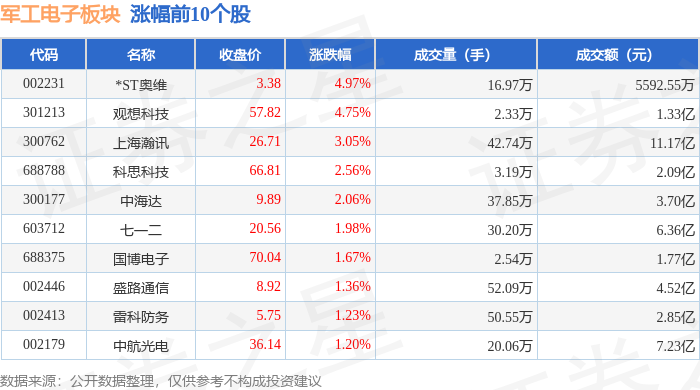
Market Overview - The military electronics sector experienced a decline of 0.26% on November 12, with Guoguang Electric leading the drop [1] - The Shanghai Composite Index closed at 4000.14, down 0.07%, while the Shenzhen Component Index closed at 13240.62, down 0.36% [1] Stock Performance - Notable gainers in the military electronics sector included: - *ST Aowei (002231): Closed at 3.38, up 4.97% with a trading volume of 169,700 shares and a turnover of 55.93 million yuan [1] - Guanshang Technology (301213): Closed at 57.82, up 4.75% with a trading volume of 23,300 shares [1] - Shanghai Jianji (300762): Closed at 26.71, up 3.05% with a trading volume of 427,400 shares [1] - Major decliners included: - Guoguang Electric (688776): Closed at 101.00, down 5.87% with a trading volume of 56,900 shares and a turnover of 578 million yuan [2] - Xingtuxinke (688081): Closed at 27.92, down 5.16% with a trading volume of 43,200 shares [2] - ST Wanfang (000638): Closed at 5.80, down 5.07% with a trading volume of 14,200 shares [2] Capital Flow - The military electronics sector saw a net outflow of 707 million yuan from institutional investors, while retail investors contributed a net inflow of 370 million yuan [2] - The capital flow for specific stocks showed: - Qiyi (603712): Net inflow of 78.32 million yuan from institutional investors, but a net outflow of 61.79 million yuan from retail investors [3] - Shanghai Chao Xun (300762): Net inflow of 76.72 million yuan from institutional investors, with a net outflow of 91.90 million yuan from retail investors [3] - Guoguang Electric (688776): Net inflow of 17.86 million yuan from institutional investors, but a net outflow of 34.29 million yuan from retail investors [3]


尾盘持续拉升,航空航天ETF(159227)跌幅不断收窄,上海瀚讯领涨
Sou Hu Cai Jing· 2025-11-12 07:24
Core Viewpoint - The aerospace ETF has attracted significant capital attention, with a recent inflow of over 247 million yuan in just four days, reaching a new high of 1.961 billion yuan in total assets, indicating strong investor interest in the aerospace sector [1] Group 1: Market Performance - As of 14:45 on November 12, the three major A-share indices collectively rebounded, with the aerospace ETF (159227) narrowing its decline to 1.33% and achieving a trading volume of 185 million yuan [1] - The aerospace ETF has seen a notable increase in its scale, reaching 1.961 billion yuan, which is the highest since its inception [1] Group 2: Industry Trends - Southwest Securities highlighted the "14th Five-Year Plan" which suggests accelerating the development of the aerospace and low-altitude economy industries, with national strategies focusing on new low-altitude economic sectors [1] - Various regions have introduced guiding policies for low-altitude economic development, and state-owned enterprises are actively establishing low-altitude economic companies [1] - Key application scenarios such as low-altitude logistics and low-altitude tourism are leading the way in this sector [1] Group 3: ETF Composition - The aerospace ETF closely tracks the Guozheng Aerospace Index, which encompasses critical industry chain segments including aerospace equipment, satellite navigation, and new materials [1] - The commercial aerospace concept holds a significant weight of 51.83% within the index, reflecting its importance in the overall aerospace sector [1]

行业聚焦:全球专用网络天线行业头部生产商市场份额及排名调查
QYResearch· 2025-11-12 01:54
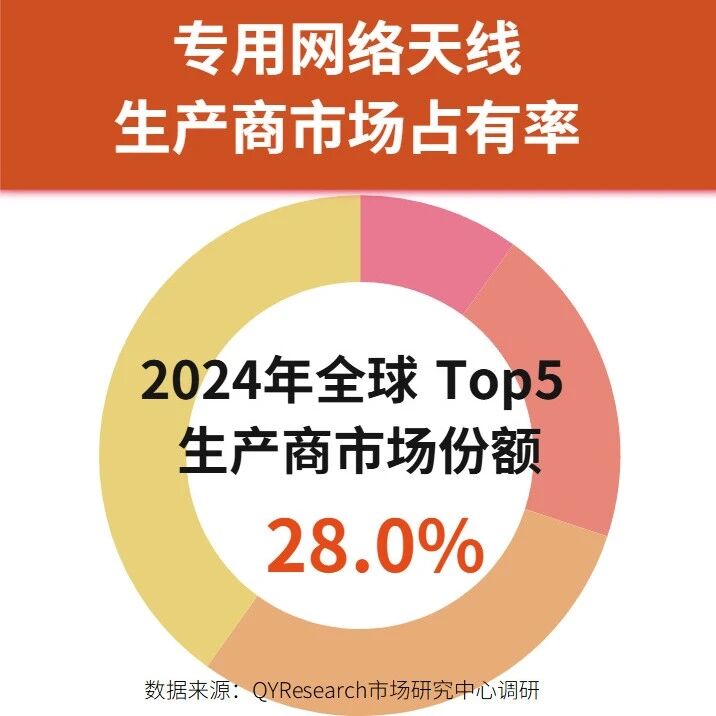
Core Insights - The article discusses the growth and significance of private network communication, particularly focusing on dedicated network antennas and their applications across various industries [1][3][14]. Market Overview - The global dedicated network antenna market is projected to reach $2.63 billion by 2031, with a compound annual growth rate (CAGR) of 46.1% in the coming years [3]. - WLAN currently dominates the dedicated network antenna market, holding approximately 46.2% market share [7]. - The government sector is identified as the largest downstream market, accounting for about 23.5% of the demand [10]. Key Players - Major manufacturers in the dedicated network antenna market include Pulse Electronics (YAGEO), Huber+Suhner, PCTEL (Amphenol), Mobile Mark, and others. The top five companies are expected to hold around 28.0% of the market share by 2024 [5]. Driving Factors - The integration of cloud computing, big data, and artificial intelligence with antenna technology is creating unprecedented innovation opportunities and applications in various fields, such as smart city management and industrial IoT [2][11]. Industry Trends - The commercialization of 5G technology is enhancing performance requirements for dedicated network antennas and expanding their application scenarios, particularly in smart cities and intelligent transportation [13]. - The rapid growth of IoT devices presents new growth opportunities for the dedicated network antenna industry, especially in government and industrial sectors [13]. Industry Structure - The dedicated network antenna industry encompasses upstream, midstream, and downstream segments. Upstream relies on materials like copper and aluminum, while midstream focuses on antenna design and manufacturing. Downstream involves deployment by system integrators and telecom operators [14].
存储大牛股,突然跳水!科技巨头押注太空算力,这些股有望受益(名单)
Zheng Quan Shi Bao· 2025-11-11 10:21
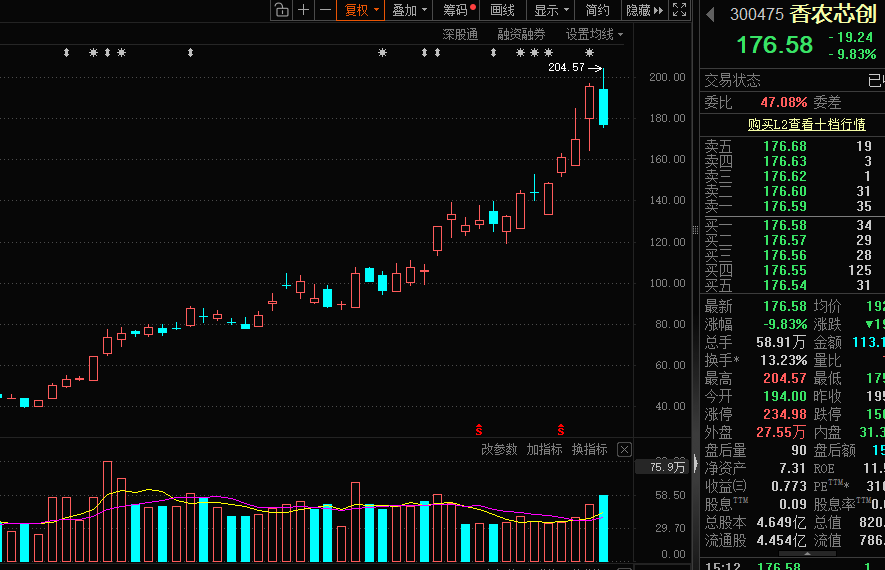
Group 1: Storage Chip Market Dynamics - The storage chip sector experienced a significant decline, with leading stock Xiangnong Xinchuan dropping nearly 10% at the close, despite earlier reaching a record high market value of over 950 billion yuan [1][3] - Xiangnong Xinchuan's stock had previously surged, with increases of approximately 25% in August, 117% in September, and over 45% in October, resulting in a cumulative rise of over 420% since August [1] Group 2: Space Computing Developments - The importance of computing power as a foundational infrastructure is increasingly recognized, with major tech companies investing in space computing, aiming for transformative advancements [4] - Notable developments include NVIDIA successfully sending its H100 GPU to space for testing, and Elon Musk's plans to expand Starlink V3 satellite capabilities to establish a space data center [4][5] - Domestic advancements in space computing are highlighted by the completion of the initial network of the "Three-Body Computing Constellation," which has deployed 12 satellites with a total computing power of 5 petaflops and 30 terabytes of storage [4][5] Group 3: Beneficiary Companies in Space Computing - Companies such as Putian Technology, Holoway, Shanghai Hantong, and Zhenlei Technology are expected to benefit from the advancements in space computing [7] - Putian Technology is significantly involved in the "Three-Body Computing Constellation" project, while Holoway is a key player in satellite measurement [7] - A total of 18 stocks are identified with projected net profit growth exceeding 20% for the next year and 2027, with some companies like Xinke Mobile-U and Xice Testing expected to see over 100% growth [7][8]

上海瀚讯涨2.07%,成交额1.59亿元,主力资金净流入253.70万元
Xin Lang Zheng Quan· 2025-11-11 01:56
Core Insights - Shanghai Hanxun's stock price increased by 2.07% to 26.60 CNY per share, with a market capitalization of 16.704 billion CNY as of November 11 [1] - The company has seen a year-to-date stock price increase of 26.49%, with a 5-day increase of 5.89% and a 20-day increase of 7.87% [1] Financial Performance - For the period from January to September 2025, Shanghai Hanxun reported a revenue of 305 million CNY, representing a year-on-year growth of 72.72% [2] - The net profit attributable to shareholders was -48.16 million CNY, showing a year-on-year increase of 47.25% [2] - Cumulative cash dividends since the A-share listing amount to 59.26 million CNY, with 8.80 million CNY distributed over the last three years [2] Shareholder Structure - As of September 30, 2025, the number of shareholders increased by 11.30% to 63,800, while the average number of tradable shares per shareholder decreased by 10.15% to 9,850 shares [2] - The top ten circulating shareholders include major ETFs, with notable changes in holdings, such as a decrease in shares held by Guotai Zhongzheng Military Industry ETF and an increase by Southern Military Reform Flexible Allocation Mixed A [3]
商业航天:卫星网络将成为太空智能体
HUAXI Securities· 2025-11-10 11:56
Investment Rating - The industry rating is "Recommended" [1] Core Insights - The trend of integrated development of satellite networks is characterized by the convergence of sensing, computing, and communication, evolving into an intelligent entity capable of perception, reasoning, and action [2][5] - The intelligent entity consists of three layers: 1) Global Connectivity Layer, providing comprehensive and optimal connectivity; 2) Fusion Capability Layer, where "cloud-edge-end collaboration" becomes an intrinsic capability; 3) Intelligent Service Layer, where "network as intelligence" offers cognitive-level information services [5][7] - The evolution of satellite networks from "technical tools and infrastructure" to "intelligent ecological hubs" and "value creation platforms" is highlighted, aiming for seamless loops of global perception, intelligent computation, and on-demand services [2][8] Summary by Sections Integrated Sensing and Computing - The sharing of satellite infrastructure allows for multi-modal functionalities on a single satellite platform, exemplified by the Iridium second-generation system integrating communication, navigation, and situational awareness [3] - The communication network is transitioning from "connective collaboration" to "integrated coexistence," with high and low orbit collaboration and integrated space-ground networking as core directions [3] Dynamic Resource Scheduling - The construction of elastic resource networks is possible through dynamic scheduling, as seen in the Zhijiang Laboratory's "Three-body Computing Constellation," which enables in-orbit computing capabilities and resource allocation [4] Global Connectivity and AI-Driven Services - The global connectivity layer features a three-dimensional backbone network with high, medium, and low orbit satellites, each serving distinct roles in global resource scheduling and data processing [5][6] - The intelligent service layer transforms the network into an intelligent entity capable of understanding user intent and providing cognitive-level responses, facilitating applications across various industries [7][10] Case Study: Palantir's Meta Constellation - Palantir's "Meta Constellation" system exemplifies the integration of satellite data with multi-domain data, enabling real-time situational awareness and decision-making across military, commercial, and governmental sectors [8][9] - The system's core functions include planetary-level situational awareness, tactical target tracking, and autonomous learning capabilities, significantly enhancing operational efficiency and responsiveness [10][14] Beneficiary Companies - Companies such as Putian Technology, Holoway, Guoke Military Industry, and others are positioned to benefit from advancements in satellite technology and the growing demand for integrated satellite services [15][16][17]
太空算力争夺赛开打
3 6 Ke· 2025-11-10 03:36
Core Insights - The article discusses the growing interest of AI companies in space computing, highlighting recent developments in space computing capabilities and infrastructure [1][2] Group 1: Space Computing Developments - The "Zero Carbon Space Computing Center" developed by Guoxing Aerospace has achieved a single satellite computing power of 744 TOPS and a constellation capability of 5 POPS, making it the strongest space computing capability globally [1] - NVIDIA has sent its H100 GPU to space, while Elon Musk announced plans to expand Starlink V3 satellites to create a space data center, aiming for 100 GW of data center deployment annually within 4-5 years [1] - Google has initiated the "Sun Catcher Project," planning to launch two prototype satellites with Trillium TPUs by early 2027, positioning space as a potential optimal location for scaling AI computing [1] Group 2: Advantages of Space Computing - Space computing allows satellites to perform data preprocessing and AI training in orbit, significantly improving real-time decision-making efficiency compared to traditional ground-based processing [2] - The deployment of data centers in space offers low operational costs, high power generation efficiency, and rapid deployment capabilities, addressing energy bottlenecks faced by terrestrial data centers [2][3] Group 3: Technological and Operational Benefits - High-orbit space data centers can utilize solar energy 24/7 with an efficiency of up to 95%, which is five times more efficient than ground-based systems [3] - The extreme cold of deep space (-270°C) allows for simpler thermal management, reducing the need for complex cooling systems [3] - Space data centers can be modularly assembled, and light travels faster in a vacuum than through standard fiber optics, enhancing deployment speed and flexibility [3] Group 4: Industry Progress and Future Outlook - China is leading in space computing deployment, with the "Three-Body Computing Constellation" set to launch over 50 satellites by 2025, aiming for a total computing power of 1000P by around 2030 [3] - The transition from "ground-based sensing and computing" to "space-based sensing and computing" is underway, creating a global space computing network [3] - Companies like Putian Technology are heavily involved in the "Three-Body Computing Constellation," contributing to key areas such as inter-satellite communication and ground station construction [3][4] Group 5: Key Companies in the Sector - Holoway is a core manufacturer in satellite measurement, addressing challenges in high-precision measurement and rapid validation for satellite mass production [4] - Shanghai Huanxun is a key supplier for the communication subsystem of the Qianfan Constellation, responsible for satellite communication payloads and ground station support [4] - Zhenlei Technology is a core supplier of satellite internet chips and components, collaborating with various research institutions and enterprises in the industry [5]
北美光通信企业当季业绩表现亮眼,英伟达、谷歌推进太空算力部署
2025-11-10 03:34
Summary of Conference Call Records Industry Overview - The conference call discusses the rapid development of the space computing industry, particularly in commercial aerospace, with major tech companies like NVIDIA and Google launching initiatives such as the Starlink project and Project Suncatch, respectively, to deploy advanced computing capabilities in space [1][2][3] - China is also making significant strides in this area, planning to launch between 1,000 to 3,000 satellites to support its three-body computing constellation, with Potevio Technology as a key supplier [1][3] Key Points and Arguments Space Computing - NVIDIA's Starlink initiative aims to send its first H100 GPU to space by November 2025, while Google's Project Suncatch plans to launch satellites equipped with TPU 6 chips by 2027 [2] - The efficiency of space computing, powered by solar energy, is several times greater than ground-based power, addressing energy shortages [2] - The commercial model for space computing is gradually taking shape, with companies like Nanjing Blue Tower exploring B-end services through satellite interconnectivity [1][3] AI Industry - There is ongoing debate regarding the existence of a bubble in the AI industry, highlighted by OpenAI's projected investment of $1.4 trillion against a quarterly revenue of over $4 billion and losses exceeding $10 billion [4] - Concerns have been raised about the low return on investment (ROI) for cloud service providers in North America, but the long-term growth potential of AI remains strong despite short-term financial data [4][6] Optical Communication Industry - The optical communication sector is experiencing significant growth, with strong demand for 1.6T optical modules and second-generation optical modules, alongside a robust supply chain for optical chips and lasers [5][7] - Companies like Lumentum and Coherent Finisar reported better-than-expected earnings, driven by data center interconnectivity and expanding production capabilities [7] - The demand for 1.6T modules is expected to reach 20 to 30 million units by 2026, while 800G demand could reach 40 to 50 million units [7] Additional Important Insights - Liquid cooling technology is highlighted as a key area of interest, with NVIDIA projecting a market size of $7 billion by 2026, indicating a significant growth opportunity [2][6] - The optical communication industry is seeing technological advancements and capacity expansions, with companies like ZTE pushing for new technology applications [5][7] - Investors are encouraged to focus on leading companies in the optical communication space, such as Zhongji Xuchuang and Tianfu Technology, as well as laser chip companies like Yuanjie Technology and Shijia Photonics [7]
