
友邦保险

Search documents
招银国际:中国平安及中国人寿均为政策受益者 保险股明年前景乐观
智通财经网· 2025-12-10 03:28
Group 1 - The core viewpoint of the article is that the recent adjustment in risk factors for insurance companies by the National Financial Regulatory Administration is expected to benefit major players like China Ping An and China Life, leading to a positive outlook for the insurance sector through 2026 [1][2] - The policy aims to guide insurance funds into the stock market, potentially injecting 102.6 billion RMB into the CSI 300 index if the released minimum capital is fully invested [2] - The adjustment in risk coefficients for investments in the CSI 300, the CSI Low Volatility 100, and STAR Market stocks is a strategic move to encourage long-term equity investments rather than merely enhancing the overall solvency ratio of the industry [2] Group 2 - The insurance sector's average allocation to the CSI 300, CSI Low Volatility, and STAR Market is estimated at 50%, 10%, and 5% respectively, with a potential release of minimum capital amounting to 30.8 billion RMB [2] - The policy emphasizes long-term holdings in blue-chip stocks, high-dividend stocks, and growth stocks, providing regulatory support for insurance funds investing in these indices [2] - The expected slight increase in the industry's overall solvency ratio to 187.4% by the end of September reflects the positive impact of the new policy [2]



大行评级丨招银国际:对保险业明年前景保持乐观 中国平安及中国人寿均为政策主要受益者
Ge Long Hui· 2025-12-10 02:56
Core Viewpoint - The recent notification from the National Financial Regulatory Administration indicates a continued effort to guide insurance funds into the stock market, potentially injecting 102.6 billion yuan into the CSI 300 index if the released minimum capital is fully invested [1] Group 1: Regulatory Changes - The policy aims to encourage long-term holdings in blue-chip stocks, high-dividend stocks, and growth stocks, providing regulatory support for insurance funds investing in the CSI 300 index, the CSI Dividend Low Volatility 100 index, and the STAR Market [1] - The highlight of the policy is the guidance for over one trillion U.S. dollars in insurance capital to engage in long-term holdings in the A-share market [1] Group 2: Market Impact - The adjustment is expected to enhance the capital efficiency of insurance funds investing in A-shares compared to H-shares [1] - China Ping An and China Life are anticipated to be the main beneficiaries of this policy [1] Group 3: Industry Outlook - The outlook for the insurance industry for the fiscal year 2026 remains optimistic, with expectations for a sustainable adjustment in asset allocation to drive industry valuation [1] - The sector is rated to "outperform the market," with recommendations to buy shares in China Ping An, China Life, China Pacific Insurance, and AIA Group [1]

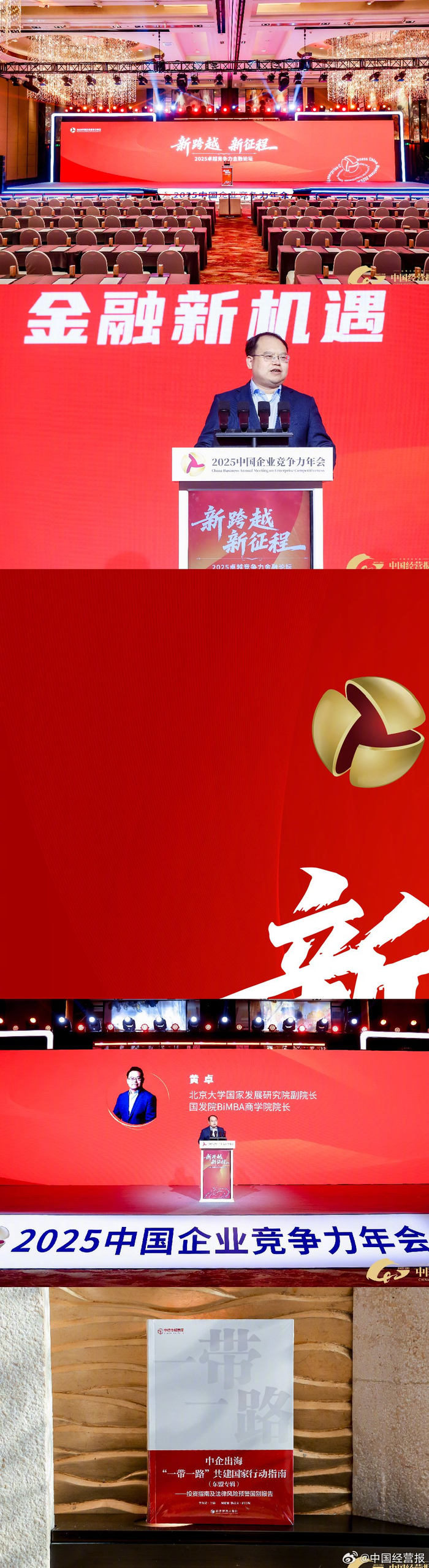
2025卓越竞争力金融论坛九宫格发布
Zhong Guo Jing Ying Bao· 2025-12-10 02:15
Group 1 - The 2025 China Enterprise Competitiveness Forum aims to discuss the future competitiveness of Chinese enterprises and the financial sector's role in enhancing this competitiveness [4][12][36] - Keynote speeches will focus on topics such as the development of pension finance and its contribution to high-quality elderly care [14][36] - The forum will feature discussions on how financial services can empower the real economy and foster new productive forces [21][36] Group 2 - The event is organized by China Business Journal, highlighting its significance in the business community [6][12] - Various financial institutions and experts will present case studies showcasing successful strategies and innovations in the financial sector [41][44] - The forum is expected to provide insights into the integration of technology and finance, particularly in the context of digital transformation [20][36]

智通港股沽空统计|12月10日
智通财经网· 2025-12-10 00:25
Group 1 - The top short-selling stocks include Sun Hung Kai Properties-R (80016), China Resources Beer-R (80291), and AIA Group-R (81299), all with a short-selling ratio of 100.00% [1][2] - The highest short-selling amounts are from Xiaomi Group-W (01810) at 2.161 billion, Alibaba-SW (09988) at 793 million, and Tencent Holdings (00700) at 733 million [1][2] - The highest deviation values are from China Resources Beer-R (80291) at 39.83%, followed by Jianfa Property (02156) at 37.09%, and AIA Group-R (81299) at 35.65% [1][2] Group 2 - The top ten short-selling ratio rankings show that all stocks listed have significant short-selling activity, with Anta Sports-R (82020) also at 100.00% [2] - The top ten short-selling amounts highlight Xiaomi Group-W leading significantly, with a short-selling ratio of 28.48% [2] - The top ten deviation values indicate that China Resources Beer-R (80291) has the highest deviation, suggesting a notable difference from its historical short-selling average [2]



智通ADR统计 | 12月10日



智通财经网· 2025-12-09 22:27
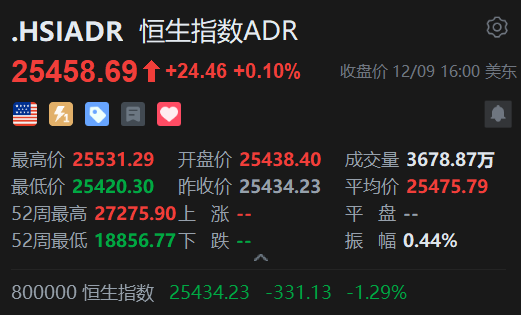
Market Overview - The Hang Seng Index (HSI) closed at 25,458.69, up by 24.46 points or 0.10% from the previous close [1] - The index experienced a trading range with a high of 25,531.29 and a low of 25,420.30, with a trading volume of 36.788 million shares [1] Major Blue-Chip Stocks Performance - HSBC Holdings closed at HKD 110.181, reflecting an increase of 0.62% compared to the Hong Kong close [2] - Tencent Holdings closed at HKD 601.643, showing a slight decline of 0.14% from the Hong Kong close [2] Stock Price Movements - Tencent Holdings: Latest price HKD 602.500, down by HKD 2.500 or 0.41% [3] - Alibaba Group: Latest price HKD 150.900, down by HKD 2.500 or 1.63% [3] - HSBC Holdings: Latest price HKD 109.500, up by HKD 0.400 or 0.37% [3] - China Construction Bank: Latest price HKD 7.610, down by HKD 0.050 or 0.65% [3] - Xiaomi Group: Latest price HKD 41.260, down by HKD 1.320 or 3.10% [3] - AIA Group: Latest price HKD 77.250, down by HKD 0.650 or 0.83% [3] - Meituan: Latest price HKD 97.350, down by HKD 2.150 or 2.16% [3] - Industrial and Commercial Bank of China: Latest price HKD 6.120, up by HKD 0.010 or 0.16% [3] - Hong Kong Exchanges and Clearing: Latest price HKD 401.200, down by HKD 3.400 or 0.84% [3] - Ping An Insurance: Latest price HKD 60.750, down by HKD 1.000 or 1.62% [3] - Ctrip Group: Latest price HKD 539.500, down by HKD 5.000 or 0.92% [3] - Baidu Group: Latest price HKD 121.400, down by HKD 4.400 or 3.50% [3] - JD Group: Latest price HKD 114.900, down by HKD 1.300 or 1.12% [3]
每日投资策略-20251209
Zhao Yin Guo Ji· 2025-12-09 04:58
Macro Economic Overview - China's exports showed a short-term rebound in November, exceeding market expectations, driven by improvements in exports to the EU, Latin America, Japan, South Korea, and Africa, while exports to the US and ASEAN remained weak [2] - The semiconductor exports benefited from the global AI boom, maintaining a high growth rate, reflecting China's ongoing technological advancements [2] - Imports slightly improved due to processing trade, but general trade continued to decline due to weak domestic demand [2] Global Market Performance - The Hang Seng Index closed at 25,765, down 1.23% for the day but up 28.44% year-to-date [3] - The Shanghai Composite Index rose 0.54% to 3,924, with a year-to-date increase of 17.08% [3] - The US markets saw a decline, with the Dow Jones down 0.45% and the S&P 500 down 0.35% [3] Automotive Industry Insights - The Chinese automotive industry is expected to see retail and wholesale sales reach historical highs in 2025, with a more complex landscape anticipated in 2026 due to the phasing out of subsidies [6][7] - Despite challenges from subsidy reductions, retail sales are expected to remain stable, with wholesale volumes projected to grow by 2.9% in 2026 [7] - The competition in the automotive sector is expected to intensify, with new model releases at historical highs and potential price increases in battery costs impacting profit margins [7] Insurance Sector Analysis - The recent adjustment in risk factors for insurance companies aims to encourage long-term equity holdings, potentially releasing a minimum capital of 30.8 billion yuan [9][10] - The adjustment is expected to enhance the capital efficiency of insurance investments in A-shares compared to H-shares, benefiting major players like China Ping An and China Life [11] - The insurance sector maintains a "buy" rating, with recommended stocks including China Ping An, China Life, and AIA Group [12] Pharmaceutical Industry Developments - The MSCI China Healthcare Index has risen by 60.9% year-to-date, outperforming the MSCI China Index [13] - The recent release of the basic medical insurance directory supports innovation, with 114 new drugs added, including 50 innovative drugs [13][14] - The commercial insurance directory's introduction is seen as a significant step towards expanding China's commercial health insurance landscape [14][15]
中国保险业_权益投资风险因子下调的影响-China Insurance_ Implications of lower risk factor for equity investments
2025-12-09 01:39
8 December 2025 | 11:28AM HKT Equity Research CHINA INSURANCE Implications of lower risk factor for equity investments The NFRA announced reductions to C-ROSS risk factors for equity investments and export credit insurance. Per the NFRA, the lower risk factors for equity investment were designed to encourage insurers to have a longer holding period, as they only apply to investments with an average holding period of at least 2 years. While we expect more inflow into equity investment in the coming months, o ...
智通ADR统计 | 12月9日
智通财经网· 2025-12-08 22:22
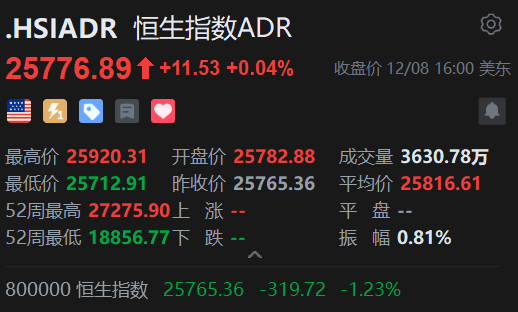
Market Overview - The Hang Seng Index (HSI) closed at 25,776.89, up by 11.53 points or 0.04% as of December 8, 16:00 Eastern Time [1] - The index reached a high of 25,920.31 and a low of 25,712.91 during the trading session, with a trading volume of 36.3078 million [1] - The 52-week high for the index is 27,275.90, while the 52-week low is 18,856.77, indicating a trading range of 0.81% for the day [1] Blue-Chip Stocks Performance - HSBC Holdings closed at 110.515 HKD, an increase of 1.30% compared to the Hong Kong closing price [2] - Tencent Holdings closed at 605.092 HKD, showing a slight increase of 0.02% from the Hong Kong closing price [2] - Alibaba Group (W) closed at 153.400 HKD, down by 1.03% [3] - China Ping An saw an increase of 2.15%, closing at 61.750 HKD [3] Notable Stock Movements - Tencent Holdings experienced a decrease of 0.82%, closing at 605.000 HKD [3] - Alibaba Group (W) decreased by 1.03%, closing at 153.400 HKD [3] - HSBC Holdings decreased by 1.71%, closing at 109.100 HKD [3] - China International Capital Corporation (CICC) saw a decline of 4.01%, closing at 7.660 HKD [3] - Meituan (W) increased by 0.45%, closing at 99.500 HKD [3]

港股A股为何总不同?三大差异揭开“定价真相”!
Sou Hu Cai Jing· 2025-12-08 16:26
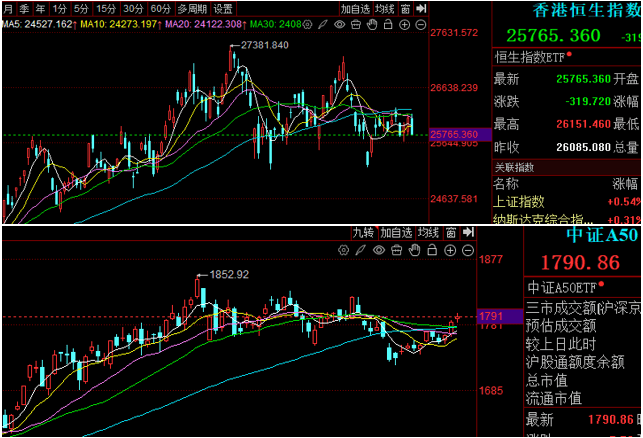
Group 1 - The core difference in market participation roles between A-shares and Hong Kong stocks is evident, with A-shares seeing increased trading volume while Hong Kong stocks experienced a decrease, indicating that foreign capital has significant pricing power in the Hong Kong market [4][7] - The Hang Seng Index saw a decline of over 1.2%, while the China A50 index recorded a small gain, reflecting the contrasting market dynamics and expectations between the two markets [6][16] - The composition of the indices shows a significant difference, with the financial sector making up nearly one-third of the Hang Seng Index, while the A50 index is more heavily weighted towards sectors like new energy and technology [10][12] Group 2 - The performance of individual stocks within the indices highlights the disparity, with stocks like China Ping An and SMIC performing similarly, but sectors such as new energy and pharmaceuticals showing stronger performance in the A50 index compared to declines in major Hong Kong stocks [8][10] - The lack of active pricing from domestic institutions in the Hong Kong market has led to a situation where it is primarily driven by foreign capital, which has different expectations and strategies compared to local investors [7][16] - The focus of foreign investors on macroeconomic factors and specific themes, such as AI breakthroughs, indicates a divergence in investment strategies compared to local investors who may have different expectations for sectors like pharmaceuticals [17][18]
创新药商保目录专家电话会议
2025-12-08 15:36
Summary of Conference Call on Commercial Health Insurance and Innovative Drugs Industry Overview - The conference focused on the commercial health insurance (CHI) sector in China, particularly its integration with the national medical insurance system and the implications for innovative drug companies [1][2]. Key Points and Arguments Integration of Commercial Health Insurance and National Medical Insurance - The National Healthcare Security Administration (NHSA) has led the establishment of a commercial insurance directory, addressing fragmentation in the commercial insurance industry and enhancing the importance of pharmaceutical companies and their products [1][3]. - The commercial health insurance directory aims to provide a platform for innovative drugs, similar to centralized procurement but with a greater emphasis on clinical and economic evaluations rather than just fund calculations [2][4]. Innovative Drug Coverage and Payment Models - Commercial health insurance is adapting to high treatment costs, such as CAR-T therapy, by implementing partial reimbursement and pay-for-performance models to alleviate patient financial burdens [1][5]. - The NHSA's increasing payment for innovative drugs is projected to reach approximately CNY 200 billion by 2024, yet the share of commercial insurance remains low, around CNY 12.5 billion [7][10]. Market Dynamics and Challenges - The high-end medical insurance market in China is currently underdeveloped, with a total market size of less than CNY 10 billion, primarily due to economic factors and the limited purchasing power of potential customers [8][9]. - The commercial health insurance sector is expected to see significant growth, with projections indicating that by 2030, health insurance investments could reach CNY 25 trillion, with CNY 500 billion allocated for innovative drugs, increasing the reimbursement share from 1/16 to 1/4 [10][11]. Future Trends and Opportunities - The future growth of commercial health insurance is anticipated to focus on mid-tier medical insurance, particularly for patients with pre-existing conditions, which can fill gaps in the current healthcare system [13][19]. - The integration of commercial insurance with national healthcare is expected to facilitate a one-stop settlement model, enhancing patient access to innovative treatments and improving overall healthcare service quality [11][27]. Characteristics of Newly Added Drugs - The drugs included in the commercial insurance directory this year are characterized by small market sizes, high costs, and uncertain efficacy, which allows for real-world studies to support future inclusion in the national insurance system [20][21]. Operational Changes in Insurance Companies - Future operational changes in commercial insurance companies may include direct settlement models, where patients do not need to pay upfront, and a focus on different customer segments through business separation [25][27]. Additional Important Insights - The average reimbursement rate for million medical insurance is around 40%, indicating a significant portion of funds is allocated to operational costs rather than patient payouts [18]. - The commercial health insurance market in China has substantial growth potential, with current insurance density and depth significantly lower than OECD averages, suggesting room for expansion [16][17]. This summary encapsulates the critical insights from the conference call, highlighting the evolving landscape of commercial health insurance in China and its implications for innovative drug companies.