
华为技术有限公司

Search documents
iPhone17中国首月销量激增37% 苹果(AAPL.US)重夺20%市场份额高地
Zhi Tong Cai Jing· 2025-11-18 06:33
Core Insights - Apple's iPhone 17 series has driven a 37% increase in monthly smartphone sales in China, indicating strong momentum in a key market [1] - In October, one in four smartphones sold in China was an iPhone, marking Apple's first time reaching this market share threshold since 2022 [1] - The sales of each subsequent iPhone model, from the iPhone 17 priced at 5999 yuan (approximately 850 USD) to the 17 Pro Max at 8999 yuan, have exceeded their predecessors by double-digit percentages [1] Market Performance - The overall smartphone market in China grew by 8%, recovering from previous struggles despite government subsidies [1] - Apple's new iPhone models account for over 80% of its total sales, with rising average selling prices contributing to revenue growth [1] - OPPO's smartphone sales increased by 19% in October, driven by demand for its Find X9 model, while Huawei's sales fell by 19% due to the absence of new releases [1] Competitive Landscape - Huawei remains Apple's strongest competitor in China, with plans to launch its new flagship device next week [1] - Despite the upcoming Huawei Mate 80 series release on November 25, current indicators suggest that Apple's sales momentum is stable [2]

2025年中国服务器操作系统行业发展历程、发展背景、装机量、市场规模及未来趋势研判:数字经济驱动服务器操作系统发展,行业总装机量将提升至552.2万套[图]
Chan Ye Xin Xi Wang· 2025-11-18 01:27
Core Insights - The server operating system market in China is experiencing significant growth, driven by the expansion of the digital economy and the acceleration of digital transformation across enterprises [1][6][8] - The total installed capacity of server operating systems in China is projected to increase from 2.987 million units in 2019 to 5.135 million units by 2024, with a compound annual growth rate (CAGR) of 11.45% [1][8] - The market is dominated by Linux, which holds a 79.6% share, while Windows Server accounts for 19.9% and other systems like Unix only 0.5% [8][10] Industry Overview - Server operating systems are critical for managing and coordinating hardware and software in enterprise IT systems, with major types including Windows Server, Linux, and Unix [1][3] - The industry is supported by a robust ecosystem of companies, including major players like China Software, Kirin Software, and Huawei, focusing on open-source technologies and self-developed capabilities [2][11] Market Growth - The market size of the server operating system industry in China is expected to grow from 4.59 billion yuan in 2019 to 9.4 billion yuan by 2024, reflecting a CAGR of 15.42% [8][9] - The demand for server operating systems is primarily concentrated in sectors such as finance, government, internet, energy, and telecommunications, with finance leading at 21.5% market share [10] Development Trends - The industry is moving towards cloud-native and intelligent architectures, integrating cloud computing and microservices to enhance operational efficiency [14] - There is a growing emphasis on ecosystem development, focusing on full-stack collaboration and open-source innovation to create a sustainable industrial ecosystem [15] - Customization for vertical industries is becoming a key trend, with server operating systems being tailored to meet specific needs in finance, government, and industrial sectors [16]


2025 GMVPS案例集重磅发布!“编委会特别推荐”称号揭晓,计算技术重塑千行百业
Zhong Guo Neng Yuan Wang· 2025-11-17 08:29
Core Insights - The 2025 Global Computing Conference (CGC) hosted the release of the "2025 Annual Global Computing Industry Application Case Compilation (GMVPS)" which serves as an annual benchmark for innovation in the global computing industry [1] - The event featured nearly 60 submitted cases across more than ten industries, highlighting the breadth of innovation in the computing sector [1][8] Group 1: Case Collection and Evaluation - The case collection process, initiated on July 21, received strong support from various communities and attracted numerous submissions from GCC member units and industry partners [8] - The focus areas included intelligent computing, high-performance computing, green computing, and edge computing, covering advanced efficiency, secure computing, and intelligent systems [8] - A committee composed of technical experts, industry leaders, and media representatives conducted multiple rounds of material reviews and evaluations to select benchmark cases in technology innovation and industry application [13] Group 2: Special Recommendations and Recognitions - The newly introduced "Committee Special Recommendation" title emphasizes technological breakthroughs and industry demonstration, with a list of notable cases announced [14] - Selected cases include advanced solutions from companies like China Mobile, Huawei, and Lenovo, showcasing significant contributions to the computing landscape [16][17] Group 3: Ecosystem Development and Future Outlook - The GMVPS case selection activity aims to build bridges for industry innovation, promoting deep integration of computing technology across various sectors [19] - The release of the annual case collection not only showcases outstanding industry practices but also establishes a platform for technical exchange and resource sharing [19] - The alliance plans to continue gathering industry forces to enhance collaborative innovation, focusing on trends like intelligent upgrades and green low-carbon initiatives, thereby driving sustainable growth in the global digital economy [19]



运机集团涨4.93%,成交额1.82亿元,今日主力净流入1354.38万
Xin Lang Cai Jing· 2025-11-17 07:35
Core Viewpoint - The company, Sichuan Zigong Transportation Machinery Group Co., Ltd., is benefiting from the Belt and Road Initiative and the depreciation of the Renminbi, leading to increased international recognition and sales growth in various regions [2][3]. Group 1: Company Performance - On November 17, the company's stock rose by 4.93%, with a trading volume of 182 million yuan and a market capitalization of 7.395 billion yuan [1]. - For the period from January to September 2025, the company achieved a revenue of 1.232 billion yuan, representing a year-on-year growth of 41.99%, and a net profit attributable to shareholders of 107 million yuan, up by 27.35% [9][10]. Group 2: International Operations - The company's overseas revenue accounted for 67.58% of total revenue, benefiting from the depreciation of the Renminbi [3]. - The company has established a presence in various international markets, including Southeast Asia, Africa, and Europe, with products recognized in countries such as Indonesia, Malaysia, Vietnam, Ethiopia, and Turkey [3]. Group 3: Strategic Partnerships - The company signed a comprehensive cooperation agreement with Huawei on July 17, 2024, focusing on intelligent production, digital solutions, and talent training [4]. - The partnership aims to leverage the company's strengths in mining and bulk material handling with Huawei's expertise in cloud computing and artificial intelligence [4]. Group 4: Product Offerings - The company specializes in energy-efficient conveyor machinery, with its main business revenue derived from conveyor equipment at 76.11%, followed by permanent magnet motor drums at 9.83%, and technical services at 8.51% [8].
【倒计时1天】5个论坛40位大咖演讲、400+参会嘉宾齐聚甬城,完整议程及参会指南已放送 | 2025 HHIC
势银芯链· 2025-11-17 04:11
Core Points - The 2025 Heterogeneous Integration Frontier Forum will be held from November 17-19, 2025, in Ningbo, organized by the Yongjiang Laboratory and TrendBank, with support from the Ningbo Electronic Industry Association [2][50]. - The forum aims to discuss advancements in heterogeneous integration technologies and their applications in various fields, including semiconductor manufacturing and optical technologies [26][30]. Event Details - The forum will take place at the Ningbo Pan Pacific Hotel, with an expected attendance of 300-500 participants [50]. - The event will feature a series of keynote speeches, panel discussions, and networking opportunities, focusing on topics such as advanced packaging technologies, optical chip innovations, and the future of semiconductor integration [26][30][50]. Registration and Fees - Registration for the forum is available, with ticket prices set at RMB 2500 per person, which includes access to conference materials, lunch, and a gala dinner [50]. - Early bird registration before October 31 offers a discounted price of RMB 2000, and students can obtain tickets for RMB 1500 by contacting the organizers [50]. Agenda Highlights - The agenda includes a variety of topics such as the launch of the 8-inch verification line at the Yongjiang Laboratory, government speeches, and discussions on the latest trends in heterogeneous integration and advanced packaging technologies [6][26][30]. - Notable speakers include experts from leading semiconductor companies and research institutions, discussing innovations in chip design, manufacturing processes, and market trends [26][30][50].
让产业“家底”更加殷实——推动“十五五”时期经济社会发展向新而行②
Ren Min Ri Bao· 2025-11-17 03:28
Group 1 - The robotics industry is rapidly evolving, with humanoid robots like "Kua Fu" participating in significant events, showcasing advancements in technology and skills [1] - China is expected to account for two-thirds of global robot patent applications in 2024, maintaining its position as the largest industrial robot market for 12 consecutive years [1] - The integration of technological and industrial innovation is crucial for driving the development of emerging industries and transforming traditional sectors, contributing to the construction of a modern industrial system in China [1] Group 2 - The modern industrial system is the material and technical foundation of Chinese-style modernization, aimed at deepening the integration of technological and industrial innovation [2] - The focus on building a modern industrial system is highlighted as a strategic task, emphasizing the importance of addressing weaknesses and promoting the integration of innovation and industry chains [2] - Ensuring technological independence and reliability is essential for the industrial system, with advancements in key areas like high-speed rail and 5G technology reinforcing China's competitive edge [2] Group 3 - The transformation of innovation into practical applications is critical, with "pilot testing" seen as a key step from laboratory success to industrial implementation [3] - Companies play a vital role in enhancing the efficiency of integrating innovation and industry chains, with examples of successful innovations in various sectors [3] - The forecast for the 14th Five-Year Plan period indicates that strategic emerging industries like new energy and new materials will create several trillion-yuan markets, emphasizing the need for continuous integration of technology and industry [3]
全国民办教育界专家齐聚沈阳 共商产教融合育才新体系
Xin Hua Wang· 2025-11-17 02:19
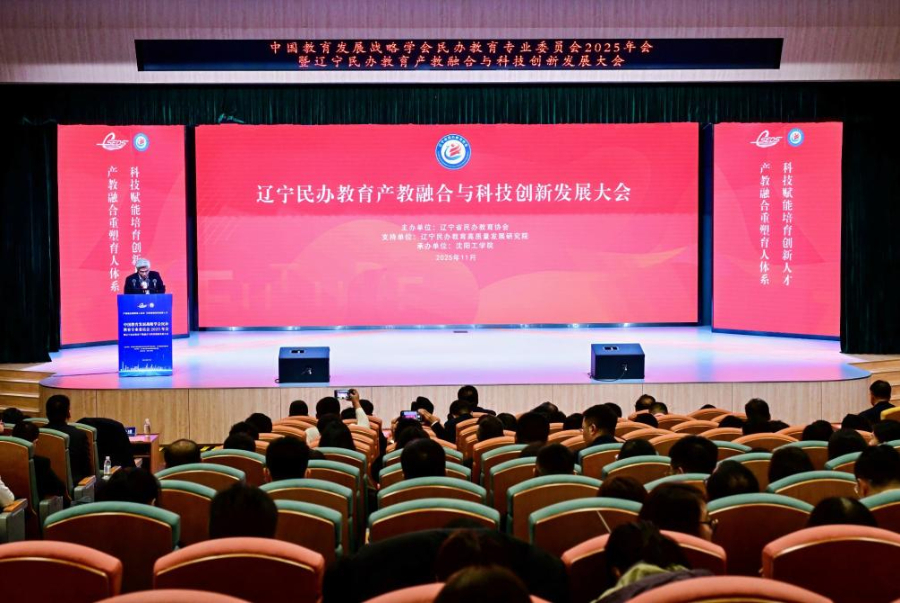
Core Insights - The conference focused on the theme "Integration of Industry and Education Reshaping Talent Cultivation System, Technology Empowering Innovative Talent Development" and attracted over 300 participants from the private education sector across China [1][5] Group 1: Conference Overview - The event was co-hosted by the China Education Development Strategy Association's Private Education Professional Committee and the Liaoning Private Education Association [1] - Various formats were utilized during the conference, including report sessions, on-site observation, parallel seminars, thematic discussions, case sharing, and roundtable dialogues, creating a comprehensive communication platform [3] Group 2: Key Activities and Discussions - Over 200 representatives participated in on-site visits to seven distinctive industrial colleges, such as Huawei-SYIT Modern Industry College and KUKA Authorized Industrial Robot College, to understand the innovative integration of industry and education [3] - Discussions in the parallel seminar focused on the application of AI in basic education and rural education revitalization, leading to multiple consensus points among participants [3] - Representatives from institutions like Xi'an Eurasia University and Chengdu Geely College shared their achievements in transforming and upgrading industry-education integration, digital teaching reforms, and innovative talent cultivation during the thematic seminar [3] Group 3: Outcomes and Implications - The conference stimulated new thoughts on the development of private higher education in terms of industry-education integration and technological innovation, injecting new energy and vitality into the sector [5] - It fostered consensus and gathered strength among various stakeholders to address the challenges of industry-education integration and build a new ecosystem of school-enterprise collaboration [5]
人工智能(AI)在农业育种行业的应用现状与商业化前景
QYResearch· 2025-11-17 01:21
Industry Background: Transition to a "Data-Driven" Era in Breeding - Traditional breeding relies heavily on time-consuming field trials and personal experience, typically requiring 7-12 years for completion, which is costly and has a limited success rate. The global breeding industry is undergoing a fundamental shift from "experience-driven" to "data + model-driven" due to the significant decrease in genome sequencing costs, widespread application of high-throughput phenotyping technologies, and continuous enhancement of AI computing power [2]. Core Applications of AI in the Breeding Industry - **Genomic Selection**: This technology analyzes vast amounts of genetic markers to accurately predict key traits such as crop yield, quality, and disease resistance. AI can reduce the breeding cycle from 7-10 years to 4-6 years and improve trait prediction accuracy by 10-25%, while significantly lowering field validation costs. Leading companies like Bayer and KWS have implemented this at scale for major crops [6]. - **Phenotypic Analysis**: AI enhances the efficiency and accuracy of collecting phenotypic data through automated analysis of plant growth, disease severity, and canopy structure using drones and hyperspectral cameras. This technology increases selection efficiency by 5-10 times and provides objective quantitative data for field trials [7]. - **Hybrid Combination Prediction**: AI integrates multi-dimensional data to improve the accuracy of predicting successful hybrid combinations, addressing the issue where over 95% of traditional combinations fail to meet expectations. This allows for the early elimination of ineffective combinations, focusing resources on high-potential materials [8]. - **Environmental Modeling**: AI constructs G×E (genotype × environment) models to predict how different genotypes perform in various environments, facilitating a shift from reliance on multi-site trials to model-driven predictions, thus overcoming geographical limitations in breeding [10]. Global Application Status: From Experimental Exploration to Large-Scale Implementation - The global breeding industry has formed three distinct tiers in AI application: - Leading seed companies like Bayer and Syngenta have established comprehensive data infrastructures and AI breeding systems, creating high technical barriers [12]. - Research institutions such as CGIAR and USDA are driving innovation in AI breeding projects for staple crops, providing theoretical and technical support [13]. - Small and medium enterprises are gaining capabilities through SaaS platforms, allowing them to access advanced breeding tools at lower costs [13]. Commercialization Models and Industry Transformation Directions - Three main commercialization models have emerged in AI breeding: - **SaaS Software Subscription Model**: Targets small and medium breeding companies, offering tiered pricing based on image processing volume or trial area, lowering the application threshold for AI technology [15]. - **Data Analysis Service Model**: Provides specialized services for specific breeding projects, converting professional knowledge into value [15]. - **AI-Driven New Variety Commercialization**: This mainstream model for seed companies enhances breeding efficiency, leading to faster market introduction and more stable traits, ultimately increasing seed sales revenue [15]. Future Prospects: AI Will Reshape the Global Breeding Competitive Landscape - The breeding industry is expected to undergo three distinct development stages driven by AI: - **Short-term (1-3 years)**: Rapid commercialization of single-point AI tools, with phenotypic analysis AI leading the way and genomic selection solidifying its mainstream status [17]. - **Mid-term (3-7 years)**: AI will evolve from single-point tools to a full-process breeding system, with digital field trials becoming common and hybrid combination prediction transitioning into routine production [17]. - **Long-term (7-10 years)**: The deep integration of AI with gene editing technologies will create a closed-loop system, significantly reducing breeding costs by 40-60% and shortening cycles by 30-50% [17]. Domestic Development Status: Breakthroughs in China's AI Breeding Field - The year 2025 is projected to be a landmark year for China's AI breeding, with several innovative achievements: - The Shanghai AI Laboratory, in collaboration with other institutions, launched the first autonomous scientific discovery system in biological breeding, capable of simulating molecular biologist functions [19]. - Zhejiang University and Huawei developed an "AI Breeder" that enhances cotton hybrid breeding efficiency by 20 times and reduces the breeding cycle from 6-8 years to 3-4 years [19]. - The establishment of a unified data platform by the Qiaozhou Bay National Laboratory and Huawei significantly improves breeding efficiency through standardized data collection [19]. Conclusion: AI Initiates the "Second Revolution" in the Breeding Industry - AI is leading the most profound transformation in the breeding industry since the advent of hybrid breeding technology, marking a shift from reliance on experience to data-driven predictions. This revolution fundamentally changes the breeding paradigm from "art" to "science," establishing quantifiable and predictable mathematical models [21]. The integration of AI with gene editing technologies will usher in an era of "precise design" in breeding, redefining competitive dynamics in the global seed industry [21].



研判2025!中国分布式全闪存储行业市场现状、企业格局及发展趋势分析:行业规模呈高速增长态势,企业加大布局力度[图]
Chan Ye Xin Xi Wang· 2025-11-17 01:08
Core Insights - The article discusses the rapid growth and development of distributed all-flash storage in China, highlighting its performance advantages and increasing market share compared to traditional storage solutions [1][7]. Distributed All-Flash Storage Overview - Distributed storage can be categorized into distributed all-flash and mixed-flash storage, with all-flash storage consisting entirely of SSDs, achieving IOPS in the millions, which is nearly a thousand times faster than traditional HDDs [1][3]. - The demand for high-performance and reliable data storage solutions is increasing due to the explosive growth of data in the digital age [1][7]. Market Size and Growth - The market size for distributed all-flash storage in China is projected to reach 4.78 billion yuan in 2024, representing a year-on-year growth of 71.5%, significantly outpacing the overall growth of the distributed storage industry [1][7]. - The overall distributed storage market in China is expected to exceed 19.82 billion yuan in 2024, with a year-on-year growth rate of 43.7%, accounting for 60.2% of the total storage market [4][6]. Market Share Dynamics - The share of distributed all-flash storage is increasing, rising from 13.4% in 2021 to 24.1% in 2024, indicating a growing adoption among users [6][7]. - In 2024, mixed-flash storage will still dominate the market with a 75.9% share, primarily due to the cost advantages of HDDs in high-capacity applications [6][7]. Competitive Landscape - Major players in the distributed all-flash storage market include Huawei, Zhongke Shuguang, and Inspur Information, alongside emerging companies like Fanlian Information, which show strong competitive potential [2][10]. - The competitive landscape is evolving, with several companies launching distributed all-flash array products that achieve throughput exceeding 100GB/s, positioning China among the global leaders in distributed storage technology [10]. Industry Trends - The industry is expected to see increased penetration, reduced costs, and enhanced security features in distributed all-flash storage solutions [1][10]. - The maturation of the domestic SSD supply chain is providing a solid foundation for the growth of distributed all-flash storage in China, with the enterprise SSD market projected to grow from 21.16 billion yuan in 2021 to 44.51 billion yuan in 2024, reflecting a compound annual growth rate of 28.13% [8][9].


开源欧拉“出海”:中国基础软件的破局之路
Zheng Quan Ri Bao· 2025-11-16 18:24
Core Insights - The openEuler operating system is positioned to lead the development of foundational software in China, particularly in the AI era, with a focus on supernodes and global expansion [1][5][6] - By the end of 2025, openEuler is expected to surpass 16 million installations, maintaining a leading market share in key industries [1][5] - The community has established partnerships with 15 global open-source organizations, enhancing its international presence and collaboration [7][8] Group 1: Technological Advancements - The openEuler operating system supports advanced AI capabilities, enabling robots to perform complex tasks through powerful computational support [2][3] - The integration of openEuler with various hardware has improved adaptability, allowing for "plug-and-play" functionality, which enhances efficiency in AI applications across multiple sectors [3][5] - The system aims to create a unified ecosystem for robotic operations, facilitating seamless interaction between hardware and software [2][3] Group 2: Market Position and Strategy - openEuler has become a cornerstone for digital transformation across various industries, with a projected increase in market share for the current year [5][6] - The community has grown to include 2,100 member organizations and 23,000 developers, indicating significant scalability in government, finance, and energy sectors [5][8] - The strategic focus on global collaboration and innovation aims to position openEuler as a leader in the international open-source community [7][8] Group 3: Future Outlook - The next five years are critical for openEuler as it seeks to embrace supernodes and AI, aiming to provide a robust software foundation for the future [1][5][6] - The transition from a survival strategy to a leadership role reflects a significant shift in China's foundational software industry, emphasizing proactive engagement in global markets [6][8] - The community's commitment to open collaboration and technological advancement is expected to drive China's progress from a digital power to a digital stronghold [8]