中复神鹰

Search documents
中复神鹰:2025年上半年净利润1192.98万元,同比下降52.23%
Xin Lang Cai Jing· 2025-08-27 12:40
中复神鹰公告,2025年上半年营业收入9.22亿元,同比增长25.86%。净利润1192.98万元,同比下降 52.23%。基本每股收益0.0133元/股,同比减少51.99%。 ...

市场即底气:国产大飞机的产业突围与广阔空间
Tianfeng Securities· 2025-08-26 06:21
Industry Rating - The industry rating is maintained at "Outperform" [1] Core Viewpoints - The domestic large aircraft industry chain's self-control is urgent, with vast market space. China's commercial aircraft global market share exceeds 20%, and the C919 production capacity is continuously expanding. By 2042, the global passenger aircraft fleet is expected to reach 48,455 units, approximately 2.2 times that of 2022, with China's fleet reaching 9,969 units, accounting for 21% [2][51]. - The demand for new commercial aircraft in China over the next 20 years (2023-2042) is projected to exceed 9,000 units, corresponding to a market value of $1.4 trillion [2]. - The C919's production capacity is set to reach 150 units per year by 2027 and 200 units per year by 2029, with plans for accelerated operations in Southeast Asia and positive progress in European airworthiness [2][18]. - The engine system, referred to as the "heart" of large aircraft, has a high technical content and value, with engine maintenance costs expected to match procurement costs over their lifecycle. The demand for new commercial engines in China over the next 20 years may exceed $600 billion, averaging over 200 billion RMB annually [2][25]. - The onboard systems are of high value, and China is transitioning from "having" to "good" in this area, with significant development plans in place [3]. Summary by Sections 1. Current Development Status of China's Civil Aircraft Industry - The C919 has achieved commercial-scale operations, and the C929 is making positive progress [8]. - The development of large aircraft in China has gone through several stages, with the C919 being the first domestically developed jet airliner with independent intellectual property rights [12]. 2. Review of Boeing and Airbus Development - The report reviews the historical development of Boeing and Airbus, providing insights into their growth patterns and strategies, which may serve as references for China's large aircraft industry [32][41]. 3. Market Demand and Supply - The global demand for passenger aircraft is expected to grow, with China projected to maintain a 21% market share by 2042. The report anticipates a total of 43,644 new aircraft deliveries globally over the next 20 years, with a market value of approximately $6.5 trillion [51][53]. 4. Investment Recommendations - The report suggests focusing on various segments of the industry, including materials, structures, engines, onboard systems, and total assembly, highlighting specific companies for potential investment [4]. 5. Engine Development Progress - The CJ-1000 and CJ-2000 engines are under development, with the CJ-1000 entering the airworthiness certification phase. The report emphasizes the importance of these engines for the C919 and C929 aircraft [25][27]. 6. Aviation Material Supply and Demand - The aviation material market in China is heavily reliant on imports, with a significant need for domestic production to meet the demands of over 4,000 existing civil aircraft [22][24]. - The aviation material management industry is projected to grow, with the market size reaching 1,601 billion RMB in 2023 [24]. 7. Future Outlook - The report indicates that the domestic large aircraft industry is on the verge of historic development opportunities, driven by external changes, national policies, and funding support [4].
深海产业研究系列报告(1):深海科技锻造战略新引擎
Orient Securities· 2025-08-23 08:29
Investment Rating - The report maintains a "Positive" outlook for the defense and military industry in China [5] Core Insights - The deep-sea industry possesses significant strategic value, impacting national energy security, technological self-reliance, and the establishment of a maritime power status [6][10] - The development of deep-sea technology is increasingly recognized as a strategic emerging industry, with government policies driving its growth [6][23] - The deep-sea sector is characterized by long commercialization cycles and high technological barriers, making it a typical "long slope, thick snow" investment track [3] Summary by Sections National Strategy and Policy - The Chinese government has significantly elevated the importance of deep-sea technology, integrating it into national strategies and policies since 2012 [23][26] - Recent policies emphasize the need for technological innovation and the development of a modern marine industry system [25][26] Resource Endowment and Industrial Foundation - China's deep-sea areas are rich in resources, with significant oil and gas reserves identified, particularly in the South China Sea [28][29] - The country has established a solid industrial foundation for deep-sea development, contributing approximately 8% to the national economy [30] Technological Development and Challenges - China has made substantial progress in deep-sea technology, particularly in manned submersibles and deep-sea drilling capabilities, achieving world-class standards [36][37][40] - However, there are still gaps in core component localization and foundational research, which need to be addressed to enhance self-sufficiency [46][49] Industry Structure and Components - The deep-sea industry comprises upstream raw materials and key components, midstream equipment manufacturing, and downstream resource development applications [50] - Key materials include high-strength metals and specialized composites, with a significant demand for domestic alternatives due to low localization rates [52] Investment Recommendations - Focus on critical materials and components with "bottleneck" risks, military applications, and the fastest commercial progress in deep-water oil and gas development [3][6] - Highlight potential investment targets such as high-end sensors, titanium alloys, and underwater unmanned combat equipment [3]
中复神鹰涨2.10%,成交额4445.21万元,主力资金净流出205.36万元
Xin Lang Cai Jing· 2025-08-22 04:42
Company Overview - Zhongfu Shenying Carbon Fiber Co., Ltd. is located in Lianyungang Economic and Technological Development Zone, Jiangsu Province, established on March 2, 2006, and listed on April 6, 2022 [1] - The company specializes in the research, development, and production of carbon fiber [1] Stock Performance - As of August 22, the stock price increased by 2.10%, reaching 23.33 CNY per share, with a trading volume of 44.45 million CNY and a turnover rate of 0.32%, resulting in a total market capitalization of 20.997 billion CNY [1] - Year-to-date, the stock price has risen by 17.06%, with a 2.59% increase over the last five trading days, 4.48% over the last 20 days, and 16.30% over the last 60 days [1] Financial Performance - For the period from January to March 2025, Zhongfu Shenying reported revenue of 402 million CNY, a year-on-year decrease of 10.40% [1] - The company has distributed a total of 185 million CNY in dividends since its A-share listing [1] Shareholder Information - As of March 31, 2025, the number of shareholders increased to 11,300, up by 4.35% from the previous period, with an average of 12,763 circulating shares per shareholder, a decrease of 4.16% [1] - Among the top ten circulating shareholders, Huaxia SSE Sci-Tech Innovation Board 50 ETF is the second-largest shareholder, holding 5.5584 million shares, a decrease of 941,900 shares from the previous period [2] Market Position - Zhongfu Shenying is classified under the Shenwan industry category of basic chemicals - chemical fibers - other chemical fibers, and is associated with concepts such as large aircraft, carbon fiber, new materials, low-altitude economy, and mid-cap stocks [1]
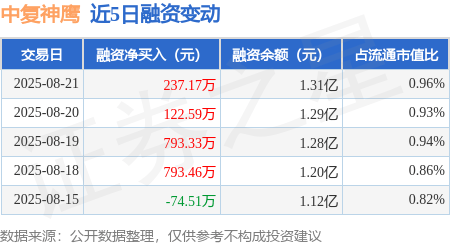
中复神鹰:8月21日融资净买入237.17万元,连续3日累计净买入1153.1万元
Sou Hu Cai Jing· 2025-08-22 02:25
Core Viewpoint - Zhongfu Shenying (688295) has shown a significant increase in financing activities, indicating a strengthening bullish sentiment in the market as evidenced by the net financing purchases over recent trading days [1][4]. Financing Activities - On August 21, 2025, Zhongfu Shenying recorded a financing buy of 8.1951 million yuan and a financing repayment of 5.8233 million yuan, resulting in a net financing purchase of 2.3717 million yuan, with a financing balance of 131 million yuan [1]. - Over the past three trading days, the cumulative net financing purchase reached 11.531 million yuan [1]. Financing Balance Trends - The financing balance on August 21, 2025, was 132 million yuan, reflecting an increase of 2.395 million yuan or 1.84% from the previous day [4]. - The financing balance has shown a consistent upward trend, with notable increases on August 19 and August 18, where the balances were 129 million yuan and 121 million yuan, respectively [4]. Margin Trading Activities - On August 21, 2025, there was a margin sell of 1,700 shares and a margin repayment of 200 shares, resulting in a net margin sell of 1,500 shares, with a remaining margin of 47,500 shares [2][3]. - In the last 20 trading days, there were 11 days with net margin sells, indicating a potential bearish sentiment among some investors [2]. Market Sentiment Indicators - The increase in financing balance suggests a strengthening bullish sentiment, while the increase in margin sell indicates a growing bearish sentiment among certain investors [5].

石化和炼油行业反内卷,对化工行业影响几何?
2025-08-20 14:49
Summary of Key Points from the Conference Call Industry Overview - The petrochemical industry is facing challenges such as declining product prices, intense competition, and anti-dumping lawsuits, prompting the government to implement measures for capacity assessment, elimination of redundant facilities, and technological upgrades to promote energy conservation and carbon reduction [1][2][3] Core Insights and Arguments - The petrochemical industry's profits have been declining, with total revenue projected at 14.6 trillion yuan in 2024, but profits falling below 1 trillion yuan, continuing a downward trend of 8.8% in 2025 [2][25] - A capacity warning report identified 14 high-risk products, including refining, propylene, and PVC, and 10 products with relatively high risk, such as soda ash and ethylene glycol, indicating structural overcapacity issues [3][4] - Private enterprises are better positioned for transformation in the petrochemical sector due to advanced technology and willingness to invest in energy-saving modifications, while state-owned enterprises face greater pressure to upgrade outdated facilities [5][10] - New capacity additions before the carbon peak include an increase of 40 million tons in primary refining capacity, which is aligned with advanced technology and will not lead to overcapacity [6][10] - The development of the petrochemical industry chain relies heavily on policy guidance and downstream market demand, with emerging markets like pharmaceuticals and renewable energy driving growth in biodegradable materials and photovoltaic materials [10][12] Additional Important Content - The petrochemical industry is experiencing structural overcapacity, particularly in low-end bulk products, while mid-to-high-end products remain scarce and reliant on imports [7][8] - The need for upgrading old facilities is critical, especially in traditional refining and caustic soda plants, many of which are over 20 years old [9] - The government is encouraging the elimination of outdated capacity and extending the industrial chain into new materials, with a focus on market-driven development rather than strict regulatory measures [17][27] - The petrochemical sector's future planning must balance specific development directions with market demand to avoid misleading the market and causing overcapacity [18] - The overall profitability of the petrochemical industry is under pressure, with a reported profit decline of 2.3% in the first half of the year and an 8.8% decline the previous year [25] Conclusion - The petrochemical industry is at a critical juncture, facing both challenges and opportunities for transformation. The emphasis on technological upgrades, market responsiveness, and policy support will be essential for navigating the current landscape and achieving sustainable growth.
化学纤维板块8月20日涨2.77%,吉林碳谷领涨,主力资金净流入4.53亿元
Zheng Xing Xing Ye Ri Bao· 2025-08-20 08:37
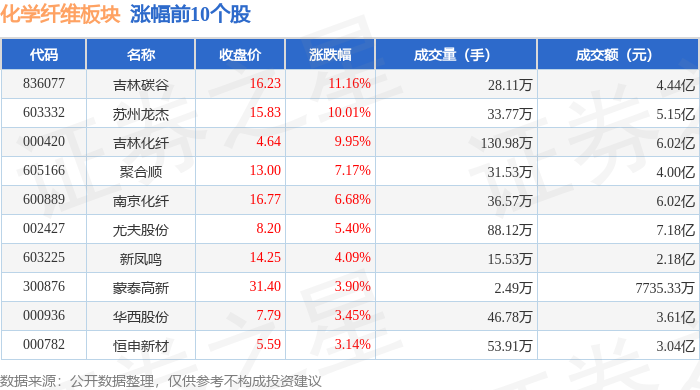
Market Overview - On August 20, the chemical fiber sector rose by 2.77% compared to the previous trading day, with Jilin Carbon Valley leading the gains [1] - The Shanghai Composite Index closed at 3766.21, up 1.04%, while the Shenzhen Component Index closed at 11926.74, up 0.89% [1] Stock Performance - Jilin Carbon Valley (836077) closed at 16.23, up 11.16% with a trading volume of 281,100 shares and a transaction value of 444 million yuan [1] - Suzhou Longjie (603332) closed at 15.83, up 10.01% with a trading volume of 337,700 shares and a transaction value of 515 million yuan [1] - Jilin Chemical Fiber (000420) closed at 4.64, up 9.95% with a trading volume of 1,309,800 shares and a transaction value of 602 million yuan [1] - Other notable stocks include 聚合顺 (605166) at 13.00, up 7.17%, and 南京化纤 (600889) at 16.77, up 6.68% [1] Capital Flow - The chemical fiber sector saw a net inflow of 453 million yuan from main funds, while retail funds experienced a net outflow of 316 million yuan [2] - The main funds' net inflow for Jilin Chemical Fiber (000420) was 200 million yuan, accounting for 33.27% of its total [3] - Suzhou Longjie (603332) had a main fund net inflow of 119 million yuan, representing 23.14% of its total [3]


化学纤维板块8月19日跌0.78%,中复神鹰领跌,主力资金净流出1.36亿元
Zheng Xing Xing Ye Ri Bao· 2025-08-19 08:32
Group 1 - The chemical fiber sector experienced a decline of 0.78% compared to the previous trading day, with Zhongfu Shenying leading the drop [1] - On the same day, the Shanghai Composite Index closed at 3727.29, down 0.02%, while the Shenzhen Component Index closed at 11821.63, down 0.12% [1] - A table detailing the individual stock performance within the chemical fiber sector was provided [1] Group 2 - The net outflow of main funds in the chemical fiber sector amounted to 136 million yuan, while retail funds saw a net inflow of 125 million yuan [2] - The net inflow of speculative funds was recorded at 10.8252 million yuan [2] - A table showing the fund flow for individual stocks in the chemical fiber sector was included [2]

“反内卷”政策推动化工行业供给侧改革,石化ETF(159731)布局价值凸显
Mei Ri Jing Ji Xin Wen· 2025-08-18 04:44
Group 1 - The three major indices opened higher and continued to rise during the trading session, with the China Securities Petrochemical Industry Index showing slight fluctuations after a strong opening. Key stocks such as Kaisa Bio rose over 5%, with others like Juhua Co., Lianhong New Science, and Zhongfu Shenying also experiencing gains [1] - According to Open Source Securities, the driving force behind the chemical market has shifted from demand stimulation to supply-side reform. The policy catalyst typically follows a period where the Producer Price Index (PPI) is at a bottom state. Currently, the chemical cycle has been hovering at the bottom for a long time based on historical PPI comparisons [1] - Indicators from the demand side, such as Consumer Price Index (CPI), Purchasing Managers' Index (PMI), and household leverage ratios, show limited short-term improvement. To optimize the supply-demand structure and promote high-quality development in the industry, breakthroughs may be sought from the supply side [1] Group 2 - The Petrochemical ETF (159731) and its linked funds (017855/017856) closely track the China Securities Petrochemical Industry Index. According to the Shenwan secondary industry classification, the top three sectors in the index are refining and trading (28.79%), chemical products (22.8%), and agricultural chemicals (19.45%), which are expected to benefit significantly from policies aimed at reducing competition, restructuring, and eliminating outdated production capacity [1]
研判2025!中国预浸料行业产业链、市场规模、需求量、产量及发展趋势分析:制造业轻量化需求激增,行业规模同比上涨8.1%[图]
Chan Ye Xin Xi Wang· 2025-08-16 03:18
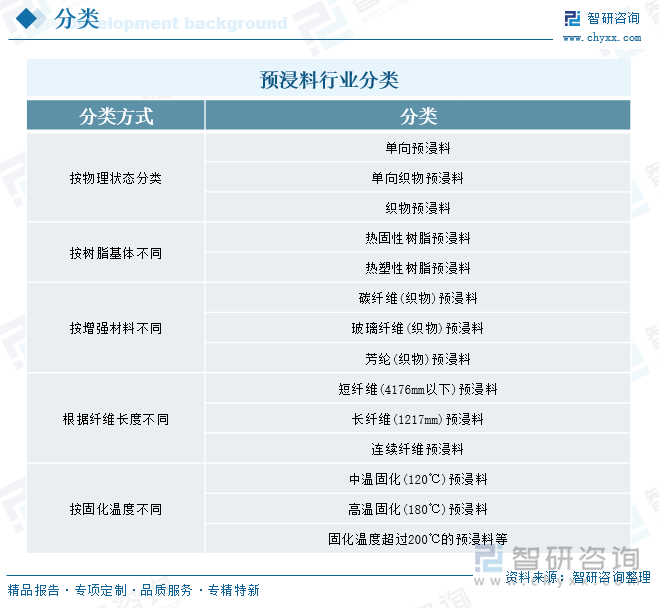
Core Insights - The prepreg industry in China is experiencing growth driven by lightweight demands, particularly in aerospace, automotive, and construction sectors, with a projected market size of 150 billion yuan in 2024, reflecting an 8.1% year-on-year increase [1][10][12] - Technological advancements, including smart production and eco-friendly thermoplastic prepregs, are enhancing performance and production efficiency [1][10] - The demand for prepregs is expected to rise from 27.2 million square meters in 2019 to 33.8 million square meters in 2024, while production is projected to reach 27.1 million square meters, resulting in a supply-demand gap of 6.7 million square meters [12] Industry Overview - Prepregs are composite materials made by impregnating continuous fibers or fabrics with resin under controlled conditions, widely used in aerospace, automotive, wind energy, and construction [3][6] - The industry is categorized based on physical state, resin matrix, reinforcement materials, fiber length, and curing temperature [4][6] Industry Chain - The upstream materials for the prepreg industry include reinforcement materials (glass fiber, carbon fiber, aramid fiber) and matrix materials (phenolic and epoxy resins) [6] - The midstream involves the manufacturing of prepregs, while the downstream includes the production of composite materials used in various applications [6] Competitive Landscape - The prepreg market is characterized by international firms dominating the high-end market, while Chinese companies focus on the mid to low-end segments [14] - Key international players include Toray and Hexcel, while domestic companies like Zhongfu Shenying and Guangwei Composite are emerging through cost control and technological advancements [14] Market Trends - The demand for high-end prepregs is expected to grow, with ongoing R&D investments aimed at meeting domestic market needs [20] - Continuous innovation in technology, such as nano-modification and rapid curing processes, is anticipated to enhance the mechanical properties and durability of prepregs [21] - The application of prepregs is expanding from high-end sectors like aerospace to consumer markets, including new energy vehicles and sports equipment [23] - The industry is increasingly focusing on sustainable development, exploring bio-based and biodegradable resins to reduce environmental impact [24]