洋河股份

Search documents
酒价内参1月22日价格发布 国窖1573下跌4元
Xin Lang Cai Jing· 2026-01-22 01:23
Core Insights - The Chinese liquor market is experiencing a general decline in retail prices, with the average price of the top ten liquor products dropping to 8,854 yuan, a decrease of 12 yuan from the previous day, marking the fifth consecutive decline to a two-month low [1][7][8] - The market shows a mixed trend with seven products declining and three increasing in price, indicating a short-term adjustment phase in the industry [1][8] Price Trends - The leading product, Xijiu Junpin, saw the largest drop of 13 yuan per bottle, while Gujing Gonggu 20 followed with a decrease of 9 yuan per bottle [1][8] - Other notable declines include Guojiao 1573 and Yanghe Dream Blue M6+, both down by 4 yuan per bottle, and Feitian Moutai, which decreased by 3 yuan per bottle [1][8] - In contrast, the premium product, Jingpin Moutai, increased significantly by 18 yuan per bottle, attributed to tightened channel supply and replenishment demand [1][8] Data Collection Methodology - The "Liquor Price Reference" collects data from approximately 200 sampling points across various regions, including designated distributors, social distributors, e-commerce platforms, and retail outlets, ensuring a comprehensive and objective representation of market prices [2][9] - The pricing data is weighted based on actual transaction volumes to reflect true market conditions, particularly for Feitian Moutai and Jingpin Moutai [2][9] Brand Value Insights - Moutai ranks first in the global spirits industry with a brand value of 59.63 billion USD, reflecting a 2.2% year-on-year increase, underscoring its role as a benchmark for Chinese liquor brands on the international stage [3][9] - The Brand Finance report indicates that while the number of Chinese brands in the top 500 decreased by one, the total brand value increased by 9.7%, with an average brand strength index of 76.4, surpassing the global average [3][9]

酒价内参1月22日价格发布 习酒君品下跌13元
Xin Lang Cai Jing· 2026-01-22 01:23
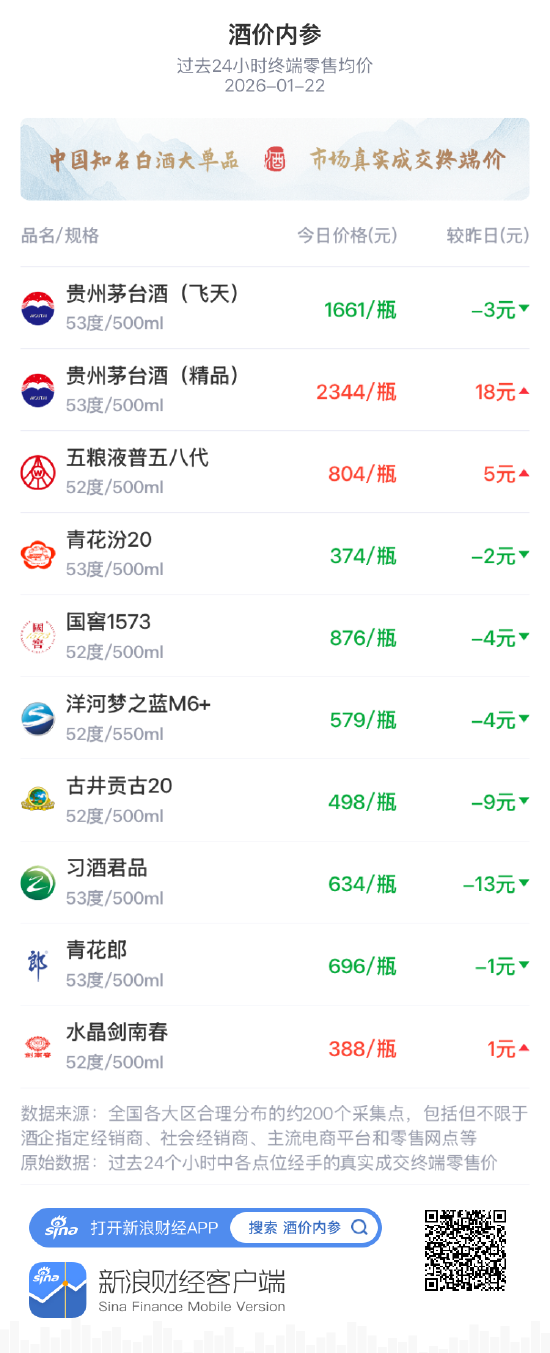
新浪财经"酒价内参"重磅上线 知名白酒真实市场价尽在掌握 新浪财经"酒价内参"过去24小时收集的数据显示,中国白酒市场十大单品的终端零售均价在1月22日迎 来普遍下跌。如果十大单品各取一瓶整体打包售卖,今日总售价为8854元,较昨日下跌12元。市场价格 第五次创下近两个月的新低,高端酒价格中枢持续下移,行业短期调整态势未改。 今日市场普跌特征凸显,十大单品七跌三涨,头部酒品走势分化,仅少数单品显露止跌回暖迹象。下跌 产品中,习酒君品领跌,环比降低13元/瓶;古井贡古紧随其后,环比下跌9元/瓶;国窖1573与洋河梦 之蓝M6+均环比下跌4元/瓶;飞天茅台环比下跌3元/瓶,i茅台平价货源持续投放,终端价格支撑进一步 弱化;青花汾20与青花郎跌幅较小,分别下跌2元/瓶与1元/瓶。上涨产品中,精品茅台领涨,环比大幅 上涨18元/瓶,渠道货源阶段性收紧,叠加部分终端补货需求释放;五粮液普五八代上涨5元/瓶;水晶 剑南春微涨1元/瓶。 "酒价内参"的每日数据源自全国各大区均有合理分布的约200个采集点,包括但不限于酒企的指定经销 商、社会经销商、电商平台和零售网点等,原始取样数据为过去24个小时各点位经手的真实成交终端零 ...






酒价内参1月22日价格发布 市场延续下跌创两月价格新低
Xin Lang Cai Jing· 2026-01-22 01:18
新浪财经"酒价内参"重磅上线 知名白酒真实市场价尽在掌握 新浪财经"酒价内参"过去24小时收集的数据显示,中国白酒市场十大单品的终端零售均价在1月22日迎 来普遍下跌。如果十大单品各取一瓶整体打包售卖,今日总售价为8854元,较昨日下跌12元。市场价格 第五次创下近两个月的新低,高端酒价格中枢持续下移,行业短期调整态势未改。 今日市场普跌特征凸显,十大单品七跌三涨,头部酒品走势分化,仅少数单品显露止跌回暖迹象。下跌 产品中,习酒君品领跌,环比降低13元/瓶;古井贡古紧随其后,环比下跌9元/瓶;国窖1573与洋河梦 之蓝M6+均环比下跌4元/瓶;飞天茅台环比下跌3元/瓶,i茅台平价货源持续投放,终端价格支撑进一步 弱化;青花汾20与青花郎跌幅较小,分别下跌2元/瓶与1元/瓶。上涨产品中,精品茅台领涨,环比大幅 上涨18元/瓶,渠道货源阶段性收紧,叠加部分终端补货需求释放;五粮液普五八代上涨5元/瓶;水晶 剑南春微涨1元/瓶。 "酒价内参"的每日数据源自全国各大区均有合理分布的约200个采集点,包括但不限于酒企的指定经销 商、社会经销商、电商平台和零售网点等,原始取样数据为过去24个小时各点位经手的真实成交终端零 ...
酒价内参1月22日价格发布 市场延续下跌五创两月价格新低
Xin Lang Cai Jing· 2026-01-22 00:59
新浪财经"酒价内参"过去24小时收集的数据显示,中国白酒市场十大单品的终端零售均价在1月22日迎来 普遍下跌。如果十大单品各取一瓶整体打包售卖,今日总售价为8854元,较昨日下跌12元。市场价格第五 次创下近两个月的新低,高端酒价格中枢持续下移,行业短期调整态势未改。今日市场普跌特征凸显,十 大单品七跌三涨,头部酒品走势分化,仅少数单品显露止跌回暖迹象。下跌产品中,习酒君品领跌,环比 降低13元/瓶;古井贡古紧随其后,环比下跌9元/瓶;国窖1573与洋河梦之蓝M6+均环比下跌4元/瓶;飞天 茅台环比下跌3元/瓶,i茅台平价货源持续投放,终端价格支撑进一步弱化;青花汾20与青花郎跌幅较小, 分别下跌2元/瓶与1元/瓶。上涨产品中,精品茅台领涨,环比大幅上涨18元/瓶,渠道货源阶段性收紧,叠 加部分终端补货需求释放;五粮液普五八代上涨5元/瓶;水晶剑南春微涨1元/瓶。 数据来源:全国各大区合理分布的约200个采集点,包括但不限于 酒企指定经销商、社会经销商、主流电商平台和零售网点等 原始数据: 过去24个小时中各点位经手的真实成交终端零售价 sma 打开新浪财经APP 搜索 酒价内参 Q 新浪财经客户端 Sina ...
贵州茅台价格市场化改革专题研究报告从外溢依赖到独立生态,构建消费者导向的价格形成机制
Guoxin Securities· 2026-01-22 00:30
Investment Rating - The report maintains an "Outperform" rating for Guizhou Moutai [6][43] Core Insights - The report emphasizes the transformation of Guizhou Moutai's pricing mechanism, which aims to create a consumer-oriented pricing structure that reflects real market demand and enhances channel profitability [1][3][29] - The white liquor industry is expected to shift from dependence on Moutai's demand to a more independent ecosystem, leading to differentiated development among companies [4][25] - The pricing reform is compared to the 1988 market liberalization, indicating a significant shift in the competitive landscape and pricing formation mechanisms in the industry [9][10][25] Summary by Sections Industry Investment Rating - Guizhou Moutai is rated as "Outperform" with projected revenues of 1833.0 billion, 1842.9 billion, and 1861.4 billion yuan for 2025-2027, reflecting growth rates of +5.3%, +0.5%, and +1.0% respectively [5][43] Pricing Mechanism Reform - The 2026 pricing reform focuses on breaking the rigid factory price model, allowing for a more market-driven pricing strategy that adapts to supply and demand dynamics [35][43] - The new pricing structure includes a multi-price system that aligns with consumer expectations and ensures channel profitability [35][43] Consumer-Centric Strategy - Guizhou Moutai is restructuring its product offerings to focus on two main products: the "Flying Heaven" and premium offerings, enhancing its core product strength [3][30] - The company is implementing a multi-channel sales strategy that includes self-sale, distribution, consignment, and direct sales to improve consumer access and service quality [34][43] Market Dynamics - The report highlights a shift in the white liquor industry from a "follow-the-leader" growth model to a "differentiated competition" model, driven by changing consumer preferences and market conditions [4][25] - The anticipated changes in consumer behavior and market structure are expected to reshape the competitive landscape, with a focus on quality and service [25][29]
贵州茅台价格市场化改革专题研究报告:从外溢依赖到独立生态,构建消费者导向的价格形成机制
Guoxin Securities· 2026-01-21 12:48
Investment Rating - The report maintains an "Outperform" rating for Kweichow Moutai [5][6] Core Insights - Kweichow Moutai is undergoing a market-oriented transformation with a focus on a consumer-driven pricing mechanism, which is expected to reshape the competitive landscape and pricing formation in the industry [1][3][4] - The 2026 pricing system reform aims to create a "multi-price coexistence" ecosystem that aligns with consumer needs and enhances channel profitability through improved service [3][35] - The white liquor industry is transitioning from dependence on Moutai's demand to establishing independent ecosystems, leading to differentiated development among companies [4][29] Summary by Sections Investment Outlook - Short-term expectations indicate stable pricing for the flagship product, with anticipated sales growth during the Spring Festival [5] - Medium-term recovery in demand and product structure upgrades are expected to enhance profitability [5] - Long-term prospects remain positive as the company focuses on consumer-centric strategies and service capabilities, with potential for price increases and brand premium [5] Market Dynamics - The white liquor industry is shifting from a "follow-the-leader" growth model to a "differentiated competition" structure, driven by Moutai's market reforms [4][29] - The report highlights the importance of adapting to changing consumer preferences and market conditions, emphasizing the need for companies to build independent customer bases and market scenarios [4][29] Pricing Mechanism - The new pricing strategy breaks away from rigid factory prices, allowing for dynamic adjustments based on market conditions and consumer expectations [35] - The pricing reform is seen as a significant step towards marketization, ensuring channel profitability while stimulating sales [35] Company Performance Forecast - Revenue projections for Kweichow Moutai are set at CNY 183.3 billion, CNY 184.3 billion, and CNY 186.1 billion for 2025-2027, reflecting year-on-year growth of 5.3%, 0.5%, and 1.0% respectively [5] - Expected net profit for the same period is CNY 90.45 billion, CNY 90.50 billion, and CNY 91.79 billion, with growth rates of 4.9%, 0.0%, and 1.4% respectively [5]
吃喝板块突遭寒流,白酒股领跌!食品饮料ETF华宝(515710)重挫1.71%,机构激辩:布局时刻到了吗?
Xin Lang Cai Jing· 2026-01-21 11:23
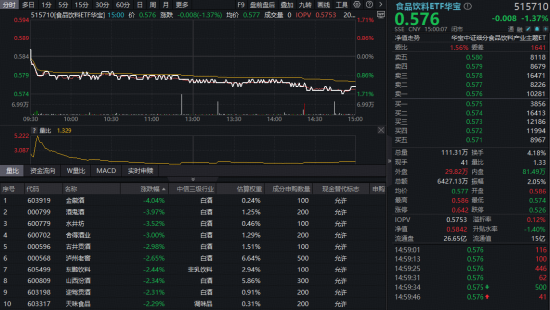
Core Viewpoint - The food and beverage sector continues to experience a downturn, with the Huabao Food and Beverage ETF (515710) showing a significant decline, particularly in the liquor stocks, which have collectively dropped, impacting the overall sector performance [1][10]. Group 1: Market Performance - On January 21, the Huabao Food and Beverage ETF (515710) experienced a maximum intraday decline of 1.71%, closing down 1.37% [1][10]. - Major liquor stocks such as Jinhui Liquor fell by 4.04%, while others like Guizhou Moutai and Wuliangye also saw significant declines, contributing to the sector's downturn [1][10]. Group 2: Company Insights - Guizhou Moutai, the largest holding in the Huabao Food and Beverage ETF, had a holding ratio of 14.89% as of the third quarter of 2025 [3][12]. - The brand value of Guizhou Moutai increased by 2.2% to reach $59.63 billion, ranking first in the global liquor industry according to the Brand Finance report [1][12]. Group 3: Valuation and Investment Strategy - The current valuation of the food and beverage sector is at a historical low, with the price-to-earnings ratio of the ETF's underlying index at 19.83, placing it in the bottom 3.33% of the last decade [4][12]. - Analysts suggest that the food and beverage sector may present a good opportunity for left-side positioning due to its low valuation and strong cash dividend capabilities [4][14]. Group 4: Future Outlook - The market is expected to show a "growth first, liquor accumulation" characteristic as the Spring Festival approaches, with increasing demand for liquor as inventory levels decrease [14][15]. - The food and beverage ETF is positioned to capture core assets in the sector, with approximately 60% of its holdings in high-end and mid-range liquor stocks, and 40% in other beverage and dairy segments [15][16].

贵州茅台价格市场化改革专题研究报告:海外溢依赖到独立生态,构建消费者导向的价格形成机制
Guoxin Securities· 2026-01-21 11:12
Investment Rating - The report maintains an "Outperform" rating for Kweichow Moutai [5][6] Core Insights - Kweichow Moutai is undergoing a market-oriented transformation with a focus on a consumer-driven pricing mechanism, which is expected to reshape the competitive landscape and pricing dynamics in the industry [1][3][4] - The 2026 pricing system reform aims to create a "multi-price coexistence" ecosystem that aligns with consumer needs and enhances channel profitability [3][35] - The white liquor industry is transitioning from dependence on Moutai's demand to establishing independent ecosystems, leading to differentiated development among companies [4][25] Summary by Sections Investment Outlook - Short-term expectations indicate stable pricing for the flagship product, with anticipated sales growth during the Spring Festival [5] - Medium-term recovery in demand and product structure upgrades are expected to enhance profitability [5] - Long-term prospects remain positive as the company focuses on consumer-centric strategies and service capabilities, with continued potential for price increases [5] Market Dynamics - The report highlights a shift in the white liquor industry towards a "product + service" economy, driven by changes in consumer preferences and market conditions [3][25] - The competitive landscape is evolving, with companies moving away from following Moutai's lead to developing their own customer bases and market strategies [4][25] Pricing Strategy - The new pricing mechanism breaks away from rigid factory prices, allowing for dynamic adjustments based on market conditions and consumer expectations [35] - The introduction of a multi-channel sales approach, including self-sale, agency sale, and consignment, aims to improve channel profitability and consumer access [34][35] Company Performance Forecast - Revenue projections for Kweichow Moutai are set at CNY 183.3 billion, CNY 184.3 billion, and CNY 186.1 billion for 2025-2027, reflecting growth rates of +5.3%, +0.5%, and +1.0% respectively [5] - Expected net profit for the same period is CNY 90.45 billion, CNY 90.50 billion, and CNY 91.79 billion, with growth rates of +4.9%, 0.0%, and +1.4% respectively [5]
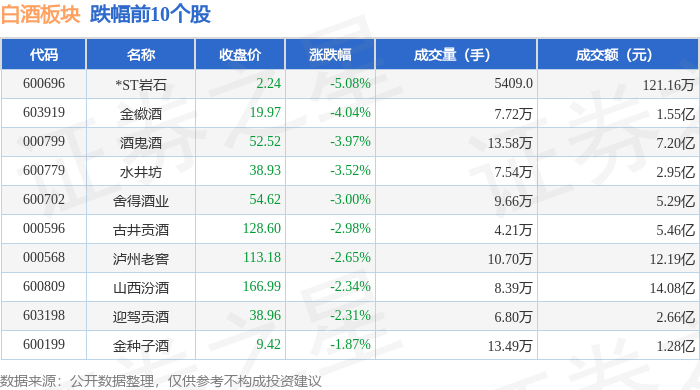
白酒板块1月21日跌1.83%,*ST岩石领跌,主力资金净流出26.42亿元
Zheng Xing Xing Ye Ri Bao· 2026-01-21 08:53
Core Viewpoint - The liquor sector experienced a decline of 1.83% on January 21, with *ST Rock leading the drop, while the overall market indices showed slight increases [1] Group 1: Market Performance - The Shanghai Composite Index closed at 4116.94, up 0.08% [1] - The Shenzhen Component Index closed at 14255.12, up 0.7% [1] - The liquor sector saw a net outflow of 2.642 billion yuan from main funds, while retail investors contributed a net inflow of 858 million yuan [1] Group 2: Individual Stock Performance - *ST Rock closed at 2.24 yuan, down 5.08% with a trading volume of 5409 lots [1] - Other notable declines included Quan Wei Jiu down 4.04%, Zhi Si Li down 3.97%, and Shui Jing Fang down 3.52% [1] - The highest closing price was for Shanxi Fen Jiu at 166.99 yuan, down 2.34% [1] Group 3: Fund Flow Analysis - Main funds showed a significant outflow from several stocks, including Lao Bai Gan Jiu with a net outflow of 18.7589 million yuan [2] - Retail investors had a net inflow in stocks like Jin Shi Zi Jiu, which saw a net inflow of 12.814 million yuan [2] - The overall trend indicates a mixed sentiment among different types of investors within the liquor sector [2]


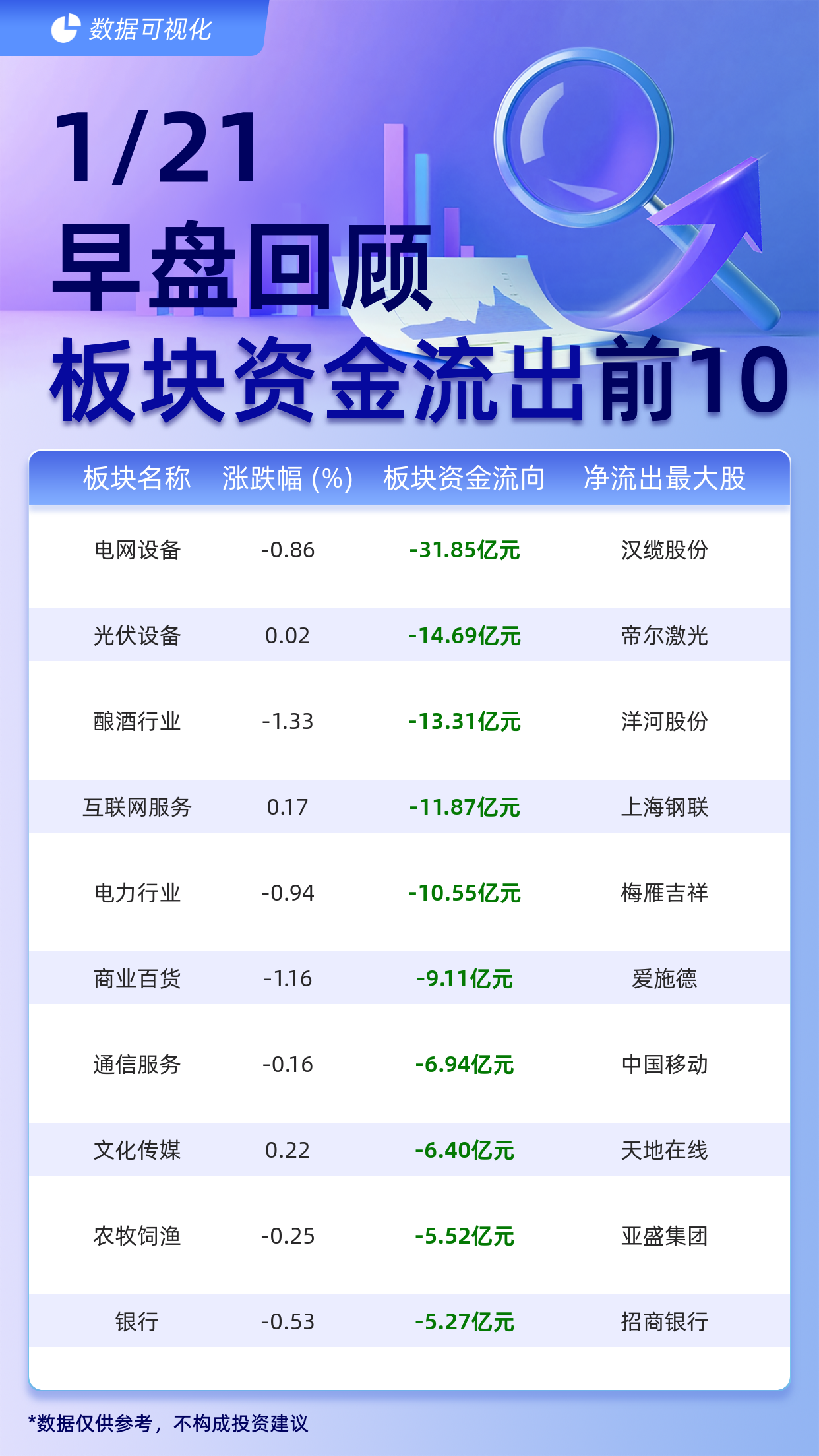
主力板块资金流出前10:电网设备流出31.85亿元、光伏设备流出14.69亿元
Jin Rong Jie· 2026-01-21 04:04
Core Viewpoint - As of January 21, the main market saw a net inflow of 7.765 billion yuan in major funds, indicating a mixed sentiment among investors across various sectors [1]. Fund Flow Summary - The top ten sectors with the largest fund outflows included: - Power Grid Equipment: net outflow of 3.185 billion yuan, with a decline of 0.86% [2] - Photovoltaic Equipment: net outflow of 1.469 billion yuan, with a slight increase of 0.02% [2] - Alcohol Industry: net outflow of 1.331 billion yuan, with a decrease of 1.33% [2] - Internet Services: net outflow of 1.187 billion yuan, with a rise of 0.17% [2] - Electric Power Industry: net outflow of 1.055 billion yuan, with a decline of 0.94% [2] - Commercial Retail: net outflow of 911 million yuan, with a decrease of 1.16% [2] - Communication Services: net outflow of 694 million yuan, with a decline of 0.16% [3] - Cultural Media: net outflow of 640 million yuan, with an increase of 0.22% [3] - Agriculture, Animal Husbandry, and Fishery: net outflow of 552 million yuan, with a decrease of 0.25% [3] - Banking: net outflow of 527 million yuan, with a decline of 0.53% [3]