东航物流

Search documents
中国实践中的利益协调:主体利益共生与算法监管
Jing Ji Guan Cha Wang· 2026-01-29 12:25
Core Insights - The article discusses China's unique governance approach in balancing fairness and efficiency in the digital economy, emphasizing institutional innovation and technological governance to create a symbiotic relationship among various stakeholders [1]. Group 1: Institutional Innovation - The foundation of China's governance practice begins with the restructuring of property rights and distribution patterns, focusing on mixed ownership reform and data rights [1]. - Mixed ownership reform serves as a crucial measure to connect public ownership with market economy, particularly evident in the digital infrastructure sector [2]. - The "three rights separation" model in Shenzhen allows data providers to retain 70% of the revenue from their data, legally affirming their rights as original producers [2]. Group 2: Technological Governance - China emphasizes the regulation of technological externalities while leveraging technology, aiming to balance efficiency and fairness through a regulatory paradigm that incorporates human concerns into automated decision-making [3]. - The "Interim Measures for the Management of Generative Artificial Intelligence Services" addresses core risks associated with algorithm applications, reflecting a clear value orientation [5]. - Algorithm auditing requirements compel platform companies to disclose discriminatory parameters in their algorithms, promoting transparency and integrating fairness into the entire algorithm development and operation process [5]. Group 3: Practical Outcomes - The Shenzhen data exchange has facilitated transactions where data providers earn an average of approximately 12,000 yuan, demonstrating the initial success of value-sharing mechanisms [4]. - The mixed ownership reform at China Unicom led to a significant increase in digital business revenue, rising from less than 10% to over 30% within five years [3]. - Eastern Airlines Logistics, as the first airline to undergo mixed ownership reform, saw a 210% increase in per capita profit, validating the effectiveness of the capital-labor shared development model [3]. Group 4: Theoretical Advancement - China's governance practices are not a collection of isolated policies but a coherent system with a clear internal logic, focusing on restructuring relationships and redefining rights and obligations in digital production [5]. - The integration of technology in enforcing new property rules and regulating capital movements reflects a governance approach that seeks to enhance equitable distribution of benefits among diverse stakeholders [5]. - The ultimate goal of these coordinated efforts is to achieve a more reasonable distribution of interests, benefiting employees, data providers, users, and the government [5].
东航物流高效完成天津至上海放射性药物运输
Zhong Guo Min Hang Wang· 2026-01-29 05:05
近年来,东航物流以核药及细胞生物制品等对储运条件要求极高的医药品类为突破口,积极拓展国内外 药企合作渠道,成功实现医药业务突围。 下一步,东航物流计划将天津口岸的成功经验推广至湖北、兰州等地,逐步构建东航冷链高端医药供应 链服务网络。(编辑:张薇,校对:李季威,审核:韩磊) 该批药物属于第7类放射性危险品,核心成分半衰期仅为72小时,其运输需遵守国际航空运输协会 (IATA)规定、《民用航空危险品运输管理规定》以及药品流通质量管理规范(GSP),并涉及药 企、机场、航空公司等多个主体间的紧密协作,对运输各环节的专业性、规范性有着较高要求。 东航物流接到任务后,制定详细保障方案,针对"时间窗口紧、监管程序严、操作要求高"等核心难点, 成立专项工作组,与天津机场等方面多次协调沟通,先后解决了危险品运输资质备案、货物表面放射性 检测等关键申报材料的完善和送审。最终,由MU5228航班完成干线运输,并提前协调对接货站、地面 运输车辆等,实现全程无缝衔接,从药厂送达医院全程耗时不足24小时,高效保障了药物品质与运输安 全。 《中国民航报》、中国民航网 记者钱擘 报道:近日,东航物流顺利完成一批由天津至上海的放射性药 物 ...

东航物流“东东测”赋能航空冷链 硬核科技驱动生物制品运输再破局
Zhong Guo Min Hang Wang· 2026-01-29 04:01
Core Viewpoint - The successful transportation of high-value biological products from Lanzhou to Changchun using Eastern Airlines' cold chain logistics technology highlights the critical role of advanced temperature control solutions in the biopharmaceutical industry, addressing key logistical challenges and enhancing product viability in global markets [1][3]. Group 1: Technology and Innovation - The "Dongdong Measurement" device developed by Eastern Airlines Logistics integrates precise sensing, safety protection, and compliance tracking, overcoming industry challenges related to temperature control during air transport [1][2]. - This device maintains temperature measurement accuracy within ±0.5°C, aligning with the stringent requirements for biological products, and meets international pharmaceutical cold chain standards [2]. - The device employs encrypted storage and blockchain technology for real-time temperature data recording and compliance with domestic and international regulations, ensuring traceability for up to five years [2]. Group 2: Logistics Efficiency - The transportation time for biological products from Lanzhou to Changchun has been significantly reduced from 2-3 days via road cold chain to just 6-8 hours through air logistics, enhancing the preservation of product viability [3]. - The comprehensive service system established by Eastern Airlines Logistics includes equipment development, compliance certification, route assurance, and data traceability, maximizing the efficiency of air logistics [3]. Group 3: Industry Impact - The application of "Dongdong Measurement" not only improves transportation efficiency but also provides a replicable and scalable cold chain solution for high-value products, facilitating better integration of Gansu's biopharmaceutical enterprises into domestic and international markets [3][4]. - The support from national policies for high-end pharmaceutical air cold chain logistics underscores the importance of air logistics as a foundational infrastructure for the globalization of the pharmaceutical industry [3].
中国实践中的利益协调(一):主体利益共生与算法监管
Jing Ji Guan Cha Bao· 2026-01-29 03:54
Core Insights - The article discusses China's unique governance approach in balancing fairness and efficiency in the digital economy, emphasizing institutional innovation and technological governance to create a symbiotic relationship among various stakeholders [1]. Group 1: Institutional Innovation - China's governance practice begins with restructuring property rights and distribution patterns, focusing on mixed ownership reform to establish a "capital-labor" community of interests [2]. - The mixed ownership reform connects public ownership with market economy, particularly evident in the digital infrastructure sector [2]. - The innovation of data ownership rights aims to break platform monopolies and protect the rights of data providers, exemplified by Shenzhen's "three rights separation" model, which allocates 70% of data revenue rights to data providers [3]. Group 2: Technological Governance - China emphasizes regulating the negative externalities of technology while leveraging it, creating a regulatory paradigm that balances efficiency and fairness [4]. - The "Interim Measures for the Management of Generative Artificial Intelligence Services" introduced in 2023 addresses core risks associated with algorithm applications [4]. - The algorithm audit system has evolved from passive response to proactive regulation, requiring platforms to disclose records of discriminatory parameters in their algorithms, promoting transparency and fairness in algorithm development and operation [4]. Group 3: Theoretical Advancement - China's governance practices are not a collection of isolated policies but a coherent system with a clear internal logic, focusing on the collaboration of institutions, technology, and distribution [5]. - The exploration of new production relationships in the digital economy aims to actively reconstruct the underlying rules of production relations and optimize capital movement through technological means, ultimately striving for a fairer and more sustainable distribution of interests [5]. - The future direction involves systematizing and normalizing these institutional innovations across broader temporal and spatial dimensions [5]. Group 4: Case Studies - China Unicom's mixed ownership reform in 2017 resulted in a shareholding structure of 53% state capital, 36% strategic investors, and 11% core employee ownership, significantly enhancing innovation capabilities and increasing digital business revenue from under 10% to over 30% within five years [6]. - Eastern Airlines Logistics, as the first "airline mixed reform stock," established a three-party interest community with 10% employee ownership, leading to a 210% increase in per capita profit since the reform [6]. - The Shenzhen Data Exchange facilitated transactions where data providers earned an average of approximately 12,000 yuan, demonstrating the practical implementation of market-oriented data allocation and profit-sharing [6].

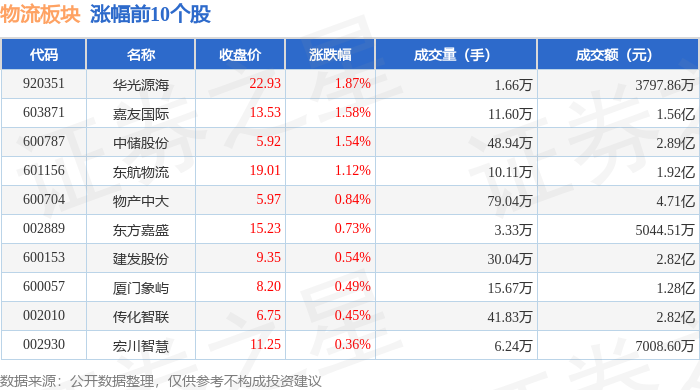
物流板块1月28日跌0.51%,密尔克卫领跌,主力资金净流出3724.74万元
Zheng Xing Xing Ye Ri Bao· 2026-01-28 09:04
证券之星消息,1月28日物流板块较上一交易日下跌0.51%,密尔克卫领跌。当日上证指数报收于 4151.24,上涨0.27%。深证成指报收于14342.9,上涨0.09%。物流板块个股涨跌见下表: | 代码 | 名称 | 收盘价 | 涨跌幅 | 成交量(手) | 成交额(元) | | | --- | --- | --- | --- | --- | --- | --- | | 920351 | 华米源海 | 22.93 | 1.87% | 1.66万 | | 3797.86万 | | 603871 | 嘉友国际 | 13.53 | 1.58% | 11.60万 | | 1.56亿 | | 600787 | 中储股份 | 5.92 | 1.54% | 48.94万 | | 2.89 乙 | | 601156 | 东航物流 | 19.01 | 1.12% | 10.11万 ﺎ | | 1.92亿 | | 600704 | 物产中大 | 5.97 | 0.84% | 79.04万 | | 4.71亿 | | 002889 | 东方嘉盛 | 15.23 | 0.73% | 3.33万 | | 5044.51万 | | ...

未知机构:国联民生交运周报260126即时零售再起势重视顺丰同城布局机会航空量价-20260128
未知机构· 2026-01-28 02:25
【国联民生交运*周报260126】即时零售再起势,重视顺丰同城布局机会;航空量价环比回升预热春运 #阿里即时零售领域长期投入的决心坚定,抖音、拼多多入局,即时零售再起势。 1)阿里:持续加码大消费和服务电商赛道,即时零售领域长期投入的决心坚定。 25H2淘宝闪购日订单峰值达1.2亿单,8月周度日均订单突破8000万单。 2025Q3,即时零售收入同比增长60%。 【国联民生交运*周报260126】即时零售再起势,重视顺丰同城布局机会;航空量价环比回升预热春运 #阿里即时零售领域长期投入的决心坚定,抖音、拼多多入局,即时零售再起势。 1)阿里:持续加码大消费和服务电商赛道,即时零售领域长期投入的决心坚定。 25H2淘宝闪购日订单峰值达1.2亿单,8月周度日均订单突破8000万单。 2025Q3,即时零售收入同比增长60%。 2)抖音&拼多多:抖音整合即时零售业务,抖音超市合并至小时达,开展"直播带货 #顺丰同城:即时零售"必争之地"趋势渐明,重视顺丰同城布局机会。 公司为独立第三方即配龙头,享即配行业规模持续快速扩张和快递业务量高增双β红利,2030年中国即时零售市场 规模有望超过2万亿元,在品牌化趋势下其竞争 ...

中银晨会聚焦-20260127
Bank of China Securities· 2026-01-26 23:41
Core Insights - The report emphasizes the steady growth of the postal industry, with a total delivery volume of 2,165.1 billion pieces in 2025, marking an 11.8% year-on-year increase, and express delivery volume reaching 1,989.5 billion pieces, up 13.6% year-on-year [15][14] - The social service sector has shown a 4.78% increase in the last two trading weeks, ranking 8th among 31 industries, with expectations for continued growth in consumer spending driven by various policies [8][12] - The logistics sector is experiencing structural optimization, with the national postal bureau reporting robust growth in the industry, while the airline sector sees a slight decrease in average ticket prices compared to 2019 due to timing issues [15][14] Market Performance - The Shanghai Composite Index closed at 4,132.61, down 0.09%, while the Shenzhen Component Index fell by 0.85% to 14,316.64 [1] - The social service sector outperformed the CSI 300 index by 5.97 percentage points, indicating strong relative performance [9][8] Industry Dynamics - The report highlights the successful first flight of a 500kg tilt-rotor drone, indicating advancements in the low-altitude economy and the potential for eVTOL applications [15][14] - The report notes a general decline in freight rates for major shipping routes due to geopolitical tensions affecting demand [15][14] Investment Recommendations - The report suggests focusing on companies with strong earnings growth certainty in the travel chain and related industries, such as Tongcheng Travel and Huangshan Tourism [12] - It also recommends monitoring opportunities in the express logistics sector, particularly for companies like SF Express and Jitu Express, as well as in the airline industry due to increased demand during the Spring Festival [17][12]
交通运输行业周报:即时零售再起势,重视顺丰同城布局机会,航空量价环比回升预热春运
Guolian Minsheng Securities· 2026-01-26 13:20
Investment Rating - The report maintains a "Buy" rating for key companies in the transportation sector, including SF Holding, YTO Express, and Spring Airlines, among others [2][3]. Core Insights - The instant retail industry is experiencing rapid expansion, with China's market expected to reach CNY 1.2 trillion by 2026 and over CNY 2 trillion by 2030, driven by a CAGR of 43.6% from 2018 to 2026 [8][10]. - Alibaba's commitment to the instant retail sector is strong, with significant investments leading to a peak order volume of 120 million for Taobao Flash Sales in December 2025, indicating a robust growth trajectory [12][15]. - SF Express is positioned as a leading independent third-party instant delivery service, benefiting from the industry's rapid growth and increasing demand for delivery services [30][18]. Summary by Sections Instant Delivery Industry - The instant retail market in China is projected to grow significantly, with a CAGR of 43.6% from 2018 to 2026, reaching CNY 1.2 trillion by 2026 and over CNY 2 trillion by 2030 [10][12]. - Alibaba's strategic investments in instant retail are evident, with a focus on expanding beyond food delivery to a broader range of products, resulting in substantial order growth [13][15]. - SF Express is highlighted as a key player in the instant delivery market, with a 49% revenue growth in H1 2025 and a significant increase in order volume [18][21]. Aviation Sector - The aviation industry is recovering from a seasonal downturn, with domestic flight volumes increasing by 1.4% week-on-week, and ticket prices showing a year-on-year increase of 8.4% [32][43]. - The cargo segment is also seeing a recovery, with stable freight rates and increased demand expected as the Chinese New Year approaches [50][57]. - Recommendations include focusing on major airlines such as China Eastern Airlines and Spring Airlines, which are expected to benefit from improved demand and pricing [57][61]. Express Delivery Sector - The express delivery industry has shown resilience, with a 6.5% year-on-year increase in total revenue for 2025, despite challenges in pricing [61][75]. - The report notes a stabilization in single-package pricing, with significant growth in market share for companies like SF Express and YTO Express [75][81]. - The ongoing "anti-involution" trend is expected to lead to improved profitability for express delivery companies as competition becomes more structured [81][82].




交通运输行业周报:即时零售再起势,重视顺丰同城布局机会,航空量价环比回升预热春运-20260126
Guolian Minsheng Securities· 2026-01-26 13:04
Investment Rating - The report maintains a "Buy" rating for key companies in the transportation sector, including SF Holding, YTO Express, and Eastern Airlines Logistics, among others [2][3]. Core Insights - The instant retail industry is experiencing rapid expansion, with China's market expected to reach 1.2 trillion yuan by 2026 and over 2 trillion yuan by 2030, reflecting a CAGR of 43.6% from 2018 to 2026 [8][10]. - Alibaba's commitment to the instant retail sector is strong, with significant investments aimed at expanding beyond food delivery into a full range of instant retail services, evidenced by a peak of 120 million daily orders on Taobao Flash Purchase [12][15]. - SF Express is highlighted as a leading independent third-party instant delivery service, benefiting from the industry's growth and increasing demand for delivery services [30][18]. - The airline industry is recovering from a seasonal downturn, with domestic flight numbers increasing by 1.4% week-on-week, and ticket prices showing a year-on-year increase of 8.4% [32][43]. - The air cargo sector is also seeing a recovery, with stable freight rates and increased demand expected as the Chinese New Year approaches [50][57]. - The express delivery industry is stabilizing, with a slight increase in average revenue per package, and major players like SF Express and YTO Express gaining market share [61][75]. Summary by Sections Instant Delivery Industry - The instant retail market in China is projected to grow significantly, with a CAGR of 43.6% from 2018 to 2026, reaching 1.2 trillion yuan by 2026 and over 2 trillion yuan by 2030 [10][18]. - Alibaba's strategic investments in instant retail are reshaping the market, with a focus on expanding beyond traditional food delivery [12][15]. - SF Express is positioned as a key player in the instant delivery sector, benefiting from rapid growth and increased order volumes [30][18]. Airline Industry - The airline sector is showing signs of recovery, with domestic flight operations increasing and ticket prices rising [32][43]. - The air cargo market is stabilizing, with expectations of increased demand leading up to the Chinese New Year [50][57]. Express Delivery Industry - The express delivery market is stabilizing, with slight improvements in revenue per package and market share gains for major companies [61][75]. - The report emphasizes the ongoing trend of "anti-involution" in the industry, which is expected to lead to improved profitability for express delivery companies [81].
多因素催化航空旺季可期,持续关注油运投资机会
ZHONGTAI SECURITIES· 2026-01-24 15:13
Investment Rating - The report maintains a "Buy" rating for major airlines including China Southern Airlines, China Eastern Airlines, Spring Airlines, and others, while recommending "Hold" for YTO Express and Shentong Express [2]. Core Insights - The report highlights a positive outlook for the aviation sector driven by multiple factors, including the upcoming Spring Festival travel peak, the appreciation of the RMB easing cost pressures, and the increase in visa-free countries for Chinese citizens, which is expected to boost international travel demand [4][7]. - The anticipated passenger transport volume during the 2026 Spring Festival is projected to reach a historical high of 95 million, with a daily average of 2.38 million passengers, reflecting a year-on-year growth of approximately 5.3% [4]. - The report emphasizes the cyclical recovery of the civil aviation market, with expectations of rising passenger load factors and ticket prices, driven by a gradual recovery in demand and limited capacity growth [4][7]. Summary by Sections Aviation and Airports - Daily flight operations from January 19 to January 23 showed slight fluctuations, with Eastern Airlines and Southern Airlines operating 2,245.80 and 2,221.80 flights respectively, while year-on-year comparisons indicate a decrease in operations [4]. - The average aircraft utilization rates during the same period were reported, with Spring Airlines achieving the highest at 9.20 hours per day, although all airlines showed a decline compared to the previous year [4]. - The report suggests that the upcoming Spring Festival will significantly enhance market demand, particularly from student travelers, as the holiday season approaches [4][7]. Logistics and Express Delivery - The report notes a divergence in the growth rates of express delivery companies, with a total of approximately 4.073 billion packages collected from January 12 to January 18, reflecting a year-on-year decline of 11.82% [7]. - It highlights the ongoing high-quality development of the express delivery industry, with policies aimed at reducing competition ("anti-involution") expected to improve profitability [7]. - The report recommends focusing on express companies with significant profit elasticity, such as Shentong Express and YTO Express, as well as those with strong growth potential in overseas markets like Jitu Express [7]. Infrastructure - The report tracks various transportation metrics, including highway and railway freight volumes, indicating a mixed performance across sectors [7]. - It suggests that the low-interest-rate environment will continue to support investment in infrastructure, with a focus on high-quality assets [7]. - Specific recommendations include investing in highway companies like Shandong Highway and Anhui Expressway, as well as railway companies like Daqin Railway and Beijing-Shanghai High-Speed Railway [7]. Shipping and Trade - The report indicates a mixed performance in shipping rates, with the SCFI index showing a decline of 7.39% week-on-week and a year-on-year drop of 28.73% [7]. - It emphasizes the potential for investment opportunities in oil and bulk shipping due to geopolitical factors and structural demand growth [7]. - Recommendations include focusing on companies like COSCO Shipping Energy and COSCO Shipping Holdings for oil shipping investments, as well as Hai Tong Development for bulk shipping [7].