滴滴自动驾驶

Search documents
前瞻全球产业早报:宇树推出首款轮式人形机器人
Qian Zhan Wang· 2025-11-14 11:30
Group 1: A-Share Market Performance - The three major A-share indices collectively rose, with the Shanghai Composite Index increasing by 0.73% to close at 4029.5 points, marking a 10-year high [2] - The Shenzhen Component Index rose by 1.78%, and the ChiNext Index increased by 2.55% [2] - The new energy sector saw significant gains, particularly in lithium battery and photovoltaic stocks, with companies like Enjie and Tianci Materials hitting the daily limit [2] Group 2: Electric Vehicle and Battery Industry Developments - The Ministry of Industry and Information Technology is preparing the "14th Five-Year" plan for intelligent connected new energy vehicles and new battery industry development [3] - The plan aims to strengthen strategic guidance and expand application scenarios for power batteries, promoting innovations in battery swapping and vehicle-infrastructure interaction [3] - A new classification standard for power batteries is expected to be implemented next year, categorizing them into solid-state, solid-liquid hybrid, and liquid batteries [4] Group 3: Tesla's Export Achievements - Tesla's Shanghai Gigafactory achieved its highest monthly export record in two years, exporting over 35,000 vehicles in October 2025, with Model Y exports increasing by 214% year-on-year [8] - The strong demand for Tesla vehicles in global markets, particularly in Europe and Asia-Pacific, reflects the brand's growing popularity and quality recognition [8] Group 4: Automotive Tax Policies - Starting next year, the purchase tax for new energy vehicles will be halved, prompting a competitive order acquisition battle among car manufacturers [9] - Seventeen major automotive brands have committed to covering the purchase tax for consumers who place orders this year, ensuring customer support during the transition [9] Group 5: Medical Technology Advancements - United Imaging Healthcare launched the uSONIQUE series of ultrasound products, which includes various forms such as desktop, portable, and handheld devices, catering to multiple clinical applications [10] Group 6: Financial Innovations in Hong Kong - The Hong Kong Monetary Authority announced the Ensemble project, which has entered a trial phase to support tokenized deposits and digital asset transactions [11] - This initiative aims to establish a controlled environment for real transactions involving tokenized deposits, with plans for continuous operation into 2026 [11]


滴滴自动驾驶宣布与阿布扎比投资办公室达成战略合作
Sou Hu Cai Jing· 2025-11-13 08:36
Core Insights - Didi Autonomous Driving has announced a strategic partnership with the Abu Dhabi Investment Office (ADIO) to support the development of smart mobility and sustainable transportation ecosystems in Abu Dhabi and the broader Middle East region [1][3] Group 1: Strategic Partnership - The partnership involves Didi joining the Abu Dhabi Smart and Autonomous Vehicle Industry Cluster (SAVI) to collaborate on innovation in autonomous driving technology, AI talent development, and ecosystem building [1][3] - The collaboration aims to establish Abu Dhabi as a leading hub for smart mobility and sustainable transportation [1][3] Group 2: Economic Impact - The SAVI cluster, initiated by the Abu Dhabi Department of Economic Development and ADIO, is expected to contribute 44 billion dirhams to Abu Dhabi's GDP and create 40,000 jobs by 2045 [3] Group 3: Company Positioning - Didi Autonomous Driving is recognized as a global leader in autonomous driving technology, and the partnership is seen as a key milestone in shaping the future of transportation in Abu Dhabi [3] - The Middle East is identified as a crucial part of Didi's global strategy, aligning with Abu Dhabi's goals for smart city development and sustainable growth [3] Group 4: Technological Advancements - Didi Autonomous Driving focuses on L4-level autonomous driving technology, leveraging advanced AI for research and product application [4] - The company has achieved over 1,900 days of safe operation and plans to deliver a new generation of autonomous vehicles in collaboration with GAC Aion by the end of the year [4]

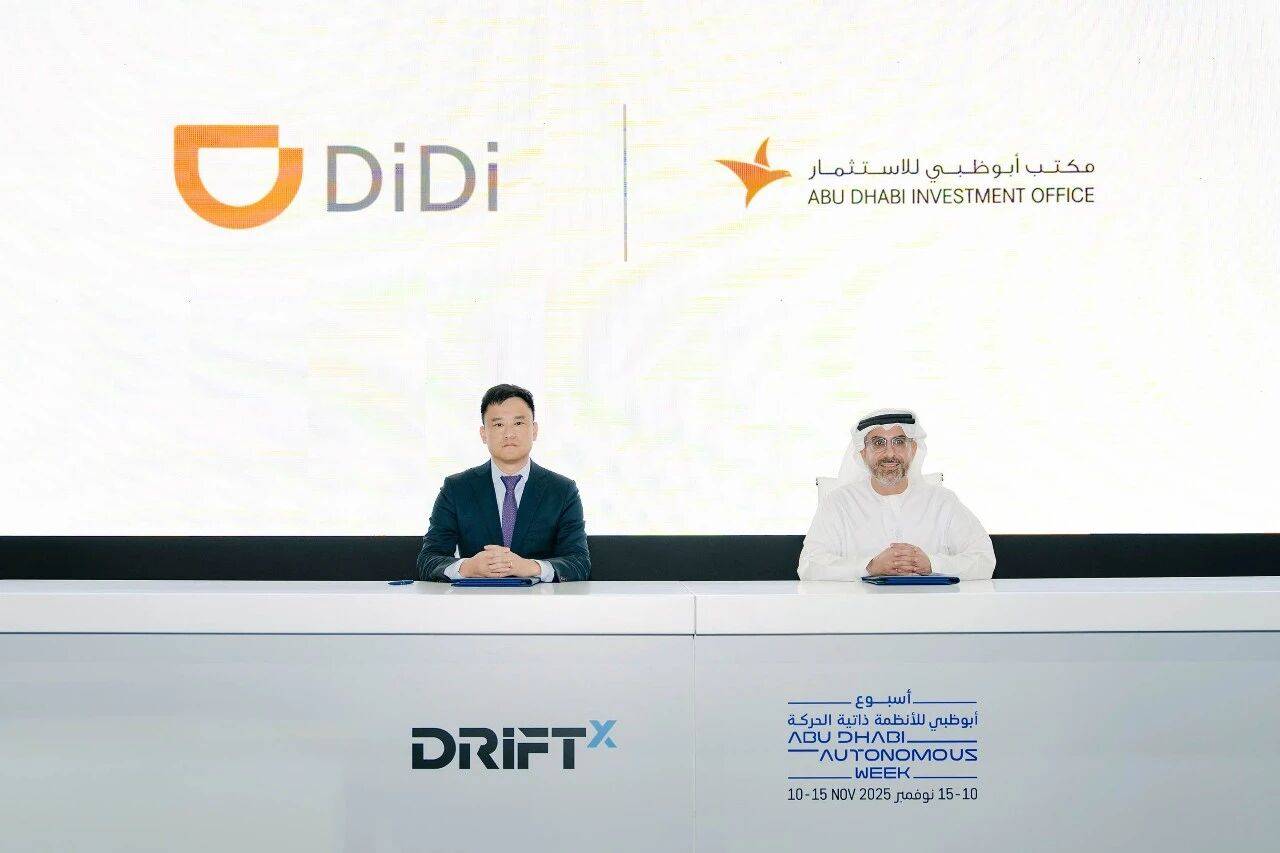
滴滴自动驾驶宣布出海,首站落户中东阿布扎比
Xin Lang Ke Ji· 2025-11-13 08:01
Core Insights - Didi Autonomous Driving has announced a strategic partnership with the Abu Dhabi Investment Office (ADIO) to join the Smart and Autonomous Vehicle Industry Cluster (SAVI) in Abu Dhabi, focusing on innovation in autonomous driving technology, AI talent development, and ecosystem building [2][2][2] Group 1: Strategic Partnership - The collaboration aims to support Abu Dhabi in building a leading smart mobility and sustainable transportation ecosystem, with plans to expand cooperation across the broader Middle East region [2][2] - The SAVI industry cluster, initiated by the Abu Dhabi Department of Economic Development and ADIO, is positioned as a smart transportation hub in the Middle East and North Africa [2][2] Group 2: Economic Impact - ADIO projects that the SAVI industry cluster will contribute 44 billion dirhams to Abu Dhabi's GDP and create 40,000 jobs by 2045 [2][2] - The partnership is seen as a key milestone in shaping the future of transportation in Abu Dhabi, with expectations for Didi to drive the large-scale application of autonomous driving technology in the region [2][2] Group 3: Company Perspectives - Didi Autonomous Driving views the Middle East as a crucial part of its global strategy, aligning with Abu Dhabi's goals for smart city development and sustainable growth [2][2] - The company aims to leverage local partnerships to advance autonomous driving technology and enhance user experience in the Middle East [2][2]

自动驾驶深度接入全运会,出行接驳环卫清扫都上阵了
Nan Fang Du Shi Bao· 2025-11-04 15:56
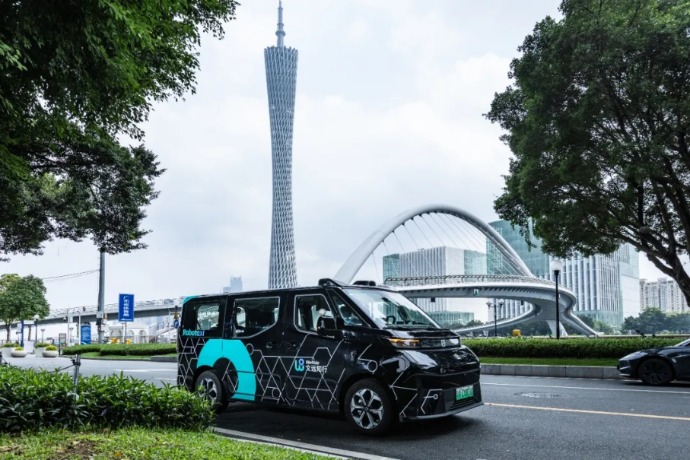
Core Viewpoint - The integration of autonomous driving technology into large-scale sports events is being showcased at the 15th National Games in Guangzhou, marking a significant step towards systematic operation rather than isolated testing [3][5]. Group 1: Autonomous Driving Services - WeRide has announced a comprehensive suite of autonomous driving services for the National Games, including transportation and sanitation, in collaboration with Guangzhou Public Transport Group and GAC [3]. - A total of 11 autonomous driving routes will be launched, covering key areas such as transportation hubs, hotels, and event venues, from November 3 to December 15, 2025 [5]. - During the event, five autonomous bus routes will connect major venues with metro stations, enhancing transportation efficiency through high-frequency scheduling [5]. Group 2: Technological Innovations - The newly launched mid-capacity bus model is 8.5 meters long, seats 21 passengers, and features a 360-degree perception system and redundant control chassis, designed to accommodate the needs of the disabled during the event [5]. - The event serves as a platform for technology companies to demonstrate their technological maturity, transitioning from isolated tests to integrated operations [5][6]. Group 3: Industry Competition and Implications - The event will last over 40 days, integrating autonomous driving services into the regular operational schedule of Guangzhou Public Transport Group, highlighting the competitive landscape among companies like Pony.ai, Didi Autonomous Driving, and Qiji Mobility [6]. - The high-density passenger flow and complex road conditions during the event are seen as a "stress test" for autonomous driving, with data collected potentially influencing future commercialization efforts [6].
超44家!2025年融资过亿企业大盘点
Sou Hu Cai Jing· 2025-10-30 09:21
Core Insights - The low-speed autonomous driving sector has seen significant investment activity, with over 49 financing events exceeding 100 million RMB since 2025, totaling nearly 21.8 billion RMB [1][4]. Financing Overview - A total of 49 financing events involved 44 companies, with 27 companies receiving A and B+ round financing in the first ten months of the year, indicating a strong interest in early-stage development [4][6]. - The financing events are categorized as follows: 27 events in the 100 million to 200 million RMB range, 14 events in the 200 million to 1 billion RMB range, 4 events in the 1 billion to 2 billion RMB range, and 4 events exceeding 2 billion RMB [6][7]. Sector Focus - The most popular financing areas include unmanned delivery, unmanned sanitation, and mining autonomous driving, with notable investments in companies like NineSight, New Stone, and White Rhino in the unmanned delivery sector [7][8]. - The mining autonomous driving sector has also seen significant activity, with 9 financing events, 5 of which were publicly disclosed as being of 100 million RMB or more, totaling 1.357 billion RMB [7]. Market Trends - Since 2025, the low-speed autonomous driving sector has exhibited a trend of "head concentration and scenario dominance," with unmanned delivery and mining scenarios becoming the primary focus for capital investment [7][8]. - The overall financing heat in the industry has increased compared to the previous year, indicating a growing interest from investors [4][6].
自动驾驶赛道“回暖”24起融资吸金超350亿元
Mei Ri Jing Ji Xin Wen· 2025-10-21 12:59
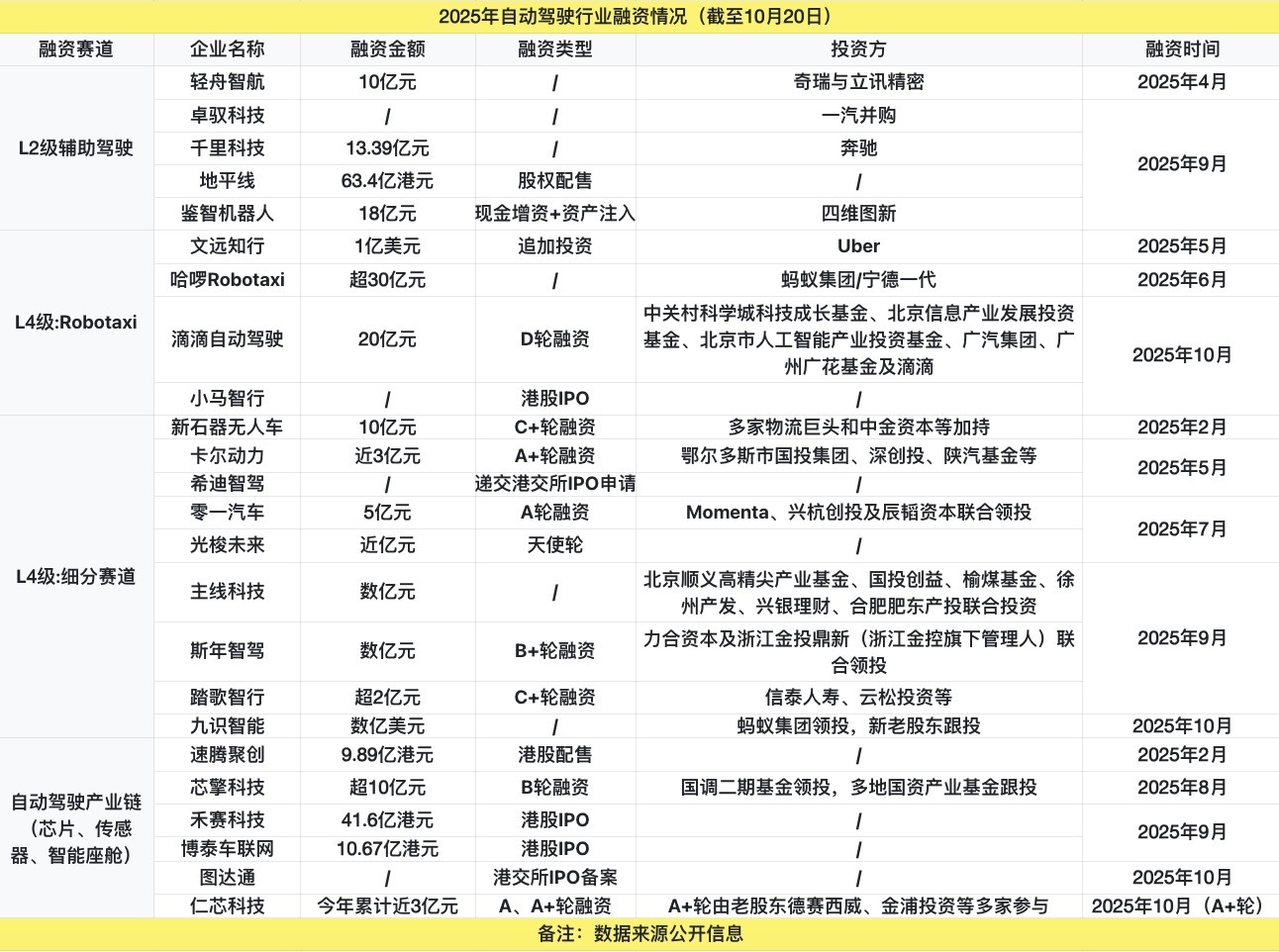
Core Insights - The autonomous driving industry is experiencing a significant resurgence in investment, with over 100 billion RMB raised in 11 financing events in the past month alone, and a total of 24 financing events exceeding 350 billion RMB since the beginning of 2025, indicating a strong recovery from previous years' downturns [1][2][6] Financing Trends - The 24 financing events in 2025 cover four main areas: L2-level assisted driving, L4-level niche markets, Robotaxi, and the autonomous driving supply chain, with 10 events raising over 10 billion RMB each, accounting for 50% of the total financing [2][3] - L2-level assisted driving saw 5 financing events, with the largest being Horizon Robotics raising approximately 58.12 billion RMB, while significant investments were also made in Robotaxi, with Didi Autonomous Driving completing a 20 billion RMB round [2][3] Market Dynamics - L4-level autonomous driving is advancing in specific applications like mining and logistics, with 9 companies raising over 30 billion RMB in total [3] - The supply chain for autonomous driving, particularly in chips and LiDAR, is also attracting substantial investments, with notable rounds from companies like Chipone Technology and Hesai Technology [3] Policy and Capital Influence - The financing landscape is characterized by a shift towards state-owned and industrial capital, which is replacing traditional financial investors, indicating a new dynamic in the industry [6][7] - The period from 2024 to 2025 has seen a significant increase in policy support, with over 71 new policies introduced in the first half of 2025 alone, laying a legal and institutional foundation for the commercialization of autonomous driving [7][8] Technological Advancements - The penetration rate of L2-level assisted driving in China has surpassed 50%, leading globally, with emerging technologies becoming standard in mid-to-high-end vehicles [8] - The cost of hardware has halved over the past two years, and the driving experience has improved tenfold, indicating rapid technological advancement [8] Profitability Challenges - Despite the influx of capital, many companies in the autonomous driving sector are still in the investment phase and have not yet achieved profitability, with significant losses reported by leading firms [9][10] - Companies like Horizon Robotics and Pony.ai are facing challenges in achieving stable profits, highlighting the ongoing need for financing to support R&D and market expansion [9][10] Future Outlook - The market for intelligent connected vehicles in China is projected to grow from 161.1 billion RMB in 2023 to 222.3 billion RMB by 2025, with expectations that China will become the largest market for autonomous driving by 2030 [11][12] - Industry leaders emphasize the importance of safety in the deployment of AI technologies in driving, suggesting a cautious yet optimistic approach to the future of autonomous driving [12]
自动驾驶再现融资热,24起融资超350亿元,但行业尚未进入盈利期
Mei Ri Jing Ji Xin Wen· 2025-10-20 11:30
Core Insights - The autonomous driving industry is experiencing a significant resurgence in investment, with over 100 billion RMB raised in 11 financing events in the past month alone, totaling 350 billion RMB for the year as of October 20, 2025, indicating a strong recovery from the previous three years of capital winter [1][2][6] - The financing landscape is characterized by a preference for companies with clear application scenarios, with state-owned and industrial capital increasingly replacing traditional financial investors as key drivers of industry development [6][7] Financing Overview - As of October 20, 2025, there have been 24 financing events in the autonomous driving sector, with a total amount exceeding 350 billion RMB, including 10 events with disclosed amounts of 10 million RMB or more, accounting for 50% of the total financing [2][3] - The L2 level assisted driving segment has seen five financing events, with the largest being Horizon Robotics raising approximately 58.12 billion RMB through a share placement [2][3] - The Robotaxi segment has attracted significant investment, with notable financing events including Didi's 20 billion RMB Series D round and Hello's over 30 billion RMB funding [3][4] Market Dynamics - The L4 level autonomous driving sector is entering a phase of accelerated commercialization, particularly in specific scenarios such as mining and logistics, with nine companies raising over 30 billion RMB [4][6] - The supply chain for autonomous driving, particularly in chips and lidar technology, has also seen substantial financing, with companies like Hesai Technology raising approximately 38 billion RMB through an IPO [4][6] Policy and Technological Support - The autonomous driving industry is supported by a surge in relevant policies, with over 71 policies released in the first half of 2025, including national-level approvals for L3 vehicle production [7][8] - Technological advancements and increased market acceptance are crucial for commercial viability, with L2 level assisted driving penetration exceeding 50% in China, the highest globally [7][8] Financial Performance and Challenges - Despite the financing boom, many companies in the autonomous driving sector remain unprofitable, with significant losses reported alongside revenue growth, indicating ongoing challenges in achieving stable profitability [8][10] - Companies like Horizon Robotics reported a revenue of 1.567 billion RMB in the first half of 2025, a 67.6% increase, but also faced a loss of 5.233 billion RMB, highlighting the financial strain in the industry [8][10] Future Outlook - The market for intelligent connected vehicles in China is projected to grow from 161.1 billion RMB in 2023 to 222.3 billion RMB by 2025, with expectations that China will become the largest autonomous driving market globally by 2030 [10][11] - The emphasis on safety and the gradual expansion of application scenarios for autonomous driving technologies are critical for the industry's future development [11]
自动驾驶再现融资热!24起融资超350亿元,但行业尚未进入盈利期
Mei Ri Jing Ji Xin Wen· 2025-10-20 11:01
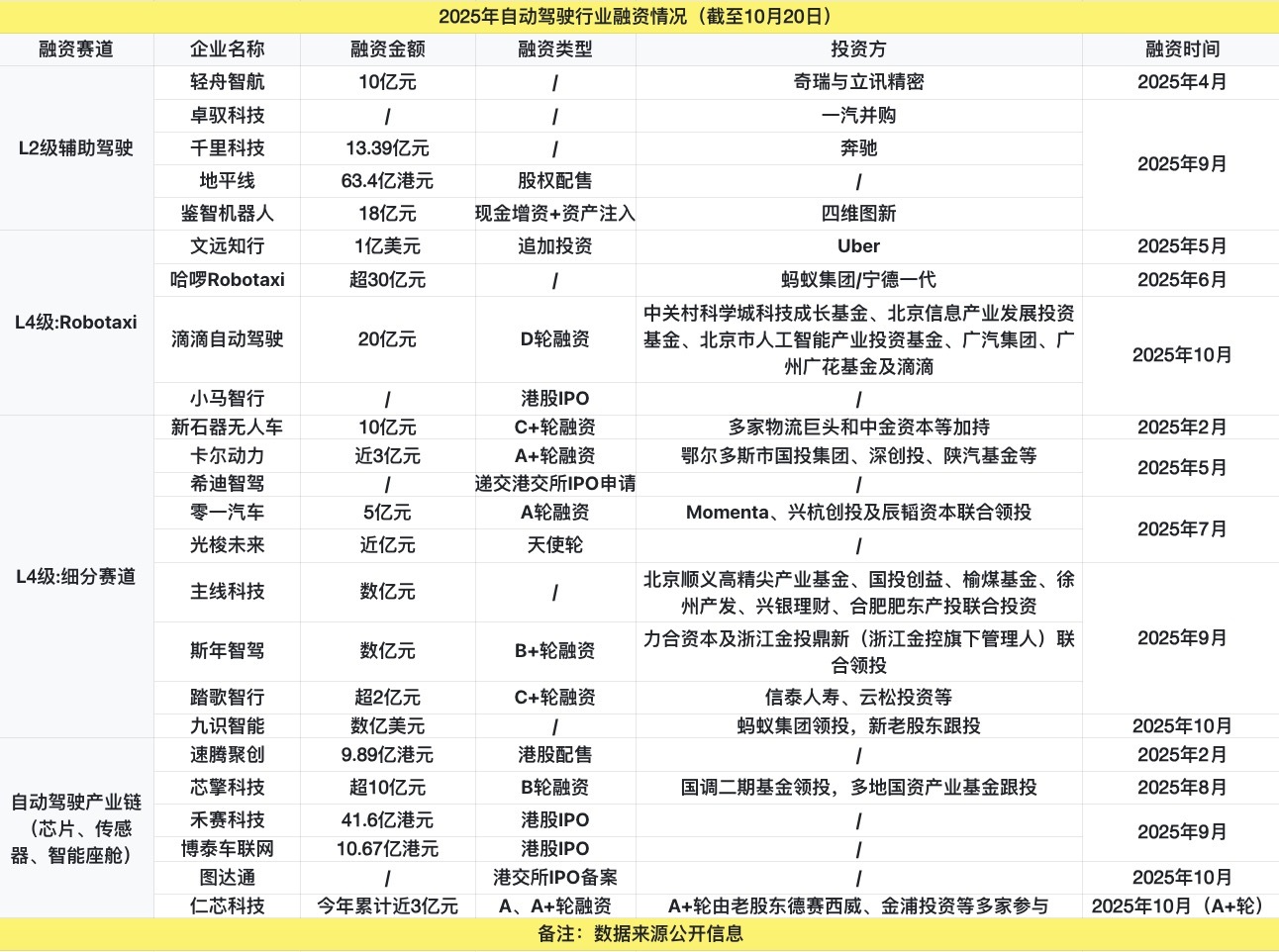
Core Insights - The autonomous driving industry is experiencing a significant resurgence in investment, with over 100 billion RMB raised in 11 financing events in the past month alone, and a total of 24 financing events exceeding 350 billion RMB since the beginning of 2025, indicating a strong recovery from the previous three years of capital winter [1][2][7] Financing Overview - The 24 financing events cover four main areas: L2 level assisted driving, L4 level subfields, Robotaxi, and the autonomous driving supply chain, with 10 events having disclosed amounts of 1 billion RMB or more, accounting for 50% of the total financing [2][5] - Notable financing events include Horizon Robotics raising approximately 58.12 billion RMB through share placement, and a strategic investment of 18 billion RMB by NavInfo in PhiGent Robotics to enhance its high-level intelligent driving technology [2][3] Sector-Specific Highlights - The Robotaxi sector has attracted significant investment, with Didi Autonomous Driving securing 20 billion RMB in D round financing and Hello announcing over 30 billion RMB in funding for its entry into the field [5][6] - In the autonomous driving supply chain, chip companies like Chipone Technology raised over 10 billion RMB in B round financing, while Hesai Technology raised approximately 38 billion RMB through a Hong Kong IPO [6][7] Policy and Market Dynamics - The financing landscape is characterized by a shift towards companies with clear application scenarios, with state-owned and industrial capital becoming key drivers of industry development, replacing traditional financial investors [7][8] - The period from 2024 to 2025 has seen a significant increase in policy support, with over 71 relevant policies released in the first half of 2025 alone, including national-level approvals for L3 vehicle production [8][9] Industry Challenges - Despite the influx of capital, most companies in the autonomous driving sector remain in a phase of continuous investment without profitability, with significant losses reported by leading firms such as Horizon Robotics and Pony.ai [9][10] - The industry is expected to face challenges in converting substantial R&D investments into revenue, as the maturity of technology and commercialization processes remain uncertain [9][10] Future Outlook - The market for intelligent connected vehicles in China is projected to grow from 161.1 billion RMB in 2023 to 222.3 billion RMB by 2025, with expectations that China will become the largest autonomous driving market globally by 2030, generating over 500 billion USD in revenue from new car sales and mobility services [10][12]
9月车市平稳,滴滴自动驾驶完成D轮融资
CAITONG SECURITIES· 2025-10-15 08:17
Core Insights - The retail sales of passenger cars in September reached 2.241 million units, a year-on-year increase of 6.3% and a month-on-month increase of 11.0%, indicating a strong growth trend before the end-of-year policy exit [4][8] - The cumulative retail sales for the year reached 17.005 million units, reflecting a year-on-year growth of 9.2%, with a notable increase from 1.2% in January-February to 11% in the first half of the year [4][8] - The market is transitioning towards a more stable operation with reduced price cuts and moderate promotions, as evidenced by 23 models having price reductions in September compared to 36 last year and 11 in 2023 [4][8] Passenger Car Market Analysis - The growth rate from July to September hovered around 6%, showing signs of deceleration due to high base effects, aligning with the earlier prediction of a "low-high-flat" trend for the year [4][8] - In September, the promotional intensity for new energy vehicles was maintained at a high level of 10.2%, an increase of 2.6 percentage points year-on-year, while traditional fuel vehicles saw a promotional intensity of 23.9% [4][8] - The penetration rate of new energy vehicles in domestic retail reached 57.8% in September, supported by policies such as tax exemptions and vehicle replacement incentives [13][17] Didi Autonomous Driving Financing - Didi Autonomous Driving completed a Series D financing round totaling 2 billion RMB, with funds primarily allocated for AI core algorithm development and the implementation of Level 4 autonomous driving applications [5][33] - This financing round brings Didi's total funding to approximately 10 billion RMB, with investments from various entities including SoftBank and GAC Group [5][33] - The CEO of Huawei's Intelligent Automotive Solutions BU announced a timeline for the commercialization of Level 3 and Level 4 autonomous driving, with expectations for significant advancements by 2027 [5][31] Investment Recommendations - The report suggests focusing on companies with strong positions in automotive intelligence and leading software capabilities, including Ruiming Technology, Daotong Technology, and others [5][37]
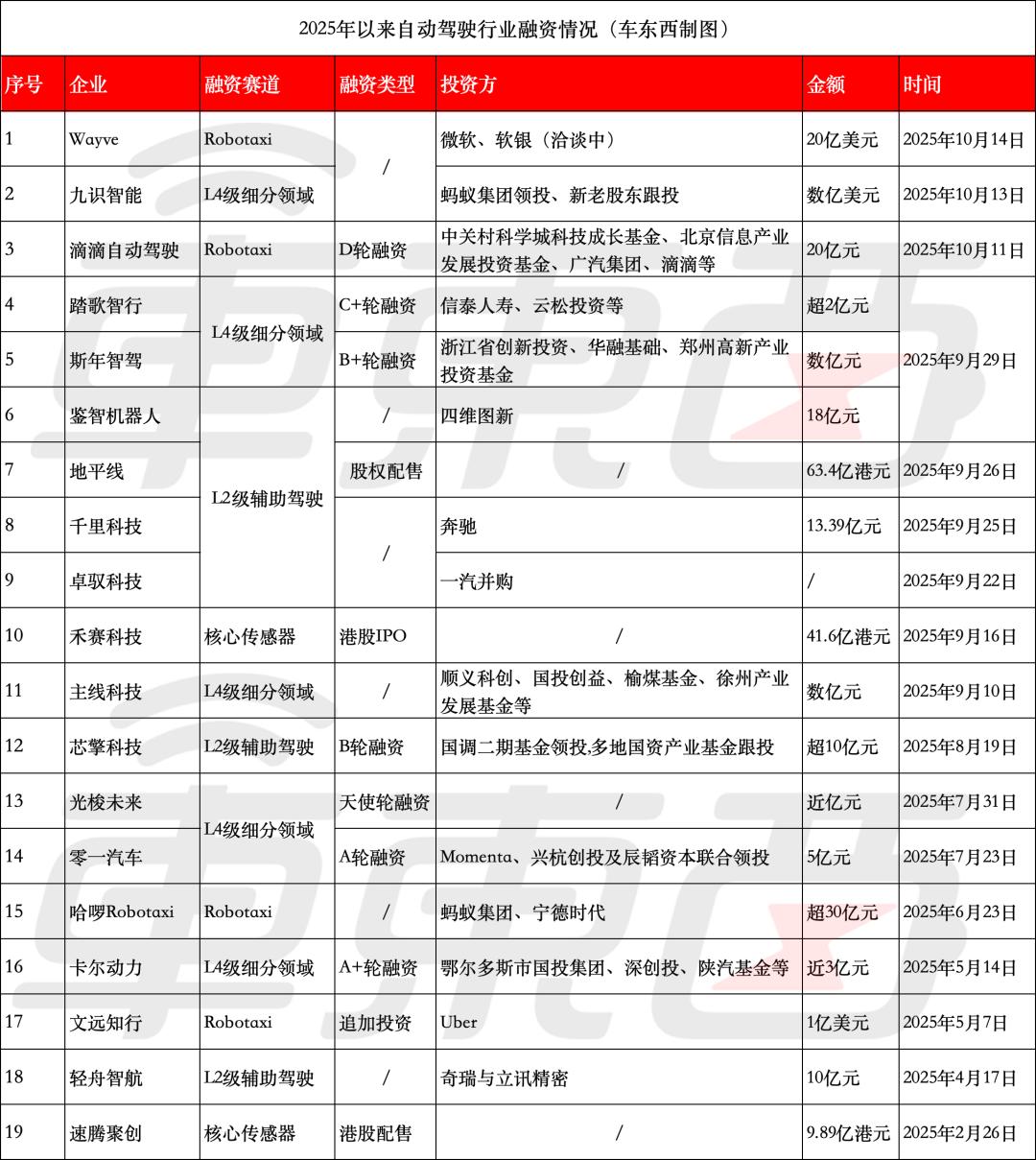
自动驾驶大爆发,19起融资吸金超300亿,四大赛道都很火热
3 6 Ke· 2025-10-15 00:35
Core Insights - The autonomous driving industry is experiencing a significant surge in financing, with 11 funding events in the past month totaling over 29.2 billion yuan, bringing the total for the year to 36.7 billion yuan across 19 events [1][2][22] - This marks a stark contrast to the previous three years of capital winter, indicating a renewed confidence in the commercialization prospects of autonomous driving by 2025 [1][22] Financing Overview - The financing landscape is dominated by four main areas: L2-level assisted driving, L4-level niche applications, Robotaxi, and core sensors [3][11] - L2-level assisted driving saw six financing events this year, with notable funding including Horizon Robotics raising approximately 6.34 billion HKD (around 5.81 billion yuan) to expand overseas and support high-level assisted driving solutions [4][11] - The Robotaxi sector is particularly lucrative, with significant funding such as Didi Autonomous Driving's 2 billion yuan in Series D financing aimed at AI core algorithm development and L4 application deployment [11][16] - L4-level applications, focusing on closed or semi-closed environments, have attracted the most funding, with seven companies receiving investments, including a recent multi-million dollar round for Jiushi Intelligent [17][19] Market Dynamics - The capital market's enthusiasm for autonomous driving has markedly increased compared to the previous three years, which were characterized by a downturn in funding and operational challenges for major companies like Argo AI and Cruise [22][25] - The turning point in 2025 is attributed to a combination of technological advancements, market readiness, and supportive policies, with Tesla's launch of Robotaxi products serving as a strong market signal [25][27] - The investment focus has shifted towards companies with clear commercial applications, particularly in the Robotaxi and L4 niche sectors, reflecting a pragmatic approach to funding [27][30] Conclusion - The influx of capital is accelerating the commercialization of autonomous driving technologies, with companies that demonstrate viable applications receiving increased support [30] - The industry is poised for a transformative year in 2025, as the convergence of technology and investment is expected to turn autonomous driving from a vision into reality [30]