陕西煤业

Search documents
煤炭开采板块12月25日跌0.38%,中煤能源领跌,主力资金净流出3.59亿元
Zheng Xing Xing Ye Ri Bao· 2025-12-25 09:15
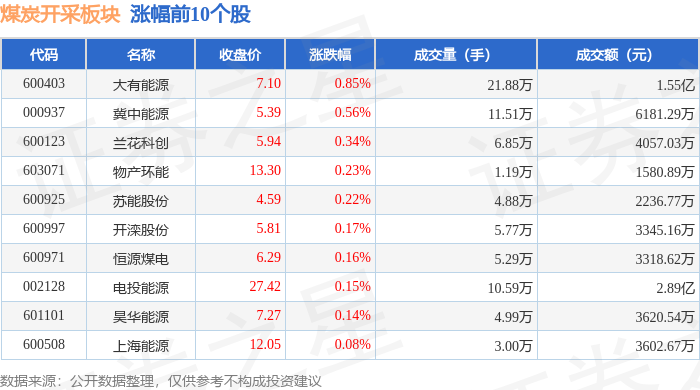
Core Viewpoint - The coal mining sector experienced a decline of 0.38% on December 25, with China Coal Energy leading the drop. Meanwhile, the Shanghai Composite Index rose by 0.47% and the Shenzhen Component Index increased by 0.33% [1]. Group 1: Market Performance - The coal mining sector's stocks showed mixed performance, with notable declines in major companies such as China Coal Energy, which fell by 1.40% to a closing price of 12.70 [2]. - The trading volume for China Coal Energy was 160,500 shares, with a transaction value of 205 million yuan [2]. - Other companies in the sector, like Jiangxi Tungsten Equipment and Jinko Energy, also saw declines of 1.17% and 0.97%, respectively [2]. Group 2: Capital Flow - The coal mining sector experienced a net outflow of 359 million yuan from major funds, while retail investors contributed a net inflow of 380 million yuan [2]. - The table of capital flow indicates that retail investors were more active, with significant inflows into stocks like Xin Dazhou A, which saw a net inflow of 852,620 yuan from major funds [3]. - Conversely, stocks like Huaihe Energy and Shanmei International faced net outflows from major and speculative funds, indicating a shift in investor sentiment [3].



“能源ESG”指数(980133)正式发布
Zheng Quan Shi Bao Wang· 2025-12-25 08:35
Core Insights - The "National Certificate Energy Sustainable Development Index" (referred to as "Energy ESG") was officially launched on December 25, developed by the China Energy Research Society and Shenzhen Securities Information Co., Ltd [1][2] - The index aims to serve as a benchmark for ESG investment in the energy sector, promoting green and low-carbon transformation [2] Group 1: Index Methodology - The selection process for the index involved ranking securities based on their average daily trading volume and market capitalization over the past six months, eliminating the bottom 20% [1] - The final sample consists of 50 companies with high ESG scores and strong profitability and growth potential, with a total market capitalization of 5.9 trillion yuan [1] - The average market capitalization of the sample companies is 118.2 billion yuan, with 12 companies exceeding 100 billion yuan in market value [1] Group 2: Sample Companies - The top ten companies by weight in the index include Yangtze Power, China Shenhua, China Petroleum, China Petrochemical, Shaanxi Coal and Chemical Industry, China Nuclear Power, CNOOC, Three Gorges Energy, Guodian Power, and Huaneng International, collectively accounting for 65% of the index [1] Group 3: Future Plans - The China Energy Research Society plans to collaborate with leading investment institutions to create ESG index funds (ETFs) that track the Energy ESG index, aiming to establish a complete ecosystem of "standards leading - index representation - fund empowerment" [2]
“能源ESG”指数正式发布
Zheng Quan Shi Bao Wang· 2025-12-25 08:23
Core Viewpoint - The "National Certificate Energy Sustainable Development Index" (Energy ESG) was officially launched, marking a significant step in promoting green and low-carbon transformation in the energy sector [1][2]. Group 1: Index Development - The index was developed by the China Energy Research Society and Shenzhen Securities Information Co., Ltd. [1] - The selection process involved ranking securities based on average daily trading volume and market capitalization, followed by ESG scoring to select the top 50 companies [1]. - The total market capitalization of the 50 sample companies is 5.9 trillion yuan, with an average market capitalization of 118.2 billion yuan [1]. Group 2: Sample Companies - The index includes companies with strong ESG scores, profitability, and growth potential, with 12 companies having a market capitalization exceeding 100 billion yuan [1]. - The top ten companies by weight in the index account for 65% of the total weight, including major players like China Yangtze Power, China Shenhua, and China Petroleum [1]. Group 3: Future Plans - The China Energy Research Society plans to collaborate with leading investment institutions to create ESG index funds (ETFs) that track the Energy ESG index [2]. - The goal is to establish a complete ecosystem that includes standard setting, index representation, and fund empowerment to position the index as a core benchmark for ESG investment in the energy sector [2].
煤炭行业:国内动力煤价跌,六大发电集团日均耗煤量上升
Dongxing Securities· 2025-12-24 11:57
Investment Rating - The coal industry is rated as "Positive" [1] Core Viewpoints - Domestic thermal coal prices have decreased, while the offshore price at Newcastle, Australia has increased. As of December 15, the price of Shanxi mixed thermal coal at Qinhuangdao was 736.00 CNY/ton, down 91 CNY/ton (11% decrease) from the previous month [2][10] - In November, coal production from key state-owned mines in Shaanxi decreased month-on-month, while production in Shanxi and Inner Mongolia increased. The total coal inventory at three major ports rose month-on-month and year-on-year, and the average daily coal consumption of the six major power generation groups increased month-on-month but decreased year-on-year [3][40] - Domestic freight rates have decreased month-on-month, while international shipping rates showed mixed trends. The freight rate from Qinhuangdao to Shanghai was 23.80 CNY/ton, down 48.37% month-on-month [4][49] Summary by Sections 1. Thermal Coal - As of December 15, the price of Shanxi mixed thermal coal at Qinhuangdao was 736.00 CNY/ton, down 91 CNY/ton (11% decrease). Prices in Inner Mongolia and Shanxi also saw month-on-month declines [2][10][13] - The offshore price of thermal coal at Newcastle was 108.60 USD/ton, up 0.30 USD/ton (0.28% increase) [18] 2. Production - In November, coal production from key state-owned mines was as follows: Shaanxi produced 21.74 million tons (2.47% increase year-on-year, 2.18% decrease month-on-month), Shanxi produced 51.04 million tons (4.45% decrease year-on-year, 3.28% increase month-on-month), and Inner Mongolia produced 19.64 million tons (0.71% increase year-on-year, 4.70% increase month-on-month) [3][22] 3. Inventory - As of December 15, the total coal inventory at Qinhuangdao, Huanghua, and Caofeidian ports was 14.90 million tons, up 200.80 thousand tons (15.58% increase month-on-month) [3][31] 4. Downstream Demand - The average daily coal consumption of the six major power generation groups was 826,600 tons, up 3.05 thousand tons (3.83% increase month-on-month) but down 3.29 thousand tons (3.83% decrease year-on-year) [40][43] 5. Freight Rates - Domestic freight rates have decreased month-on-month, with the rate from Qinhuangdao to Shanghai at 23.80 CNY/ton, down 48.37% [4][49]
煤炭行业2026年度投资策略:遇火生辉
Changjiang Securities· 2025-12-24 11:41
Core Insights - In 2025, coal prices significantly declined, leading to a return of sector profitability to the lowest levels in the past decade. However, the outlook for 2026 suggests potential demand improvement and limited supply capacity utilization, which may lead to a recovery in coal price levels [2][5][6]. - The report emphasizes that with a clear supply-demand improvement and the presence of both defensive and offensive investment opportunities, the likelihood of success for selected stocks is high. If demand is strong and coal prices improve beyond expectations, attention should be given to currently undervalued stocks with low liquidity and lower profit margins [2][7]. Industry Overview - The coal industry faced a challenging year in 2025, with thermal coal prices dropping from 855 CNY/ton in 2024 to 697 CNY/ton, an 18% decrease. The profitability of the sector fell to the 30th percentile of the past decade due to weak demand driven by warm weather and sluggish manufacturing electricity consumption [5][16]. - Coking coal prices also saw a significant decline, dropping 26% from 2024's 2022 CNY/ton to 1502 CNY/ton, with profitability at the 10th percentile of the past decade. This was primarily due to strong supply, with a 1.5% year-on-year increase in coking coal supply in the first three quarters of 2025 [5][16]. Demand and Supply Dynamics - For thermal coal in 2026, demand improvement is anticipated, with limited supply growth expected. The report identifies three key questions regarding market resilience: whether negative growth in thermal power will become the norm, if domestic supply can be controlled, and whether rising coal prices will increase imports [6][30]. - The report suggests that the central government's focus on controlling "involution" competition will continue to limit supply growth in 2026, despite some new production capacity coming online. Long-term resource depletion may also exert upward pressure on domestic coal prices [6][30]. Investment Recommendations - The report advocates for investment in the coal sector in 2026, highlighting the potential for a bottom reversal. It suggests that the timing for investment should align with capital flows, particularly in the first quarter when there is often a demand for increased allocation to dividend-paying sectors [7][30]. - Recommended stocks include Yanzhou Coal Mining Company and China Shenhua Energy, which are expected to benefit from a recovery in coal prices to a range of 750-800 CNY/ton. Additionally, stocks with significant growth potential and low valuations, such as Huayang Co. and Jinkong Coal Industry, are highlighted as potential targets if demand and price improvements exceed expectations [7][30].


煤炭行业今日净流出资金7371.92万元,陕西煤业等7股净流出资金超千万元
Zheng Quan Shi Bao Wang· 2025-12-24 09:46
Market Overview - The Shanghai Composite Index rose by 0.53% on December 24, with 26 out of the 28 sectors experiencing gains, led by defense and electronics, which increased by 2.88% and 2.12% respectively [1] - The coal industry saw a decline of 0.70%, ranking second in terms of the largest drop [1] Capital Flow - The net inflow of capital in the two markets was 10.37 billion yuan, with 17 sectors experiencing net inflows. The electronics sector had the highest net inflow of 8.68 billion yuan, followed by the power equipment sector with a net inflow of 3.76 billion yuan [1] - Conversely, 14 sectors experienced net outflows, with the non-ferrous metals sector leading with a net outflow of 1.635 billion yuan, followed by the basic chemicals sector with a net outflow of 1.212 billion yuan [1] Coal Industry Analysis - Within the coal industry, there were 37 stocks, with 18 rising and 15 falling. The net outflow of capital for the coal sector was 73.72 million yuan [2] - The top three stocks with the highest net inflow in the coal sector were Jiangxi Tungsten Equipment (47.77 million yuan), Shanxi Coal International (22.18 million yuan), and Shanxi Coking Coal (16.85 million yuan) [2] - The stocks with the largest net outflows included Shaanxi Coal and Chemical Industry (48.62 million yuan), Yongtai Energy (44.88 million yuan), and Electric Power Investment Energy (34.78 million yuan) [2] Individual Stock Performance - The top performers in terms of capital inflow included Jiangxi Tungsten Equipment (4.77%), Shanxi Coking Coal (0.53%), and Baotailong (1.77%) [3] - The stocks with the largest declines included Shaanxi Coal and Chemical Industry (-0.32%), Yongtai Energy (0.00%), and Electric Power Investment Energy (-1.05%) [3]

国泰海通晨报-20251223
GUOTAI HAITONG SECURITIES· 2025-12-23 02:54
Group 1: Strategy Research - Global asset performance shows significant divergence, with developed European equities rising while emerging Asian equities decline. COMEX silver saw a weekly increase of 9.4%, with an annual increase exceeding 120%. The Federal Reserve has brought forward its interest rate cut expectations for 2026 [3][4][5] Group 2: Food and Beverage Research - Wuliangye held its 29th conference, emphasizing a pragmatic attitude and commitment to reform. The company aims to anchor its market share goals for 2026, maintaining a balance between volume and price, and focusing on product and channel collaboration to solidify its industry-leading position [3][8][9] Group 3: Oil and Chemical Research - Since Q4 2025, crude oil prices have been on a downward trend, with Brent crude closing at $59.68 per barrel as of December 18, 2025, a decrease of 12.43% since early September. Upstream oil and gas extraction companies are expected to face profit pressure, while refining businesses may see improved profitability due to expanded price differentials [3][11][12][14] Group 4: Automotive Research - The draft "Automotive Industry Price Behavior Compliance Guidelines" is expected to advance the anti-involution process in the automotive sector. This guideline aims to regulate pricing behaviors of automotive manufacturers and dealers, potentially alleviating price wars and improving profit margins for dealers [3][15][16][17]
重视煤炭板块年初红利投资机会
2025-12-22 15:47
Summary of Coal Industry Conference Call Industry Overview - The conference call focuses on the coal industry, specifically the dynamics of thermal coal prices and market conditions in China [1][2][3]. Key Points and Arguments Price Trends - As of December 19, the Qinhuangdao thermal coal price dropped significantly from around 800 RMB to 703 RMB, a decline exceeding 100 RMB within the month, nearly erasing gains since October [2]. - The current price is close to the October 9 level of 699 RMB and only about 100 RMB above the lowest point of 609 RMB projected for mid-2025 [2]. Supply Factors - Supply is expected to remain tight due to several factors: - Year-end production cuts as coal mines complete their annual production plans [4]. - The re-emphasis on anti-competition policies by the central government, leading to cautious supply from production areas [4]. - Indonesia's implementation of a 1% to 5% export tax starting January 1, 2026, which will increase import costs and reduce coal imports, thereby supporting domestic supply [4]. Demand Factors - Demand is anticipated to improve marginally due to: - The commencement of long-term contracts in 2026, which will stimulate downstream transportation demand [5]. - The approaching Lunar New Year, prompting increased inventory replenishment by power plants and non-power enterprises [5]. - Seasonal increases in daily consumption, with current daily consumption at 5.8 million tons, compared to a historical average of 6.3 million tons for late December to early January, indicating significant room for improvement [5]. Investment Recommendations - The current market conditions are deemed suitable for investing in the coal sector, with specific recommendations for various types of stocks: 1. **Balanced Stocks**: Yanzhou Coal Mining (A and H shares), China Power Investment Corporation (A shares), and Power Development (Hong Kong stocks) are expected to benefit from a projected price recovery to around 750 RMB, a 10% year-on-year increase [6]. 2. **Stable Dividend Stocks**: China Coal (especially Hong Kong shares), Shaanxi Coal, and Shenhua Energy are highlighted for their safety margins and potential for dividends, with China Coal's Hong Kong shares valued at less than 9 times earnings [6]. 3. **Aggressive Stocks**: Companies like Huayang and Pingmei in the thermal coal sector, as well as Lu'an, Pingmei, and Huai Mining in the metallurgical coal sector, are positioned to benefit from winter storage demand and supply reductions [6]. Overall Recommendation - The thermal coal sector is recommended for investment due to the high certainty of price increases in the coming year, making it a valuable opportunity for investors [7].
东兴证券晨报-20251222
Dongxing Securities· 2025-12-22 10:31
Core Insights - The report highlights the "anti-involution" policy as a catalyst for coal price recovery, with expectations for stable price increases in 2026. The lowest price for Qinhuangdao 5500 kcal thermal coal was 610 RMB/ton in June 2025, while it rose to 813 RMB/ton by December 1, 2025, indicating a recovery trend [7][8] - The coal industry is expected to shift from "scale expansion" to "quality improvement" due to regulatory measures and market mechanisms, which will likely lead to a decrease in domestic coal production in 2026 [8][12] - The demand for thermal power is projected to remain resilient, supported by AI computing power driving new electricity demand, with a forecasted increase in coal consumption due to sustained thermal coal demand [9][10] Industry Overview - The report discusses the impact of the "anti-involution" policy on the coal industry, emphasizing the need for self-discipline and capacity checks, which may lead to a reduction in production capacity and a tightening of imports [8][12] - The report notes that the coal price index fluctuated between 1100 and 1570 RMB/ton in 2025, with a significant increase in prices following the implementation of long-term contracts [7][8] - The report anticipates that the coal industry will see a shift towards high-quality development, with a focus on stable dividends and improved return on equity (ROE) for listed companies [11][12] Investment Recommendations - The report suggests investing in leading coal companies with strong resource endowments, cost advantages, and stable dividend policies, such as China Shenhua, China Coal Energy, and Yanzhou Coal Mining [12] - It also recommends companies with growth potential based on their production capacity and profitability, including Guanghui Energy and Huayang Co [12]
行业研究|行业周报|煤炭与消费用燃料:重视煤炭板块年初红利投资机会-20251222
Changjiang Securities· 2025-12-22 09:44
Investment Rating - The industry investment rating is "Positive" and maintained [8] Core Viewpoints - Recent coal prices have been declining, raising concerns about future price trends. The supply side is expected to remain tight due to year-end production cuts and the imposition of export taxes by Indonesia, while demand may improve with the new year's long-term contracts and seasonal increases in consumption [2][7] - The coal price is anticipated to stabilize and recover in the short term due to supply constraints and seasonal demand increases, suggesting a favorable investment opportunity in the coal sector [6][7] Summary by Sections Market Performance - The coal index (Yangtze) increased by 0.36%, outperforming the CSI 300 index by 0.64 percentage points, ranking 19th out of 32 industries [6][22] - As of December 19, the market price for Qinhuangdao thermal coal was 703 CNY/ton, down 42 CNY/ton week-on-week, while the price for coking coal at Jingtang Port was 1740 CNY/ton, up 110 CNY/ton week-on-week [6][16] Supply and Demand Analysis - As of December 18, the daily coal consumption across 25 provinces was 580.2 million tons, a decrease of 2.0% week-on-week and 9.8% year-on-year. The inventory at power plants was 134 million tons, with a usable days count of 23.2 days, an increase of 0.3 days week-on-week [17][36] - The supply side is influenced by production cuts at coal mines and the impact of export taxes from Indonesia, which could tighten supply further [7][17] Price Trends - The price of thermal coal has seen a significant decline, with a monthly drop of 105 CNY/ton (-13%), nearly erasing gains from October [7][43] - The report suggests that while coal prices are currently under pressure, improvements in supply and demand dynamics could provide a floor for prices in the near term [6][7] Investment Recommendations - The report recommends focusing on coal sector investments, particularly as the first quarter is typically a period of increased insurance capital inflow, which may enhance the attractiveness of coal stocks [7][12]