
北大荒

Search documents
种植业板块8月15日涨1.04%,诺 普 信领涨,主力资金净流入1.28亿元
Zheng Xing Xing Ye Ri Bao· 2025-08-15 08:37
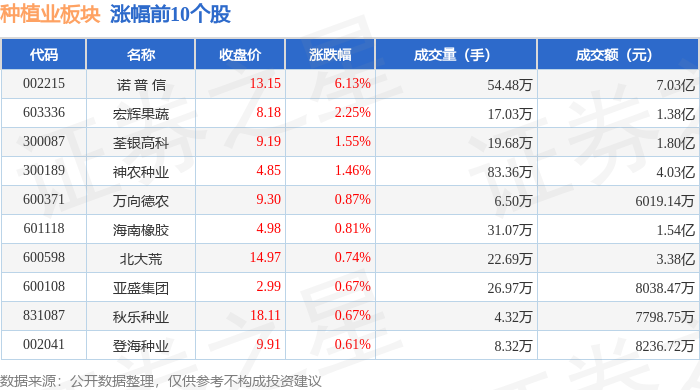
证券之星消息,8月15日种植业板块较上一交易日上涨1.04%,诺 普 信领涨。当日上证指数报收于 3696.77,上涨0.83%。深证成指报收于11634.67,上涨1.6%。种植业板块个股涨跌见下表: | 代码 | 名称 | 收盘价 | 涨跌幅 | 成交量(手) | 成交额(元) | | --- | --- | --- | --- | --- | --- | | 002215 | 诺普信 | 13.15 | 6.13% | 54.48万 | 7.03亿 | | 603336 | 宏辉早蔬 | 8.18 | 2.25% | 17.03万 | 1.38亿 | | 300087 | 茎银高科 | 9.19 | 1.55% | 19.68万 | 1.80亿 | | 300189 | 神农种业 | 4.85 | 1.46% | 1 83.36万 | 4.03亿 | | 600371 | 万向德农 | 9.30 | 0.87% | 6.50万 | 6019.14万 | | 601118 | 海南橡胶 | 4.98 | 0.81% | 31.07万 | 1.54亿 | | 600598 | 北大荒 | 14.97 | 0 ...


这一中央金融企业更换董事长!
Jin Rong Shi Bao· 2025-08-14 07:07
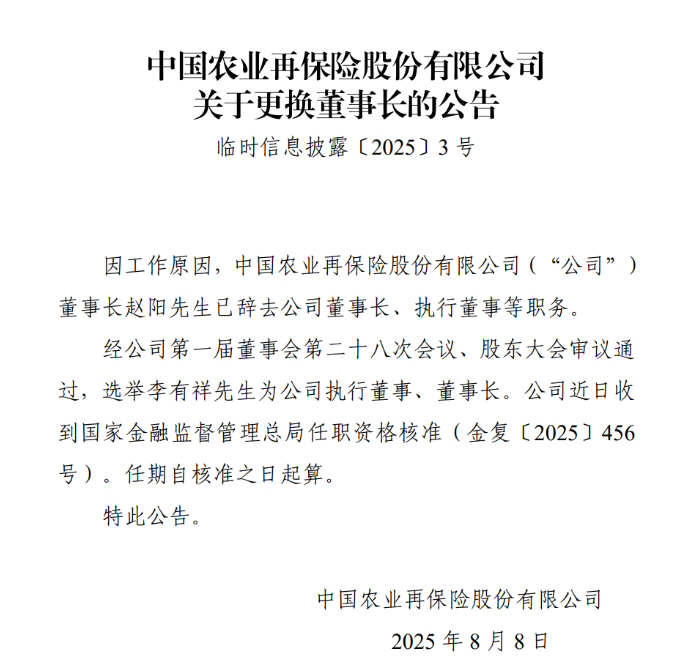
Group 1 - The core point of the news is the significant leadership change at China Agricultural Reinsurance Co., Ltd. (China Nongzai), with Zhao Yang resigning as chairman and Li Youxiang being elected as the new chairman and executive director [1] - Li Youxiang has extensive experience in the insurance regulatory field, having held various positions in the former China Insurance Regulatory Commission and the current Financial Regulatory Administration [4] - China Nongzai was established in November 2019 with a registered capital of 16.1 billion yuan, aimed at improving the disaster risk diversification mechanism for agricultural insurance and managing the national agricultural insurance disaster risk fund [4] Group 2 - In May 2025, the Financial Regulatory Administration approved the transfer of 9 billion shares from the Ministry of Finance to Central Huijin, making Central Huijin the controlling shareholder with a 55.90% stake [5] - This share transfer marks a significant adjustment in the equity structure of China Nongzai and is expected to enhance the company's governance structure and market-oriented operational capabilities [5]
中国经济半年报丨煤炭智能开采产能占比首超50% 立体输送格局基本形成
Yang Shi Xin Wen· 2025-08-14 02:49
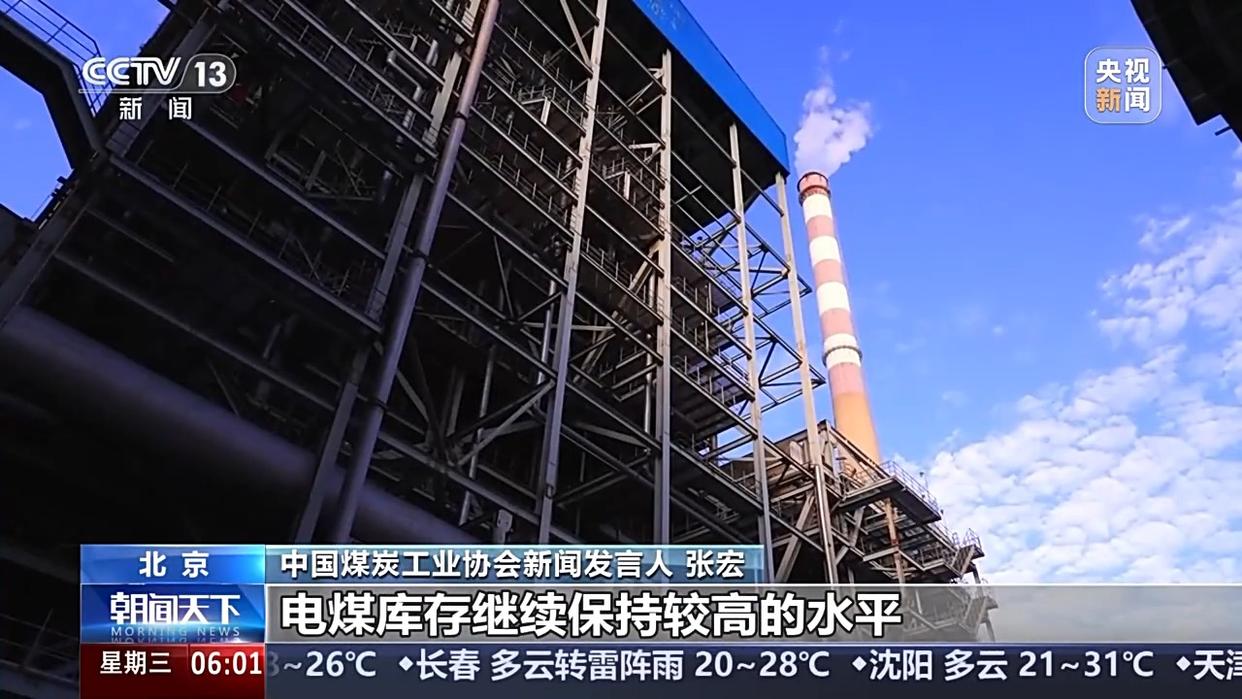
Group 1 - The China Coal Industry Association reported stable and orderly supply of thermal coal in the first half of the year, with a total raw coal production of 2.4 billion tons, a year-on-year increase of 5.4% [1][3] - In June, the raw coal production reached 420 million tons, showing a 3.0% year-on-year growth, with an average daily output of 14.04 million tons [1] - Coal imports decreased to 222 million tons in the first half of the year, reflecting an 11.1% decline compared to the previous year [1] Group 2 - The national coal mining production continues to grow steadily, with high levels of thermal coal inventory ensuring stable supply during peak summer demand [3] - The proportion of intelligent mining capacity has historically surpassed 50%, with over 16,000 high-risk positions replaced by automation, marking a new phase in safe and efficient coal mining development [3][8] - In Inner Mongolia, advanced intelligent mining technologies are being applied, including autonomous trucks and precision loading systems that operate without human intervention [3][5] Group 3 - The entire mining system has achieved a response time of 0.001 seconds, enabling coordinated operation of nearly 40 devices, with advanced monitoring systems in place [5] - The use of waste oil regeneration technology allows for the conversion of over 8,000 tons of hazardous waste into high-performance explosives annually, enhancing blasting efficiency by 15% [5] - In Heilongjiang, the Long Coal Group has established five new intelligent mining faces and upgraded 32 unmanned production auxiliary systems, achieving a mechanization rate of 99.5% [7] Group 4 - A comprehensive coal transportation network has been established, with new coal trains connecting Xinjiang to Jiangsu, enhancing energy security in East China [8][10] - As of July 24, the daily coal transportation from Xinjiang reached 410,000 tons, with a total of 50.774 million tons transported, marking a 12.3% increase year-on-year [10] - The Daqin Railway, known as "China's first heavy-load railway," has been operating at full capacity, transporting an average of 1.05 million tons of coal daily [10]
【人民日报】黑龙江妇女发挥优势助力农业科技创新、提质增效 黑土地上绽放巾帼风采
Ren Min Ri Bao· 2025-08-14 00:04
Core Insights - The article highlights the significant advancements in agricultural technology and production in Heilongjiang Province, emphasizing its role in ensuring national food security and promoting high-quality agricultural development [1][5]. Group 1: Agricultural Production and Innovation - Heilongjiang's total grain output exceeded 160 billion jin, marking a year-on-year increase of 4.27 billion jin, leading the nation in both total and net production [1]. - The province has implemented a seed industry revitalization action, fostering leading seed technology enterprises and promoting the application of agricultural biotechnology [2]. - New rice varieties developed in the region have been planted over 4 million mu, increasing yields by over 50 kg per mu, resulting in over 100 million yuan in additional income for farmers [2]. Group 2: Technological Advancements in Agriculture - The introduction of smart agriculture practices, including unmanned farming machinery and data monitoring systems, has significantly enhanced production efficiency [4]. - The comprehensive mechanization rate for crop farming reached 99.1%, while the contribution rate of agricultural technology progress was 70.8% [5]. - The establishment of an intelligent irrigation system for cranberry cultivation has led to an annual production of 3,000 tons, generating nearly 80 million yuan in sales [5]. Group 3: Women in Agriculture and Community Development - A team of 17 female researchers in the agricultural technology park has been actively involved in providing one-on-one guidance to farmers, conducting over 200 activities annually [3]. - The rise of female "field anchors" in e-commerce has empowered local women, leading to increased sales and community engagement [6][7]. - Initiatives like the "cloud-based adoption" model allow consumers to monitor their crops remotely, enhancing the connection between agriculture and urban consumers [6]. Group 4: Integration of Agriculture and Tourism - The integration of agricultural and tourism sectors has been promoted, with initiatives like the "I have a field in Sanjiang" WeChat mini-program allowing users to adopt real farmland [6]. - Local farmers are encouraged to engage in agritourism, offering experiences such as rice planting and harvesting, which attract visitors and boost local economies [7].
发力“地、种、技、人”提升粮食产能
Jing Ji Ri Bao· 2025-08-13 22:10
Core Viewpoint - The article highlights the steady improvement in grain yield per unit area in China, with a focus on the integration of technology, infrastructure, and agricultural practices to enhance productivity and ensure food security [1][2]. Group 1: Grain Yield Data - In 2025, summer grain production is projected to reach 299.48 billion jin, with a yield of 375.6 kg per mu, remaining stable compared to the previous year [1]. - From 2020 to 2024, the average yield per mu for major grains such as corn, rice, and wheat increased from 421 kg, 470 kg, and 383 kg to 439 kg, 477 kg, and 396 kg respectively [2]. Group 2: Technological and Infrastructure Development - The article emphasizes the importance of high-standard farmland construction and the integration of various agricultural elements such as water, soil, and technology to enhance grain production capacity [3]. - It discusses the need for a breeding innovation system that focuses on advanced biotechnological research and the development of high-yield, quality, and resilient crop varieties [3]. Group 3: Agricultural Practices and Management - The integration of agricultural machinery and practices throughout the entire production cycle is crucial for optimizing yield, with a focus on precision sowing, dynamic water and fertilizer management, and effective pest control [4]. - The article stresses the importance of fostering new agricultural management entities such as family farms and cooperatives to enhance the organization and support for small farmers, thereby improving overall productivity [4].
黑土地上绽放巾帼风采
Ren Min Ri Bao· 2025-08-13 21:50
Core Insights - The article highlights the significant advancements in agricultural technology and production in Heilongjiang Province, emphasizing its role in ensuring national food security and promoting high-quality agricultural development [1][5]. Group 1: Agricultural Production and Innovation - Heilongjiang's total grain output exceeded 160 billion jin, marking a year-on-year increase of 4.27 billion jin, leading the nation in both total and net production [1]. - The province has implemented a seed industry revitalization action, fostering leading seed technology enterprises and promoting the application of agricultural biotechnology [2]. - New rice varieties developed in the region have been planted over 4 million mu, increasing yields by over 50 kg per mu, resulting in over 100 million yuan in additional income for farmers [2]. Group 2: Technological Advancements in Agriculture - The introduction of smart agriculture practices, including a three-dimensional monitoring system that integrates satellite, drone, and ground data, has enhanced production efficiency [4]. - The mechanization rate for crop farming and the contribution rate of agricultural technology progress have reached 99.1% and 70.8%, respectively [5]. - The establishment of an intelligent irrigation system for cranberry cultivation has led to a production of 3,000 tons annually, generating nearly 80 million yuan in sales [5]. Group 3: Women in Agriculture and Community Development - A female research team in the agricultural technology park has been instrumental in providing one-on-one guidance to farmers, conducting over 200 activities annually [3]. - The rise of female "field anchors" in e-commerce has empowered local women, leading to increased sales and community engagement in agricultural tourism [6][7]. - Initiatives like the "cloud-based adoption" model allow consumers to monitor their crops in real-time, enhancing the connection between agriculture and urban consumers [6].
北大荒:利用闲置资金开展理财业务致金融资产大幅增加
Sou Hu Cai Jing· 2025-08-13 08:47
Core Viewpoint - The company has experienced a significant increase in financial assets due to the utilization of idle cash for investment activities, leading to a decrease in monetary funds [1] Financial Performance - In the first quarter, the company's monetary funds decreased primarily because it engaged in wealth management activities with idle funds, resulting in a substantial increase in financial assets [1]

消费主题基金业绩分化!传统赛道陷入低迷,“掘新”选手表现亮眼
Huan Qiu Wang· 2025-08-13 05:11
Group 1 - Some consumer-themed funds have performed poorly this year, with notable negative returns, such as Guorong Rongxin Consumer Select C and A, which reported returns of -15.06% and -14.97% respectively as of August 12 [1] - The top holdings of these underperforming funds included major liquor stocks like Wuliangye and Moutai, indicating a reliance on traditional consumer sectors [1] - In contrast, several consumer-themed funds have achieved impressive returns, such as Haifutong Consumer Select A, which reported a return of 60.48% year-to-date [3] Group 2 - The performance disparity among consumer-themed funds highlights the strong demand for new consumption sectors, while traditional consumption remains sluggish without clear signs of recovery [4] - Fund managers have noted a shift in capital towards new consumption, particularly in the Hong Kong market, which focuses on service and experiential consumption, aligning with the preferences of the "Z generation" [4] - The A-share market primarily consists of traditional essential consumption stocks like liquor and white goods, while the Hong Kong market's new consumption sector has a non-essential consumption ratio of 68.6%, indicating a more balanced approach [4]

破解消费投资密码:向“新”而行 主题基金“同路不同命”
Zhong Guo Zheng Quan Bao· 2025-08-12 23:22
Core Viewpoint - The A-share market has shown a structural trend this year, with over 95% of actively managed equity funds achieving positive returns, while consumer-themed funds have experienced significant performance divergence [1][2]. Fund Performance - A significant number of consumer-themed funds have underperformed, with some funds showing negative returns due to heavy investments in traditional consumer stocks like liquor [2][3]. - For instance, the Guorong Rongxin Consumer Select C and A funds reported returns of -15.20% and -15.10% respectively, ranking them among the bottom in their category [2]. - Conversely, the Hai Fudong Consumer Preferred A fund achieved a return of 60.13%, indicating a successful strategy focused on new consumer sectors [4]. Investment Strategy - Fund managers emphasize the importance of adapting to new consumer trends and categories, especially in the context of unclear recovery signals in traditional consumption [1][6]. - The Hai Fudong fund's strategy involved a significant rotation of its holdings, focusing on new consumer stocks and maintaining a high allocation to the new consumption sector [4]. New Consumer Trends - The new consumer sector has shown strong performance, with funds like Xinyuan Consumer Selection investing in popular new consumer stocks such as Pop Mart, which saw a price increase of over 200% this year [3][5]. - The market is witnessing a shift towards new consumption opportunities, particularly in the Hong Kong market, which is attracting investment due to its lower volatility and potential for growth [6]. Market Dynamics - The competition between domestic brands and international giants is intensifying, requiring local brands to enhance their product offerings [6]. - The consumer landscape is evolving, with service-oriented consumption, such as dining and travel, showing signs of recovery, while changes in retail channels are creating new opportunities in various sectors [6][7].
破解消费投资密码:向“新”而行
Zhong Guo Zheng Quan Bao· 2025-08-12 21:06
Core Insights - The A-share market has shown a structural trend this year, with over 95% of actively managed equity funds achieving positive returns, while consumer-themed funds have experienced significant performance divergence [1][2][5] - Some consumer-themed funds have struggled due to heavy investments in traditional consumer stocks like liquor, while others have thrived by identifying new consumption trends [1][5] Fund Performance - As of August 11, 2023, among nearly 8000 actively managed equity funds, over 95% reported positive returns, but several consumer-themed funds were among the 300+ funds with negative returns [2] - Specific funds like Guorong Rongxin Consumer Select C and A reported returns of -15.20% and -15.10%, respectively, ranking them poorly among 4521 similar funds [2] - In contrast, Hai Fu Tong Consumer Preferred A achieved a return of 60.13%, indicating a successful strategy focused on new consumption sectors [4] Investment Strategies - Fund managers emphasize the importance of adapting to new consumption trends, with a focus on new categories and directions in the consumer sector [1][6] - The Hai Fu Tong fund demonstrated a flexible investment strategy, frequently rotating its holdings to capture emerging opportunities [4] - Funds that have performed well often focus on new consumption stocks or have significant exposure to the Hong Kong market, which has shown resilience [4][6] Market Trends - The new consumption sector is gaining traction, while traditional consumption remains uncertain, highlighting a shift in investor focus [5][6] - The competition between domestic brands and international giants is intensifying, necessitating improvements in product quality and market strategies for local brands [6] - The shift towards service-oriented consumption is becoming evident, with sectors like dining and travel showing recovery [6]

