DeepSeek

Search documents
没有商业模式--DeepSeek最坚固的“护城河”
华尔街见闻· 2026-01-19 09:46
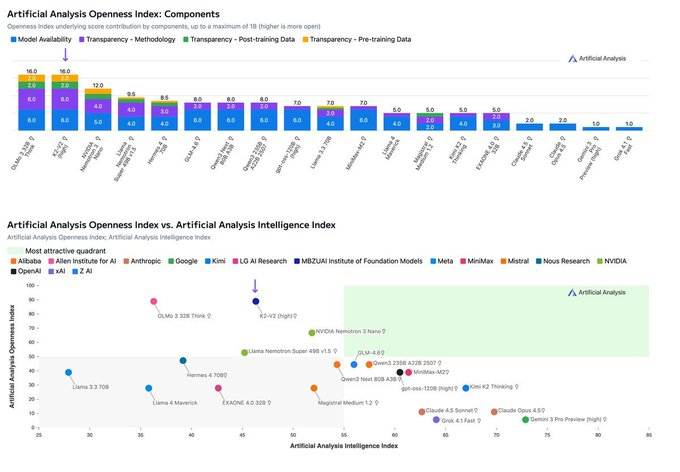
Core Viewpoint - DeepSeek's unique advantage lies in its lack of a commercial model, allowing it to focus solely on its AGI (Artificial General Intelligence) aspirations without external pressures or funding requirements [3][8][12]. Group 1: Market Expectations and Competition - The market's expectations for DeepSeek's upcoming model are tempered by the saturation of open-source models, making it less likely to shock the world again as it did previously [3][4]. - DeepSeek is no longer the only or the most open player in the market, as other labs have quickly followed suit with their own models [5][8]. Group 2: Funding and Control - DeepSeek's founder, Liang Wenfeng, has maintained a "zero external financing" approach, prioritizing control over financial gain, which is unique among top labs [3][9]. - The success of Liang's quantitative fund, which generated over $700 million in profit with a 53% return rate, allows DeepSeek to fund its operations without external investment [3][11]. Group 3: Advantages of No Commercial Model - The absence of external funding means DeepSeek is not burdened by commercial KPIs, allowing it to focus purely on technological advancements [3][12]. - The lack of external financial pressures fosters a flat organizational structure, reducing internal competition and bureaucracy, which can hinder innovation [14][15]. Group 4: Research and Resource Allocation - DeepSeek's limited resources do not impede its research quality, as good research does not necessarily require excessive computational power [13][14]. - The organization can prioritize innovative ideas without the distractions and conflicts that often accompany larger, well-funded labs [15][18].


租了8张H100,他成功复现了DeepSeek的mHC,结果比官方报告更炸裂
机器之心· 2026-01-19 08:54
Core Insights - DeepSeek's mHC architecture addresses numerical instability and signal explosion issues in large-scale training by extending traditional Transformer residual connections into a multi-stream parallel architecture [1][5] - The mHC model has garnered significant attention in the AI community, with successful reproductions yielding better results than the original DeepSeek paper [5][6] Group 1: mHC Architecture - The mHC model utilizes the Sinkhorn-Knopp algorithm to constrain the connection matrix to a doubly stochastic matrix manifold, ensuring stability during training [1][25] - Traditional residual connections in Transformers have remained unchanged since 2016, relying on a single information flow, while mHC introduces multiple parallel streams for enhanced expressiveness [9][14] - The mHC architecture maintains stability by preventing signal amplification, which can lead to catastrophic failures in large models [20][28] Group 2: Experimental Results - In experiments with 10M parameters, the original hyper-connection (HC) model exhibited a signal amplification of 9.2 times, while mHC maintained stability with an amplification of 1.0 [36][61] - Scaling up to 1.7B parameters, the HC model showed an alarming amplification of 10,924 times, highlighting the instability associated with larger models [54][66] - The experiments demonstrated that while HC models accumulate instability, mHC models consistently maintain structural integrity across different training conditions [70][71] Group 3: Implications and Future Directions - The findings suggest that while traditional residual connections are stable, they may not be optimal for larger models, as mHC offers a balance between expressiveness and stability [57][58] - Future research aims to explore scaling laws further, particularly at the 10B parameter scale, where significant amplification trends are anticipated [101] - The mHC approach not only mitigates instability but also eliminates the risk of catastrophic failures in large-scale training scenarios [93][96]
没有商业模式,是DeepSeek最坚固的“护城河”
3 6 Ke· 2026-01-19 08:22
Core Insights - The article discusses the upcoming anniversary of DeepSeek and the expectations surrounding its new model release, emphasizing that the market should temper its expectations as the AI landscape has evolved significantly since last year [1][10]. Group 1: Business Model and Funding - DeepSeek's strongest competitive advantage is its unique model of zero external financing, allowing it to pursue its AGI dream without commercial pressures [2][15]. - The founder, Liang Wenfeng, prioritizes control over financial backing, making DeepSeek an outlier in a capital-driven AI industry [3][18]. - DeepSeek's funding comes from its profitable quantitative fund, Huanfang Quantitative, which generated over $700 million (approximately 5 billion RMB) in profit last year, allowing for investment in resources without external investor pressure [4][18]. Group 2: Market Position and Competition - The article warns that while DeepSeek previously led the market with its models, it is no longer the only or the most open player, as many competitors have emerged with open-source models [10][11]. - The expectation that DeepSeek will release a groundbreaking model is tempered by the reality that the market is now saturated with open-source alternatives, diminishing its unique position [10][14]. Group 3: Internal Dynamics and Research Quality - The absence of external funding allows DeepSeek to maintain a flat organizational structure, reducing internal competition and bureaucracy, which can hinder research quality [20][22]. - The article highlights that excessive funding can lead to "big company syndrome," where resources are mismanaged and research quality suffers, a situation DeepSeek avoids by self-funding [6][20]. - The focus on research quality over sheer computational power is emphasized, with insights from Ilya Sutskever suggesting that significant breakthroughs do not necessarily require vast computational resources [7][21]. Group 4: Investor Perspective - The author expresses a paradoxical desire to invest in DeepSeek while recognizing that accepting external funding would compromise its unique characteristics and mission [9][25]. - The article concludes that DeepSeek's lack of a commercial model is its enduring strength, allowing it to align its internal goals with its AGI research without external pressures [25].

China Tech Boom Leaves Economic Malaise Behind
ZeroHedge· 2026-01-19 04:55
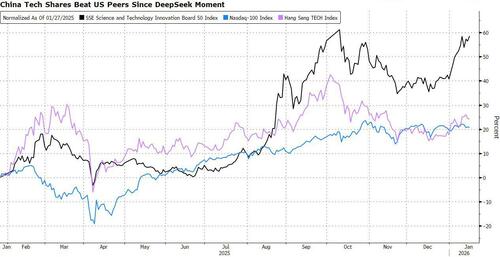
Core Viewpoint - China's technological advancements are driving a stock rally, despite a fragile economy, with significant enthusiasm for homegrown technologies leading the market [1][3]. Group 1: Market Performance - Chinese tech shares have surged nearly 13% this month, with Hong Kong-listed tech firms climbing almost 6%, outperforming the Nasdaq 100 [2]. - A basket of 33 Chinese AI stocks has seen their combined market value increase by approximately $732 billion over the past year, with further upside expected as their market capitalization is only 6.5% of the US's [8]. Group 2: Technological Developments - Progress in various sectors, including commercial rockets, robotics, and flying cars, is contributing to the bullish sentiment in Chinese equities [2]. - The adoption of generative AI has surged among major Chinese internet companies, such as Alibaba and Tencent, following DeepSeek's AI breakthrough [6]. Group 3: Future Outlook - Anticipation of DeepSeek's new AI model release and China's upcoming five-year economic plan focusing on technological self-reliance may further bolster market confidence [3][14]. - Analysts predict that the next major AI breakthrough will occur at the application layer, with China well-positioned to lead due to its diverse user cases [10]. Group 4: Investment Sentiment - Some investors remain optimistic about the technology sector's prospects, citing advantages like a low-cost base and strong state support [12]. - The expected release of DeepSeek's R2 model may act as a catalyst for further disruption in the sector, reinforcing China's competitive stance against US AI dominance [13]. Group 5: Valuation Concerns - The recent stock rally has raised concerns about stretched valuations, with some companies trading at significantly higher multiples compared to the Nasdaq 100 [12].

对话自变量王潜:错过图灵奖,要做具身界的 OpenAI
晚点LatePost· 2026-01-19 02:52
Core Viewpoint - The company aims to create a groundbreaking AI company similar to OpenAI, focusing on original innovation in embodied intelligence [4][5][47]. Background and Experience - Wang Qian, the founder, has a diverse academic background, including a degree in electronic engineering from Tsinghua University and a PhD in Robotics Learning from USC, which contributes to his unique perspective in the AI field [4][6]. - He has been involved in neural networks since 2009 and was one of the earliest adopters of deep learning in China, missing a significant opportunity for a Turing Award-level discovery [5][8]. Investment and Funding - The company recently completed a 1 billion RMB A++ round of financing, led by ByteDance, indicating growing investor confidence in its vision [5][47]. - Wang Qian believes that the Chinese capital market often undervalues unique technological innovations, which has made early-stage financing challenging [47]. Technological Approach - The company is focused on developing an end-to-end embodied intelligence model, rejecting traditional layered or specialized models, which Wang argues have not yielded significant results over the past 80 years [26][29]. - Data quality is emphasized as the primary bottleneck in improving model performance, with a shift in focus from model algorithms to data collection and quality [30][41]. Market and Competitive Landscape - The company perceives a clear distinction between its AI-driven approach and competitors focused on traditional robotics, which do not integrate AI effectively [61][62]. - Wang Qian predicts that the commercialization of robotics will begin in earnest by 2026, with the company aiming to achieve positive ROI in specific applications such as household chores and industrial tasks [57][60]. Future Vision - The company aspires to be a leader in the field of embodied intelligence, with a long-term goal of achieving significant advancements akin to those of OpenAI [47][65]. - Wang Qian expresses confidence in the potential of Chinese companies to excel in the AI sector, particularly in the foundational stages of development [64].

海外周观点:阿里千问APP版本大更新,25Q4出海APP中短剧和AI影像工具创收能力较强海外周观点-20260118
HUAXI Securities· 2026-01-18 13:33
Group 1 - The report highlights a significant update to the Alibaba Qianwen App, which now integrates services from Taobao, Alipay, and other Alibaba businesses, allowing users to order food, shop, and book travel directly within the app [1][8] - The app has introduced a "Task Assistant" feature that can handle complex tasks such as making restaurant reservations and generating reports, currently in a testing phase [1][9] - The Qianwen App aims to differentiate itself by focusing on task quality and value, targeting educated and tech-savvy users while leveraging Alibaba's ecosystem for enhanced functionality [1][9] Group 2 - According to Sensor Tower data, the fourth quarter of 2025 saw strong revenue generation from short video and AI imaging tools, with global in-app purchases for short video applications exceeding $2.8 billion, marking a 116% year-over-year increase [2][11] - The report notes that short video applications accounted for half of the top 20 non-gaming overseas revenue-generating apps in Q4 2025, driven by seasonal shopping events [2][14] - Active user rankings show that applications like Temu, SHEIN, and AliExpress are leading in user engagement, indicating a robust demand for cross-border e-commerce applications [2][18] Group 3 - The investment strategy suggests a positive outlook for Hong Kong stocks, particularly in the internet and technology sectors, with companies like Alibaba, Tencent, and Meituan expected to benefit from increased capital expenditure and AI adoption [3] - The report identifies emerging consumer brands with strong growth potential, such as Maogeping and Mixue Group, as key beneficiaries in the domestic consumption sector [3]
没有商业模式,是DeepSeek最坚固的“护城河”
硬AI· 2026-01-18 13:03
Core Viewpoint - DeepSeek stands out in the AI industry as a unique entity that operates without external financing and commercial pressures, allowing it to pursue its AGI (Artificial General Intelligence) dream freely, unlike other AI giants that are compelled to generate profits [3][5][6]. Group 1: Market Expectations - The article cautions against high expectations for DeepSeek's upcoming model, suggesting it may not replicate last year's groundbreaking impact due to the saturation of the market with open-source models [5][18]. - DeepSeek, while initially a pioneer, is no longer the sole or most open player in the market, as other labs have quickly followed suit with their own models [14][18]. Group 2: Unique Funding Model - DeepSeek's founder, Liang Wenfeng, has maintained a "zero external financing" approach, which is rare among top-tier labs, prioritizing control over financial gain [6][22]. - The success of Liang's quantitative fund, Huanfang Quantitative, which achieved a 53% return and over $700 million in profit, allows DeepSeek to fund its operations without external pressures [7][23]. Group 3: Advantages of Limited Funding - The lack of external funding has allowed DeepSeek to avoid the pitfalls associated with excessive capital, such as bureaucratic inefficiencies and internal competition for resources [9][28]. - The absence of a commercial model means DeepSeek can focus solely on research quality and innovation without the constraints of commercial KPIs [8][31]. Group 4: Research and Innovation - The article emphasizes that significant research breakthroughs do not necessarily require vast computational resources, as demonstrated by past innovations like the Transformer architecture [10][27]. - DeepSeek's internal structure promotes a flat organization, fostering creativity and collaboration without the distractions of external funding pressures [28][30]. Group 5: Investor Perspective - The author reflects on the paradox faced by investors who are eager to invest in DeepSeek but recognize that external funding could compromise its unique characteristics and mission [12][31].

China-focused hedge funds surged in 2025. Here's who won big.
Business Insider· 2026-01-18 12:06
Economic Environment - At the start of 2025, concerns about investing in China were heightened due to a new protectionist US administration and instability in China's real estate market [1] - By the end of 2025, many fears were deemed overblown as the Chinese government focused on economic stimulation, leading to increased buybacks by public companies [2] Company Performance - ByteDance, after selling a majority stake in its US TikTok operations, is now valued between $350 billion and $370 billion, marking a significant increase in its worth [2] - Hedge funds that invested in China saw substantial returns, with Bridgewater's China Total Returns fund generating a 34.2% return and Tekne Capital achieving over 50% [3] Investment Strategies - Kothari's firm, which manages $1.5 billion, invested in Chinese companies like DiDi Global and GDS, capitalizing on the low valuations of strong companies amid headwinds [4] - China-focused funds performed well, with Pinpoint's strategy returning over 24% and George Jiang's Golden China fund close to 33% [5] Market Trends - The average return for China-focused funds was nearly 18%, surpassing the industry average of 10.7% [6] - Investors are closely monitoring the evolving US-China relationship, particularly regarding trade agreements related to chips and potential geopolitical tensions [6]
没有商业模式--DeepSeek最坚固的“护城河”
Hua Er Jie Jian Wen· 2026-01-18 08:58
Core Insights - The article discusses the unique business model of DeepSeek, emphasizing its lack of external funding and commercial pressures, which allows it to focus solely on its AGI (Artificial General Intelligence) ambitions [2][10][18] - As the one-year anniversary of the "DeepSeek Moment" approaches, expectations for a new model release are high, but the author cautions against overestimating its impact due to the saturation of the AI market with open-source models [3][4][8] Group 1: Business Model and Funding - DeepSeek's strongest competitive advantage is its unique model of zero external financing, allowing it to operate without the pressures of profitability that other AI companies face [2][10] - The founder, Liang Wenfeng, has chosen to fund DeepSeek through profits from his quantitative fund, Huanfang Quantitative, which generated over $700 million (approximately 5 billion RMB) in profit last year [3][12] - The decision to avoid venture capital funding has allowed DeepSeek to maintain control over its direction and avoid the commercialization pressures that come with external investments [10][13] Group 2: Market Position and Competition - The AI landscape has become crowded with numerous players releasing open-source models, diminishing DeepSeek's previous status as a market leader [4][5][8] - Despite its initial impact, DeepSeek is no longer the most powerful, cheapest, or most open model available, as competitors like Alibaba and OpenAI have quickly followed suit with their own offerings [4][5][8] - The article highlights that the lack of a commercial model is not a flaw but rather a unique characteristic that allows DeepSeek to focus on research and innovation without external pressures [8][10][18] Group 3: Internal Dynamics and Research Culture - DeepSeek's internal structure benefits from the absence of external funding, leading to a flat organization with minimal bureaucratic competition for resources [15][16] - The article argues that having less money can reduce internal conflicts and promote a culture of collaboration and innovation, contrasting with larger labs that may suffer from "big company syndrome" [14][15][16] - The absence of external valuation pressures allows DeepSeek to prioritize research quality over superficial metrics of success, fostering a more genuine pursuit of AGI [18]
被员工怒怼“磕了”,追觅CEO:我有肚量;AI恋人陪聊涉黄被判刑,2.4万人付费;马斯克、奥特曼又开撕|AI周报
AI前线· 2026-01-18 05:32
Group 1: AI-related Legal Issues - The first criminal case involving AI-related obscenity in China was brought to trial, with the accused facing charges for providing chat services through the AlienChat software, which had 116,000 users, including 24,000 paying members, generating over 3 million yuan in revenue [3][4]. - The court found that out of 12,495 chat segments sampled from paying users, 3,618 segments were deemed obscene, leading to convictions for the founders [4]. Group 2: Corporate Developments in Technology - Pursuing a goal to create the world's first trillion-dollar company, the CEO of Chasing Technology, Yu Hao, stated that achieving this target is not expected within a year, despite facing internal criticism from employees regarding ambitious strategic goals [5][6][7]. - Ctrip is under investigation for alleged monopolistic practices, with the company confirming it will cooperate with regulatory authorities [10][11]. - The "Dead or Not" app, previously renamed "Demumu," is seeking a new brand name after feedback indicated the original name was considered inauspicious [12]. Group 3: Semiconductor and Tariff Changes - The U.S. government announced a 25% tariff on certain imported semiconductors and related products, effective January 15, 2026, as part of ongoing trade policy adjustments [14][15]. Group 4: Talent Movements in AI - Chen Lijie, a notable figure from Tsinghua University's Yao Class, has joined OpenAI to focus on mathematical reasoning, alongside the return of former OpenAI executives [16][18]. Group 5: Legal Actions and Financial Claims - Elon Musk is suing OpenAI and Microsoft for up to $134 billion, claiming that OpenAI has deviated from its non-profit mission and misled him regarding its financial dealings [19][20]. - OpenAI has characterized Musk's lawsuit as part of a pattern of harassment rather than a legitimate economic claim [20]. Group 6: AI Infrastructure and Innovations - Elon Musk announced the operational status of the "Colossus 2" supercomputer, which is designed to support the Grok AI chatbot, with plans for further upgrades [24][25]. - Meta is launching a new infrastructure initiative called "Meta Compute" to enhance its AI capabilities, while also planning to cut about 10% of jobs in its Reality Labs division [26][27]. Group 7: New AI Models and Technologies - Baichuan Intelligence released a new medical AI model, Baichuan-M3, which outperformed GPT-5.2 in various assessments, showcasing advanced diagnostic capabilities [39]. - Tencent's WeDLM model aims to improve inference efficiency in AI applications, addressing traditional limitations in model performance [35].