LG

Search documents
美国为何如此急于“混改”英特尔?
芯世相· 2025-08-27 05:52
Core Viewpoint - The article discusses the U.S. government's efforts to revitalize its manufacturing sector, particularly focusing on Intel, as part of a broader strategy to bring manufacturing back to the U.S. and reduce reliance on foreign supply chains [4][5]. Group 1: Historical Context and Policy Initiatives - The U.S. manufacturing sector's vulnerability was highlighted in 2007, with supply chain weaknesses exceeding 10%, leading to a collective realization post-2008 financial crisis about the risks of deindustrialization [5][6]. - Bipartisan consensus has emerged around the need to "bring manufacturing home," especially in light of global events like the Russia-Ukraine conflict and the COVID-19 pandemic [7][8]. - Key initiatives include the Obama administration's infrastructure investments, the Biden administration's CHIPS Act, and Trump's "Make America Great Again" agenda, all aimed at revitalizing manufacturing [8][9]. Group 2: Manufacturing Metrics and Performance - From 2010 to 2023, U.S. manufacturing employment increased by over 1.3 million, but the share of employment in the secondary sector continues to decline [11]. - Fixed asset investment in manufacturing exceeded $740 billion in 2023, more than doubling since 2010, particularly in electronics and transportation equipment [11]. - Despite a 5.9% increase in manufacturing value added, its share of GDP has decreased from 11.9% in 2010 to 10.2% in 2023, indicating ongoing challenges [15]. Group 3: Supply Chain Diversification - The share of imports from China has decreased from 22% at its peak to below 15%, with significant increases in imports from Canada, Mexico, and Southeast Asia, particularly Vietnam [12]. - However, the overall effectiveness of these policies remains questionable, as the U.S. trade deficit reached a record $1.1 trillion in 2023, doubling compared to 20 years ago [15]. Group 4: Sector-Specific Insights - Certain sectors, like chemicals and high-tech manufacturing (medical devices, aerospace), have shown resilience and growth, while the semiconductor industry continues to struggle despite substantial government support [18][24]. - The U.S. chemical industry is projected to capture about 15% of the global market by 2025, benefiting from energy cost advantages and a focus on high-end materials [22]. - The automotive sector faces significant challenges, with production dropping below 1.5 million vehicles, and reliance on Mexican components increasing for electric vehicles [25]. Group 5: Challenges to Manufacturing Return - High labor costs in the U.S., averaging $34 per hour, significantly hinder the competitiveness of mid-range manufacturing compared to East Asia [28]. - Despite some advantages in energy and land costs, the overall cost structure makes it difficult for many manufacturing sectors to return to the U.S. [29][30]. - High-end manufacturing sectors may have a better chance of returning due to their reliance on technology and brand value, which can offset higher labor costs [31][32]. Group 6: Future Outlook - The U.S. strategy of using subsidies and tariffs to protect high-end manufacturing may not diminish China's competitive edge in mid-range manufacturing, as China's supply chain remains robust [34]. - The future of U.S. manufacturing will depend on its ability to maintain high-value production while navigating the challenges posed by global competition and domestic cost structures [34].


科创新源稳健发展净利涨520.7% 热管理业务营收3.11亿增95%
Chang Jiang Shang Bao· 2025-08-25 23:37
Core Viewpoint - The company, Kexin New Source, has achieved significant growth in its business, with a notable increase in revenue and net profit in the first half of 2025, driven primarily by advancements in liquid cooling technology for electric vehicle batteries [1][2]. Financial Performance - In the first half of 2025, Kexin New Source reported revenue of 541 million yuan, a year-on-year increase of 43.90% [2][3]. - The net profit attributable to shareholders reached 17.604 million yuan, marking a substantial year-on-year growth of 520.71% [1][2]. - The operating profit for the same period was 23.6715 million yuan, up 405.78% compared to the previous year [2]. - The company's cash flow from operating activities also saw a significant increase, growing by 1076.14% to 24.21 million yuan [3]. Business Segments - The main business areas include the research, production, and sales of polymer materials and thermal management systems, applicable in various sectors such as telecommunications, power, traditional home appliances, automotive, new energy vehicles, energy storage, and data centers [2][3]. - The thermal management system segment emerged as a key growth driver, with revenue reaching 311 million yuan, a remarkable increase of 95.31% year-on-year [1][3]. - The polymer materials segment generated revenue of 229 million yuan, reflecting a steady growth of 6.04% [3]. Product Performance - Specific product revenues in the first half of 2025 included: - Heat dissipation metal structural parts: 303 million yuan (up 99.83%) - Automotive sealing strips: 89.25 million yuan (up 9.79%) - Insulation and fireproof materials: 73.80 million yuan (up 3.41%) - Waterproof sealing materials: 58.49 million yuan (up 8.96%) [3]. Research and Development - Kexin New Source has consistently increased its R&D investment, with expenditures of 42.99 million yuan in 2023, 46.43 million yuan in 2024, and 24.49 million yuan in the first half of 2025, reflecting year-on-year growth rates of 17.57%, 8.02%, and 21.50% respectively [4]. Client Relationships - The company has established long-term partnerships with major clients in various sectors, including telecommunications (Huawei, ZTE, Ericsson), power (State Grid, Southern Power Grid), and automotive (Chery, Geely) [5]. - In the new energy sector, Kexin New Source has stable business relationships with leading battery manufacturers such as CATL and LG [5]. Strategic Expansion - Kexin New Source is pursuing strategic acquisitions to enhance its core competitiveness, including plans to acquire Dongguan Zhaoke Electronic Materials Technology Co., Ltd. and its subsidiaries [6]. - As of June 2025, the company's total assets amounted to 1.254 billion yuan, with a debt ratio of 46.94% [6].
聚飞光电20250825
2025-08-25 14:36
Summary of 聚飞光电 Conference Call Company Overview - **Company**: 聚飞光电 (Jufei Optoelectronics) - **Date**: August 25, 2025 Key Industry Insights - **Industry**: LED and Optoelectronics - **Market Trends**: Benefiting from national subsidy policies and high-quality product demand, with stable overseas market demand [2][3] Core Business Performance - **Revenue Growth**: Company reported an 18.9% increase in revenue for the first half of the year [2][6] - **Profit Decline**: Non-recurring net profit decreased by 6% due to product structure adjustments and increased competition in large-size and MINI products, leading to a 2% drop in gross margin [2][7] - **Product Segmentation**: - **LED Products**: Accounted for 91% of revenue, with significant growth in MINI backlight for TVs and automotive products [3][4] - **Automotive Products**: Grew by approximately 30%, with automotive backlight ranking among the top three globally [2][3][11] - **Mini LED and Micro LED**: Contributed to the growth in small-sized displays, which have a higher gross margin than the company's overall margin [10] Market Share and Product Mix - **Automotive Product Share**: 15% of total revenue, with MINI backlight for TVs increasing from 20% to 25% [2][4] - **Traditional Lighting**: Experienced a decline, but overseas demand remains strong, maintaining a 22% share in large-size backlight [2][4] - **Other Segments**: Optical modules and optical materials accounted for 7-8%, while LED key lights and home appliance infrared displays made up 3% [5] Future Development Focus - **Strategic Focus**: Emphasis on expanding MINI backlight both domestically and internationally, with significant development expected in overseas markets [2][8] - **Collaboration**: Plans to collaborate with major companies like Samsung and LG to mitigate tariff risks through global supply [8][14] - **Investment in R&D**: Increased investment in R&D and human resources to address market competition and improve product offerings [7][20] Challenges and Adjustments - **Competition**: Intense competition in the TV market, particularly for low-end MINI products, has pressured overall gross margins [9][19] - **Resource Allocation**: Challenges in resource distribution and personnel strength in the automotive display sector, leading to lost orders [20] - **Profitability Outlook**: Anticipated improvement in gross margin in the second half of the year due to strategic adjustments and focused problem-solving [21] Financial Projections - **Revenue Expectations**: Projected revenue for new business segments around 50 million yuan, with ongoing subsidies to support growth while controlling overall operational impact [18] Conclusion 聚飞光电 is positioned to leverage its strengths in the LED and optoelectronics market, with a clear focus on expanding its MINI backlight segment and enhancing its international presence. Despite facing challenges in competition and resource allocation, the company is optimistic about improving profitability and market share through strategic partnerships and increased R&D investment.

海信视像20250825
2025-08-25 09:13
Summary of Hisense Visual Conference Call Company Overview - **Company**: Hisense Visual - **Industry**: Black Electronics (TVs) Key Points and Arguments 1. **Cost Control and Margin Improvement**: Hisense Visual has effectively controlled costs through optimized procurement and supply chain management, leading to a significant increase in gross margin, with TV business gross margin rising to 17.35% in 2022, outperforming Korean brands [2][6] 2. **Multi-Brand Strategy**: The company utilizes a multi-brand matrix (Hisense, Toshiba, VIDAA) to precisely target users and enhance market share in the large-size TV segment through high-end technologies like ULED and self-developed image quality chips [2][7] 3. **Market Share Recovery**: Traditional brands like Hisense have regained market share from internet TV brands like Xiaomi, which faced challenges with its low-price competition strategy, allowing Hisense to reclaim its position as the sales champion in China [2][10] 4. **Profit Growth through Brand Expansion**: Hisense has achieved profit growth through the expansion of brands like Vita and the mid-to-high-end Toshiba brand, successfully implementing a high-end strategy that has led to a return to the top of the Chinese market in terms of shipment volume [2][13] 5. **Global Market Positioning**: Chinese panel manufacturers' expansion and procurement scale advantages have positioned Hisense and other domestic brands to challenge Samsung for the top global shipment volume [2][14] 6. **Brand Awareness through Sports Sponsorship**: Hisense has enhanced its global brand recognition by sponsoring major sports events like the UEFA European Championship and the World Cup, particularly boosting its presence in European and American markets [2][16] Financial Outlook 1. **Profit Projections**: Hisense Visual is expected to achieve a net profit exceeding 2.6 billion RMB in 2025, with an average annual growth rate of 15% over the next three years, potentially reaching 3 to 3.5 billion RMB by 2027 [3][17] 2. **Market Valuation**: The current market valuation of approximately 28 billion RMB is seen as a good opportunity for accumulation, with expectations of exceeding 40 billion RMB in market value by 2027 [3][18] 3. **Positive Industry Factors**: The black electronics industry is expected to benefit from low inventory levels and declining panel prices in the second half of the year, which will support revenue and profit performance [3][19] Misconceptions and Responses 1. **Market Misconceptions**: Prior to 2022, the market believed that black electronics brands were heavily impacted by upstream panel price cycles, making sustained profit improvement difficult. Hisense has countered this by demonstrating effective cost control, outperforming Korean brands like Samsung and LG [5][6] 2. **Challenges for Second-Tier Brands**: Second-tier traditional TV companies like Changhong and Konka are facing challenges and shifting focus to other businesses, leading to declining sales and market share in the black electronics sector [12] Future Considerations 1. **Investor Guidance**: Investors are advised to closely monitor the upcoming 2025 first-half performance report, which may reflect positive trends such as low inventory levels and cost benefits from declining panel prices [20] 2. **Sustainability of Profit Improvement**: The sustainability of profit improvement is supported by factors related to cost, revenue, and profit, indicating a strong outlook for Hisense Visual [9][8]

同飞股份20250822
2025-08-24 14:47
Summary of Tongfei Co., Ltd. Conference Call Industry Overview - The data center liquid cooling market is rapidly expanding, with projections indicating that by 2027, when NVIDIA's M172 ships 100,000 units, the market size will reach a trillion-level scale [2][3] - The liquid cooling market for data centers is expected to grow from less than 2 billion in 2024 to nearly 5 billion in 2025, and potentially reach 10 billion in 2026 [3] Company Performance and Market Position - Tongfei Co., Ltd. holds a leading position in the energy storage liquid cooling sector, with a market share of 40%-50%, and has established stable partnerships with major companies such as Sungrow, CATL, and BYD [2][5] - The company’s core products, CDU and manifold, account for approximately 30% of the value in liquid cooling systems, with the overall business system value potentially reaching 40% [2][3] - In the semiconductor equipment liquid cooling field, Tongfei is one of the few domestic manufacturers capable of high-precision temperature control, with products already applied in key clients' equipment [2][6] Financial Projections - The expected net profit attributable to the parent company for Tongfei is projected to reach 450 million by 2026, corresponding to a current market value of approximately 11 billion [2][7] - The company anticipates profits of 330 million and 450 million for 2025 and 2026, respectively, with corresponding price-to-earnings ratios of 35 and 25 [3][10] - The global market share for Tongfei's products in the data center liquid cooling segment is estimated at 10%, which could correspond to a target market value of around 15 billion [2][7] Competitive Advantages - Tongfei has demonstrated significant improvements in profitability through technological and cost advantages, allowing it to stand out in a competitive environment [5] - The company has expanded its client base to include international customers such as LG and Samsung, with the proportion of orders for overseas end applications increasing to 60%-70% [5] Future Outlook - The company is expected to enter a harvest period starting in 2025, with long-term growth prospects bolstered by the anticipated trillion-level markets for energy storage and data center liquid cooling [3][10] - The company is recommended as a key focus for investors due to its strong market position and growth potential in the liquid cooling sector [11] Technical Insights - The temperature control precision required for semiconductor equipment is significantly higher (±0.02°C) compared to that for data centers (±0.1°C) and energy storage [8] - Tongfei has successfully entered the semiconductor equipment market, with expectations of revenue reaching around 100 million by 2025 [9]
大涨344%!巴斯夫、金发供应商,化工新材料“小巨人”,上市
DT新材料· 2025-08-22 16:04
Core Viewpoint - Ningbo Nengzhiguang New Materials Technology Co., Ltd. officially listed on the Beijing Stock Exchange on August 22, with a first-day closing price of 32.04 yuan, marking a significant increase of 344.38% and a market capitalization of 2.546 billion yuan [2]. Fundraising and Investment Projects - The company aims to raise approximately 160 million yuan for three main projects: a 30,000-ton functional polymer material expansion project, a research and development center construction project, and working capital supplementation [4][5]. - The total investment for these projects is 160.0845 million yuan, with the breakdown as follows: - Functional polymer material expansion project: 91.166 million yuan - R&D center construction project: 35.4185 million yuan - Working capital: 33.5 million yuan [5]. Financial Performance - Revenue for the years 2021 to 2023 was 529 million yuan, 555 million yuan, and 569 million yuan, respectively, with net profits of 24.145 million yuan, 21.864 million yuan, and 49.807 million yuan, showing significant growth in 2023 [6]. - For 2024, the company projects revenue of 610 million yuan with a gross margin of 17% and a net profit of 55.94 million yuan. In the first half of 2025, it expects to achieve revenue of 301 million yuan, a year-on-year growth of 2.61%, and a net profit of approximately 26.9918 million yuan, a growth of 3.39% [6]. Production Capacity and Utilization - The company has maintained a production capacity of 30,000 tons in Ningbo from 2022 to 2024, with production volumes increasing from 29,499.45 tons in 2022 to 33,911.62 tons in 2024, resulting in a capacity utilization rate of 113.04% in 2024 [7]. - In the Ganzhou facility, production capacity increased from 18,681.47 tons in 2022 to 19,639.50 tons in 2024, with a production volume of 14,913.69 tons and a utilization rate of 75.94% in 2024 [7]. Product Offerings and Applications - The company specializes in functional polymer products such as compatibilizers, toughening agents, and adhesive resins, which are widely used in modified plastics, composite materials, and polymer functional films across various sectors including automotive, electronics, and construction [7][8]. - Current research and development focus on products like flame-retardant toughening agents for nylon, high-performance lithium battery separators, and modified polypropylene wax [8][10]. - The adhesive resins produced by the company are utilized in applications such as photovoltaic films and barrier packaging, with a strong emphasis on environmental performance [13][14]. Market Trends and Future Directions - The shift from P-type to N-type solar cells and advancements in materials like copper indium gallium selenide and perovskite thin-film batteries are driving demand for new encapsulation materials, which presents growth opportunities for the company [14]. - The company is strategically positioned to meet the evolving needs of the photovoltaic industry, particularly in developing functional masterbatches that enhance the performance of solar modules [14].

万朗磁塑:拟2.36亿元收购泰州天恩全部股权
Zheng Quan Shi Bao Wang· 2025-08-22 15:05
Group 1 - The company Wanlong Magnetic Plastic (603150) announced on August 22 that it plans to acquire 100% equity of Taizhou Tian'en Electronics Co., Ltd. from HAYOUNG for an initial cash consideration of 236 million yuan [1] - Taizhou Tian'en's core products include refrigerator glass doors, refrigerator glass shelves, and washing machine glass doors, with LG as a key customer [1] - This investment is expected to create synergies in technology research and development, supply chain integration, and market resource sharing with the company's existing glass-related business [1]

L'Air Liquide (AIQU.F) M&A Announcement Transcript
2025-08-22 13:02
Summary of the Conference Call on Air Liquide's Acquisition of DIG IAS Company and Industry - **Company**: Air Liquide - **Acquisition Target**: DIG IAS, a leading industrial gas company in South Korea - **Industry**: Industrial gases, with a focus on manufacturing sectors such as electronics, chemicals, and healthcare Core Points and Arguments 1. **Strategic Growth Acquisition**: Air Liquide announced the acquisition of DIG IAS to strengthen its position in growth markets, particularly in South Korea, which is the fourth largest industrial gas market globally and expected to double by 2035 [2][4][11] 2. **Complementarity**: The acquisition will double Air Liquide's size in Korea, enhancing its local density by adding 60 plants and over 220 kilometers of pipeline, which will service key customers across 10 major industry basins [5][12] 3. **Earnings Accretion**: The acquisition is expected to be earnings accretive within one year, with a return on capital employed (ROCE) remaining above 10% [5][25] 4. **Investment Backlog**: DIG has secured €240 million in investments through long-term contracts, with 19 projects in its diversified backlog, projected to generate over €50 million in additional EBITDA by 2030 [6][21] 5. **Market Position**: South Korea's manufacturing sector contributes over 25% to its GDP, with significant presence in industries such as refining, chemicals, and steel, making it an attractive market for industrial gases [8][10] 6. **Electronics Sector**: DIG holds a strong position in the electronics market, which accounts for 60% of the Korean industrial gas market, particularly in carrier gases for semiconductors and flat panel displays [13][9] 7. **Healthcare Supply**: DIG supplies medical gases to hospitals across Korea, complementing Air Liquide's existing healthcare operations [14][16] 8. **Regulatory Considerations**: The acquisition is subject to Korean regulatory clearance, but the companies do not anticipate significant competition issues due to the complementarity of their operations [42][46] Additional Important Content 1. **Historical Context**: Air Liquide previously exited the South Korean market in 2014 due to limited impact as a minority partner in a joint venture. The current acquisition is seen as a strategic return to a transformed and more promising market [78][86] 2. **Financial Structure**: The acquisition will be financed through a structured bridge loan, with plans for refinancing through bond issues to maintain an A category credit rating [24][25] 3. **Long-term Vision**: The acquisition aligns with Air Liquide's growth-oriented strategy, focusing on both organic growth and strategic acquisitions to enhance its market position [43][60] 4. **Risk Management**: Concerns regarding trade wars and their impact on the Korean market were addressed, with confidence in the quality of DIG's customer base mitigating potential risks [55][58] 5. **Project Diversity**: The 19 projects in DIG's backlog are diverse, not solely focused on electronics, indicating a balanced approach to growth across various sectors [73][74] This summary encapsulates the key points discussed during the conference call regarding Air Liquide's strategic acquisition of DIG IAS, highlighting the rationale, expected benefits, and market context.
能之光北交所上市:高分子新材料领域创新引领者迈向新篇章
Sou Hu Cai Jing· 2025-08-22 10:55
Core Viewpoint - Ningbo Enerlight New Materials Technology Co., Ltd. officially listed on the Beijing Stock Exchange on August 22, 2025, marking a new phase of high-quality development for the company [1] Group 1: Company Overview - Established in 2001, the company has over 20 years of experience in the polymer materials field, focusing on the industrial application of polymer graft modification technology [1] - The company has developed three core technology platforms: "Polymer Chemical Grafting Modification," "Polymer Supercritical Fluid Purification," and "Organic-Inorganic Functional Composites" [1] - The company has successfully developed key technologies such as melt grafting reaction extrusion technology, supercritical fluid purification technology, and functional masterbatch preparation technology, creating a solid technological moat [1] Group 2: Leadership and Innovation - Under the leadership of Dr. Zhang Farou, the company has overcome technical bottlenecks and established a professional and efficient R&D team [3] - The company has set up multiple high-level R&D platforms, including a national postdoctoral research station and a provincial high-tech enterprise R&D center, supporting continuous innovation [3] - The company has obtained 51 invention patents, showcasing its strong independent innovation capability [3] Group 3: Market Position and Product Development - As one of the early domestic companies to achieve the localization of compatibilizers, the company has promoted the widespread application of halogen-free flame-retardant cable sheath compatibilizers in China [3] - The company has grown into a large-scale supplier of polymer functional materials with a rich product line, leading the industry in the compatibilizer field [3] - The technical indicators of its core products have significant advantages over domestic peers, with some products' performance comparable to imported counterparts [3] Group 4: Product Innovation and Applications - The company has launched nylon toughening agent products that have reached the performance level of similar imported products, achieving steady sales growth [4] - The company is actively developing and industrializing functional polymer materials, with adhesive resins and functional masterbatches achieving large-scale sales [4] - In the photovoltaic film sector, the company has introduced series of functional masterbatches, such as acid-free masterbatches and anti-PID masterbatches, enhancing the stability and lifespan of photovoltaic components [4] Group 5: Customer Engagement and Market Strategy - The company adheres to a technology-driven and customer-oriented approach, providing stable performance products, customized solutions, and high-quality services [5] - The company has established a stable and high-quality customer network, including well-known domestic enterprises and international industry leaders [5] - National policies have positioned high polymer new materials and high-performance modified plastics as key development directions for strategic emerging industries, providing a favorable policy environment for the company's growth [5]

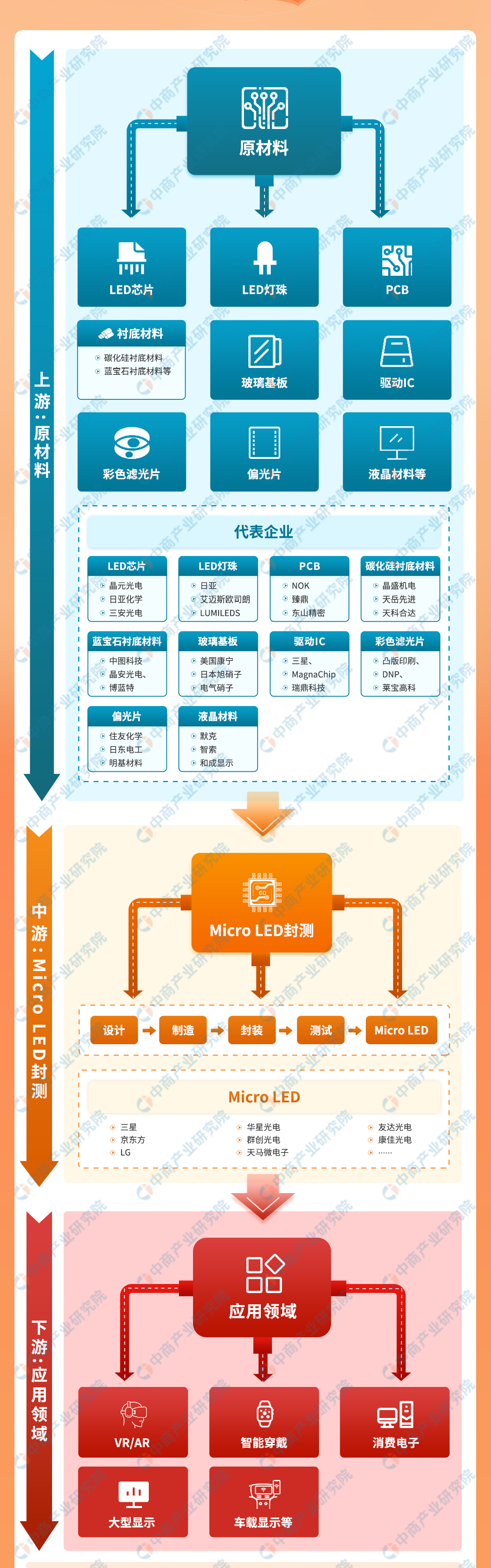
一图了解MicroLED产业链
Xuan Gu Bao· 2025-08-22 06:06
Group 1: Industry Overview - The document lists various materials and components used in the LED and Micro LED industries, including substrates like silicon carbide and sapphire, as well as LED chips and driving ICs [1][2]. - Key players in the LED chip and component market include companies such as 日亚 (Nichia), 晶元光电 (Epistar), and 三安光电 (San'an Optoelectronics) [1][2]. Group 2: Material Types - The document highlights several types of materials essential for LED technology, such as polarizers, liquid crystal materials, and color filters [1][2]. - Specific materials mentioned include glass substrates, driving ICs, and various substrate materials like silicon carbide and sapphire [1][2]. Group 3: Micro LED Technology - Micro LED technology is noted for its applications in display technology, with companies like 三星 (Samsung), 友达光电 (AU Optronics), and 京东方 (BOE) involved in design and manufacturing [2]. - The document emphasizes the importance of packaging and testing in the Micro LED supply chain, indicating a growing focus on this technology [2].