
邮储银行

Search documents
近期金价持续创造历史,国有六大银行提示风险
Sou Hu Cai Jing· 2026-02-01 23:26
Core Viewpoint - Recent fluctuations in gold prices have prompted major banks in China to adjust their gold-related business operations and issue risk warnings to clients [1][3][4]. Group 1: Bank Announcements - The Industrial and Commercial Bank of China (ICBC) has issued a risk warning, advising clients to assess their risk tolerance and adopt a rational investment approach amid significant price volatility in precious metals [1]. - Agricultural Bank of China (ABC) has increased the margin requirement for gold trading contracts from 44% to 60%, effective January 30, and has implemented stricter risk assessment measures for clients engaging in gold accumulation transactions [3]. - China Construction Bank (CCB) has raised the minimum investment amount for its gold accumulation business to 1500 yuan, effective February 2, and has warned clients about the heightened market risks due to increased price volatility [4]. Group 2: Risk Management Recommendations - Banks are advising clients to control their positions and conduct transactions based on their financial situation and risk tolerance to mitigate potential losses from gold price fluctuations [4][5]. - The banks emphasize the importance of a diversified investment strategy and suggest clients avoid impulsive trading behaviors such as chasing price increases or following market trends blindly [1][5]. Group 3: Market Outlook - Despite recent volatility, the long-term outlook for gold prices remains positive, supported by various factors, according to industry experts [5].








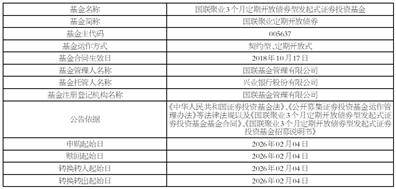
国联聚业3个月定期开放债券型发起式证券投资基金第二十八个开放期开放申购、赎回、转换业务的公告
Sou Hu Cai Jing· 2026-02-01 23:14
| 基金的繁持有时间(Y) | 明治费率 | | --- | --- | | 在同一开放朝内中刷后又棋剧的 | Y = 7 H 1.50% | | | V287. 0.10% | | 超级 -- 一般一个人 时间期 | 0 8 10 | | 甚金丝胸 | 图联聚量3个月定期开放债券型发起式证券投资基金 | | --- | --- | | 西省同时 | 国联聚设定期开放信券 | | 张会世代码 | 005637 | | 基金或作方式 | 知的型,定期开放式 | | 基金合同生效日 | 2018年10月17日 | | 基金管理人名称 | 图联播全管理有限公司 | | 品会托管人名称 | 供业银行股份有限公司 | | 新設正是登记机构名称 | 国联播全省理有限公司 | | 公告批服 | 【中华人民共和国主教授课会法》,《公开学生学校招聘》第9文字中中 理办法》等法律法服以及《国庆聚重3个月定期开放德参照发起关注 第四章 1997年 1975年 1977年 1977年 1997 1997 1997 1997 1994 1994 1999 | | | 设计量安招商设计 | | 申财志给日 | 2026年02月04日 | ...
政法骨干精准护航“政银企”对接
Xin Lang Cai Jing· 2026-02-01 22:24
本报讯(沈阳日报、沈报全媒体记者周贤忠)1月30日下午,市委政法委会同市法院、市检察院、市公 安局,依托沈阳中央法务区法治服务体系,组织金融审判、知识产权保护、公安经侦、民事执行等方面 业务骨干,在沈阳创新天地参加"政银企"对接活动(第二场)。 活动期间,各单位负责同志通过面对面交流、点对点对接,先后为中国银行、工商银行、邮储银行、民 生银行等金融机构及相关企业,解答了金融借款诉讼、金融犯罪防范等方面的法律问题,并发放了《法 官说法》《风险防范指引》等实用资料,为参与单位提供了"一站式""全链条"法治服务。参与此次活动 的政法机关表示,将以此次活动为契机,精准对接金融机构和企业法治需求,持续创新服务举措,不断 优化服务方式,提供更加优质、高效、精准的法治服务保障。 转自:沈阳日报 (来源:沈阳日报) ...
流程优化与风险防控协同发力——个人消费贷贴息政策加快落地
Jing Ji Ri Bao· 2026-02-01 22:06
财政部等三部门近日发布通知,优化实施个人消费贷款财政贴息政策。各家银行积极响应,详细解读政 策优化要点。具体包括:延长政策期限,将个人消费贷款财政贴息政策实施期限延长至2026年12月31 日;扩大支持范围,将信用卡账单分期业务纳入支持范围;拓展贴息领域,取消单笔5万元及以上消费 领域限制;提高贴息标准,取消单笔消费贴息金额上限500元的要求,取消每名借款人在一家经办机构 可享受5万元以下累计消费贴息上限1000元的要求。 新政策将监管评级3A及以上的城商行、农商行、外资银行、消费金融公司、汽车金融公司纳入经办机 构,多家新增机构正抓紧制定实施细则,发力精细化服务。 (文章来源:经济日报) "中小金融机构与非银机构的深度参与,将推动消费金融供给结构优化,倒逼机构下沉服务重心,围绕 居民多元消费场景开展产品创新。"国家金融与发展实验室副主任曾刚表示,金融机构需加快推出针对 性产品,可联合商超、汽车、文旅、家居等消费场景方打造"信贷+贴息+消费"一站式服务方案,叠加 线上线下网点运营,提升客户获取政策支持的便捷性。 监管部门与银行均高度重视风险防控与合规管理,注重消费者权益保护,强化贷款用途和资金流向监 测。多家 ...
希望农村快递上门像城市一样便捷
Xin Hua Ri Bao· 2026-02-01 21:10
当前我国农村物流快递发展成效显著,行政村快递服务覆盖率已达95%。但纵观整个快递市场,各家快 递公司的上门服务存在明显差异,偏远地区仍有不足。多位网友通过交汇点新闻客户端"我请代表委员 捎句话"栏目,提出破解农村快递上门难题、助力乡村振兴的需求。 分析农村物流快递上门的发展"瓶颈",省政协委员,中国邮政集团有限公司镇江市分公司运管部揽投管 理员、镇江市总工会副主席(兼)周江认为,末端投递能力不足与资源协同性差是两大突出问题。"农村 地域广阔、人口分散导致上门配送成本高、效率低,而邮政、客运、快递等配送渠道未能有效打通,资 源重复投入现象较为明显。" □ 本报记者林惠虹 为此,周江提出四条建议:一是深化资源整合,强化央企担当,优化三级物流体系,推广"邮快合作、 交邮融合"模式,由邮政统筹偏远地区上门派送,其他快递企业集中分拣至乡镇;二是优化盈利模式, 在村级站点叠加农产品收购、农资销售、便民缴费等多元业务,以增值收入补贴上门成本,对生鲜、高 价值快递实行差异化收费;三是科技赋能升级,推广无人车、智能柜在农村的应用,针对分散村落设置 移动取送点,通过数字化系统规划最优配送路线;四是完善政策保障,建议政府加大专项资 ...
金融风向标2026-W04:不一样的“开门红”
CMS· 2026-02-01 12:31
Investment Rating - The report maintains a positive outlook on the banking sector, indicating a potential for stabilization and improvement in operational pressures for banks in 2026 [2][5]. Core Insights - The banking sector has shown a "double opening red" phenomenon in both deposits and loans, with a structural difference in credit allocation. The signs of "deposit migration" are not significant, suggesting a stable deposit base [2][5]. - The total assets of the banking industry reached 471 trillion yuan by the end of 2025, reflecting an 8.0% year-on-year growth. Major banks, joint-stock banks, city commercial banks, and rural commercial banks reported asset growth rates of 11.0%, 4.7%, 9.7%, and 5.2%, respectively [3][14]. - The overall net interest margin is expected to decline further, but at a slower pace, indicating some relief in operational pressures. The banks have passed the phase of accelerated risk exposure and are nearing a "stock digestion period" [5][6]. Summary by Sections Regulatory Dynamics - The Financial Regulatory Bureau released data on the total assets and liabilities of the banking sector for 2025, showing a total asset growth of 8.0% year-on-year [3][14]. Industry Dynamics - Qingdao Bank and Xiamen Bank reported their 2025 performance, with Qingdao Bank achieving a net profit growth of 21.66% and an asset quality improvement, while Xiamen Bank also reported significant growth in total assets and loans [15][16]. Market Dynamics - The overall A-share market saw a decline of 1.59%, while the banking sector increased by 0.86%, indicating a defensive characteristic of the banking stocks [2][18]. Data Overview - The report highlights the central bank's net injection of 0.4 trillion yuan and the mixed movement of interest rates across different maturities, with short-term rates showing slight declines and long-term rates experiencing mixed trends [4][21][23].


六大行召开重要会议 多银行强调数智化
Zhong Guo Jing Ying Bao· 2026-02-01 09:28
中经记者 张漫游 北京报道 近日,工商银行、农业银行、中国银行、建设银行、交通银行、邮储银行六家国有大行陆续召开2026年 党建和经营(管理)工作会议,对2026年重点任务进行部署。 《中国经营报》记者梳理发现,2026年,4家国有银行明确要布局数智化发展,在2025年仅一家国有银 行提到数智化;同时2026年多家银行提出降本增效。 业内人士认为,这一变化折射出在经济增长模式深化调整、利率市场化持续推进、客户行为深度线上化 以及金融科技深刻演进的宏观背景下,中国银行业正从规模扩张驱动转向质量与效率驱动,科技与智能 正从辅助工具演变为重塑业务模式与核心竞争力的重要抓手。 从"数字化"到"数智化" 在2026年的重点工作部署中,数智化转型成为多家国有大行的核心发力点。其中,工商银行在"提升高 质量发展能级,展现服务现代化新担当"时提到,要"升级打造数智工行,增强数智化动能";建设银行 方面谈到,2026年要"加快推动集团数智化转型,持续提升企业级运营能力";交通银行方面强调"要深 入推进'人工智能+'行动,强化数智化思维、深化实践运用,通过AI技术重构业务流程、创新服务模 式";邮储银行方面指出,要"全面推进特色 ...
一年649家银行退出,中小银行“减量提质”加速
Zhong Guo Ji Jin Bao· 2026-02-01 06:08
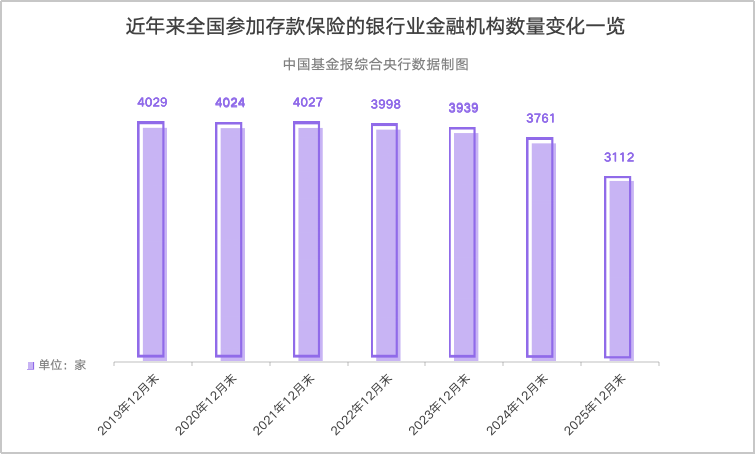
Core Viewpoint - The number of banking institutions participating in deposit insurance in China decreased by 649 in 2025, marking a significant trend towards "reducing quantity and improving quality" among small and medium-sized banks [1][2][3]. Group 1: Industry Trends - As of the end of 2025, there are 3,112 banking institutions participating in deposit insurance, a reduction from the previous year [3]. - The decline in the number of banks has been consistent since 2022, with reductions of 59, 178, and 649 banks in 2023, 2024, and 2025 respectively, primarily affecting rural commercial banks, village banks, and rural credit cooperatives [5]. - Over 400 banks exited the market in 2025 through dissolution or mergers, predominantly among small and medium-sized banks [5]. Group 2: Regulatory and Market Dynamics - Regulatory policies have driven the "reducing quantity and improving quality" initiative, focusing on reforming and mitigating risks in small and medium-sized financial institutions [5][9]. - Increased market competition has pressured small banks, as larger state-owned and joint-stock banks enhance their services, making it difficult for smaller institutions to compete [5]. - Issues such as small asset sizes, weak risk resistance, and inadequate corporate governance are prevalent among rural commercial banks and village banks [5][6]. Group 3: Reform and Risk Mitigation - The reform process for small banks has shown significant progress, characterized by a shift from isolated risk management to systematic resolution [8][9]. - Strategies include horizontal integration through the establishment of provincial-level legal entities and vertical absorption by stronger banks, which inject capital and governance capabilities [8][9]. - The focus is on a dual approach of risk resolution and capacity enhancement, with a combination of capital replenishment, mergers, and market exits [9]. Group 4: Future Directions - The core policy remains centered on "reducing quantity and improving quality," with an emphasis on creating differentiated competitive advantages for small banks [12]. - Future development for small banks should focus on enhancing quality, leveraging local advantages, and deepening digital transformation to optimize risk control and reduce operational costs [12][13]. - Recommendations include strengthening provincial-level coordination, establishing shared technology platforms, and focusing on localized and specialized services to avoid direct competition with larger banks [13].
固收专题研究:怎么把握10年二级资本债投资机会?
Guolian Minsheng Securities· 2026-02-01 02:25
1. Report Industry Investment Rating No information provided in the content. 2. Core View of the Report The report delves into the investment opportunities of 10 - year secondary capital bonds. It analyzes the development history of commercial bank secondary capital bonds, the issuance and trading condition of 10 - year secondary capital bonds, the main investors, and provides investment strategies from both allocation and trading perspectives [4][7][49]. 3. Summary According to the Directory 10 - year Commercial Bank Secondary Capital Bond Decryption - **Development History of Commercial Bank Secondary Capital Bonds**: The development of China's commercial bank secondary capital bonds can be divided into four stages. From 2004 - 2012, it was the "old - style sub - debt" stage; from 2013 - 2019, "new - style secondary capital bonds" emerged; from 2020 - 2023, the market's risk perception deepened; from 2024 to the present, the market entered a new innovation cycle [4][8][9]. - **The "Past and Present" of 10 - year Secondary Capital Bonds**: The first 10 + 5 - year secondary capital bond was issued by Agricultural Bank of China in March 2019. Since 2019, only state - owned large - scale banks and state - owned joint - stock banks have issued 10Y secondary capital bonds. The state - owned large - scale banks are the main issuers, with Agricultural Bank of China having the largest issuance volume. In terms of the stock, the secondary capital bonds with a remaining term of 3 - 5 years have the largest stock, followed by those with a remaining term of 7 - 10 years [18][22][24]. - **Secondary Transaction Situation of 10 - year Secondary Capital Bonds**: From January 1, 2025, to January 13, 2026, the secondary capital bonds with a term of 3 - 5 years were the most actively traded, followed by those with a term of 1 - 3 years. The 7 - 10 - year secondary capital bonds ranked fourth in terms of trading volume. The 9 - 10 - year secondary capital bonds had the largest trading volume among long - term bonds, and the 10 - year secondary capital bonds issued by Agricultural Bank of China had the best liquidity [30][32][33]. - **Who is Buying 10 - year Secondary Capital Bonds**: Insurance institutions are the main buyers of 10Y secondary capital bonds, with a net increase of about 1.6 billion yuan in 7 - 10Y secondary capital bonds in the past year. However, due to accounting treatment issues, insurance funds are more cautious in asset allocation. The increase in trading volume in the past month may be due to insurance companies' net purchases. In addition, securities companies, insurance companies, and fund products are the top three buyers in the past month, but the net purchase scale of securities companies is negative, indicating a stronger trading nature [36][42][43]. Investment Strategies for 10 - year Secondary Capital Bonds - **From the Perspective of Allocation**: The report uses interest rate spread and variety premium as key indicators to measure the relative value of 10Y secondary capital bonds. In terms of interest rate spread, when the funds are loose and the interest rate spread is high, the yield of 10Y secondary capital bonds may decline. In terms of variety premium, the trend of 10Y secondary capital bonds is highly consistent with that of ultra - long local bonds, with a "volatility amplification" effect in some periods [50][52][54]. - **From the Perspective of Trading**: The report reviews the term spread, the order of yield peaks of 10Y secondary capital bonds and other varieties, and the spread indicators between secondary capital bonds and urban investment bonds. Since 2025, the term spread between 10Y and 5Y secondary capital bonds has moved in the same direction as the 10Y secondary capital bond. In the interest rate upward cycle since 2023, 10Y secondary capital bonds have risen and fallen in the same direction as other varieties; in the downward cycle, almost all varieties reach the stage low at the same time. When the spread between 10Y secondary capital bonds and 10Y urban investment bonds turns negative, the yield of 10Y secondary capital bonds often has room to decline [59][66][76]. - **Summary of Trading Strategies**: The report provides a basic framework for investment decisions by reviewing historical experiences from the perspectives of allocation and trading, and summarizing the core judgment indicators and rules for the interest rate to reach the stage peak and bottom [81][82][83].
暴跌之后:黄金门店冷热不一,银行网点仍“一金难求”
Bei Jing Shang Bao· 2026-01-31 11:30
在连续多日刷新历史高点后,贵金属市场突发"过山车"式暴跌,现货黄金盘中一度跌破每盎司4700美元关口,最终收跌9.25%,收报4880美元/盎司。受此影 响,国内主流黄金品牌首饰金价也同步下行。1月31日,北京商报记者走访发现,当前,线下金店普遍将金价进行下调,促销活动均以克减活动为主,每克 减幅度在80—120元左右,客流冷热不均;银行实物黄金现货则延续缺货约定状态。 此次金价闪崩,主要受美联储主席提名变动、美国PPI数据超预期等消息面影响,叠加市场高位获利盘平仓引发的技术性回调。业内人士表示,短期实物黄 金供货紧张或持续,长期来看贵金属避险属性仍存,但投资者需警惕行情震荡风险,理性布局相关产品。 金店调价促销:客流冷热不同 受国际金价急速下跌影响,国内首饰金价迎来回调,北京商报记者实地走访北京地区多家金店发现,多家门店已将金价进行下调,在具体的促销政策上,各 品牌均以克减活动为核心,优惠力度则是各有不同。 从终端实际客流情况来看,市场呈现出冷热不一态势。多数金店门店内人员并不算密集,未出现扎堆选购的场景,不过店内始终有零星顾客陆续前来咨询金 价、挑选黄金饰品,刚需性的选购需求持续存在。而部分优惠力度突出、 ...
