
国投电力

Search documents
社保基金投资运营持续稳健 2024年收益率为8.1%
Zhong Guo Jing Ji Wang· 2025-10-10 00:31
Core Insights - The National Social Security Fund achieved a strong investment performance in 2024, with an investment income of 218.418 billion yuan and an investment return rate of 8.1% [1] - The total assets of the fund reached 3,322.462 billion yuan by the end of 2024, with domestic investments accounting for 86.82% and foreign investments for 13.18% [1] Investment Strategy - The fund adopted a "steady progress, promote stability through progress" strategy, maintaining a stable stock risk exposure and benefiting from the rebound in the A-share market [1] - There was an increased allocation to fixed-income assets, effectively capturing investment opportunities from the continuous decline in interest rates [1] - The fund actively increased equity investments and optimized overseas investment layouts to diversify risks and stabilize overall returns [1][2] Stock Investment - The fund remains optimistic about the long-term investment value of domestic stocks, leveraging its advantages as a long-term and patient capital [2] - It closely monitors capital market dynamics and regulatory policies to enhance its secondary asset allocation analysis framework [2] - The fund is advancing index investment initiatives and establishing index replication products to improve stock investment quality [2] Real Economy Investment - The fund is increasing investments in key sectors and major projects, supporting national strategies and regional coordinated development [2] - It emphasizes market-oriented and legal principles, utilizing long-term capital to support national strategies through various investment vehicles [2] Fixed Income Investment - The fund has strategically increased investments in bank deposits and domestic and foreign bonds, effectively utilizing fixed-income assets as a safety net [3] - It supports national strategies related to basic livelihoods, sustainable investments, and rural revitalization through targeted bond investments [3] Market Impact - The fund's stability, professionalism, and sustainability contribute to the smooth operation of the capital market and enhance market pricing efficiency [3] - It plays a crucial role in stabilizing market expectations and guiding resource allocation towards national strategic areas, especially in the context of an aging population [3]
社保基金投资运营持续稳健
Jing Ji Ri Bao· 2025-10-09 22:36
Core Insights - The National Social Security Fund achieved a strong investment performance in 2024, with an investment income of 218.418 billion yuan and an investment return rate of 8.1% [1] - The total assets of the fund reached 3,322.462 billion yuan by the end of 2024, with domestic investments accounting for 86.82% and foreign investments 13.18% [1] Investment Strategy - The fund adopted a "steady progress, promote stability through progress" strategy, maintaining a stable stock risk exposure and benefiting from the rebound in the A-share market [1][2] - The fund emphasized long-term investment and value investment principles, enhancing its professional management capabilities to support the national social security system [2] Stock Investment - The fund remains optimistic about the long-term investment value of domestic stocks, leveraging its advantages as a long-term and patient capital [2] - It is actively improving its overseas stock research system and optimizing existing structures while adhering to risk prevention measures for foreign assets [2][3] Fixed Income Investment - The fund increased investments in bank deposits and domestic and foreign bonds, effectively utilizing fixed income assets as a safety net [3] - It supports national strategies related to basic livelihood, sustainable investment, and rural revitalization through targeted bond investments [3] Market Impact - The fund's strategic stability and proactive market engagement have contributed positively to market expectations and confidence amid external pressures and market volatility [3] - The fund plays a crucial role in the healthy development of the capital market by guiding resource allocation towards national strategic areas and stabilizing market expectations through long-term investments [3]
电力行业2025年三季报前瞻:火电经营持续改善,清洁能源延续分化
Changjiang Securities· 2025-10-08 23:30
Investment Rating - The industry investment rating is "Positive" and is maintained [11] Core Viewpoints - The report indicates that while electricity prices and volumes continued to decline in the third quarter, the significant drop in coal prices is expected to lead to positive performance for thermal power operators in northern and parts of eastern and central China [2][6] - Hydropower performance is anticipated to be limited due to weak electricity generation during the main flood season, with a year-on-year decrease of 9.95% in hydropower generation from July to August [7][35] - Nuclear power generation is expected to grow steadily, but performance may vary by province due to differing impacts from declining electricity prices [7][36] - Clean energy utilization hours have decreased nationally, but regions like Fujian, Shanghai, and Guangdong have shown recovery in wind energy utilization hours, leading to strong performance from certain regional new energy operators [8][43] Summary by Sections Thermal Power - The three core factors affecting thermal power profitability are coal prices, electricity prices, and utilization hours. Despite a general decline in electricity prices across provinces, coal prices have significantly decreased, with the average coal price in Qinhuangdao dropping by 175.63 yuan/ton year-on-year [6][20] - The comprehensive coal price drop is expected to reduce thermal power fuel costs by approximately 0.035 yuan/kWh year-on-year, supporting continued improvement in thermal power operations, especially in northern and eastern provinces [6][32] Hydropower - Hydropower generation faced a year-on-year decline of 9.95% due to high base effects and uneven rainfall distribution. However, improved water inflow in September is expected to alleviate some pressure on hydropower performance [7][35] - Major hydropower companies are expected to manage water reservoir operations effectively to mitigate fluctuations in water inflow [35] Nuclear Power - Nuclear power generation is projected to grow by 7.09% year-on-year, supported by increased installed capacity and stable maintenance schedules. However, market price fluctuations may impact performance differently across operators [36][7] Clean Energy - Wind and solar power generation saw significant year-on-year growth of 11.85% and 22.09%, respectively, but utilization hours have decreased. Regional disparities exist, with eastern coastal provinces showing improved wind energy utilization [8][43] - Despite high growth in installed capacity, the overall performance of new energy operators may face pressure due to rising costs and weak electricity prices, although some regional operators are expected to perform well [8][43] Investment Recommendations - The report recommends focusing on quality thermal power operators such as Huaneng International, Datang Power, and Guodian Power, as well as major hydropower companies like Yangtze Power and State Power Investment Corporation. For new energy, it suggests companies like Longyuan Power and China Nuclear Power [9][54]



全国社保基金高收益率背后的“投资大智慧”
Zheng Quan Ri Bao· 2025-10-08 16:12
Core Insights - The National Social Security Fund (NSSF) achieved an investment income of 218.418 billion yuan with an investment return rate of 8.10% for the year, and a cumulative investment income of 1,900.998 billion yuan since its establishment [1][2][3] - The NSSF's investment strategy emphasizes long-term, value, and responsible investing, aligning with China's economic growth and national strategies [1][2] Investment Performance - The NSSF's average annual investment return since inception stands at 7.39%, reflecting a strong performance in the context of China's resilient economy [1][3] - The fund's asset allocation is heavily focused on domestic investments, with 86.82% of assets allocated to domestic markets by the end of 2024, creating a positive feedback loop between economic growth and fund appreciation [1][2] Policy Environment - Recent policy improvements, including the "National Nine Articles" and guidelines for promoting long-term capital market participation, have facilitated a more predictable and transparent market environment for the NSSF [2] - These policies support the NSSF's focus on long-term investments and value discovery, enhancing its operational framework [2] Strategic Alignment - The NSSF's investment decisions are closely aligned with national strategies, focusing on sectors such as renewable energy and rural revitalization, which are expected to yield stable long-term returns [2] - The fund's approach to investment not only captures policy-driven opportunities but also aims to achieve a balance between economic benefits and social value [2] Investment Operations - The NSSF employs a professional investment operation strategy, leveraging its long-term capital advantages to navigate market volatility effectively [3] - The fund's investment philosophy resonates with other long-term capital market participants, reinforcing stability in the capital market and supporting sustainable economic growth [3] Conclusion - The NSSF's investment success underscores the importance of synchronizing with China's economic trajectory and maintaining a commitment to value investing for sustained returns [3]

机构上调评级+低PE,18只个股上榜!股息率最高在7%以上
Xin Lang Cai Jing· 2025-10-08 00:50
Core Insights - Institutional upgrades in ratings indicate a positive market outlook for related assets or companies, suggesting good growth potential and investment value [1] Group 1: Institutional Upgrades - As of September 2025, 41 stocks received upgrades from institutions, with several leading companies from various sectors included [1] - Traditional industry leaders such as Yangtze Power, Huaneng Hydropower, Guotou Power, Sany Heavy Industry, XCMG, and Yanzhou Coal Mining are among those upgraded [1] - Emerging industry leaders like BAIC BluePark and Xinzhou Bang also made the list [1] Group 2: Valuation Metrics - As of September 30, 2025, 18 stocks had a rolling price-to-earnings (PE) ratio below 30, with 6 stocks having a PE ratio under 15, including Yanzhou Coal Mining, Boss Electric, Hailide, Yuntu Holdings, Zhou Dazheng, and Anhui Hefei [1] Group 3: Dividend Yields - The highest dividend yield over the past 12 months was recorded by Pingmei Shenma, reaching 7.25% as of September 30, 2025 [1]




2025年1-8月中国发电量产量为64193.3亿千瓦时 累计增长1.5%
Chan Ye Xin Xi Wang· 2025-10-07 02:06
上市企业:华能国际(600011),大唐发电(601991),国电电力(600795),华电国际(600027),长江电 力(600900),国投电力(600886),川投能源(600674),桂冠电力(600236),内蒙华电(600863),浙 能电力(600023) 相关报告:智研咨询发布的《2026-2032年中国海上风力发电行业市场调研分析及发展规模预测报告》 根据国家统计局数据显示:2025年8月中国发电量产量为9363亿千瓦时,同比增长1.6%;2025年1-8月中 国发电量累计产量为64193.3亿千瓦时,累计增长1.5%。 2020-2025年1-8月中国发电量产量统计图 数据来源:国家统计局,智研咨询整理 知前沿,问智研。智研咨询是中国一流产业咨询机构,十数年持续深耕产业研究领域,提供深度产业研 究报告、商业计划书、可行性研究报告及定制服务等一站式产业咨询服务。专业的角度、品质化的服 务、敏锐的市场洞察力,专注于提供完善的产业解决方案,为您的投资决策赋能。 ...


如果电力是AI发展的瓶颈,中国是否在领先?
傅里叶的猫· 2025-10-03 15:07
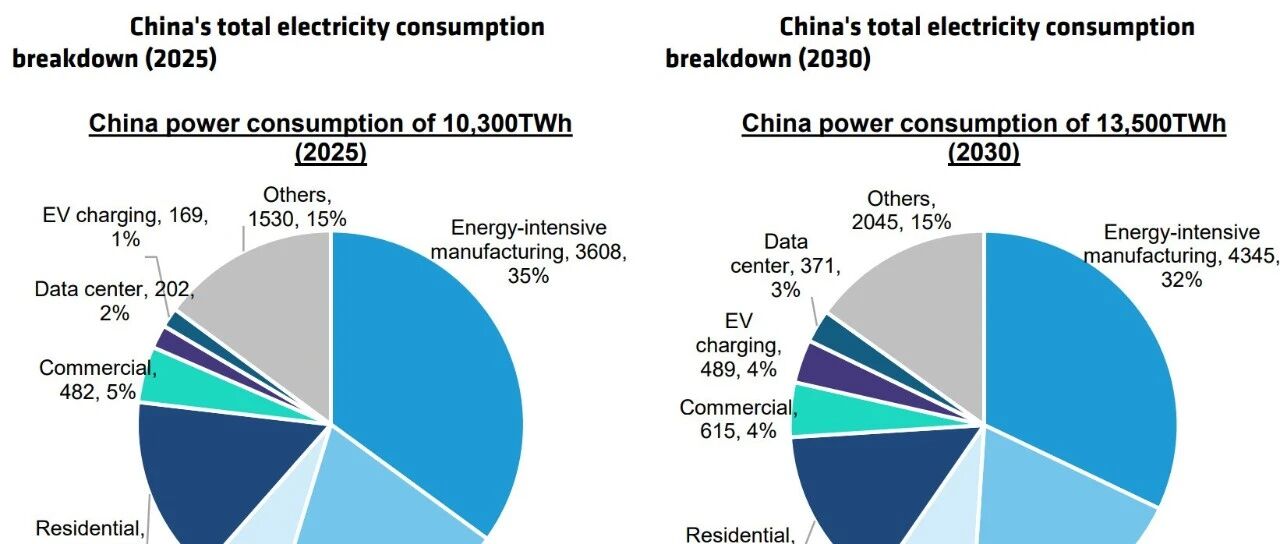
Core Viewpoint - The article emphasizes the critical role of electricity supply and energy storage in supporting the growing demand from AI data centers, highlighting that power availability has become a significant bottleneck for AI infrastructure development [1][7][9]. Electricity Demand and Supply - AI data centers are projected to significantly increase electricity demand, with the International Energy Agency estimating that annual electricity consumption from data centers will rise from 415 TWh in 2024 to 945 TWh by 2030, a growth of over 120% [7]. - In the U.S., data center electricity demand is expected to increase from 4% in 2023 to 12% by 2030, contributing nearly half of the new load [8]. - China is the world's largest electricity consumer, with annual consumption exceeding 9000 TWh, and is projected to reach 13500 TWh by 2030 [9][14]. Growth in Data Center Capacity - By 2030, China's data center capacity may reach 47 GW, with electricity consumption potentially exceeding 371 TWh, accounting for approximately 2.7% of national electricity demand [22]. - The compound annual growth rate (CAGR) for data center electricity demand in China is expected to be 13% from 2025 to 2030, reaching 400 TWh [20]. Renewable Energy and Infrastructure - China is leading in renewable energy, contributing 70% of global new power capacity additions, particularly in solar and wind energy [25]. - By 2050, solar and wind energy generation in China could increase tenfold to 18000 TWh, with these sources expected to account for 70% of total electricity generation [28]. - The expansion of the electricity grid is crucial, as solar and wind resources are primarily located in central and western regions, necessitating significant investment in infrastructure [32]. Energy Efficiency and Usage - The Power Usage Effectiveness (PUE) of data centers in China is expected to remain stable, with Beijing's data center cluster leading the industry at a PUE of 1.4 [23]. - The total electricity demand from data centers in China is projected to grow from 69 TWh in 2020 to 371 TWh by 2023, reflecting a significant increase in energy consumption [24]. Long-term Energy Strategy - Nuclear power is anticipated to play a role in China's energy mix, but its contribution is expected to be smaller compared to solar and wind energy by 2050 [35]. - The need for energy storage systems is highlighted, with an estimated requirement of approximately 3300 GW or 12000 GWh of storage capacity by 2050 to support renewable energy integration [29].
环保公用事业行业周报(2025、09、28):用电量连续第二个月破万亿,绿色能源转型持续发力-20250930
CMS· 2025-09-30 13:05
Investment Rating - The report maintains a "Recommendation" rating for the environmental and public utility sector [2] Core Insights - The environmental and public utility sectors have shown an upward trend, with the environmental index rising by 1.06% and the public utility index by 0.28%. The cumulative increase for the environmental sector since the beginning of 2025 is 15.86%, outperforming the CSI 300 index but lagging behind the ChiNext index [5][22] - The report highlights that the total electricity consumption in China exceeded 1 trillion kilowatt-hours for the second consecutive month, driven by prolonged high temperatures and a recovering macroeconomic environment. In August, the total electricity consumption reached 1.02 trillion kilowatt-hours, a year-on-year increase of 5.0% [9][18] - Key recommendations include focusing on companies like Guodian Power, China Resources Power, and Sheneng Co., with a long-term positive outlook on nuclear and hydropower investments [5][9] Summary by Sections Key Event Interpretation - In August, total electricity consumption was 1.02 trillion kilowatt-hours, with a year-on-year growth of 5.0%. The second industry's electricity consumption growth rate increased to 5.0% [9] - President Xi Jinping announced at the UN Climate Change Summit that by 2035, China's wind and solar power capacity will reach six times that of 2020, aiming for a total of 3.6 billion kilowatts [18] Market Review - The environmental and public utility sectors experienced slight increases, with the environmental index up 1.06% and the public utility index up 0.28%. The electricity sector within public utilities rose by 0.37% [22] - The report notes that the environmental sector's cumulative increase of 15.86% since the start of 2025 is ahead of the CSI 300 but behind the ChiNext index [22] Key Data Tracking - As of September 26, 2025, the price of Qinhuangdao 5500 kcal thermal coal was 710 RMB/ton, a slight increase of 0.71% from the previous week, but down 18.9% year-on-year [38] - The average price of LNG at the port was 11.14 USD/million BTU (4113 RMB/ton), down 2.13% from the previous week and down 14.2% year-on-year [51][52] - The average electricity price in Guangdong reached a peak of 300.79 RMB/MWh on September 23, 2025, a decrease of 6.5% from the previous week [57] Key Events in the Industry - The report discusses various regulatory updates, including the implementation of market-oriented pricing reforms for renewable energy in Hainan Province and the public consultation on the long-term trading rules in Chongqing [65][66][70] Upcoming Events Reminder - Important announcements include dividend distributions by companies such as Blue Sky Gas and Yingke Recycling, as well as the resumption of trading for Guanzhong Ecology [71]




8.1%!社保基金2024年投资成绩单来了
Zheng Quan Shi Bao· 2025-09-30 12:01
Core Insights - The National Social Security Fund achieved significant investment returns in 2024, with an annual investment income of 218.42 billion and an investment return rate of 8.10% [1][2] - Since its establishment, the fund has maintained an average annual investment return rate of 7.39%, with cumulative investment income exceeding 1.9 trillion, reaching 1.900998 trillion [1][2] Investment Performance - By the end of 2024, the total assets of the National Social Security Fund reached 3.322462 trillion, with total equity of 2.912802 trillion [2] - The fund's asset allocation is characterized by a predominance of domestic investments, with 86.82% of assets invested domestically, contributing significantly to overall returns [2] - The fund achieved realized income of 43.65 billion, with a realized return rate of 1.64%, and fair value changes of trading assets amounting to 174.77 billion, indicating strong performance in capital market fluctuations [2] Investment Strategy - The fund employs a comprehensive asset allocation system, including strategic and tactical asset allocation, as well as asset rebalancing, to manage investments effectively [4] - The fund maintains a long-term investment perspective in domestic stocks, leveraging the advantages of long-term capital to optimize asset allocation and enhance investment quality [4] - In fixed income investments, the fund has increased investments in bank deposits and domestic and foreign bonds, effectively utilizing fixed income assets as a safety net [5] Policy and Market Environment - The continuous promotion of long-term capital entering the market has a dual empowering effect on fund growth, providing flexible investment space and a stable investment environment [3] - The fund's investment management capabilities have matured, demonstrating a systematic approach to balancing risks while supporting national strategic goals [6] - The fund is advised to dynamically adjust asset allocation ratios to manage potential risks, particularly in overseas investments, while exploring opportunities in emerging technology sectors [6]
8.1%!社保基金2024年投资成绩单来了!
Zheng Quan Shi Bao· 2025-09-30 11:28
Core Insights - The National Social Security Fund achieved a remarkable investment return of 218.42 billion yuan in 2024, with an investment yield of 8.10%, and a cumulative investment return exceeding 1.9 trillion yuan since its establishment [1][2] Investment Performance - The total assets of the National Social Security Fund reached 3.322 trillion yuan by the end of 2024, with total equity amounting to 2.9128 trillion yuan [2] - The fund's investment management is characterized by a high proportion of entrusted investments, with direct investments accounting for 28.55% and entrusted investments for 71.45% of total assets [2] - Domestic investments dominate, comprising 86.82% of total assets, while overseas investments account for 13.18% [2] - The fund realized a total income of 43.65 billion yuan in 2024, with a realized return rate of 1.64%, and significant gains from fair value changes of trading assets amounting to 174.77 billion yuan [2] Investment Strategy - The fund employs a comprehensive asset allocation system, including strategic and tactical asset allocation, as well as asset rebalancing [4] - The focus on long-term investment in domestic stocks is emphasized, leveraging the advantages of long-term capital to navigate market fluctuations [4] - The fund actively adjusts its overseas investment structure and enhances risk prevention measures for foreign assets [4] Real Economy Support - The fund is committed to investing in key sectors and major projects aligned with national strategies, supporting regional coordinated development [5] - Fixed income investments are strategically increased in response to declining interest rates, with a focus on bonds related to national strategies and sustainable development [5] Professional Management - The fund demonstrates a mature investment management capability, effectively balancing risks while contributing to national strategic goals [6] - The integration of policy and market dynamics allows the fund to adhere to regulatory requirements while actively participating in the real economy [6]