国联安基金

Search documents
ETF融资融券日报:两市ETF两融余额较前一交易日减少5.26亿元,广发纳斯达克100(QDII-ETF)融资净买入达8153.18万元
2 1 Shi Ji Jing Ji Bao Dao· 2025-05-19 03:04
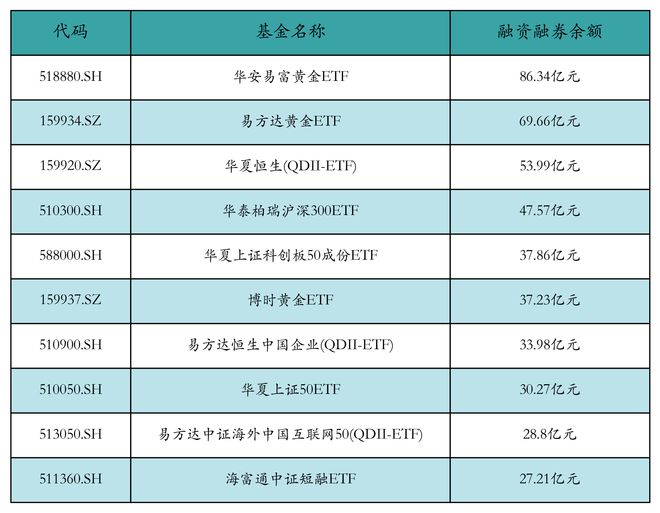
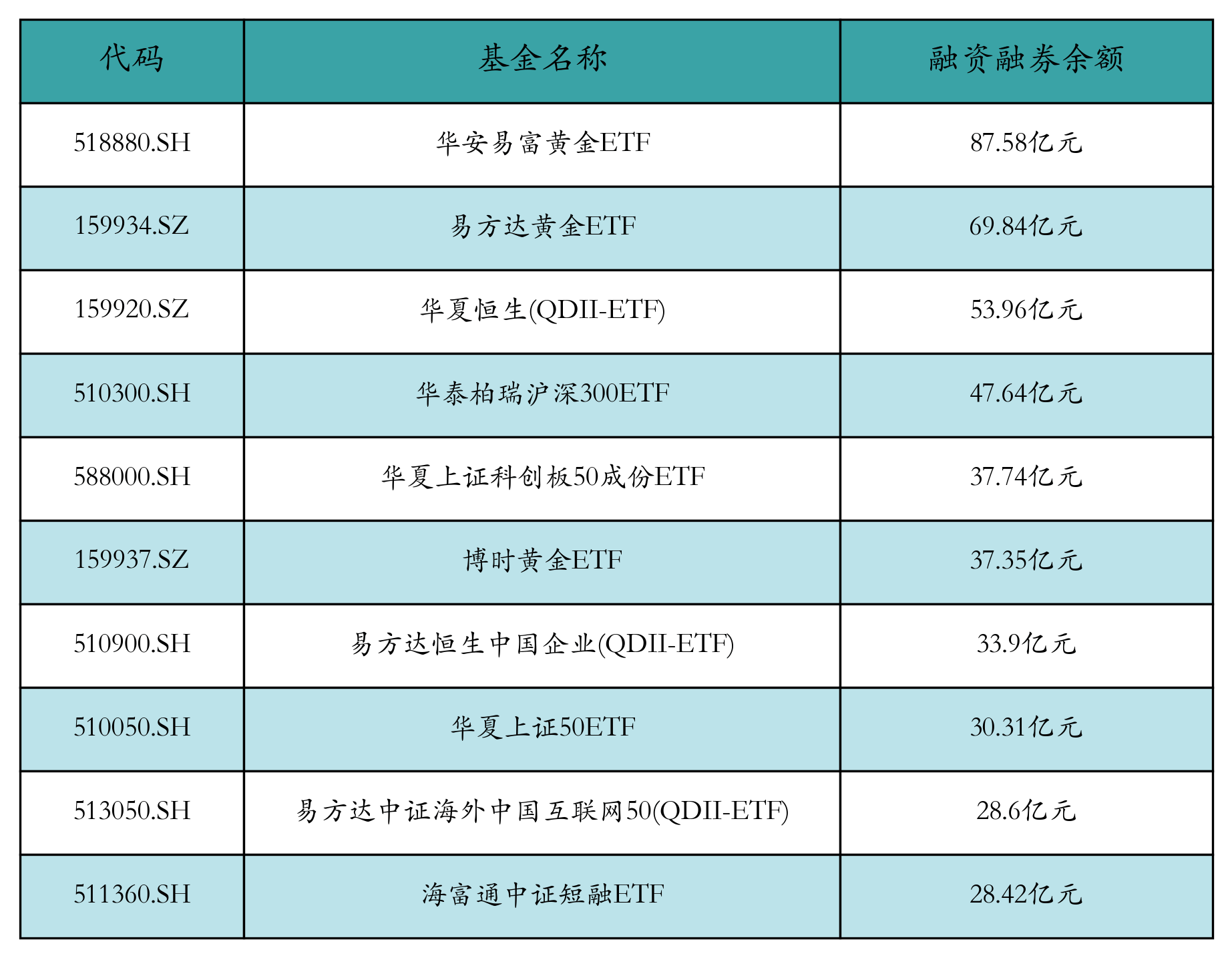
Market Overview - As of May 16, the total ETF margin balance in the two markets is 100.267 billion yuan, a decrease of 0.0526 billion yuan from the previous trading day [1] - The financing balance is 95.31 billion yuan, down by 0.0529 billion yuan, while the securities lending balance is 4.956 billion yuan, an increase of 3.6604 million yuan [1] - In the Shanghai market, the ETF margin balance is 65.902 billion yuan, a decrease of 0.0301 billion yuan, with a financing balance of 61.641 billion yuan, down by 0.0285 billion yuan [1] - In the Shenzhen market, the ETF margin balance is 34.364 billion yuan, a decrease of 0.0224 billion yuan, with a financing balance of 33.669 billion yuan, down by 0.0244 billion yuan [1] ETF Margin Balance - The top three ETFs by margin balance on May 16 are: - Huaan Yifu Gold ETF (8.634 billion yuan) - E Fund Gold ETF (6.966 billion yuan) - Huaxia Hang Seng (QDII-ETF) (5.399 billion yuan) [2] - The top ten ETFs by margin balance include: - Huatai-PB CSI 300 ETF (4.757 billion yuan) - Huaxia Shanghai Stock Exchange Science and Technology Innovation Board 50 ETF (3.786 billion yuan) - Bosera Gold ETF (3.723 billion yuan) [2] ETF Financing Buy Amount - The top three ETFs by financing buy amount on May 16 are: - Haifutong CSI Short Bond ETF (845 million yuan) - Huatai-PB Southern East England Hang Seng Technology Index (QDII-ETF) (679 million yuan) - Huaxia Hang Seng Technology (QDII-ETF) (561 million yuan) [3][4] ETF Financing Net Buy Amount - The top three ETFs by financing net buy amount on May 16 are: - GF Nasdaq 100 (QDII-ETF) (81.5318 million yuan) - Huatai-PB Southern East England Hang Seng Technology Index (QDII-ETF) (42.5431 million yuan) - E Fund Hong Kong Securities Investment Theme ETF (36.2626 million yuan) [5][6] ETF Securities Lending Sell Amount - The top three ETFs by securities lending sell amount on May 16 are: - Southern CSI 1000 ETF (56.9146 million yuan) - Huaxia CSI 1000 ETF (20.2667 million yuan) - Huatai-PB CSI 300 ETF (11.9076 million yuan) [7][8]

东方因子周报:Growth风格登顶,单季ROE因子表现出色-20250518
Orient Securities· 2025-05-18 14:43
Quantitative Factors and Construction Methods - **Factor Name**: Single-quarter ROE **Construction Idea**: This factor measures the return on equity (ROE) for a single quarter, reflecting the profitability of a company relative to its equity base[2][18] **Construction Process**: The formula for single-quarter ROE is: $ Quart\_ROE = \frac{Net\ Income \times 2}{Beginning\ Equity + Ending\ Equity} $ Here, "Net Income" represents the net profit for the quarter, and "Beginning Equity" and "Ending Equity" are the equity values at the start and end of the quarter, respectively[18] **Evaluation**: This factor performed well in the CSI All Share Index space during the past week, indicating its effectiveness in identifying profitable stocks[2][42] - **Factor Name**: Single-quarter ROA **Construction Idea**: This factor evaluates the return on assets (ROA) for a single quarter, assessing how efficiently a company utilizes its assets to generate profits[18] **Construction Process**: The formula for single-quarter ROA is: $ Quart\_ROA = \frac{Net\ Income \times 2}{Beginning\ Assets + Ending\ Assets} $ "Net Income" is the quarterly net profit, while "Beginning Assets" and "Ending Assets" are the total assets at the start and end of the quarter, respectively[18] **Evaluation**: This factor also demonstrated strong performance in the CSI All Share Index space over the past week, highlighting its utility in asset efficiency analysis[2][42] - **Factor Name**: Standardized Unexpected Earnings (SUE) **Construction Idea**: This factor captures the deviation of actual earnings from expected earnings, standardized by the standard deviation of expected earnings, to measure earnings surprises[18] **Construction Process**: The formula for SUE is: $ SUE = \frac{Actual\ Earnings - Expected\ Earnings}{Standard\ Deviation\ of\ Expected\ Earnings} $ "Actual Earnings" refers to the reported earnings, while "Expected Earnings" and their standard deviation are derived from analyst forecasts[18] **Evaluation**: This factor showed significant positive performance in the National SME Index (CSI 2000) and the ChiNext Index spaces, indicating its effectiveness in identifying earnings surprises[36][39] Factor Backtesting Results - **Single-quarter ROE**: - CSI All Share Index: Weekly return of 1.46%, monthly return of 1.95%, annualized return over the past year of -1.73%, and historical annualized return of 4.88%[42][43] - **Single-quarter ROA**: - CSI All Share Index: Weekly return of 1.09%, monthly return of 1.33%, annualized return over the past year of 0.27%, and historical annualized return of 4.14%[42][43] - **Standardized Unexpected Earnings (SUE)**: - National SME Index (CSI 2000): Weekly return of 6.41%, monthly return of 19.22%, annualized return over the past year of 32.33%, and historical annualized return of 10.98%[36] - ChiNext Index: Weekly return of 7.76%, monthly return of 26.34%, annualized return over the past year of 44.74%, and historical annualized return of 7.82%[39] Composite Factor Portfolio Construction - **MFE Portfolio Construction**: **Idea**: The Maximized Factor Exposure (MFE) portfolio is designed to maximize the exposure to a single factor while controlling for constraints such as industry and style exposures, stock weight deviations, and turnover[55][59] **Optimization Model**: The optimization problem is formulated as: $ \begin{array}{ll} max & f^{T}w \\ s.t. & s_{l} \leq X(w-w_{b}) \leq s_{h} \\ & h_{l} \leq H(w-w_{b}) \leq h_{h} \\ & w_{l} \leq w-w_{b} \leq w_{h} \\ & b_{l} \leq B_{b}w \leq b_{h} \\ & 0 \leq w \leq l \\ & 1^{T}w = 1 \\ & \Sigma|w-w_{0}| \leq to_{h} \end{array} $ Here, $f$ represents the factor values, $w$ is the weight vector, and the constraints include style, industry, stock weight, and turnover limits[55][58] **Evaluation**: The MFE portfolio approach ensures that factor effectiveness is tested under realistic constraints, making it a robust method for evaluating factor performance[55][59] MFE Portfolio Backtesting Results - **CSI 300 Index**: - Weekly excess return: Maximum 1.05%, minimum -0.81%, median 0.00%[46][49] - Monthly excess return: Maximum 3.00%, minimum -1.15%, median 0.30%[46][49] - **CSI 500 Index**: - Weekly excess return: Maximum 1.00%, minimum -0.08%, median 0.40%[50][52] - Monthly excess return: Maximum 2.73%, minimum -0.42%, median 0.99%[50][52] - **CSI 1000 Index**: - Weekly excess return: Maximum 0.82%, minimum -0.26%, median 0.28%[53][54] - Monthly excess return: Maximum 3.52%, minimum -0.08%, median 1.72%[53][54]
量化基金周度跟踪(20250512-20250516):A股表现分化,量化基金整体收涨、超额回升-20250517
CMS· 2025-05-17 14:43
Report Industry Investment Rating No relevant content provided. Core View of the Report From May 12th to May 16th, 2025, the A-share market showed divergence, while quantitative funds as a whole recorded gains and their excess returns rebounded. The main stock indices also showed divergence, with the one-week returns of CSI 300, CSI 500, and CSI 1000 being 1.12%, -0.10%, and -0.23% respectively. All types of quantitative funds had positive average returns this week, with active quantitative funds rising 0.60% and market-neutral funds rising 0.11%. The excess returns of index-enhanced funds rebounded, and the average excess returns of CSI 500 index-enhanced and CSI 1000 index-enhanced funds were relatively high, at 0.40% and 0.26% respectively [2][6][8]. Summary by Relevant Catalog 1. Performance of Major Indices and Quantitative Funds in the Past Week - The A-share market showed divergence, and quantitative funds as a whole recorded gains and their excess returns rebounded. The one-week returns of CSI 300, CSI 500, and CSI 1000 were 1.12%, -0.10%, and -0.23% respectively [6]. - All types of quantitative funds had positive average returns this week, with active quantitative funds rising 0.60% and market-neutral funds rising 0.11%. The excess returns of index-enhanced funds rebounded, and the average excess returns of CSI 500 index-enhanced and CSI 1000 index-enhanced funds were relatively high, at 0.40% and 0.26% respectively [8]. 2. Performance of Different Types of Public Quantitative Funds - **CSI 300 Index-Enhanced Funds**: The one-week return was 1.16%, the excess return was 0.04%, the maximum drawdown was -1.20%, the excess maximum drawdown was -0.24%, and the excess return dispersion was 0.26% [12]. - **CSI 500 Index-Enhanced Funds**: The one-week return was 0.30%, the excess return was 0.40%, the maximum drawdown was -1.17%, the excess maximum drawdown was -0.14%, and the excess return dispersion was 0.23% [12]. - **CSI 1000 Index-Enhanced Funds**: The one-week return was 0.04%, the excess return was 0.26%, the maximum drawdown was -1.47%, the excess maximum drawdown was -0.26%, and the excess return dispersion was 0.24% [13]. - **Other Index-Enhanced Funds**: The one-week return was 0.53%, the excess return was -0.02%, the maximum drawdown was -1.47%, the excess maximum drawdown was -0.32%, and the excess return dispersion was 0.41% [13]. - **Active Quantitative Funds**: The one-week return was 0.60%, the maximum drawdown was -1.10%, and the return dispersion was 0.63% [14]. - **Market-Neutral Funds**: The one-week return was 0.11%, the maximum drawdown was -0.21%, and the return dispersion was 0.22% [14]. 3. Performance Distribution of Different Types of Public Quantitative Funds - The report shows the six-month performance trends and the one-week and one-year performance distribution of different types of public quantitative funds, with index-enhanced funds showing excess return performance [15]. 4. High-Performing Public Quantitative Funds - **CSI 300 Index-Enhanced High-Performing Funds**: Include funds such as FURONG CSI 300 Index Enhancement and HUAXIA CSI 300 Index Enhancement Strategy ETF [29]. - **CSI 500 Index-Enhanced High-Performing Funds**: Include funds such as PINGAN CSI 500 Index Enhancement and CHANGXIN CSI 500 Index Enhancement [30]. - **CSI 1000 Index-Enhanced High-Performing Funds**: Include funds such as GUOLIANAN CSI 1000 Index Enhancement and TIANHONG CSI 1000 Enhancement Strategy ETF [31]. - **Other Index-Enhanced High-Performing Funds**: Include funds such as ZHAOSHANG CSI 2000 Enhancement Strategy ETF and YONGYING SSE STAR MARKET 100 Index Enhancement [32]. - **Active Quantitative High-Performing Funds**: Include funds such as PINGAN HK STOCK CONNECT DIVIDEND PREFERRED and NUODE NEW ENERGY VEHICLE [33]. - **Market-Neutral High-Performing Funds**: Include funds such as DACHENG ABSOLUTE RETURN and DEBANG QUANTITATIVE HEDGING STRATEGY [34].
创新红利显著 科技成长领域吸金又吸睛
Shang Hai Zheng Quan Bao· 2025-05-16 20:05
Group 1 - Recent fund flows show a shift, with broad-based ETFs experiencing redemptions while technology-themed ETFs attract significant inflows, leading to multiple ETFs reaching historical highs in share volume [1] - As of May 15, 2023, notable net subscriptions include 3.102 billion CNY for Huaxia SSE Sci-Tech Innovation Board 50 ETF, 1.376 billion CNY for Guolian An Semiconductor ETF, and 1.104 billion CNY for Harvest SSE Sci-Tech Innovation Board Chip ETF, among others [2] - Several technology-themed ETFs are expected to expand significantly, with new funds being launched, including E Fund Digital Economy ETF and ICBC Credit Suisse Digital Economy ETF [2][3] Group 2 - Institutions are actively conducting research in the technology sector, with over 3,000 institutional inquiries in the computer software and semiconductor industries, and more than 2,600 in electronic equipment manufacturing [4] - Notable institutions involved in recent research include Xing Shi Investment and Freshwater Spring Investment, focusing on companies like Anji Technology and Weir Shares [4] - Institutions are particularly interested in companies' profitability and global expansion strategies, as seen in inquiries about gross margin improvements and overseas investment plans [4] Group 3 - The technology sector is viewed as a key investment focus for public funds, with multiple fund companies collaborating to launch a series of products, including both active equity funds and passive index funds [3] - The current technological breakthroughs in areas such as large models, smart vehicles, and robotics are attributed to a significant influx of engineering talent in China, marking the beginning of a new cycle of technological innovation [5] - Investment opportunities are anticipated in AI applications, particularly in smart driving, AI-integrated internet giants, AI hardware, and computing power, as the A-share market shows signs of structural opportunities [5]
落袋为安!64亿“跑了”
Zhong Guo Ji Jin Bao· 2025-05-16 07:07
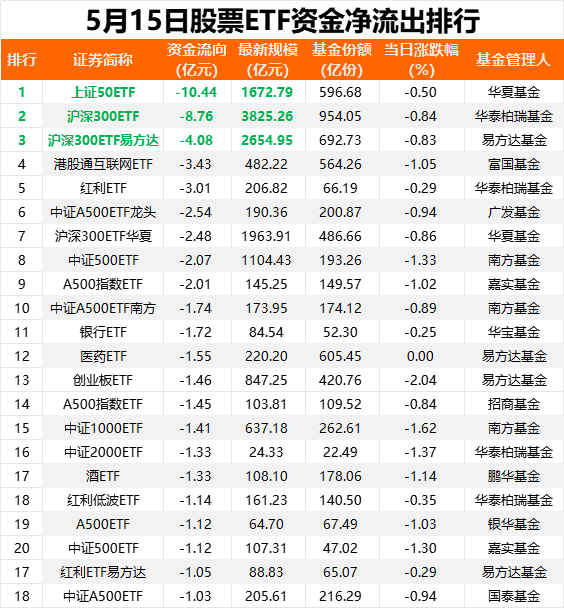
【导读】昨日股票ETF市场净流出资金64亿元,宽基ETF净流出居前 昨日(5月15日),三大股指收跌,当日股票ETF(含跨境ETF,下同)市场净流出资金约64亿元。其 中,宽基ETF净流出居前。 股票ETF单日净流出64亿元 数据显示,截至5月15日,全市场1089只股票ETF总规模达3.54万亿元。当日股票ETF市场总份额减少 41.33亿份,按照成交均价测算,当日净流出资金约为63.74亿元。 细分品类中,宽基ETF净流出居前,净流出53.37亿元。规模变化方面,宽基ETF规模下降296.85亿元。 具体到指数维度,5月15日沪深300指数单日净流出居前,达17.91亿元。 从单只基金看,上证50ETF单日净流出居前,达10.44亿元。沪深300ETF、中证A500ETF龙头等核心宽 基指数ETF均出现一定资金净流出。 业内表示,近期场内资金情绪虽有改善但在多重因素扰动下整体依然偏谨慎,因此一些资金开始对宽基 指数"获利了结"。 | | | | 5月15日股票ETF资金净流出排行 | | | | | --- | --- | --- | --- | --- | --- | --- | | 排行 | 证券简称 ...
ETF基金日报丨科创50、军工等ETF获资金流入居前,机构:深度回调后的成长科技具备较强的布局价值
Sou Hu Cai Jing· 2025-05-16 03:16
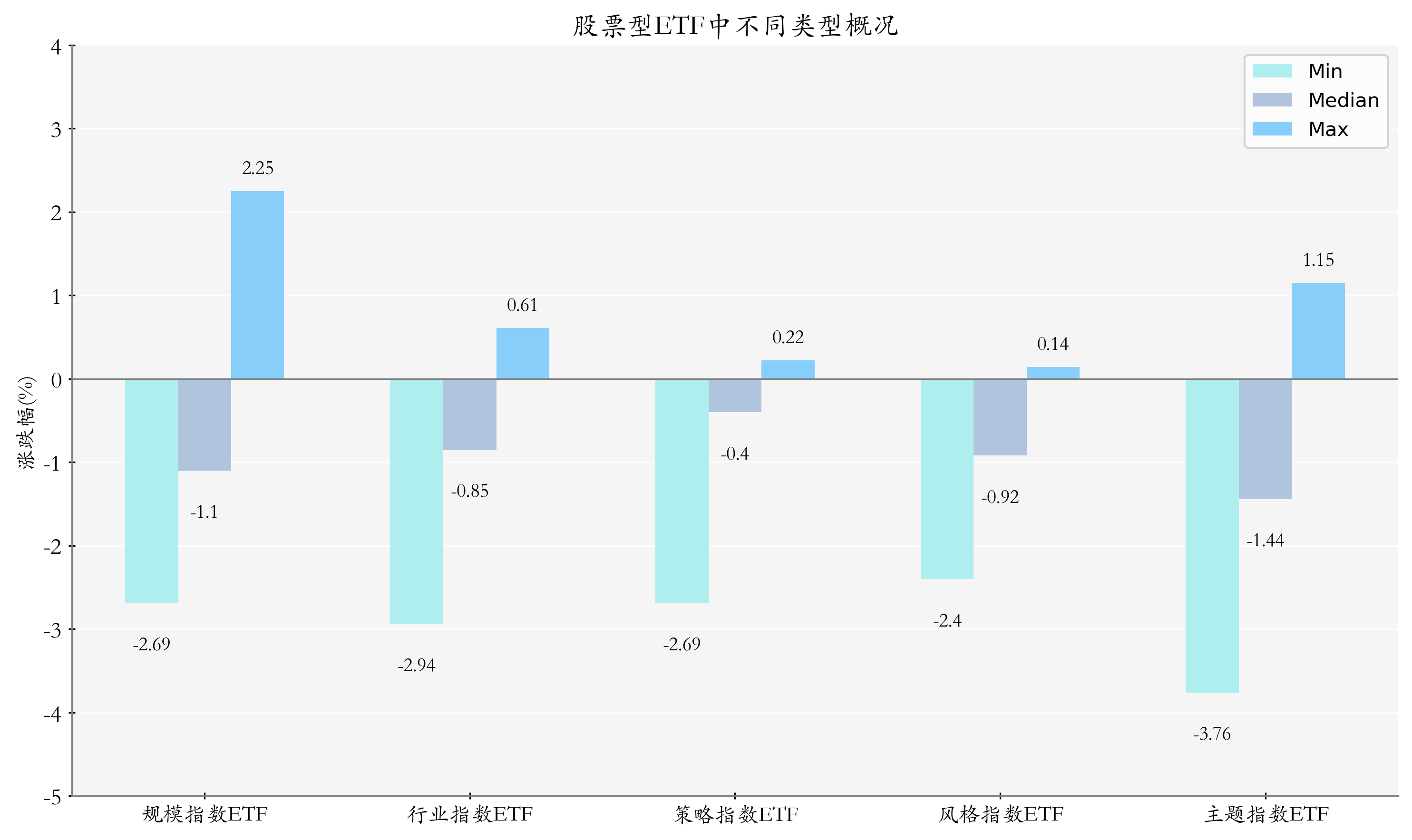
Market Overview - The Shanghai Composite Index fell by 0.68% to close at 3380.82 points, with a high of 3402.87 points during the day [1] - The Shenzhen Component Index decreased by 1.62% to 10186.45 points, reaching a peak of 10324.84 points [1] - The ChiNext Index dropped by 1.92% to 2043.25 points, with a maximum of 2076.04 points [1] ETF Market Performance - The median return of stock ETFs was -1.11% [2] - The top-performing ETFs included: - Fortune Growth Enterprise 50 ETF with a return of 2.25% [2][5] - Ping An China Securities Guangdong-Hong Kong-Macao Greater Bay Area Development Theme ETF with a return of 1.15% [2][5] - Huazhong China Securities Health Care 100 Strategy ETF with a return of 0.72% [5] - The worst-performing ETFs included: - Huabao China Securities Financial Technology Theme ETF with a return of -3.76% [6] - Huaxia China Securities Financial Technology Theme ETF with a return of -3.59% [6] - E-Fonda China Securities Cloud Computing and Big Data Theme ETF with a return of -3.52% [6] ETF Fund Flows - The top three ETFs with the highest inflows were: - Huaxia Shanghai Stock Exchange Science and Technology Innovation Board 50 ETF with an inflow of 455 million yuan [8] - Fortune China Securities Military Industry Leading ETF with an inflow of 296 million yuan [8] - Guolian An China Securities All-Index Semiconductor Products and Equipment ETF with an inflow of 289 million yuan [8] - The top three ETFs with the highest outflows were: - Huatai-PB CSI 300 ETF with an outflow of 876 million yuan [9] - E-Fonda CSI 300 ETF Initiated with an outflow of 408 million yuan [9] - Huatai Shanghai Stock Exchange Dividend ETF with an outflow of 301 million yuan [9] Financing and Securities Lending Overview - The top three ETFs with the highest financing buy amounts were: - Huaxia Shanghai Stock Exchange Science and Technology Innovation Board 50 ETF with a buy amount of 537 million yuan [11] - Guolian An China Securities All-Index Semiconductor Products and Equipment ETF with a buy amount of 217 million yuan [11] - E-Fonda Growth Enterprise ETF with a buy amount of 212 million yuan [11] - The top three ETFs with the highest securities lending sell amounts were: - Southern China Securities 1000 ETF with a sell amount of 37.43 million yuan [13] - Southern China Securities 500 ETF with a sell amount of 28.10 million yuan [13] - Huatai-PB CSI 300 ETF with a sell amount of 17.82 million yuan [13] Institutional Insights - Huazhong Securities highlighted the strong layout value of growth technology after a deep correction, particularly in the electronic, computer, media, and communication sectors [14] - Xiangcai Securities noted that increasing geopolitical uncertainties and escalating conflicts will drive demand for military equipment, benefiting military enterprises, especially in aviation and missile systems [14]
ETF融资融券日报:两市ETF两融余额较前一交易日减少1.86亿元,华安易富黄金ETF融资净买入达1.18亿元
Sou Hu Cai Jing· 2025-05-16 02:42
Market Overview - As of May 15, the total ETF margin balance in the two markets is 100.79 billion, a decrease of 1.86 billion from the previous trading day [1] - The financing balance is 95.84 billion, down by 1.13 billion, while the securities lending balance is 4.95 billion, decreasing by 72.76 million [1] - In the Shanghai market, the ETF margin balance is 66.20 billion, a decrease of 14.58 million, with a financing balance of 61.93 billion, increasing by 44.55 million, and a securities lending balance of 4.28 billion, down by 59.13 million [1] - In the Shenzhen market, the ETF margin balance is 34.59 billion, a decrease of 1.71 billion, with a financing balance of 33.91 billion, decreasing by 1.58 billion, and a securities lending balance of 676 million, down by 13.63 million [1] ETF Margin Financing Balances - The top three ETF margin financing balances as of May 15 are: 1. Huaan Yifu Gold ETF (8.76 billion) 2. E Fund Gold ETF (6.98 billion) 3. Huaxia Hang Seng (QDII-ETF) (5.40 billion) [2] ETF Financing Buy Amounts - The top three ETF financing buy amounts on May 15 are: 1. Hai Fudong Zhong Zheng Short Bond ETF (887 million) 2. Huatai Bairui Southern Dongying Hang Seng Technology Index (QDII-ETF) (714 million) 3. Huaxia Hang Seng Technology (QDII-ETF) (688 million) [4] ETF Financing Net Buy Amounts - The top three ETF financing net buy amounts on May 15 are: 1. Huaan Yifu Gold ETF (118 million) 2. Hai Fudong Zhong Zheng Short Bond ETF (97.51 million) 3. Huaxia Shanghai Stock Exchange Science and Technology Innovation Board 50 Component ETF (62.76 million) [5] ETF Securities Lending Sell Amounts - The top three ETF securities lending sell amounts on May 15 are: 1. Southern Zhong Zheng 1000 ETF (37.43 million) 2. Southern Zhong Zheng 500 ETF (28.10 million) 3. Huatai Bairui Shanghai Shenzhen 300 ETF (17.82 million) [6]
为什么没人愿意认购ETF了?
Sou Hu Cai Jing· 2025-05-15 12:05
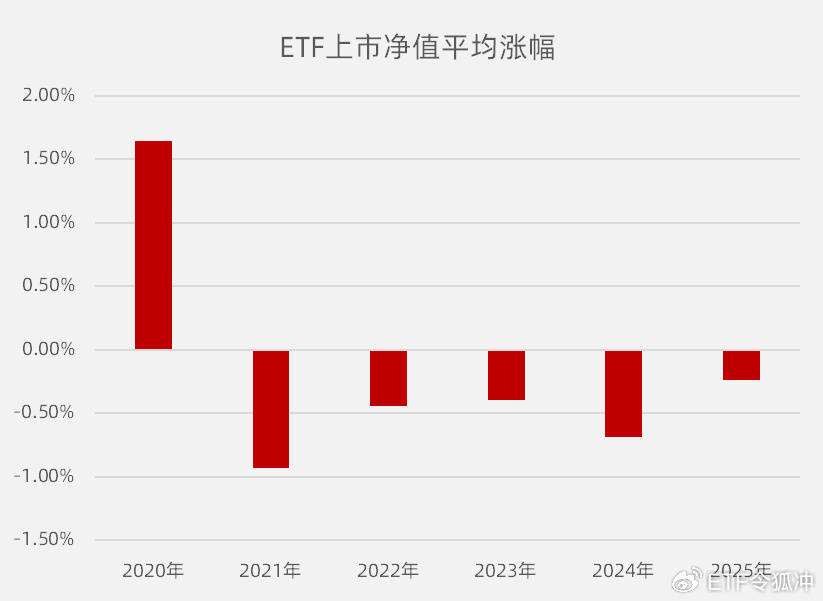
Core Viewpoint - The article discusses the challenges faced by financial institutions in Taiwan and mainland China regarding the practice of "self-funding" to meet ETF sales targets, highlighting the negative returns associated with this practice in recent years [1][2][3]. Group 1: Self-Funding and Negative Returns - The phenomenon of "self-funding" exists across various industries, but negative expected returns in the fund industry are rare [3]. - For example, newly launched stock ETFs in 2020 had an average net value increase of approximately 1.5% from establishment to listing, allowing managers to lock in profits through market transactions [5]. - However, by 2021, self-funding behavior began to yield negative returns, with an average net value performance of -1% for self-funded ETF subscriptions [6]. - In some cases, such as a specific startup board ETF, losses could exceed 10% by the time of listing [8]. Group 2: Accelerated Construction Periods - The article notes that the construction period for ETFs has significantly decreased, from an average of 28 days in 2020 to just 11 days by 2025 [12]. - This rapid construction leaves fund managers with limited opportunities for market timing, leading to a mechanical approach to building positions [13][19]. - The average construction time for ETFs has remained under 15 days from 2021 to 2025, making it challenging for managers to find suitable entry points [18]. Group 3: Successful Timing by Fund Managers - Data shows that certain fund managers have successfully timed their ETF launches, resulting in significant profits for initial investors [20]. - For instance, the "Chip ETF Leader" managed by GF Fund earned nearly 386 million yuan for its initial subscribers [21]. - The timing of these successful launches often coincided with favorable market conditions, such as the semiconductor industry's growth during the trade war [23]. Group 4: Investor Experience and Fund Management - The article emphasizes that while ETF products are primarily tools for market participation, the experience of initial investors is crucial [28]. - It suggests that fund managers should consider the timing of product issuance and the length of the construction period to enhance investor returns [29].
515投资者保护日 | 火爆出圈!国联安基金荣获2025年度投教项目优秀实践奖
Xin Lang Ji Jin· 2025-05-15 06:20
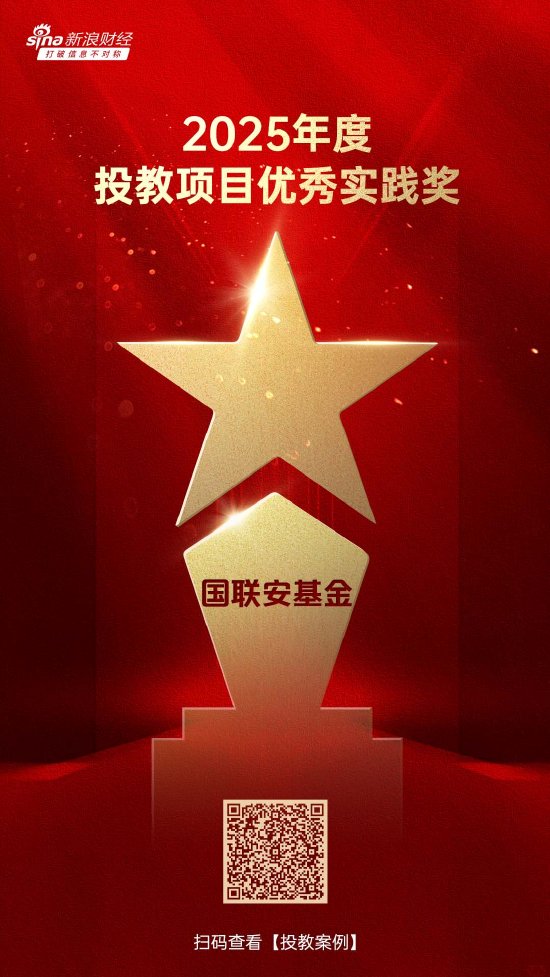
专题:515投资者保护!新浪财经2025年度投教案例评选结果公布 5月15日,新浪财经2025年度基金投教案例评选结果正式揭晓!国联安基金"60秒投教碎碎念"荣获"2025 年度投教项目优秀实践奖"。 MACD金叉信号形成,这些股涨势不错! 责任编辑:彭紫晨 特色上,通过倒计时式"干货时刻",用直白语言拆解专业逻辑,帮助观众快速捕捉关键知识点。栏目在 内容规划上摒弃术语堆砌,始终以投资者视角切入,聚焦"回本焦虑""止损决策"等常见的投资痛点,将 复杂理论原创为"身边人"的经验分享,形成"非说教式"的知识传递。自上线以来,栏目凭借差异化的定 位获得市场良好反响,单期视频最高播放量达12万次。 以其中流量较高的一期为例,聚焦在"基金回本焦虑",指出市场波动、非理性决策是亏损主因,倡导通 过理性审视沉没成本、灵活调整配置、坚守投资纪律缓解焦虑,强调定投策略与长期视角的重要性,帮 助投资者摆脱短期情绪干扰,回归价值投资本质。再如以债市"日历效应"为主题的一期,通过解析市场 周期规律,结合经济政策与历史数据,揭示年末行情驱动逻辑,提示投资者需以史为鉴不盲从,注重动 态分析与风险分散。 未来,国联安基金表示,栏目将继续拓 ...
ETF融资融券日报:两市ETF两融余额较前一交易日增加1.27亿元,易方达创业板ETF融资净买入达1.22亿元
2 1 Shi Ji Jing Ji Bao Dao· 2025-05-15 03:20
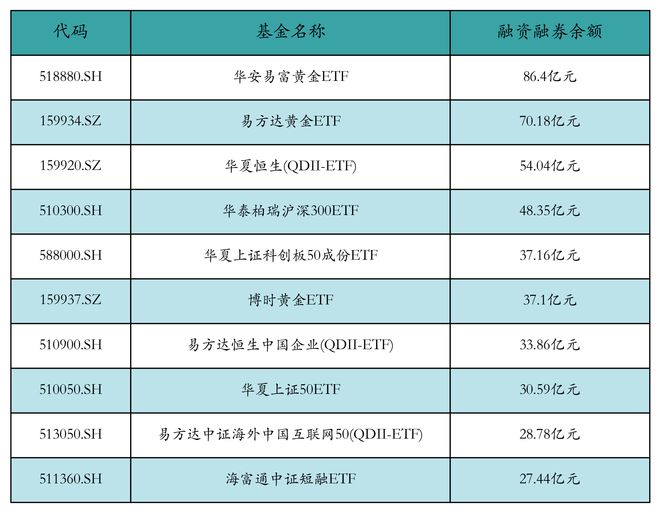
5月14日ETF两融余额前三位分别为:华安易富黄金ETF(86.4亿元)、易方达黄金ETF(70.18亿元)和华夏 恒生(QDII-ETF)(54.04亿元),前10具体见下表: | 代码 | 基金名称 | 融资融券余额 | | --- | --- | --- | | 518880.SH | 华安易富黄金ETF | 86.4亿元 | | 159934.SZ | 易方达黄金ETF | 70.18亿元 | | 159920.SZ | 华夏恒生(QDII-ETF) | 54.04亿元 | | 510300.SH | 华泰柏瑞沪深300ETF | 48.35亿元 | | 588000.SH | 华夏上证科创板50成份ETF | 37.16亿元 | | 159937.SZ | 博时黄金ETF | 37.1亿元 | | 510900.SH | 易方达恒生中国企业(QDII-ETF) | 33.86亿元 | | 510050.SH | 华夏上证50ETF | 30.59亿元 | | 513050.SH | 易方达中证海外中国互联网50(QDII-ETF) | 28.78亿元 | | 511360.SH | 海富通中证短融E ...