中国太平

Search documents
人工智能如何重塑再保险行业? 访太平再保险(中国)有限公司党委书记、总经理李立松
Jin Rong Shi Bao· 2025-11-12 13:17
Core Viewpoint - The introduction of the AI agent "Rui Shu" by Taiping Reinsurance (China) is a strategic move to enhance the competitiveness of the reinsurance industry and better serve the real economy, aligning with national policies on AI application in finance [1][2]. Group 1: AI Integration in Reinsurance - The development of "Rui Shu" aims to address industry challenges by integrating AI models with professional expertise, achieving over 90% accuracy in generating high-quality reinsurance contracts exceeding 100,000 tokens [2]. - AI is seen as a strategic necessity for the company, enhancing both internal efficiency and external service innovation, which are core competitive advantages in financial services [2][3]. - The reinsurance sector's unique characteristics, such as high professional barriers and compliance requirements, make traditional automation difficult, highlighting the need for AI to overcome efficiency bottlenecks [1][3]. Group 2: Challenges and Solutions - The reinsurance industry faces common challenges in AI integration, including the complexity of professional knowledge, compliance and risk management, talent development, and organizational restructuring [5][6]. - AI's application in reinsurance requires a careful balance between innovation and risk assessment, particularly in understanding which business areas are suitable for AI deployment [5]. - The company emphasizes the importance of building an open, collaborative, and healthy AI ecosystem within the industry, focusing on the systematic collection and definition of professional knowledge [6][7]. Group 3: Future Directions - The company plans to deepen its "AI+" strategy, aiming to enhance service levels, operational efficiency, innovation capabilities, and risk management through intelligent transformation [4]. - The introduction of AI functionalities into traditional tools, such as the global natural disaster risk analysis platform, demonstrates the commitment to integrating AI into existing processes for improved performance [4]. - The company recognizes the need for ongoing collaboration with industry peers and regulatory bodies to foster a robust AI ecosystem that supports sustainable growth and innovation [7].

中国平安,阶段新高
Di Yi Cai Jing Zi Xun· 2025-11-12 02:56
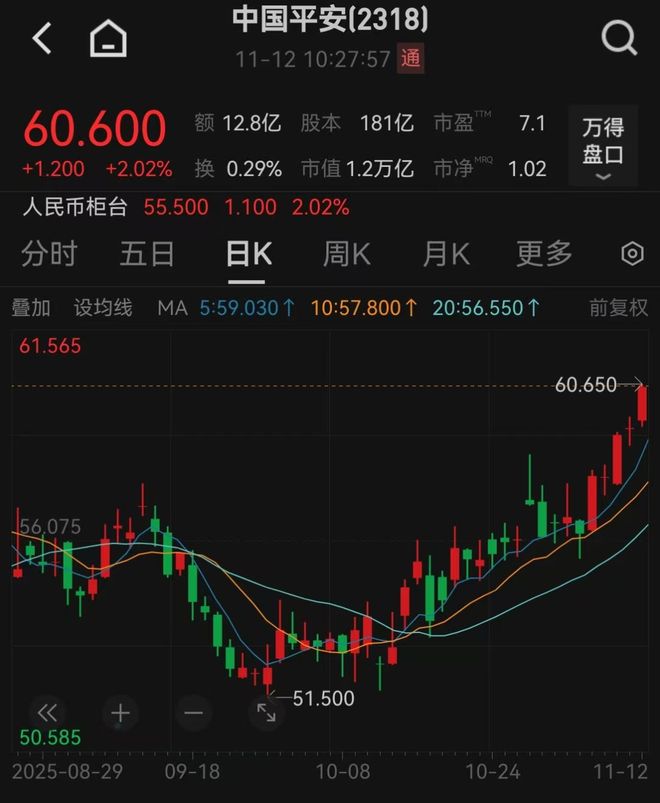
编辑丨瑜见 | < ロ | Wind香港保险(887185) 19034.04 459.37 2.47% | | Q | | --- | --- | --- | --- | | 资料 | 成分 资讯 | 相关基金 | 月度收益 | | 名称 | | 现价 | 涨跌幅 == | | 中国人寿 2628.HK | | 27.580 | 4.08% | | 新华保险 1336.HK | | 52.600 | 4.06% | | 中国大平 0966.HK | | 19.950 | 3.80% | | 中国大保 | | 34.200 | 3.45% | | 2601.HK | | | | | 中国再保险 | | 1.650 | 3.12% | | 1508.HK | | | | | 友邦保险 | | 84.400 | 2.49% | | 1299.HK | | | | 11月12日,中国平安AH股盘初拉升,截至发稿, 港股股价突破60港元/股,创2021年8月以来新高。 与此同时,港股保险股走强,中国人寿、新华保险涨超4%,中国太平、中国太保等涨超3%。 ...


中国平安,阶段新高
第一财经· 2025-11-12 02:48
11月12日,中国平安AH股盘初拉升,截至发稿, 港股股价突破60港元/股, 创2021年8月以来新高。 与此同时,港股保险股走强, 中国人寿、新华保险涨超4%, 中国太平、中国太保等涨超3%。 | く ロ | Wind香港保险(887185) | Q | | --- | --- | --- | | | 19034.04 459.37 2.47% | | | 资料 | 成分 相关基金 | 月度收益 | | 名称 | 现价 | 涨跌幅一 | | 中国人寿 | 27.580 | 4.08% | | 2628.HK | | | | 新华保险 | 52.600 | 4.06% | | 1336.HK | | | | 中国太平 | 19.950 | 3.80% | | 0966.HK | | | | 中国太保 | 34.200 | 3.45% | | 2601.HK | | | | 中国再保险 | 1.650 | 3.12% | | 1508.HK | | | | 友邦保险 | 84.400 | 2.49% | | 1299.HK | | | 编辑丨瑜见 ...

保险业:锚定发展目标 助力共同富裕
Jin Rong Shi Bao· 2025-11-12 02:29
Group 1: Core Insights - The insurance industry plays a crucial role in supporting the goal of "common prosperity" by contributing to economic growth and wealth distribution [1][2][3] - The second Fourming Insurance Forum emphasized the need for the insurance sector to find a balance between expanding the economy ("making the cake bigger") and ensuring equitable distribution of wealth ("dividing the cake well") [1][2] Group 2: Industry Development - Ningbo has launched nearly 350 innovative insurance projects, integrating insurance deeply into economic construction, social governance, and public welfare [2] - The insurance sector in Zhejiang Province reported an asset value of 1.2 trillion yuan, a year-on-year increase of 14.5%, with premium income reaching 389.2 billion yuan [2] Group 3: Key Focus Areas - The China Insurance Group highlighted three key areas for the insurance industry: supporting innovation and entrepreneurship, ensuring fair distribution and improving livelihoods, and enhancing economic resilience [3] - Long-term care insurance has emerged as a focal point in addressing the challenges of an aging population, with calls for a statutory long-term care insurance system [4][5] Group 4: Financial Integration and Social Governance - The insurance industry has a significant role in financial integration, with an investment balance of 36.23 trillion yuan as of mid-2023, including over 5.4 trillion yuan in stocks and equity funds [7] - Commercial insurance is essential in various sectors such as healthcare, pension, disaster reduction, and poverty alleviation, contributing to the reduction of public service gaps [7][8]
中国太平(00966.HK)深度研究报告:兼具弹性 转型头雁估值修复可期
Ge Long Hui· 2025-11-11 12:47
Core Viewpoint - China Taiping is transforming into a dividend insurance leader, focusing on high-quality development and leveraging its strong capital structure to enhance profitability and growth potential [1][3]. Group 1: Life Insurance - The company is leading the transformation towards dividend insurance, with a continuous release of CSM (Contractual Service Margin) profits [1]. - In 2023, new business value (NBV) is recovering, although growth rates are fluctuating due to policy impacts; the new business value rate is second only to Ping An in the industry [1]. - The distribution channel is primarily agent-based, with ongoing reforms leading to improved performance; the bancassurance channel is optimizing both volume and price, driven by network expansion and enhanced policy quality [1]. - The premium structure remains dominated by traditional insurance, but dividend insurance accounts for 87.1% of first-year premiums, significantly higher than peers, indicating a positive shift in cost structure [1]. Group 2: Property Insurance - The property insurance business is mainly concentrated domestically, accounting for 86% of total operations, with steady growth driven by auto and non-water insurance [2]. - Domestic combined operating ratio (COR) is improving, gradually narrowing the gap with the top three players in the property insurance sector [2]. - Internationally, the property insurance segment, primarily in Hong Kong and Macau, is experiencing slower growth, with noticeable COR fluctuations [2]. - Reinsurance business has seen a reduction in scale this year, but the central COR has improved significantly [2]. Group 3: Asset Management - The asset management segment is experiencing steady growth, primarily driven by insurance premium inflows, with total managed assets exceeding HKD 2.65 trillion by mid-2025 [2]. - Net investment returns are declining due to interest rate impacts, with total investment returns showing significant volatility [2]. - The allocation structure is increasingly favoring bonds, maintaining a leading position compared to listed peers; equity allocation is also rising, placing the company at the median level within the industry [2]. Group 4: Investment Recommendations - The company's push for dividend insurance transformation is expected to reduce rigid costs from existing policies, alleviating pressure from declining interest rate spreads [3]. - The capital market's improved activity since last year presents opportunities for the company to capitalize on equity asset allocations, potentially leading to excess returns [3]. - The company is primarily focused on life insurance, with a projected PEV (Price-Embedded Value) valuation method indicating an expected target price of HKD 22.6, with a recommendation rating of "Buy" [3].
中金:25Q3险企NBV延续高增速 向后看负债端对股价影响或增强
Zhi Tong Cai Jing· 2025-11-11 07:50
Group 1 - The core viewpoint is that the new business value (NBV) of Chinese life insurance companies continues to show high growth, with optimistic outlooks for the liability side [2][1] - In 9M25, the NBV growth rates for major life insurance companies are as follows: China Life +76.6%, Ping An +46.2%, China Life +41.8%, and Taiping +31.2% [2][1] - The first-year premium value rates for Ping An and Taiping increased by 7.6 percentage points and 1.7 percentage points to 25.2% and 18.0%, respectively [2][1] Group 2 - The comprehensive cost ratio (CoR) for property insurance companies is improving, with the following year-on-year changes: China Property -2.1 percentage points to 96.1%, Ping An Property -0.8 percentage points to 97.0%, and Taiping Property -1.1 percentage points to 97.6% [3][1] - Regulatory measures have led to improvements in the quality and efficiency of auto insurance, and the current focus on non-auto insurance governance is expected to enhance profitability for leading property insurance companies [3][1] Group 3 - Net profits are experiencing significant growth, driven by strong stock market performance, with annualized total investment returns for China Life and Xinhua increasing by 1.0 and 1.8 percentage points to 6.4% and 8.6%, respectively [4][1] - Taiping and China Property's non-annualized total investment returns increased by 0.5 and 0.8 percentage points to 5.2% and 5.4%, while Ping An's non-annualized comprehensive investment return rose by 1.0 percentage point to 5.4% [4][1] Group 4 - The impact of the liability side on stock prices may increase, as the high investment return-driven market may be nearing its end, leading to a higher probability of weakened asset-side elasticity [5][1] - The focus should be on optimizing liability product structures, reducing costs, and highlighting growth trends in quality life insurance [5][1] - The industry ranking remains as follows: Ping An (601318.SH), China Taiping (00966), China Taiping (601601.SH), China Life (02628), and China Property (601319) [5][1]



资负两端全面开花,估值低位攻守兼备 - 保险行业2026年度投资策略
2025-11-11 01:01
Summary of Insurance Industry Conference Call Industry Overview - The insurance industry is experiencing significant profit growth, with overall profit growth exceeding 30% in the first three quarters of 2025, and quarterly growth approaching 70% [1][5] - The industry is shifting focus from premium income to investment returns, emphasizing the importance of positive returns from premiums rather than just the total premium volume [1][10] Key Financial Metrics - Insurance companies' return on equity (ROE) has surpassed 30% for some A-share listed companies, significantly higher than the approximately 10% ROE of leading brokerage firms [5] - The non-annualized comprehensive investment return rate for the first three quarters of 2025 is approximately 5.4%, a year-on-year increase of 1 percentage point [4][14] Premium Income and Growth - Premium income is expected to continue double-digit growth, projected to reach between 4.45 trillion to 4.6 trillion yuan in 2025, up from around 4 trillion yuan the previous year [1][7] - New business value (NBV) is also showing high growth, with some companies like China Life and Ping An seeing significant increases in new single premium income [7] Investment Strategies - As of mid-2025, the insurance industry's investment asset scale is approximately 36 trillion yuan, reflecting a growth of about 9% since the beginning of the year [11] - The proportion of bond investments has risen to over 50%, while equity assets remain stable at around 12% to 13% [12] Dividend Policies - Companies are expected to announce significant increases in dividends for the 2025 fiscal year, reflecting strong profit performance despite previous volatility in profit due to new accounting standards [6][21] Channel Development - The bank insurance channel is gaining prominence, with its new business value share increasing significantly, while the number of individual insurance agents is declining [9][20] - The bank insurance channel's premium share is expected to surpass that of individual insurance channels soon [20] Future Outlook - The outlook for the insurance industry in 2026 is optimistic, with expectations of continued growth in premium income, particularly from the bank insurance channel [22] - The market is advised to focus on profit growth rather than just valuation levels when selecting investment targets [22][27] Regulatory Changes - The transition to new accounting standards from 2023 to 2025 is a significant factor, with full implementation expected in 2026, which poses challenges for companies, especially smaller ones [13] Investment Opportunities - The insurance sector remains an attractive investment option, with a recommendation to focus on companies with strong profit growth and stable dividend policies [27] Miscellaneous Insights - The demand for savings-type products remains strong despite declining household incomes, as these products are more closely related to household wealth rather than income levels [8] - The insurance industry is increasingly viewed as a potential asset management company, focusing on improving asset management capabilities in a low-interest-rate environment [19]
中国太平(00966):深度研究报告:兼具弹性,转型头雁估值修复可期
Huachuang Securities· 2025-11-10 08:40
Investment Rating - The report assigns a "Buy" rating for China Taiping (00966.HK) with a target price of HKD 22.6 [1][6][9] Core Views - China Taiping is positioned as a leader in the transformation towards participating insurance, with a strong potential for valuation recovery. The company is actively pushing for this transformation, which is expected to reduce rigid costs from new policies and alleviate the pressure from declining interest rates [8][9][10] Financial Performance - The projected insurance service revenue for 2024 is HKD 22,024 million, with a year-on-year growth of 18.8%. The net profit attributable to shareholders is expected to reach HKD 8,432 million, reflecting a significant year-on-year increase of 36.2% [2][3] - The earnings per share (EPS) for 2024 is forecasted at HKD 2.35, with a price-to-earnings (P/E) ratio of 7.8 [2][3] Business Segments Life Insurance - China Taiping's life insurance segment is a key driver, contributing approximately 80% of the net profit. The new business value (NBV) has started to recover in 2023, with a year-on-year increase of 23% to HKD 6.8 billion in 2025H1 [6][32] - The company has a robust channel structure, primarily through individual agents, with a significant shift towards participating insurance, which accounted for 29% of the new business in 2025H1 [32][52] Property and Casualty Insurance - The domestic property and casualty insurance business is gradually improving, with a combined ratio (COR) of 95.5% in 2025H1, indicating a year-on-year improvement [59][60] - The overseas property and casualty insurance segment, primarily in Hong Kong and Macau, has shown slower growth, contributing 14% to the overall property and casualty business [67] Asset Management - The asset management segment has seen steady growth, with total managed assets exceeding HKD 2.65 trillion as of 2025H1. The investment performance has been influenced by interest rates, with a focus on equity allocations expected to yield strong beta opportunities [6][9][10] Valuation and Estimates - The report utilizes the Present Value of Embedded Value (PEV) method for valuation, predicting an embedded value per share (EVPS) of HKD 56, 64.6, and 74.1 for 2025, 2026, and 2027 respectively. The current dynamic PEV is estimated at 0.33x for 2025 and 0.28x for 2026, with a target PEV of 0.35x for 2026 [9][10]
2025年中国UBI车险行业定义、产业链、市场规模、竞争格局及趋势研判:车联网技术赋能保险创新,UBI车险市场前景广阔[图]
Chan Ye Xin Xi Wang· 2025-11-10 00:59
Core Insights - The UBI auto insurance industry in China is experiencing steady growth driven by both policy support and market demand for fair pricing and personalized services [1][10] - The market size is projected to grow from 10.238 billion yuan in 2021 to 13.249 billion yuan in 2024, with a compound annual growth rate (CAGR) of 8.97% [1][10] - By 2025, the market size is expected to reach 14.322 billion yuan, indicating UBI's role in optimizing the auto insurance market structure and upgrading services [1][10] Industry Overview - UBI auto insurance is defined as insurance based on driving behavior, utilizing connected devices to analyze driver habits, vehicle information, and environmental data for pricing [3][8] - The industry has evolved from basic mileage-based pricing to a comprehensive smart protection system that includes driving behavior analysis and real-time risk warnings [1][10] Market Dynamics - The Chinese government has implemented various policies to stimulate the automotive market, including tax exemptions and subsidies for new energy vehicles, which have increased car ownership from 172 million in 2015 to 353 million in 2024, with a CAGR of 8.32% [8][10] - The shift from traditional insurance pricing models to UBI products reflects the need for more accurate risk assessment based on actual driving behavior [8][10] Industry Chain - The UBI insurance industry chain includes hardware suppliers (sensors, OBD devices, GPS modules), traditional and internet insurance companies, and technology firms providing end-to-end solutions [8][9] - Sales channels have shifted towards online platforms, enhancing user experience with features like instant claims and accident detection [8][9] Competitive Landscape - The global UBI insurance market is dominated by major North American and European insurers, while Chinese companies like China Life, Ping An, and China Pacific Insurance are actively entering the UBI space [10][11] - The competitive landscape is characterized by three tiers: leading global insurers, large domestic firms, and numerous regional and emerging tech companies [10][11] Future Trends - The UBI industry is expected to undergo significant transformations, including multi-dimensional changes in technology, service models shifting towards platform ecosystems, and product innovations focusing on personalization and social engagement [14][15] - The integration of advanced data collection methods and real-time pricing models will enhance risk assessment and customer experience [14][15]


非银周报:保险非车险报行合一细则落地,利好大型险企盈利能力与市占率提升-20251109
SINOLINK SECURITIES· 2025-11-09 12:28
Investment Rating - The report suggests a focus on two main lines: (1) Listed securities firms with better-than-expected Q3 performance and (2) multi-financial companies with impressive growth rates, particularly recommending Hong Kong Exchanges and Clearing [2] Core Insights - The average daily trading volume of A-shares in 2025 from January to October reached 2.02 trillion yuan, a year-on-year increase of 92% [1] - The margin trading balance continues to grow, with financing and securities lending balances as of November 6 being 248.05 billion yuan and 183 billion yuan, respectively, marking increases of 33.8% and 75.3% compared to the end of last year [1] - The insurance sector saw a cumulative original premium income of 5.21 trillion yuan in the first nine months of 2025, reflecting a year-on-year growth of 8.8% [36] Summary by Sections Securities Sector - The average daily margin trading balance in 2025 is projected to be 1.999 trillion yuan, a year-on-year increase of 32% [1] - New account openings in October decreased significantly, with 2.31 million new accounts opened, a 66% drop compared to October last year [35] Insurance Sector - The introduction of unified reporting guidelines for non-auto insurance is expected to enhance the profitability and market share of large insurance companies [3] - The report anticipates a double-digit growth in new premium income for the insurance sector in 2026, driven by strong investment performance in 2025 [4] - The insurance asset management sector has seen a 25.1% year-on-year increase in the registration scale of asset-backed securities (ABS) in the first three quarters of 2025 [40]