分众传媒

Search documents
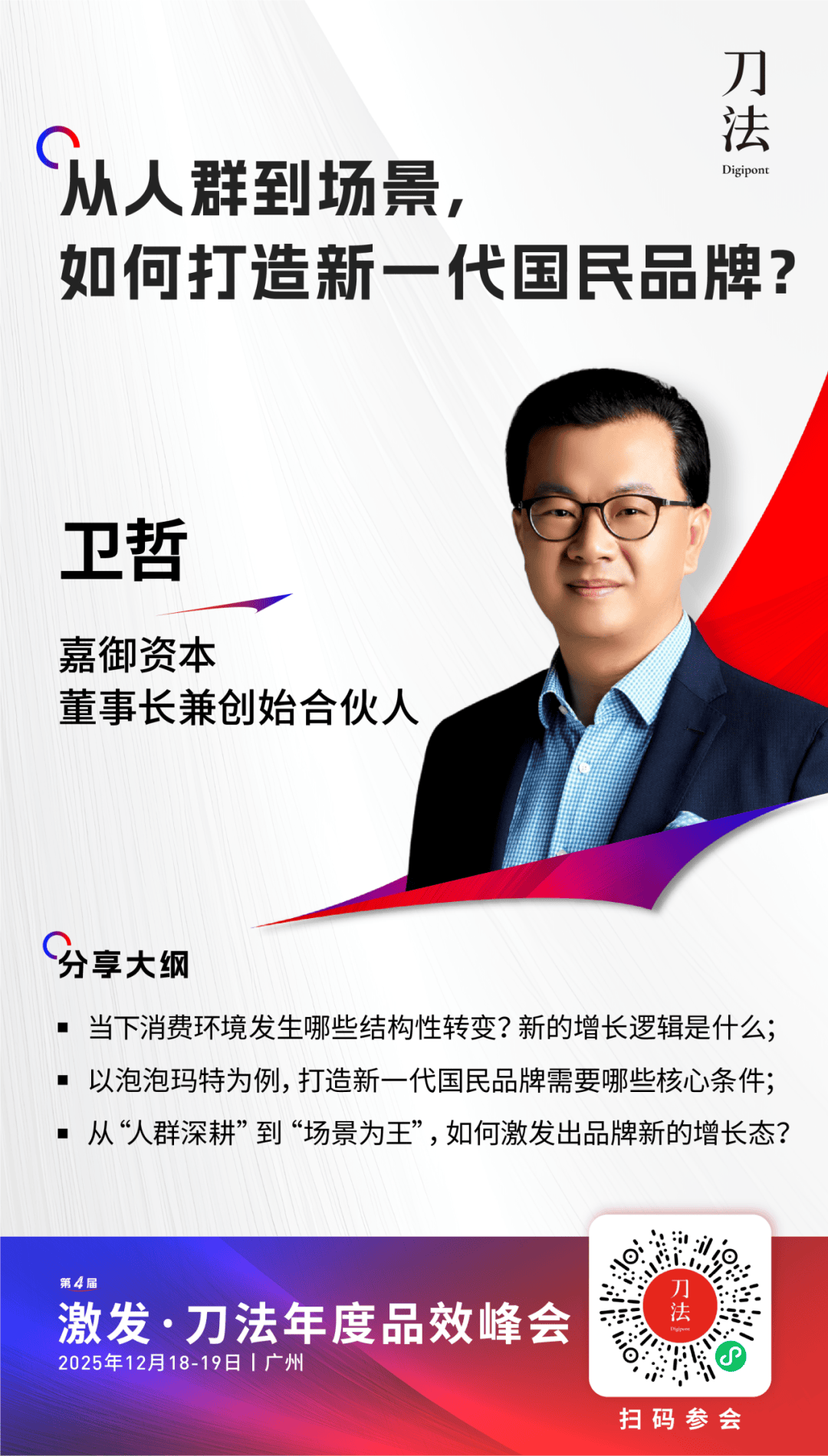
阿里巴巴前B2B CEO、嘉御资本创始合伙人兼董事长卫哲,如何用“场景”打造国民品牌 | 激发·2025刀法年度品效峰会
Sou Hu Cai Jing· 2025-11-18 13:10
Core Insights - The transition of the Chinese economy from a high-growth phase to a stock-based phase presents an opportunity for the emergence of "national brands" as defined by Wei Zhe, the former B2B CEO of Alibaba and founder of GGV Capital [1] - National brands must cover over half of the country's population and satisfy the seemingly contradictory needs of urban middle-class consumers and young people in smaller towns [1] - Wei Zhe identifies three eras of national brands: 1.0 era focusing on category penetration, 2.0 era emphasizing deep engagement with specific demographics, and 3.0 era leveraging scenarios for explosive growth [1] National Brand Development - The 1.0 era saw brands like Head & Shoulders and Wanglaoji successfully penetrate the market through extensive distribution and strong branding [1] - The 2.0 era featured Xiaomi as a leading choice for young consumers and Lululemon appealing to the middle class [1] - The 3.0 era is exemplified by Pop Mart, which transformed collectible toys into fashionable items that serve as social currency, broadening its appeal beyond core audiences [1] Investment Practices - Wei Zhe's investment philosophy emphasizes creating happiness-inducing scenarios rather than merely categorizing consumers, as seen in successful brands like Pop Mart and Anker Innovations [2] - Wei Zhe will share insights on the new pathways for consumer brands to break through in the current environment during an upcoming summit [2] Summit Details - The summit will feature various industry experts discussing topics related to brand growth, consumer engagement, and innovative marketing strategies [12][13] - Key speakers include founders and executives from leading companies and consulting firms, highlighting the importance of understanding consumer needs and market trends [9][10]


中国广告协会中国广告业大奖——2025商业广告长城奖:创意链接价值,彰显广告的商业实效与社会力量
Jing Ji Guan Cha Wang· 2025-11-18 10:12
Core Insights - The 2025 China Commercial Advertising Great Wall Award ceremony was held during the 32nd China International Advertising Festival and the 34th Asian Advertising Conference, recognizing outstanding contributions in the advertising industry [1] - The Great Wall Award has become a prestigious accolade in China's advertising sector, with over 7,000 entries submitted this year, resulting in 164 awards after rigorous evaluation [1] - The award-winning works not only excelled in creativity and execution but also set benchmarks in value transmission and social leadership, showcasing the industry's resilience despite current challenges [1] Industry Trends - The academic awards focused on cutting-edge theories, including AI advertising ethics and e-commerce marketing models, providing theoretical support for commercial advertising practices [1] - The commercial case awards spanned various industries such as fast-moving consumer goods and technology, highlighting trends in AI application and integrated marketing [1] - The winning teams shared insights on their successful campaigns, emphasizing the importance of strategic thinking and execution in achieving market and social value [3][4] Social Responsibility - The ceremony recognized companies contributing to the self-regulation of advertising aimed at minors, with Tencent and Baidu among those awarded for their efforts in creating a healthy advertising ecosystem [5] - The event also acknowledged the best-organized units and contributors to the advertising festival, reinforcing the importance of collaboration in advancing the advertising industry [5] Knowledge Sharing - The "Gold Award Case Deep Dive" segment allowed industry professionals to learn from the creative logic behind award-winning campaigns, providing a comprehensive reference for advertising practitioners [2][4] - The case studies presented by the winning teams illustrated practical strategies and execution details, offering valuable insights for the industry [4]
传媒行业年度投资策略:AI产业加速迭代,科技赋能价值提升
East Money Securities· 2025-11-18 06:00
Key Insights - The report highlights the rapid development of the AI industry and its positive impact on the media sector, particularly in gaming and film, driven by favorable policies and technological advancements [1][2][6] - The media industry has outperformed the market, with the Shenwan Media Index rising by 27.45% as of November 12, 2025, surpassing the Shanghai Composite Index's increase of 18.07% [15][16] - The gaming sector has shown significant growth, with a year-on-year revenue increase of 24.4% and a net profit growth of 88.61% in the first three quarters of 2025 [28][34] - The film industry has benefited from blockbuster films, with total box office revenue reaching 450.97 billion yuan, a 15.44% increase compared to the previous year [76][78] - The advertising sector is experiencing moderate growth, with a revenue increase of 5.97% in the first three quarters of 2025 [37] Group 1: Media Industry Overview - The media industry is experiencing a positive trend, with the gaming sector leading the growth, followed by television broadcasting and film [15][16] - The gaming sub-sector has seen a remarkable increase of 59.84%, while the film sector has grown by 19.07% [16][19] - The overall revenue for the media industry reached 3,875.61 billion yuan, reflecting a 5.58% year-on-year growth [23][24] Group 2: Gaming Sector Insights - The gaming industry has achieved a revenue of 848.14 billion yuan in the first three quarters of 2025, with a significant net profit margin of 16.31% [28][34] - The introduction of new games and the revival of existing titles have contributed to the positive growth trajectory in the gaming market [63][66] - The trend of cross-platform gaming is emerging, enhancing user engagement and revenue generation [69][71] Group 3: Film Industry Insights - The film industry is witnessing a resurgence, with a strong pipeline of upcoming films expected to drive further box office growth [76][78] - The dominance of blockbuster films is evident, with the top five films accounting for 57.06% of total box office revenue [78][79] - The average ticket price has slightly decreased to 42.1 yuan, indicating a competitive market environment [77] Group 4: Advertising Sector Insights - The advertising sector has shown stable revenue growth, with a total revenue of 1,292.33 billion yuan in the first three quarters of 2025 [37] - The sector is adapting to new marketing strategies, including programmatic advertising and innovative consumer engagement methods [37][41] - Despite the growth, the profit margins in advertising are under pressure, reflecting the competitive landscape [37][41]
AI应用爆发,蓝色光标暴涨超14%,带动传媒ETF上涨
Ge Long Hui A P P· 2025-11-18 05:41
Group 1 - The core viewpoint of the news highlights the explosive growth of AI applications, leading to a significant increase in BlueFocus's stock price by over 14%, which in turn boosted the Media ETF [1] - Alibaba has officially announced its "Qwen" project, aiming to penetrate the AI to C market by providing a free personal AI assistant that can interact with users and assist in various life scenarios [2][3] - The Media ETF closely tracks the CSI Media Index, with key stocks including BlueFocus, Focus Media, Giant Network, and others, reflecting the growing interest in media and technology convergence [2] Group 2 - Recent developments in AI applications have accelerated, with major players investing in model capabilities and consumer-facing ecosystems, indicating a new catalytic phase for AI applications [3] - The emergence of new media formats such as micro-short dramas and interactive dramas is rapidly expanding content consumption boundaries, while the live streaming industry is undergoing structural transformation [4] - The media sector is expected to evolve from a single entertainment focus to a diversified value system integrating technology, innovation, and interactivity, driven by policy support and platform guidance [4]


分红早知道|最近24小时内,无线传媒、国航远洋、巴兰仕、豪威集团、分众传媒等8家A股上市公司发布分红派息实施公告!
Mei Ri Jing Ji Xin Wen· 2025-11-18 02:06
Group 1: Dividend Announcements - Wireless Media will distribute a cash dividend of RMB 3.75 per 10 shares (including tax), with the record date on November 21, 2025, and the ex-dividend date on November 24, 2025 [1] - Air China Ocean will distribute a cash dividend of RMB 1.00 per 10 shares (including tax), with the record date on November 24, 2025, and the ex-dividend date on November 25, 2025 [1] - Balanshi will distribute a cash dividend of RMB 5.00 per 10 shares (including tax), with the record date on November 25, 2025, and the ex-dividend date on November 26, 2025 [1] Group 2: Additional Dividend Announcements - OmniVision Technologies will distribute a cash dividend of RMB 4.00 per 10 shares (including tax), with the record date on November 21, 2025, and the ex-dividend date on November 24, 2025 [2] - *ST Kaixin will distribute a cash dividend of RMB 3.90 per 10 shares (including tax), with the record date on November 24, 2025, and the ex-dividend date on November 25, 2025 [2] - Guoguang Co., Ltd. will distribute a cash dividend of RMB 3.00 per 10 shares (including tax), with the record date on November 24, 2025, and the ex-dividend date on November 25, 2025 [2] Group 3: Further Dividend Announcements - Focus Media will distribute a cash dividend of RMB 0.50 per 10 shares (including tax), with the record date on November 24, 2025, and the ex-dividend date on November 25, 2025 [3] - Jidian Co., Ltd. will distribute a cash dividend of RMB 0.21 per 10 shares (including tax), with the record date on November 24, 2025, and the ex-dividend date on November 25, 2025 [3]
2025年中国传媒行业发展历程、政策、发展现状、重点企业经营情况及趋势研判:传媒整体业绩回升向好,游戏板块表现突出[图]
Chan Ye Xin Xi Wang· 2025-11-18 01:27
Industry Overview - The Chinese media industry has maintained rapid growth over the past 20 years, but growth rates have slowed due to the saturation of internet user demographics and the decline in traditional media advertising revenues [1][13] - In 2019, the growth rate of the media industry fell below 10% for the first time, with a total output value of 22,625.4 billion yuan, reflecting a growth rate of 7.95% [1][13] - The media industry experienced rare negative growth in 2022, primarily due to macroeconomic pressures, the impact of the pandemic, and regulatory changes in sectors like online gaming [1][13] - In 2023, the media industry began to recover, with a total output value of 31,518.23 billion yuan, marking an 8.38% year-on-year increase [1][13] - The projected total output value for the media industry in 2024 is approximately 34,157.9 billion yuan [1][13] Market Dynamics - The emergence of new competitive phenomena such as the rise of live-streaming e-commerce and the popularity of short dramas indicates that media companies must explore new avenues or enhance existing potential sectors to break through in a saturated market [1][13] - The media industry has formed a diverse and rich competitive landscape, encompassing content production, marketing services, channel distribution, and cultural communication [15] Policy and Regulation - Recent policies have focused on the integration of traditional and new media talent, encouraging professionals to leverage their skills across platforms to enhance the influence and credibility of mainstream media [7] - The government is also supporting high-quality cultural development, emphasizing the importance of original content creation across various media sectors [7] Industry Trends - The media industry is undergoing a profound transformation driven by technology, with AI and big data becoming core engines for content production and distribution [17] - The deep integration of media forms is reshaping user experiences, creating immersive storytelling through cross-media narratives and IP collaborations [18] - The industry is moving towards verticalization and community building, with platforms focusing on specific content areas to foster digital communities with strong cultural identities [19] Financial Performance - In 2022, the media sector's revenue was 4,701.87 billion yuan, a decline of 6.07% year-on-year, returning to 2019 levels [10] - The projected revenue for the media industry in 2024 is 6,059.64 billion yuan, reflecting a year-on-year growth of 1.89% [10] - The gaming sector showed significant growth, with revenues in the first half of 2025 reaching 544.52 billion yuan, a 22.17% increase year-on-year [11]


中原证券晨会聚焦-20251118
Zhongyuan Securities· 2025-11-18 00:13
Core Insights - The report highlights a significant growth trajectory in various sectors, particularly in the technology and healthcare industries, driven by increased capital expenditure and innovation [5][16][21] - The A-share market is currently in a consolidation phase around the 4000-point mark, with a balanced market style expected to continue, favoring both cyclical and technology sectors [8][12][27] - The communication industry is projected to maintain a strong performance due to rising demand for AI infrastructure and digital services, with major cloud providers increasing their capital expenditures [35][36] Domestic Market Performance - The Shanghai Composite Index closed at 3,972.03, down 0.46%, while the Shenzhen Component Index closed at 13,202.00, down 0.11% [3] - The average P/E ratios for the Shanghai Composite and ChiNext are 16.36 and 49.18, respectively, indicating a suitable environment for medium to long-term investments [8][12] International Market Performance - The Dow Jones closed at 30,772.79, down 0.67%, while the S&P 500 and Nasdaq also experienced declines of 0.45% and 0.15%, respectively [4] - The global semiconductor market is expected to grow significantly, with a projected increase in sales driven by AI and cloud computing demands [32][34] Industry Developments - The communication sector saw a 0.24% increase in October, outperforming the Shanghai Composite Index, with a focus on 5G and digital transformation [16][19] - The sports nutrition market in China is expected to grow at an annual rate of 11.56%, driven by an increasing number of fitness enthusiasts and improved infrastructure [22][23] - The mechanical industry reported a revenue increase of 5.98% year-on-year, with significant growth in sub-sectors like lithium battery equipment and shipbuilding [25][26] Investment Recommendations - Investors are advised to focus on sectors with strong growth potential, such as software development, energy metals, and aerospace, while maintaining a balanced portfolio [8][12][27] - The report suggests monitoring the performance of companies in the sports nutrition sector, such as Kangbiter and Tongchen Beijian, due to their favorable market positions [22][23] - In the semiconductor industry, domestic storage manufacturers are expected to benefit from rising prices and increased demand, making them attractive investment opportunities [31][34]

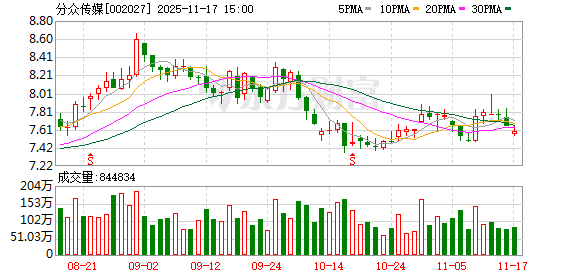
分众传媒:2025年第三季度权益分派实施公告
Zheng Quan Ri Bao· 2025-11-17 13:38
Core Viewpoint - The announcement from the company indicates a cash dividend distribution plan for shareholders, reflecting its commitment to returning value to investors [2]. Group 1: Dividend Distribution - The company announced a cash dividend of 0.500000 RMB per 10 shares, which translates to a total distribution based on its total share capital of 14,442,199,726 shares [2]. - The record date for the dividend is set for November 24, 2025, while the ex-dividend date is November 25, 2025 [2].
分众传媒(002027) - 公司2025年第三季度权益分派实施公告
2025-11-17 12:00
一、股东会授权及董事会审议通过利润分配方案情况 本公司及董事会全体成员保证信息披露的内容真实、准确、完整,简明清 晰,通俗易懂,没有虚假记载、误导性陈述或重大遗漏。 分众传媒信息技术股份有限公司(以下简称"公司")2025 年第三季度权 益分派方案已获公司 2024 年年度股东会和公司第九届董事会第五次会议审议通 过,现将权益分派实施事宜公告如下: 证券代码:002027 证券简称:分众传媒 公告编号:2025-068 分众传媒信息技术股份有限公司 2025 年第三季度权益分派实施公告 1、公司于 2025 年 6 月 25 日召开 2024 年年度股东会,审议通过的 2025 年 中期利润分配条件为:相应期间合并报表归属于上市公司普通股股东的净利润为 正;2025 年中期利润分配现金分红上限为:相应期间合并报表归属于上市公司 普通股股东净利润的 100%,并同意授权董事会在符合上述利润分配的条件下制 定具体的 2025 年中期利润分配方案。 2、公司于 2025 年 10 月 28 日召开第九届董事会第五次会议,审议通过了《公 司 2025 年第三季度利润分配方案》,同意以公司总股本 14,442,199, ...
并购潮起,PE巨头接连出手
FOFWEEKLY· 2025-11-17 10:56
Core Viewpoint - The M&A market in China is experiencing an unprecedented surge in 2025, driven by private equity (PE) firms and public companies actively pursuing acquisitions [3][4]. Group 1: Recent M&A Activities - CPE Yuanfeng, a Chinese private equity firm, has partnered with RBI Group, the parent company of Burger King, to establish a joint venture for Burger King's operations in China, with CPE holding 83% of the joint venture [7]. - CPE Yuanfeng will inject $350 million (approximately 2.5 billion RMB) into the joint venture to support restaurant expansion, marketing, menu innovation, and operational improvements [7][8]. - The transaction is expected to be completed in the first quarter of 2026, pending regulatory approvals [8]. Group 2: Market Trends and Statistics - The Chinese M&A market is witnessing a significant increase, with disclosed transaction amounts exceeding $170 billion in the first half of 2025, a 45% increase compared to the same period last year [11]. - There were 29 large-scale M&A transactions (over $1 billion each) in the first half of 2025, with 20 of these being domestic strategic investments, nearly half led by state-owned enterprises [11]. - The Shanghai Stock Exchange reported over 1,000 disclosed M&A transactions since the introduction of the "Six M&A Guidelines" in September 2022, with significant growth in technology-related mergers [11][12]. Group 3: Policy and Government Support - The Chinese government is actively promoting M&A activities through various policies, including the "Six M&A Guidelines" released by the China Securities Regulatory Commission [11]. - Local governments are establishing M&A funds to provide financial support for acquisitions, with cities like Shenzhen and Nanjing announcing related policies [14][15]. - The Shenzhen government aims to complete over 200 M&A projects with a total transaction value exceeding 100 billion RMB by the end of 2027 [14]. Group 4: Future Outlook - The M&A market is evolving from a secondary exit strategy to a critical strategic tool for companies, with increasing participation from professional buyers [16][19]. - The market is expected to continue growing, driven by patient capital, institutional investment strategy transformations, and a more regulated market environment [19].