同花顺

Search documents
创业板公司融资余额七连增 其间累计增加179.90亿元
Zheng Quan Shi Bao Wang· 2025-12-26 02:43
Core Insights - The total margin financing balance of the ChiNext market reached 554.14 billion yuan as of December 25, 2025, marking an increase of 50.44 billion yuan from the previous trading day, and has risen for seven consecutive trading days, accumulating an increase of 179.90 billion yuan during this period [1][2]. Margin Financing Balance Changes - As of December 25, 2025, the margin financing balance was 552.30 billion yuan, which increased by 50.59 billion yuan from the previous day [2]. - The margin financing balance has seen increases across 509 stocks, with 66 stocks experiencing an increase of over 20% [2]. - The stock with the highest increase in margin financing balance was Jiangxin Home, which saw a 123.76% increase, bringing its latest balance to 39.73 million yuan [2][3]. Stocks with Significant Margin Financing Changes - The stocks with the largest increases in margin financing included: - Jiangxin Home: 39.73 million yuan, +123.76% - Kema Technology: 97.47 million yuan, +118.89% - Yidong Electronics: 44.34 million yuan, +116.06% [3][4]. - Conversely, the stocks with the largest decreases included: - Green Island Wind: 10.27 million yuan, -29.55% - Kaichuang Electric: 11.48 million yuan, -25.91% - Jiayuan Technology: 19.87 million yuan, -23.72% [3][4]. Market Performance - Stocks with margin financing increases of over 20% averaged a rise of 16.41%, outperforming the ChiNext index [5]. - Notable performers included: - Yidong Electronics: +79.99% - Kaige Precision Machinery: +45.63% - Hongda Electronics: +38.89% [5]. - The stock with the highest total margin financing increase was Zhongji Xuchuang, with a balance of 22.02 billion yuan, increasing by 2.51 billion yuan [5]. Summary of Margin Financing Changes - The stocks with the most significant increases in margin financing included: - Zhongji Xuchuang: 22.02 billion yuan, +2.51 billion yuan - Yangguang Electric: 15.10 billion yuan, +2.06 billion yuan - Xinyi Sheng: 21.42 billion yuan, +1.30 billion yuan [5][6]. - The stocks with the largest decreases in margin financing included: - Dongfang Caifu: 26.89 billion yuan, -0.54 billion yuan - Tonghuashun: 5.43 billion yuan, -0.30 billion yuan - Kunlun Wanwei: 3.10 billion yuan, -0.21 billion yuan [5][6].






ETF盘中资讯|沪指冲击八连阳!互联网券商异动,金融科技ETF(159851)直线冲高逾1%,加仓资金涌入!
Sou Hu Cai Jing· 2025-12-26 02:21
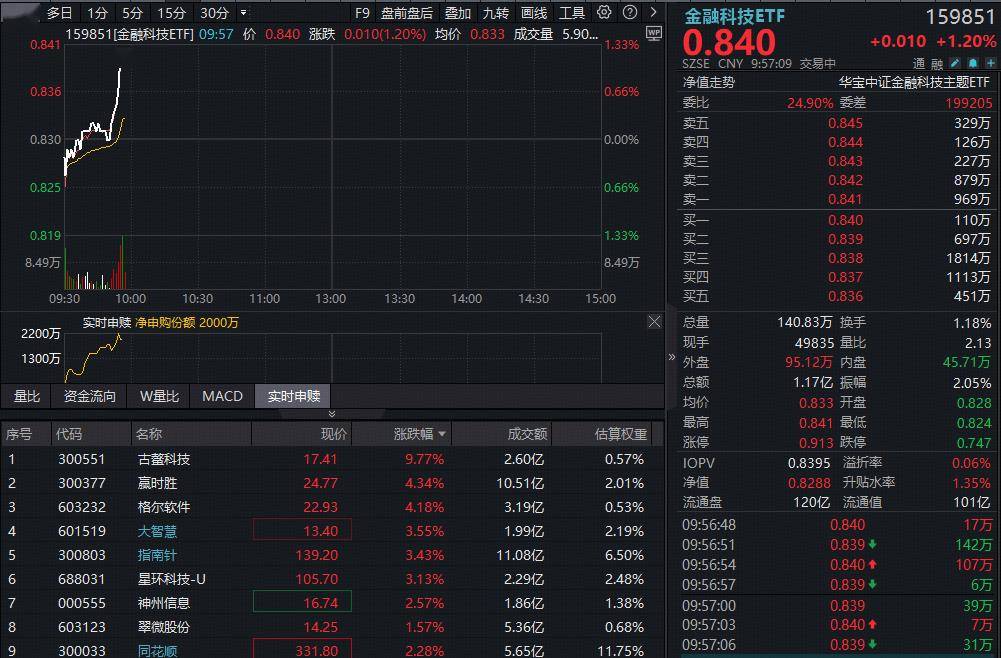
Group 1 - The core point of the news highlights a significant surge in financial technology stocks as the market approaches the 4000-point mark, with notable gains from companies like Guoao Technology and Yingshisheng [1] - The financial technology ETF (159851) has seen a rapid increase of over 1%, indicating strong market interest and a net subscription of 20 million units [1] - A record-breaking trading volume in A-shares has been reported, surpassing 405 trillion yuan, suggesting a continued active capital market into 2025 [2][3] Group 2 - The current valuation of the CSI Financial Technology Theme Index is at a near six-month low, indicating a potential opportunity for left-side allocation in financial technology investments [3] - The financial technology ETF (159851) has a scale exceeding 9.9 billion yuan, with an average daily trading volume of 800 million yuan over the past six months, leading among similar ETFs [3]

沪指冲击八连阳!互联网券商异动,金融科技ETF(159851)直线冲高逾1%,加仓资金涌入!
Xin Lang Cai Jing· 2025-12-26 02:12
Core Viewpoint - The financial technology sector is experiencing significant upward movement, with major stocks and ETFs showing strong performance as the A-share market hits new trading volume records [1][6]. Group 1: Market Performance - The A-share market has achieved a historic milestone, surpassing 405 trillion yuan in annual trading volume for the first time [1][6]. - Financial technology stocks such as Guoao Technology surged over 7%, while others like Yingshisheng, Geer Software, and Dazhihui rose over 4% [1][6]. - The financial technology ETF (159851) has seen a rapid increase of over 1%, indicating strong market interest and a net subscription of 20 million units [1][6]. Group 2: Investment Opportunities - The current valuation of the CSI Financial Technology Theme Index is at a near six-month low, suggesting a potential buying opportunity as the market is expected to remain active [3][8]. - The financial technology ETF (159851) and its associated funds are recommended for investment, covering key sectors such as internet brokerage, financial IT, cross-border payments, and AI applications [3][8]. - As of December 25, the financial technology ETF (159851) has a scale exceeding 9.9 billion yuan, with an average daily trading volume of 800 million yuan over the past six months, leading among similar ETFs [3][8].
全球资管深研系列(四):全球智能投顾全景图
Guoxin Securities· 2025-12-25 15:25
Core Insights - The rise of robo-advisors is driven by the integration of financial technology and traditional wealth management, offering low costs, high accessibility, and convenience. Post-global financial crisis, stricter regulations and technological advancements have facilitated the emergence of non-bank fintech companies, with robo-advisors serving as a cost-effective alternative to human advisors. They utilize algorithms to automatically construct investment portfolios, significantly reducing advisory fees and breaking geographical barriers, allowing investors to access professional services anytime and anywhere. Robo-advisors particularly attract low-income groups and younger users by minimizing trading costs through passive investment strategies, enhancing capital market participation for long-term goals like retirement and emergency savings. The evolution of robo-advisors has progressed through four stages: early online questionnaires and static advice, full automation and passive management, establishment of hybrid models, and AI-driven hyper-personalization and intelligent agents [2][9][10]. - The global robo-advisory market is experiencing rapid expansion, with the U.S. maintaining a dominant position while emerging markets like China show significant potential for growth. The market size is projected to increase from $7.7 billion in 2023 to approximately $116.4 billion by 2033, with the U.S. accounting for 81% of global assets under management (AUM). The competitive landscape in the U.S. has formed a "three giants and many strong" scenario, with Vanguard, Schwab, and Fidelity as the major players, while independent unicorns like Betterment and Wealthfront continue to thrive. In Europe, the market share remains relatively small, with key players categorized into pan-European super platforms, market consolidators, and regional champions. China's robo-advisory market is expected to exceed $2 billion by 2028 and $4 billion by 2030, contributing to the development of passive investment strategies and long-term capital market participation [2][15][21][25][30]. - The business model of robo-advisors is evolving towards platformization and ecosystem integration, with revenue models shifting from single asset management fees to layered charging and technology empowerment. Robo-advisors have expanded from B2C to B2B and ecosystem models, exemplified by Ant Wealth's scenario collaboration for traffic conversion. Revenue diversification includes pure digital models relying on AUM management fees, tiered subscription models offering premium services, B2B tool empowerment models generating profits through technology output, and ecosystem platform models depending on product distribution commissions. This evolution highlights the industry's transition from scale expansion to value extraction [2][35][39]. - The core competitive advantages of leading robo-advisors include comprehensive strength, digital experience, and user-friendliness for beginners. Platforms with strong comprehensive capabilities often excel in long-term performance and service quality, while the best digital planning platforms possess robust personal asset aggregation tools that create automated financial management loops. User-friendly platforms may excel in brand trust or community ecosystem development. In the competitive landscape, Betterment and Wealthfront not only survive but thrive, embodying the pure fintech spirit by creating value through technological innovation and exceptional user experience [2][39][50]. - The development trend of robo-advisors is characterized by a philosophical debate between "active" and "passive" investment strategies. Analyzing the portfolio data of various robo-advisors reveals a shift in the industry towards this philosophical contention, categorized into MPT believers (Vanguard & Betterment), potential active managers (SoFi & Axos), and tech-driven alpha harvesters (Wealthfront) [2][11]. - Looking ahead, the industry is poised for significant restructuring and a new journey. By 2025, the robo-advisory sector will have transitioned from rapid growth to a phase of integration and iteration. Three major trends are expected to continue: industry consolidation, a shift from scale to sustainable profitability, and AI reshaping robo-advisory services. The complete withdrawal of bank-affiliated robo-advisors reflects ongoing industry consolidation, as the mismatch between customer acquisition costs and lifetime value necessitates substantial new scale to cover technology and compliance costs. Independent platforms are now focusing on sustainable profitability rather than blind scale expansion, as exemplified by Robinhood's acquisition of AI financial planning company Pluto and the launch of its own robo-advisory service, which aims to provide genuinely personalized financial consulting through large language models [2][15][30].

低利率遇见高股息,红利基金凭什么成为最稳“现金牛”?
Mei Ri Jing Ji Xin Wen· 2025-12-25 14:51
Core Insights - The investment strategy of dividend investing is regaining prominence as a stable investment approach in 2025, contrasting with previous years focused on growth and resilience [1] - Dividend funds are highlighted as a key investment tool for 2025, offering steady returns and enhancing overall yield through dividends [1] Group 1: Dividend Fund Performance - Since the beginning of 2025, public funds have distributed over 220 billion yuan in dividends, with a total of 3,492 funds implementing dividend distributions, marking a year-on-year increase of approximately 13.5% [2] - Leading fund companies like E Fund and Huaxia Fund have demonstrated significant dividend capabilities, each surpassing 10 billion yuan in annual dividends [2] - Equity funds are increasingly contributing to the total dividend pool, with their share rising as bond funds' contribution declines, indicating a shift in investor preference [2][3] Group 2: Specific Fund Highlights - The top five funds in terms of dividend payouts in 2025 are all ETFs, with the Huatai-PB CSI 300 ETF leading at 8.39 billion yuan [3] - Funds with a high frequency of dividends, particularly those focused on dividend strategies, have shown strong performance, with some funds achieving over 10 distributions in 2025 [3] - The highest-performing dividend fund in 2025 is E Fund Kexiang, with a return of 66.37%, significantly outperforming others in the same category [3] Group 3: Fee Structure and Growth - Dividend funds are characterized by lower management and custody fees compared to actively managed equity funds, making them more attractive in a low-fee environment [4] - As of mid-2025, the asset management scale of dividend funds reached approximately 240 billion yuan, reflecting a significant increase driven by low fees and improved dividend mechanisms [5] - The growth of dividend funds is attributed to a combination of low-fee environments, enhanced dividend mechanisms, and rising demand for stable returns amid market uncertainties [5] Group 4: Future Outlook - Industry experts believe that dividend funds will continue to be a favored asset class due to ongoing policy support for dividend distributions from both funds and listed companies [6] - Key areas of focus for 2026 include traditional industry leaders with stable earnings and clear dividend policies, as well as emerging dividend stocks with strong payout intentions [7] - The long-term value of Hong Kong dividend assets is also highlighted, particularly for investors seeking cash flow returns in a low-interest-rate environment [7]
一家优秀且极端低估的公司?
集思录· 2025-12-25 14:28
看到有个v说 在我眼里,a股千亿市值以上公司,仅剩一个优秀且极端的低估。也就不在意他未 来一年,可能部分业务未来一年可能出现略有下滑,大概公司整体还是增长的。常 年经营现金流大于净利润+折旧摊销的,常年ROE大于20%,以及本年接近100% 的股东回报,账上几千亿现金,公司治理优秀。。无一不让人流口水。很久没说那 一句,涨跌随意 这v我也不知道准不准,但是很好奇 我就查了一下 千亿以上公司有173家 再要求ROE大于20,就只剩下34家 然后按照股利支付率排序 | ○查找 | | | | | | | ▼ 点击查看4列数据洞察结果 | | | --- | --- | --- | --- | --- | --- | --- | --- | --- | | | | 证券名称 | > | 总市值 | [交易日期]2025-11 ... | 净资产收益率ROE [报告期]去年年报 | 年度股利支付率 年度 2024 | 货币资金 [报告期]去年年报 | | 序号 | 证券代码 | | | 单位亿元 | | [单位]% [单位]% | | [报告类型]合并报表 | | | | | | | | | | [单位]亿元 | | ...

股价4个交易日大涨78%,中能电气拟终止热门募投项目!
Mei Ri Jing Ji Xin Wen· 2025-12-25 12:37
Group 1 - The core point of the article is that Zhongneng Electric (300062) has announced the early redemption of its 400 million yuan convertible bonds, with only 6.35% of the raised funds allocated to new energy storage and research center projects [1] - The company plans to change the use of the remaining raised funds, totaling 254 million yuan, to permanently supplement its working capital, pending approval from the shareholders' meeting [1] - The projects that the company intends to terminate are related to popular concepts this year, such as new energy storage and charging piles [1] Group 2 - The storage index from Tonghuashun (300033) has seen a significant increase since April, rising from a low of 1489.71 points to a high of 2502.54 points in August, marking a maximum increase of 68% [1] - The charging pile index from Tonghuashun also experienced growth, increasing from 3859.06 points in April to 6451.82 points in November, with a maximum increase of 67.2% [1] - The company's stock price surged by 78.09% over four trading days from November 4 to November 7, triggering the conditional redemption clause of the convertible bonds [1]

AI龙头压轴冲刺!年内暴涨420%创新高!创业板人工智能ETF(159363)大举吸金,标的指数翻倍增长
Xin Lang Cai Jing· 2025-12-25 11:48
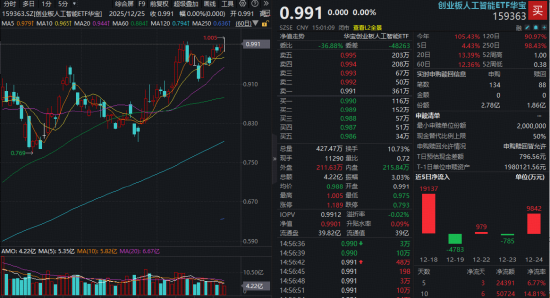
周四(12月25日),创业板人工智能全天"V"型回升,成份股大面积飘红。算力硬件局部亮眼,存储芯 片龙头北京君正领涨超6%,光模块CPO龙头中际旭创再创新高,年内累计涨超420%,总市值超7100亿 元!此外,AI应用方向多股活跃,易点天下、长亮科技、蓝色光标、芒果超媒,同花顺等多股涨超 2%。 热门ETF方面,同类规模最大、流动性最佳的创业板人工智能ETF(159363)早盘一度涨逾1%创下历史 高点纪录,随后冲高回落跌逾1.5%,午后"V"型回升,报收0.991元历史收盘最高价!资金持续涌入,单 日再度净申购9200万份,近十日已累计加仓超5亿元。 光模块龙头正成为杠杆资金"宠儿"。Wind数据显示,近期A股融资余额站上2.5万亿元,这也是自A股两 融市场开设以来新高!个股方面,下半年以来,两大光模块龙头股新易盛、中际旭创进入榜单前五,融 资净买入额均超140亿元,另一光模块巨头天孚通信融资净买入额也高达46.21亿元,排名第11位。 从业绩表现看,光模块CPO龙头年末压轴发力,重仓光模块龙头的创业板人工智能频刷新高。截至最 新,创业板人工智能年内涨幅高达106.87%,已翻倍增长有余,大幅领跑人工智能、 ...
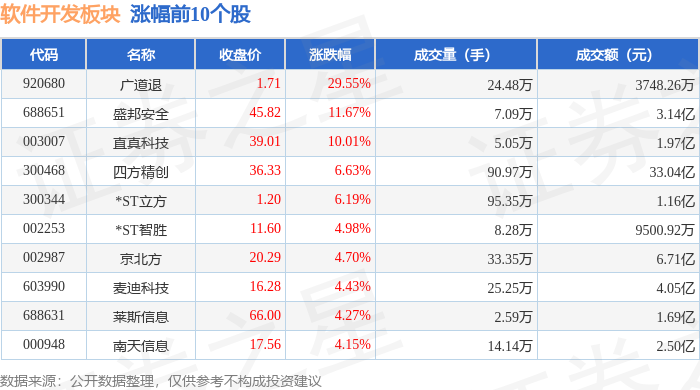
软件开发板块12月25日涨0.77%,广道退领涨,主力资金净流出1.53亿元
Zheng Xing Xing Ye Ri Bao· 2025-12-25 09:14
Market Performance - The software development sector increased by 0.77% on December 25, with Guangdao Tui leading the gains [1] - The Shanghai Composite Index closed at 3959.62, up 0.47%, while the Shenzhen Component Index closed at 13531.41, up 0.33% [1] Stock Highlights - Guangdao Tui (code: 920680) saw a significant rise of 29.55%, closing at 1.71, with a trading volume of 244,800 shares and a transaction value of 37.48 million yuan [1] - Shengbang Security (code: 688651) increased by 11.67%, closing at 45.82, with a transaction value of 314 million yuan [1] - Zhizhen Technology (code: 003007) rose by 10.01%, closing at 39.01, with a transaction value of 197 million yuan [1] - Sifang Jingchuang (code: 300468) increased by 6.63%, closing at 36.33, with a transaction value of 3.304 billion yuan [1] Capital Flow - The software development sector experienced a net outflow of 153 million yuan from institutional investors and 141 million yuan from retail investors, while retail investors had a net inflow of 294 million yuan [2] - Notable stocks with significant capital flow include Sifang Jingchuang, which had a net inflow of 320 million yuan from institutional investors [3] Individual Stock Performance - Zhizhen Technology had a net inflow of 99.19 million yuan from institutional investors, representing 50.35% of its total capital flow [3] - Jingbeifang experienced a net inflow of 72.57 million yuan from institutional investors, accounting for 10.82% of its total capital flow [3] - Other stocks like Tonghuashun and Zhinanzhen saw net outflows from both institutional and retail investors, indicating mixed investor sentiment [3]





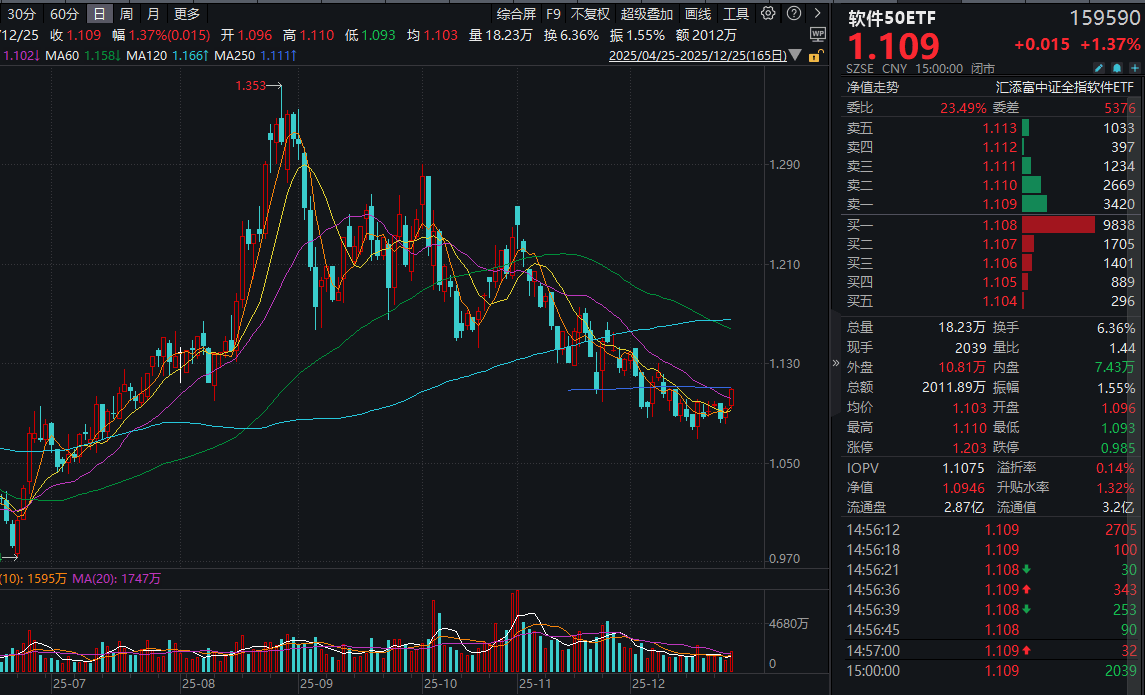
豆包DAU破亿,蚂蚁阿福横空出世,AI软件催化不断!软件50ETF(159590)放量收涨1.37%,年内份额增幅领先!哪三类AI应用方向值得关注?
Sou Hu Cai Jing· 2025-12-25 08:26
Group 1: Market Performance - The A-share market continues to rise, with the Shanghai Composite Index recording a seven-day winning streak, and the Software 50 ETF (159590) increasing by 1.37% for two consecutive days [1] - The trading volume for the Software 50 ETF exceeded 20 million yuan, showing a 76% increase compared to the previous period [1] - Since the beginning of the year, the share of the Software 50 ETF has surged by 164%, leading among all index ETFs in terms of share growth [1] Group 2: Key Stocks Performance - Most of the popular component stocks of the Software 50 ETF closed in the green, with notable gains: Zhongke Xingtu up over 7%, Sifang Jingchuang up over 6%, and Aerospace Information up 4% [2] - The trading volumes for key stocks include: - Zhina Zhen: 3.33 billion yuan, up 1.05% - Sifang Jingchuang: 3.30 billion yuan, up 6.63% - Tonghuashun: 2.08 billion yuan, up 2.01% - Zhongke Jujia: 1.83 billion yuan, up 7.11% - Aerospace Information: 1.44 billion yuan, up 4.00% [4] Group 3: AI Application Insights - Ant Group's AI health application "Antifufu" has reached 15 million monthly active users, leading the health management AI application sector [5] - The application has a unique advantage in payment integration, serving 800 million medical insurance code users, and has established deep cooperation with over 5,000 hospitals [5] - Antifufu has achieved a monthly active growth rate of 83.4%, answering 5 million questions daily, with 55% of users from third-tier cities [6] Group 4: AI Application Directions - Three AI application directions are highlighted for attention: 1. General tools that enhance work efficiency, leveraging large model advantages [8] 2. AI applications built on vertical scenarios that deliver quantifiable results [8] 3. Edge AI hardware, which is the fastest commercialized AI application direction [9] Group 5: Software Industry Overview - The Software 50 ETF closely follows the CSI All-Share Software Index, covering the entire AI software industry chain, with approximately 67% of its weight in application software and over 15% in AI-related fields [10]