
荣盛石化

Search documents
【市场探“涨”】磷化工上游核心材料价格飙升
Shang Hai Zheng Quan Bao· 2025-11-25 14:05
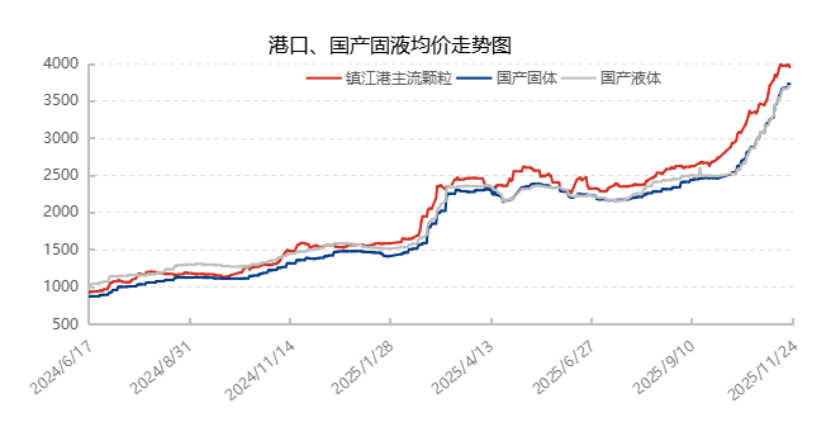
Core Insights - The recent surge in chemical and industrial product prices, particularly sulfur, is driven by supply constraints and increased demand from the renewable energy sector [1][2] - The price of liquid sulfur in China rose from 2860 CNY/ton to 3692 CNY/ton, marking a 29.09% increase, while solid sulfur prices increased by 29.66% during the same period [1][2] - The sulfur price increase is expected to continue in the short term, supported by seasonal agricultural demand and a new procurement cycle starting in January 2026 [8] Supply Dynamics - Global sulfur supply is primarily derived from oil and gas processing by-products, which have been affected by reduced traditional energy consumption and OPEC+ production cuts [2] - Russia's recent sulfur export ban has further tightened supply, impacting imports to China [2] - Domestic sulfur production capacity is projected to grow, reaching approximately 18.11 million tons by 2024, with a year-on-year increase of 5.7% [8] Demand Trends - The renewable energy sector, particularly lithium iron phosphate battery production, is a significant driver of sulfur demand, as sulfuric acid production relies heavily on sulfur [2] - Phosphate fertilizers account for the largest share of sulfur demand, projected to represent 52.75% in 2024 [2] Price Impact on Related Products - The rise in sulfur prices has led to an increase in sulfuric acid prices, which rose from 710 CNY/ton to a range of 1050-1110 CNY/ton, reflecting a 4.00% to 4.72% increase [3] - Industries such as titanium dioxide may face cost pressures due to rising sulfur prices, potentially impacting profit margins [5] Industry Outlook - Companies like Rongsheng Petrochemical and China Petroleum are key players in the domestic sulfur supply market, with significant production capacities [8] - The ongoing price increases are expected to positively impact the sulfur business of these companies, prompting them to optimize resource allocation in response to market dynamics [8]

中国银河证券:化工业供需双底基本确立 2026年或开启“戴维斯双击”
智通财经网· 2025-11-25 09:13
Group 1: Oil and Chemical Industry Outlook - China Galaxy Securities forecasts Brent crude oil prices to range between $60-70 per barrel by 2026, with costs expected to stabilize [1] - The chemical industry is experiencing negative capital expenditure growth since 2024, with supply expected to contract due to the "anti-involution" trend and accelerated elimination of outdated overseas capacity [1] - The "14th Five-Year Plan" draft emphasizes expanding domestic demand, combined with the onset of the US interest rate cut cycle, which is expected to open up demand for chemical products [1] - A dual bottom in supply and demand is anticipated, with strong policy expectations catalyzing a potential cyclical upturn in the chemical industry by 2026, leading to a "Davis Double Play" from valuation recovery to earnings growth [1] Group 2: Specific Chemical Sector Recommendations - PTA industry is operating at low levels, with increasing calls for anti-involution; recommended companies include Hengli Petrochemical, Rongsheng Petrochemical, Xinfon Ming, and Tongkun [1] - Polyester filament capacity is becoming concentrated, with industry self-discipline enhancing cyclical elasticity; recommended companies include Xinfon Ming, Tongkun, and Hengyi Petrochemical [1] - The spandex industry is expected to see increased concentration; recommended companies include Huafeng Chemical and Xinxiang Chemical Fiber [1] - Global demand for pesticides is improving, with bottom-priced varieties likely to rebound; recommended companies include Yangnong Chemical, Runfeng Shares, Jiangshan Shares, Guangxin Shares, and Lier Chemical [1] - Organic silicon capacity expansion is nearing completion, with supply-demand dynamics expected to improve; recommended companies include Hesheng Silicon Industry, Xin'an Shares, and Dongyue Silicon Material [1] - The titanium dioxide industry is facing challenges and opportunities; recommended company is Longbai Group [1] - Refining capacity is being optimized, with a shift from oil to chemicals enhancing effective supply; recommended companies include Sinopec, PetroChina, Rongsheng Petrochemical, and Hengli Petrochemical [1] Group 3: Demand-Supported Chemical Sectors - Strong pricing power from suppliers is expected to sustain high demand for potash fertilizers; recommended companies include Yara International and Dongfang Iron Tower [2] - Phosphate supply and demand remain tight, benefiting resource-based companies; recommended companies include Batian Shares, Yuntianhua, Xingfa Group, and Chuanheng Shares [2] - Strict quota policies are expected to sustain high demand for refrigerants; recommended companies include Juhua Co., Sanmei Co., and Yonghe Co. [2] - Amino acids are expected to maintain their upward trend, with overseas capacity gradually exiting; recommended companies include New Hope Liuhe, Andisu, and Meihua Biological Technology [2] - The chlorinated sugar market is anticipated to see anti-involution, with significant potential for allulose; recommended companies include Jinhui Industrial, Bailong Chuangyuan, and Baolingbao Biology [2] - Vitamins are leading the current round of chemical price increases, entering the second phase; recommended companies include New Hope Liuhe and Zhejiang Medicine [2] - The EU's preliminary anti-dumping ruling is expected to reassess the value of overseas tires; recommended companies include Sailun Tire and Senqilin [2] - The civil explosives industry is developing steadily, with policy guidance likely accelerating industry consolidation; recommended companies include Guangdong Hongda, Yipuli, and Jiangnan Chemical [2] Group 4: New Materials and Technologies - Lightweight humanoid robots may benefit from PEEK as a key solution; recommended companies include Zhongyan Shares, Water Shares, and Guoen Shares [3] - AI is driving global demand for computing power, with electronic-grade PPO expected to grow; recommended companies include Shengquan Group and Dongcai Technology [3] - The domestic substitution of core chip materials, particularly photoresists, is accelerating; recommended companies include Wanrun Shares and Dinglong Shares [3]

炼化及贸易板块11月25日跌0.04%,和顺石油领跌,主力资金净流入1.54亿元
Zheng Xing Xing Ye Ri Bao· 2025-11-25 09:10
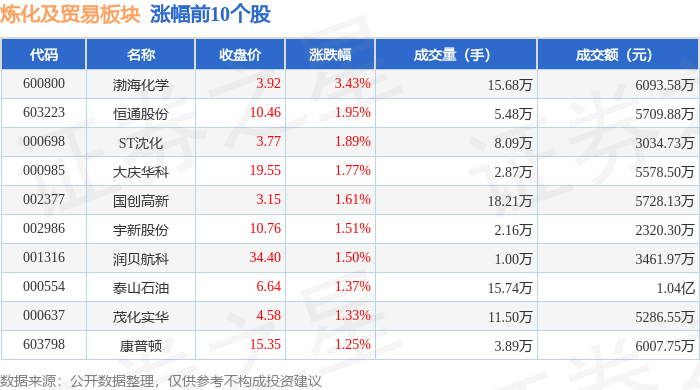
Core Viewpoint - The refining and trading sector experienced a slight decline of 0.04% on November 25, with Heshun Petroleum leading the losses, while the overall market indices showed positive movements, with the Shanghai Composite Index rising by 0.87% and the Shenzhen Component Index increasing by 1.53% [1][2]. Group 1: Market Performance - The Shanghai Composite Index closed at 3870.02, up 0.87% [1]. - The Shenzhen Component Index closed at 12777.31, up 1.53% [1]. - The refining and trading sector saw a net inflow of 154 million yuan from main funds, while retail investors experienced a net outflow of 239 million yuan [2][3]. Group 2: Individual Stock Performance - Heshun Petroleum (603353) closed at 28.44, down 1.96% with a trading volume of 92,100 shares and a transaction value of 26.9 million yuan [2]. - China Petroleum (600028) closed at 5.80, down 0.68%, with a trading volume of 1,513,500 shares and a transaction value of 875 million yuan [2]. - Bohai Chemical (600800) closed at 3.92, up 3.43%, with a trading volume of 156,800 shares and a transaction value of 60.94 million yuan [1]. Group 3: Fund Flow Analysis - Major funds showed a net inflow of 80.57 million yuan for China Petroleum, while retail investors had a net outflow of 39.5 million yuan [3]. - Rongsheng Petrochemical (002493) had a net inflow of 43.55 million yuan from major funds but a net outflow of 75.79 million yuan from retail investors [3]. - The overall trend indicates that while major funds are entering the market, retail investors are withdrawing, reflecting a cautious sentiment among smaller investors [2][3].




石油石化行业今日跌1.21%,主力资金净流出5.30亿元
Zheng Quan Shi Bao Wang· 2025-11-24 13:16
Market Overview - The Shanghai Composite Index rose by 0.05% on November 24, with 19 sectors experiencing gains, led by defense and military industry (up 4.31%) and media (up 3.49%) [1] - The oil and petrochemical sector saw the largest decline, down 1.21%, followed by coal, which fell by 1.09% [1] Capital Flow - The main capital outflow from both markets totaled 10.192 billion yuan, with 11 sectors seeing net inflows [1] - The defense and military sector had the highest net inflow of 5.466 billion yuan, while the media sector followed with 2.542 billion yuan [1] - The electronic sector experienced the largest net outflow, totaling 6.708 billion yuan, followed by the power equipment sector with 2.087 billion yuan [1] Oil and Petrochemical Sector Analysis - The oil and petrochemical sector experienced a decline of 1.21%, with a net capital outflow of 530 million yuan [2] - Out of 47 stocks in this sector, 24 rose, including one that hit the daily limit, while 20 fell [2] - The top net inflow stocks included Rongsheng Petrochemical (43.186 million yuan), Huibo Technology (31.2136 million yuan), and Bomaike (25.2525 million yuan) [2] Individual Stock Performance - Major stocks with significant net outflows included China Petroleum (-2.49%, -316.2775 million yuan), China National Offshore Oil Corporation (-3.15%, -157.0026 million yuan), and Guanghui Energy (-0.59%, -42.7184 million yuan) [3][4] - Stocks with notable gains included Bomaike (up 10.01%, 25.2525 million yuan) and Huibo Technology (up 2.65%, 31.2136 million yuan) [4]



俄炼厂遭袭 中国成品油出口与硫黄市场迎机遇
Zhong Guo Hua Gong Bao· 2025-11-24 12:06
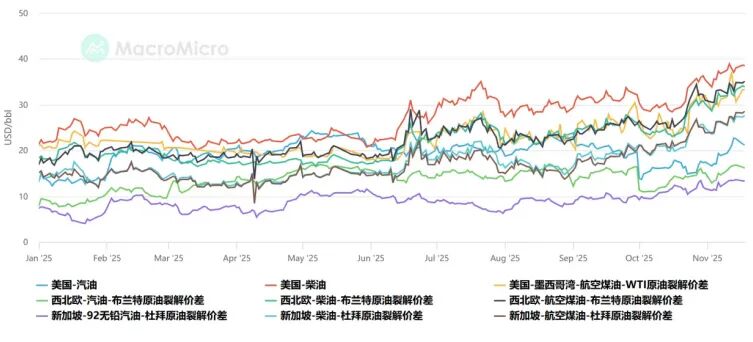
Core Viewpoint - The ongoing drone attacks by Ukraine on Russian energy infrastructure have significantly impacted Russia's refining capacity, leading to a surge in global oil product prices and creating new opportunities for China's oil product exports and sulfur industry [1][4][10]. Group 1: Impact on Russian Refining Capacity - Since November 2025, Ukraine has conducted multiple drone strikes targeting key Russian refineries, including Ryazan, Samara, and Volgograd, resulting in a 6% decrease in overall Russian refining output [1]. - The Ryazan refinery, one of Russia's four major refineries with an annual processing capacity of 13.1 million tons (340,000 barrels per day), suffered damage to its distillation units and fuel storage tanks [1]. - The Volgograd refinery, with an annual capacity of 15.7 million tons, has faced multiple shutdowns due to these attacks, further exacerbating the decline in Russian refining capacity [1]. Group 2: Global Oil Product Price Surge - The reduction in Russian refining capacity has led to a significant increase in overseas oil product crack spreads, with the 3-2-1 crack spread reaching $32.13 per barrel, the highest level since March 2024, reflecting a more than 30% increase from October's average [2]. - Diesel prices have seen the most substantial rise among oil products, indicating a high-profit cycle for the refining industry [2]. Group 3: Sulfur Market Dynamics - The attacks have also disrupted sulfur production, as Russia is the second-largest sulfur producer globally, accounting for 15%-20% of the world's supply [4]. - Domestic sulfur prices have surged, with the port spot index reaching 3,990 yuan per ton in late November, marking an increase of over 1,000 yuan per ton in just over a month and a rise of approximately 2,500 yuan per ton since the beginning of the year [4]. - Forecasts suggest that sulfur prices may exceed 5,000 yuan per ton in 2026 due to a tight supply-demand balance [4]. Group 4: Opportunities for Chinese Companies - The international supply gap has created a favorable window for China's oil product exports, with a total export quota of 40.195 million tons for 2025 [7]. - Major state-owned enterprises dominate China's oil product export market, with Sinopec and PetroChina holding significant shares [7]. - The sulfur industry in China is experiencing a dual benefit of rising prices and increasing demand, particularly due to the growth in the new energy sector and solid-state battery technology [7][8]. Group 5: Market Position of Leading Companies - China's total sulfur production capacity is approximately 16.8 million tons per year, with Sinopec, PetroChina, and Rongsheng Petrochemical being the top three producers, collectively holding over 70% of the market share [8][10]. - A price increase of 100 yuan in sulfur can lead to significant profit gains for leading companies, indicating a positive outlook for profitability in the current high-demand environment [8].
人民币升值受益板块11月24日跌0.55%,凯撒旅业领跌,主力资金净流出8047.44万元
Sou Hu Cai Jing· 2025-11-24 09:25
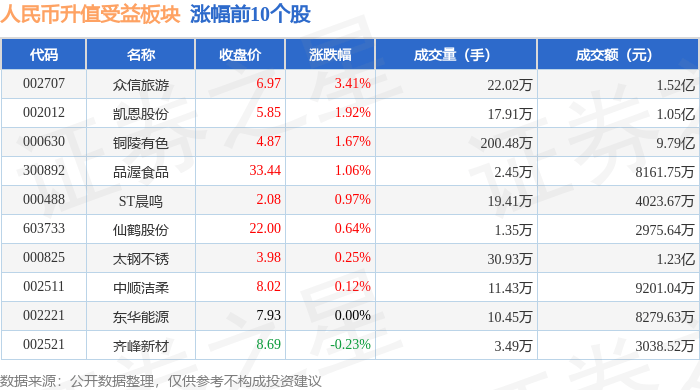
Core Insights - The Chinese yuan appreciated, leading to a decline of 0.55% in the benefiting sectors on the previous trading day, with Caesar Travel leading the losses [1][2] - The Shanghai Composite Index closed at 3836.77, up 0.05%, while the Shenzhen Component Index closed at 12585.08, up 0.37% [1] Sector Performance - The benefiting sector saw a mixed performance with notable gainers including: - Zhongxin Tourism (002707) with a closing price of 6.97, up 3.41% and a trading volume of 220,200 shares [1] - Kain Co. (002012) at 5.85, up 1.92% with a trading volume of 179,100 shares [1] - Tongling Nonferrous Metals (000630) at 4.87, up 1.67% with a trading volume of 2,004,800 shares [1] - Conversely, Caesar Travel (000796) experienced a significant drop of 6.69%, closing at 6.69 with a trading volume of 1,428,100 shares [2] Capital Flow Analysis - The benefiting sector experienced a net outflow of 80.47 million yuan from institutional investors, while retail investors saw a net inflow of 205 million yuan [2][3] - Notable capital flows included: - Tongling Nonferrous Metals (000630) with a net inflow of 114 million yuan from institutional investors [3] - Rongsheng Petrochemical (002493) with a net inflow of 42.31 million yuan from institutional investors [3] - Zhongxin Tourism (002707) with a net inflow of 13.34 million yuan from institutional investors [3]

炼化及贸易板块11月24日跌2.15%,和顺石油领跌,主力资金净流出4.49亿元
Sou Hu Cai Jing· 2025-11-24 09:19
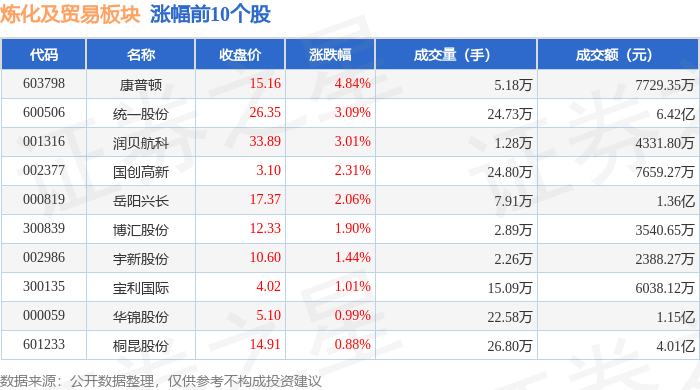
Market Overview - The refining and trading sector experienced a decline of 2.15% on November 24, with Heshun Petroleum leading the drop [1] - The Shanghai Composite Index closed at 3836.77, up 0.05%, while the Shenzhen Component Index closed at 12585.08, up 0.37% [1] Stock Performance - Notable gainers in the refining and trading sector included: - Compton (603798) with a closing price of 15.16, up 4.84% [1] - Unified Shares (600506) at 26.35, up 3.09% [1] - Runbei Aerospace (001316) at 33.89, up 3.01% [1] - Major decliners included: - Heshun Petroleum (603353) at 29.01, down 5.17% [2] - Rongsheng Petrochemical (002493) at 9.52, down 2.96% [2] - China Petroleum (601857) at 9.78, down 2.49% [2] Capital Flow - The refining and trading sector saw a net outflow of 449 million yuan from main funds, while retail funds had a net inflow of 262 million yuan [2] - The following stocks had significant capital flows: - Rongsheng Petrochemical had a main fund net inflow of 42.31 million yuan, but retail funds saw a net outflow of 22.34 million yuan [3] - Compton had a main fund net inflow of 7.05 million yuan, with retail funds experiencing a net outflow of 9.01 million yuan [3]


成品油周报:原油转弱成品油出口利润维持高位国内柴油裂解利润回升-20251124
Zhong Tai Qi Huo· 2025-11-24 09:13
1. Report Industry Investment Rating No relevant content provided. 2. Core Viewpoints of the Report This week, Brent crude oil first rose and then fell to the $62 area, with the focus of the crude oil market shifting to geopolitical and financial - end asset liquidity. Geopolitical risks have cooled down. The refined oil cracking profit remains at a high level, and the market has entered a rhythm where the current demand is resilient but weak in the long - term. The main supply has declined, and the inventory has decreased at a low level. The diesel cracking profit has continuously risen and recovered. It is recommended to take profit and wait and see for the cracking profit in the short term, and participate at low levels in the medium term [7]. 3. Summary According to the Directory 3.1 Product Oil Price Analysis - The price difference between gasoline and diesel has slightly widened, and the support for gasoline is stronger than that for diesel [15]. - The cracking spread of gasoline and diesel has hit a high as crude oil prices fall [45]. 3.2 Product Oil Supply Analysis - **Crude Oil Import and Inventory**: The import volume and inventory of crude oil show certain trends and fluctuations over time [54][57]. - **Crude Oil Processing Volume**: The processing volume of crude oil by refineries, including main refineries and local refineries, has different changes in monthly and weekly data [63][66][68]. - **Domestic Atmospheric and Vacuum Distillation Unit Capacity**: The operating rates of main refineries and local refineries' atmospheric and vacuum distillation units have different trends [70]. - **Domestic Gasoline and Diesel Production**: The production of gasoline and diesel has monthly and weekly data changes, and the diesel - to - gasoline ratio also shows corresponding trends [72][74][78][80][84]. - **Domestic Kerosene Production**: The production of kerosene has shown certain trends in monthly data [86]. - **Profit**: The profits of different types of refineries and their sub - items have different changes [89][92][94][96][99]. - **Coking**: The coking profit, inventory, and production of petroleum coke have corresponding data changes [101][103][105]. 3.3 Product Oil Demand Analysis - **Domestic Gasoline, Diesel, and Kerosene Exports**: The export volumes and export profits of gasoline, diesel, and kerosene have different trends [111][113][116]. - **Gasoline and Diesel Apparent Consumption**: The apparent consumption of gasoline and diesel has monthly and weekly data changes [119][124]. - **Automobile Sales and Ownership**: The sales, ownership, and related indicators of automobiles, including new - energy vehicles, have different trends [129][131]. - **Congestion Delay Index**: The congestion delay index is reflected by the average weekly passenger volume of the subway in major cities [136]. - **Logistics and Express Delivery Index**: The development trend, ability, service quality, and scale indexes of the logistics and express delivery industry have different trends [138]. - **Purchasing Managers' Index (PMI)**: The PMI and its sub - items (such as employment, new orders, production, etc.) have monthly data changes [141][143]. - **Industrial Added Value**: The industrial added value and industrial electricity consumption have corresponding trends [146]. - **Excavators and Heavy Trucks**: The sales, cumulative sales, and working hours of excavators, as well as the sales of heavy trucks, have different trends [148][150]. - **Executed Flights**: The number of executed flights, including international and domestic flights, is presented [152]. - **Gas Station Profit**: The weekly retail profits of gasoline and diesel at gas stations have different trends [155]. - **Freight Volume**: The freight volume in different regions and types (such as Shenzhen, import - export, etc.) has different trends [158][160][162]. 3.4 Product Oil Inventory Analysis - **Commercial Inventory of Gasoline and Diesel**: The commercial inventories of gasoline and diesel at the national and main refinery levels have weekly data changes [169][172]. - **Inventory of Gasoline and Diesel at National Local Refineries**: The inventory rates and inventory volumes of gasoline and diesel at local refineries, especially in Shandong, have weekly data changes [175]. - **Social Inventory of Gasoline and Diesel**: The social inventories of gasoline and diesel at the national level have weekly data changes [182]. - **Sales - to - Production Ratio of Local Refineries**: The sales - to - production ratios of diesel and gasoline at local refineries, including Shandong local refineries, have weekly data changes [177][179]. - **Zhongtai Product Oil Index**: The Zhongtai gasoline and diesel indexes at the national, main refinery, and local refinery levels have weekly data changes [185][187]. 3.5 Market Summary - **Device Maintenance Plan**: The maintenance plans of main refineries and local refineries, including the names of refineries, locations, maintenance devices, capacities, start times, and end times, are presented [191][193][196]. - **Industry News**: No specific industry news content is provided in the text.
ETF盘中资讯 | 化工板块意外回调!热门板块领跌,是风险还是布局良机?细分化工指数年内涨幅仍超24%傲视大盘
Sou Hu Cai Jing· 2025-11-24 06:59
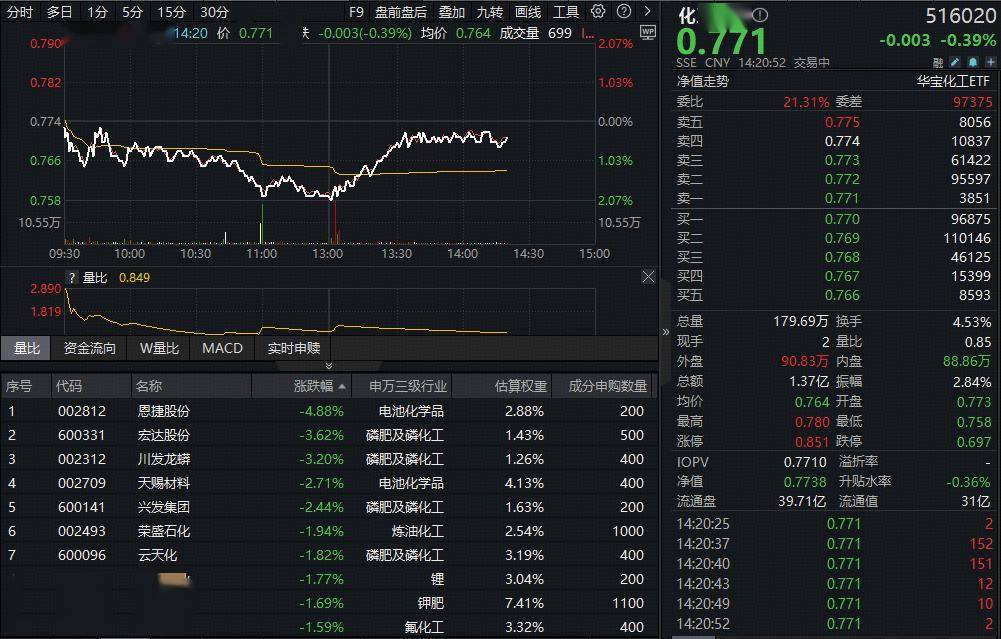
Group 1 - The chemical sector continues to experience a downward trend, with the Chemical ETF (516020) showing a decline of 0.39% as of the latest update, after a drop of over 2% during the day [1] - Key stocks in the lithium battery and phosphate chemical sectors have seen significant declines, with Enjie Co. down over 4%, and Hongda Co. and Chuanfa Longmang both down over 3% [1] - The Chemical ETF has shown a year-to-date increase of 24.89%, outperforming major A-share indices such as the Shanghai Composite Index (14.41%) and the CSI 300 Index (13.18%) [1][3] Group 2 - The basic chemical industry is expected to benefit from supply-side reforms driven by "anti-involution" policies, leading to an improved supply-demand balance and increased market share for leading companies [4] - The phosphoric and potash sectors are experiencing high demand, with stable prices for phosphate rock and steady growth in potash demand [4] - The valuation of the Chemical ETF is relatively low, with a price-to-book ratio of 2.28, indicating a favorable long-term investment opportunity [4] Group 3 - The Chemical ETF (516020) tracks the sub-sector chemical industry index, covering various segments of the chemical industry, with nearly 50% of its holdings in large-cap leading stocks [5] - Investors can also access the chemical sector through linked funds of the Chemical ETF, enhancing investment efficiency [5]



2025年1-9月中国合成纤维产量为5951.2万吨 累计增长5.6%
Chan Ye Xin Xi Wang· 2025-11-24 03:24
Core Viewpoint - The report highlights the growth trends in China's synthetic fiber industry, indicating a production increase and positive market outlook for the coming years [1]. Industry Summary - As of September 2025, China's synthetic fiber production reached 6.77 million tons, reflecting a year-on-year growth of 4.8% [1]. - Cumulatively, from January to September 2025, the total production of synthetic fibers in China was 59.512 million tons, marking a cumulative growth of 5.6% [1]. - The data is sourced from the National Bureau of Statistics and compiled by Zhiyan Consulting, a leading industry research institution in China [1]. Company Summary - Listed companies in the synthetic fiber sector include Hengyi Petrochemical (000703), Rongsheng Petrochemical (002493), Xin Fengming (603225), Tongkun Co., Ltd. (601233), Hengli Petrochemical (600346), Jilin Chemical Fiber (000420), Huafeng Chemical (002064), Aoyang Health (002172), Taihe New Materials (002254), and Jiangnan High Fiber (600527) [1]. - The report emphasizes the importance of these companies in the context of the industry's growth and market dynamics [1].
