
中材科技

Search documents
午评:创业板指半日涨1.76%,全市场超4200只个股上涨
Feng Huang Wang· 2026-02-24 03:48
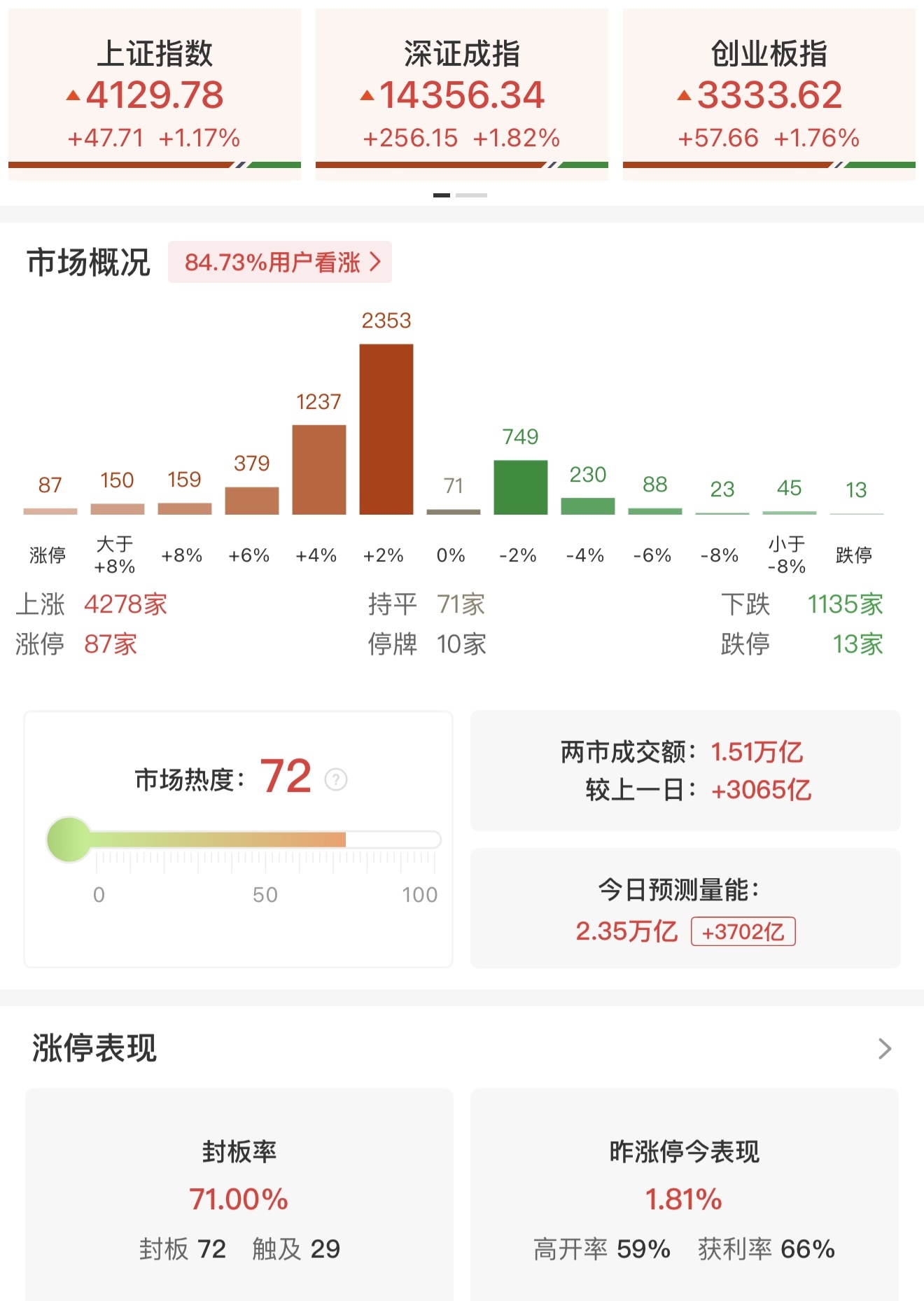
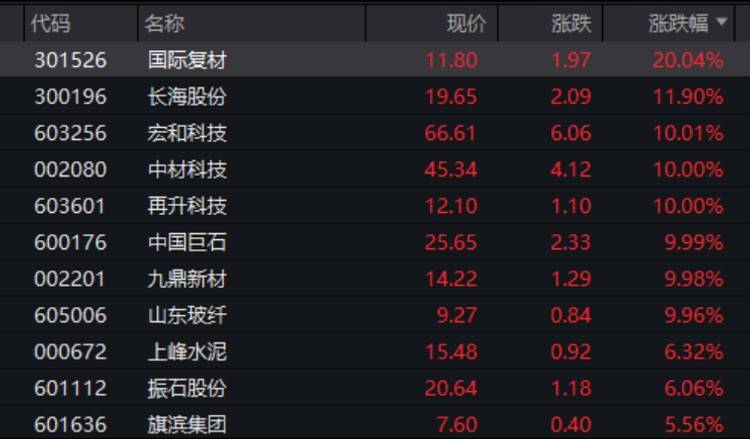
Market Overview - The market opened high on February 24 but retreated before rebounding, with all three major indices rising over 1% [1] - The total trading volume in the Shanghai and Shenzhen markets reached 1.51 trillion yuan, an increase of 306.5 billion yuan compared to the previous trading day [1] - By the end of the trading session, the Shanghai Composite Index rose by 1.17%, the Shenzhen Component Index increased by 1.82%, and the ChiNext Index gained 1.76% [1] Sector Performance - Oil and gas stocks experienced a collective surge, with companies like Zhun Oil Co., Shandong Molong, Intercontinental Oil & Gas, and Zhongman Petroleum hitting the daily limit [1] - The chemical sector saw significant growth, with Meibang Co. achieving four consecutive limit-ups, Jinniu Chemical hitting four limit-ups in seven days, and companies like Chengxing Co. and Jinpu Titanium Industry also reaching the daily limit [1] - The fiberglass concept remained active, with International Composites rising over four days and achieving two limit-ups, setting a new historical high [1] - Precious metals stocks also saw gains, with Hunan Silver hitting the daily limit [1] - Conversely, the film and cinema sector faced a collective decline, with Hengdian Film and Television, Bona Film Group, and China Film all hitting the daily limit down [1]


港股异动 | 中国建材(03323)涨超7% 公司在玻璃纤维领域具有领先优势
智通财经网· 2026-02-24 03:45
另外,中国建材此前预期2025年股东应占亏损至多约40亿元,主要因与水泥产能置换相关的60亿至83亿 元资产减值。美银证券发布研报称,亏损幅度远超该行预期。该行认为2025全年股息率约5%的预期将 面临风险。该行认为,此次资产减值属单次性质。随着水泥产能置换窗口将于3月底关闭,进一步减值 的空间有限。 消息面上,据报道,供应商和业内人士预计,由于成本上升和供应紧张,玻璃纤维制造商将掀起第二轮 涨价潮。计划中的月度调价幅度为10%至15%,若按当前计划推进,到年底价格可能翻倍。根据华泰证 券此前研报,中国建材在玻璃纤维领域具有领先优势,分别持有中材科技60.24%、中国巨石29.22%股 权。 智通财经APP获悉,中国建材(03323)涨超7%,截至发稿,涨6.92%,报6.8港元,成交额2.65亿港元。 ...
建筑材料行业跟踪周报:海外模型大厂融资落地,算力链条迎来新动力-20260224
Soochow Securities· 2026-02-24 03:28
证券研究报告·行业跟踪周报·建筑材料 建筑材料行业跟踪周报 海外模型大厂融资落地,算力链条迎来新动 力 增持(维持) [Table_Tag] [Table_Summary] 投资要点 2026 年 02 月 24 日 证券分析师 黄诗涛 执业证书:S0600521120004 huangshitao@dwzq.com.cn 行业走势 -10% -4% 2% 8% 14% 20% 26% 32% 38% 44% 2025/2/24 2025/6/22 2025/10/18 2026/2/13 建筑材料 沪深300 相关研究 《地产链有望继续震荡向上》 2026-02-08 《建筑、建材 2025Q4 公募基金持仓 低位回升,持仓集中度有所下降》 2026-02-08 东吴证券研究所 1 / 19 请务必阅读正文之后的免责声明部分 ◼ 本周(2026.2.7–2026.2.13,下同):本周建筑材料板块(SW)涨跌幅 2.86%,同期沪深 300、万得全 A 指数涨跌幅分别为 0.36%、1.11%,超 额收益分别为 2.50%、1.74%。 ◼ 大宗建材基本面与高频数据:(1)水泥:本周全国高标水泥市场价格为 ...
PCB概念股持续拉升,中材科技等多股创新高
Xin Lang Cai Jing· 2026-02-24 01:53
Group 1 - PCB concept stocks continue to rise, with companies such as Zhongcai Technology, Jiangnan New Materials, International Composites, Honghe Technology, China Jushi, and Tongguan Copper Foil reaching new highs during trading [1] - Shandong Glass Fiber and Tiantong Co., Ltd. hit the daily limit, while Mingyang Circuit and Delong Laser increased by over 10% [1] - Other companies like Yihau New Materials, Feilihua, and Shenzhen South Circuit also experienced gains [1]






氢能周度观察(11):液氢储运产业进展如何?-20260224
Changjiang Securities· 2026-02-24 00:35
联合研究丨行业点评 [Table_Title] 氢能周度观察(11):液氢储运产业进展如何? 报告要点 [Table_Summary] 2025 年液氢储运技术加速突破,液氢储运正从示范走向规模化应用。液化能耗持续优化,规模 化建设是降本的关键,可显著降低单位能耗与成本。在长距离运输场景中,液氢已展现出比高 压气态方式更优的经济性,运输效率大幅提升,这成为推动氢能产业链加速降本与规模化的重 要动力。展望"十五五",预计氢能产业将向规模化、商业化深度演进。 分析师及联系人 [Table_Author] 徐科 司鸿历 贾少波 SAC:S0490517090001 SAC:S0490520080002 SAC:S0490520070003 SFC:BUV415 SFC:BVD284 李博文 盛意 SAC:S0490524080004 SAC:S0490525070006 请阅读最后评级说明和重要声明 2 / 6 %% %% %% %% research.95579.com 1 丨证券研究报告丨 %% %% %% %% research.95579.com 2 丨证券研究报告丨 cjzqdt11111 2026-02 ...
玻璃纤维短缺加剧,价格有望继续上调
Xuan Gu Bao· 2026-02-23 14:40
据上证报报道,供应商和业内人士预计,由于成本上升和供应紧张,玻璃纤维制造商将掀起第二轮涨价 潮。计划中的月度调价幅度为10%至15%,若按当前计划推进,到年底价格可能翻倍。此次预期涨价是 在2025年以来累计年涨幅超过50%的基础上进行的。 中材科技:玻璃纤维产品结构优化,价格同比上升,对主营利润贡献较大。 *免责声明:文章内容仅供参考,不构成投资建议 *风险提示:股市有风险,入市需谨慎 研究机构指出,特种玻纤布应科技时代而生。在算力时代下,AI硬件和终端设备均对芯片材料提出更 高要求,使得Low-DK,LowCTE纤维布迎来大规模放量,其中Low-DK用于主板基材,LowCTE用于芯 片封装基板。因AI需求爆发且供给壁垒高,均出现供不应求局面。未来在数据通信日趋高速且大容量 背景下,特种玻纤布将迎来量价齐升。 公司方面,据上证报表示, 宏和科技:称电子级玻璃纤维布市场需求量增加,公司产品售价受市场需求影响而增加,2025年公司预 计净利润为1.927-2.255亿元,同比增长745-889%。 ...
板块异动喧嚣,看穿资金才是关键
Sou Hu Cai Jing· 2026-02-18 13:01
Core Viewpoint - Recent market fluctuations have led to significant price movements in certain sectors, while others have shown weaker performance. The underlying behavior of institutional investors is crucial for understanding these market dynamics, but ordinary investors often lack access to this information [1]. Group 1: Market Movements - Various sectors have displayed notable performance, with specific stocks experiencing significant price volatility [1]. - New stock listings have also shown marked changes in market performance, particularly in the Hong Kong stock market where certain stocks surged due to positive news [1]. Group 2: Institutional Inventory - "Institutional inventory" serves as a key indicator of institutional investor activity, similar to health metrics that reflect overall vitality rather than just food intake [2][3]. - The concept of institutional inventory is derived from analyzing long-term trading data to identify unique patterns in institutional trading behavior, visualized as active orange bars [3]. Group 3: Importance of Institutional Participation - Price increases without corresponding activity in institutional inventory should be approached with caution, as this may indicate a lack of genuine support for the price movement [5]. - Active institutional inventory during price adjustments suggests that institutional investors remain engaged, providing a more reliable basis for market stability [11]. Group 4: Data-Driven Investment Decisions - Monitoring institutional inventory can help investors avoid emotional decision-making based on market fluctuations, allowing for more rational investment strategies [13]. - The use of quantitative data, represented by the active institutional inventory, can guide investors in understanding the true sentiment of institutional capital without needing extensive financial knowledge [13].
建材新材料行业研究:AI PCB升级迭代,通胀看上游新材料
SINOLINK SECURITIES· 2026-02-13 14:24
Investment Rating - The industry is rated as "Buy" with expectations of an increase exceeding 15% in the next 3-6 months [57]. Core Insights - The report emphasizes that upstream materials are a key inflationary component in the PCB upgrade iteration process, with three main conclusions: the number of PCBs is increasing, the value of PCBs per cabinet/GPU is rising, and upstream materials are undergoing continuous upgrades [2][8]. - The market is focusing on materials that are close to "ultimate" technology or "upgrade" directions, indicating a potential profit release in 2026 [3][18]. - The report highlights the significant price inflation in electronic fabrics, particularly Low-CTE and Q fabrics, driven by supply constraints and increasing demand from high-end applications [4][15][24]. Summary by Sections Upstream Materials - The report identifies that the PCB board count is increasing, and the corresponding value per cabinet/GPU is also on the rise, particularly with the introduction of new PCB designs like the Vera Rubin NVL144 CPX [2][8]. - Continuous upgrades in PCB upstream materials are necessary to meet the higher demands for transmission speed and signal integrity from AI applications [11][12]. - Upstream materials are prone to inflation, with significant price differences observed in various generations of electronic fabrics [15][18]. Electronic Fabrics - The report predicts a continued price increase for Low-CTE fabrics in 2026 due to supply shortages and rising demand from high-end applications [4][36]. - The second-generation Low-Dk fabrics are expected to face a clear supply-demand gap in 2026, driven by the large-scale deployment of Google's TPU V7 and above [36][37]. - Q fabrics are highlighted for their superior performance and scarcity, with a gradual increase in production expected in 2027 [26][34]. Copper Foil - The report notes a clear upgrade trend in HVLP copper foil, with significant price increase potential due to rising demand from AI applications and planned expansions by leading manufacturers [5][41]. - The market for carrier copper foil is identified as a second growth pole, with a current global market size of approximately 5 billion, primarily dominated by Japanese companies [49][50]. Resins - The report discusses the importance of resin types, particularly carbon-hydrogen resins, in high-frequency and high-speed applications, with domestic companies accelerating production to meet demand [51][54].


AI PCB升级迭代,通胀看上游新材料
SINOLINK SECURITIES· 2026-02-13 09:54
Investment Rating - The industry is rated as "Buy" with an expected increase of over 15% in the next 3-6 months [57]. Core Insights - The report emphasizes that upstream materials are a key inflationary component in the PCB upgrade iteration process, with three main conclusions: the number of PCBs is increasing, the value of PCBs per cabinet/GPU is rising, and upstream materials are undergoing continuous upgrades [2][8]. - The market is focusing on materials that are close to "ultimate" technology or "upgrade" directions, indicating a potential profit release in 2026 [3][18]. - The report highlights the significant price inflation in electronic fabrics, particularly Low-CTE and Q fabrics, driven by supply constraints and increasing demand from AI applications [4][15][26]. Summary by Sections Upstream Materials - The report identifies that the PCB upgrade process is characterized by increasing PCB quantities and value, with a focus on the evolving requirements for materials such as electronic fabrics, copper foil, and resins [2][8]. - It notes that the industry trends for upstream materials lag behind PCB developments by 0.5-1 year, suggesting a delayed but strong profit release potential in 2026 [3][21]. - The sensitivity of material prices to market trends is highlighted, indicating that cost structures and supply dynamics are favorable for upstream materials [3][22]. Electronic Fabrics - The report predicts a continued price increase for Low-CTE fabrics due to supply shortages and rising demand, particularly from high-end applications [4][38]. - Q fabrics are expected to see significant adoption starting in 2027, with a strong short-term outlook due to supply constraints [26][34]. - The second-generation Low-Dk fabrics are anticipated to face a clear supply-demand gap in 2026, driven by the large-scale rollout of Google's TPU V7 and above [36][37]. Copper Foil - The report discusses the clear upgrade path for HVLP copper foil, with major producers expanding capacity and confirming strong demand trends [5][41]. - The market for carrier copper foil is identified as a second growth area, with a current global market size of approximately 5 billion, primarily dominated by Japanese firms [49]. - Price increases for HVLP copper foil are expected, supported by strong demand from AI and high-performance computing applications [46][45]. Resins - The report highlights the importance of resin types in high-frequency and high-speed applications, with carbon-hydrogen resins being the mainstream choice for advanced PCBs [51][54]. - Domestic companies are accelerating production to meet the growing demand for high-performance resins, indicating a shift towards local supply chains [54].

氢能与核聚变能将伴随资本市场共同成长
Zhong Guo Fa Zhan Wang· 2026-02-13 07:33
Core Insights - Hydrogen and nuclear fusion energy are identified as key economic growth points in China's 14th Five-Year Plan, emphasizing the importance of a mature capital market for supporting breakthroughs in these industries [1][2][3] - The global energy landscape is undergoing significant transformation towards decarbonization and smart restructuring, with hydrogen and nuclear fusion positioned as disruptive future energy solutions [2][3] Global Industry Landscape - The hydrogen industry is entering a phase of commercialization and rapid expansion, driven by strategic planning and policy incentives in developed economies, leading to high valuations for hydrogen technology companies [3] - Nuclear fusion is transitioning from government-led research to a public-private partnership model, attracting significant investment from venture capital and tech giants, reflecting strong market expectations for its long-term potential [3] China's Role in Global Capital Landscape - China is becoming an increasingly important player in the global renewable energy capital landscape, with its vast market potential and rapid development in hydrogen and nuclear fusion attracting international capital [3][4] - To enhance its competitive position, China must focus on original technology leadership, self-sufficiency in core supply chains, and building a more internationalized and market-oriented innovation capital ecosystem [3][4] Capital Market Empowerment - The development of hydrogen and nuclear fusion industries in China is characterized by a "national leadership, market participation, and capital promotion" model, with the capital market playing a crucial role in driving innovation [4][5] - In the hydrogen sector, China has established a complete industrial chain, with capital market support focusing on upstream hydrogen production, midstream storage and transportation, and downstream applications [4][5] Technological Challenges and Investment Dynamics - Both hydrogen and nuclear fusion face significant technological and economic challenges, requiring substantial long-term capital investment and a shift in investment logic towards patience and long-termism [6][7] - The hydrogen sector's challenges include reducing production costs and improving storage and transportation efficiency, while nuclear fusion faces fundamental scientific hurdles that require decades of research [7][8] Policy and Financial Collaboration - Policy and finance are essential drivers for the development of hydrogen and nuclear fusion industries, with the capital market's role evolving from a passive financing channel to an active enabler and value integrator [8][9] - For hydrogen, policies should create stable expectations and clear pathways, while for nuclear fusion, establishing specialized funds and supportive regulatory frameworks is crucial for attracting investment [9][10] Opportunities for Securities Firms - The success of hydrogen and nuclear fusion will reshape global capital dynamics and investment paradigms, creating new asset classes and investment opportunities [10][11] - Securities firms are tasked with broadening financing channels, innovating financial products, and enhancing research capabilities to support the growth of these industries [10][11] Future Implications - The capital influx into hydrogen and nuclear fusion signifies a broader investment in future energy solutions, which will fundamentally alter the logic of capital markets and global financial landscapes [12][13] - This shift will lead to the emergence of new asset valuation models and accelerate the transition of global capital towards sustainable technologies [12][13]