
丸美生物

Search documents
大消费行业周报:2025年社零首破50万亿,关注细分赛道机会-20260125
Ping An Securities· 2026-01-25 11:09
Investment Rating - The industry investment rating is "stronger than the market," indicating that the industry index is expected to outperform the market by more than 5% in the next six months [28]. Core Insights - The total retail sales of consumer goods in 2025 are projected to exceed 50 trillion yuan, highlighting significant growth potential in the consumer sector [4][10]. - The report emphasizes the importance of focusing on specific segments within the consumer industry, such as tourism, beauty, jewelry, media, and food and beverage, which are expected to show resilience and growth [4][10]. Summary by Relevant Sections Social Services - The tourism sector is expected to continue its recovery, with leading companies responding effectively to changing consumer demands, particularly as the Spring Festival approaches [4]. - The beauty industry is experiencing steady growth, with a focus on companies that can quickly adapt to market dynamics [4]. - The jewelry sector presents investment opportunities, particularly for brands that can increase market share and maintain strong performance [4]. Food and Beverage - Alcohol - Major liquor companies are experiencing a deeper decline in net profits compared to previous quarters, but leading firms are expected to enhance market share through effective brand management [4]. - The report identifies three key investment lines: high-end liquor with stable demand, mid-range liquor with national expansion, and local real estate liquor [4]. Food and Beverage - General - The at-home dining market, represented by companies like Guoquan, shows significant growth potential, with a focus on product, channel, and supply chain advantages [4]. - The restaurant sector is entering a peak season with the upcoming Spring Festival, and supply chain conditions are stabilizing [4]. Key Company Announcements - China Duty Free Group is expanding its international retail market presence through a strategic partnership with LVMH, which includes a significant acquisition [12]. - Meili Tianyuan is forecasting a revenue increase of at least 16% in 2025, driven by both external acquisitions and strong internal growth [15]. - Longzi Co. is expecting a net profit of 9-10.5 billion yuan for 2025, indicating a positive outlook despite some adjustments in financial reporting [15].
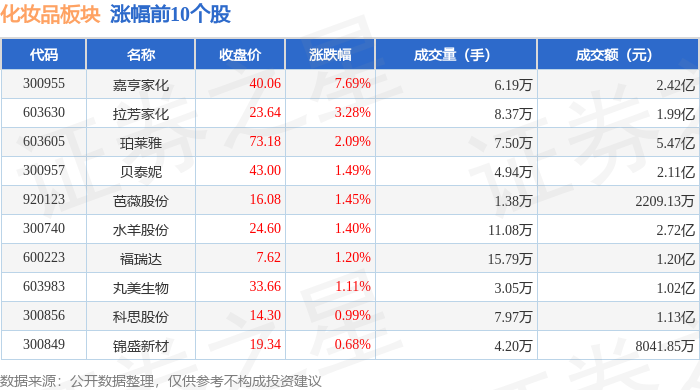
化妆品板块1月23日涨1.34%,嘉亨家化领涨,主力资金净流出3535.3万元
Zheng Xing Xing Ye Ri Bao· 2026-01-23 09:07
Group 1 - The cosmetics sector experienced a rise of 1.34% on January 23, with Jiaheng Jiahua leading the gains [1] - The Shanghai Composite Index closed at 4136.16, up 0.33%, while the Shenzhen Component Index closed at 14439.66, up 0.79% [1] - Jiaheng Jiahua's stock price increased by 7.69% to 40.06, with a trading volume of 61,900 shares and a transaction value of 242 million yuan [1] Group 2 - The cosmetics sector saw a net outflow of 35.35 million yuan from institutional investors, while retail investors had a net inflow of 31.72 million yuan [2] - Key stocks in the sector included Qingdao Jinwang, which had a net inflow of 13.85 million yuan from institutional investors, but a net outflow of 21.21 million yuan from speculative funds [3] - Jiaheng Jiahua had a net inflow of 11.11 million yuan from institutional investors, but also saw a net outflow of 1.77 million yuan from speculative funds [3]





申万宏源研究晨会报告-20260123
Shenwan Hongyuan Securities· 2026-01-23 01:10
Group 1: Gold Market Analysis - The bull market for gold is not over, with macro factors remaining optimistic and short-term fluctuations driven by geopolitical events [3][11][13] - Key macro pricing factors for gold have not changed, indicating a sustained upward potential in the medium to long term [3][13] - Micro indicators show that while gold price deviations are high, the RSI is healthy, and ETF inflows continue to rise, suggesting no clear direction for gold prices [3][13] Group 2: Semiconductor Industry Insights - TSMC's revenue for December 2025 is projected to grow by 20.4% year-on-year, driven by high-margin advanced processes and strong demand from AI/HPC sectors [4][12] - The advanced process capacity is fully loaded, with HPC accounting for 55% of revenue and 3nm technology representing 28% of wafer revenue [4][12] - TSMC's guidance for Q1 2026 indicates revenue between $34.6 billion and $35.8 billion, with a gross margin of 63%-65%, reflecting strong demand visibility in AI [4][14] Group 3: Beauty Industry Trends - The South Korean beauty market has undergone several growth and decline phases, with the current phase focusing on global market expansion and reducing reliance on China [18][20] - New brands like APR and Silicon2 are outperforming traditional giants, indicating a shift in market dynamics and consumer preferences [20] - The report highlights the importance of innovation in product formulation and packaging, with South Korean brands leading in areas like cushion packaging and functional skincare products [20]
富国消费主题混合C基金近3年单位净值下跌23.03% 长期重仓白酒股
Xi Niu Cai Jing· 2026-01-22 14:45
Core Insights - The performance of the Fuqua Consumer Theme Mixed Fund has attracted market attention, particularly since the establishment of its C-class shares, which has seen a decline in net asset value [2][4] Fund Performance - The C-class shares of the Fuqua Consumer Theme Mixed Fund have experienced a 29.9% decline in net asset value since their inception on January 18, 2021, with a 23.03% drop over the past three years and a modest 1.03% increase over the last year [2][3] - As of January 19, 2026, the fund's net asset value stood at 2.1520, with a recent monthly performance of -0.55% and a three-month decline of 6.19% [3] Fund Management - The fund is managed by Wang Yuanyuan, who has been with Fuqua Fund since April 2015 and has held various positions, including industry researcher and senior equity fund manager [3][4] - As of the end of Q3 2025, the fund's net asset value was approximately 4.241 billion, with 91.4% of its assets allocated to stocks and no bonds held [3] Investment Strategy - The fund has historically maintained a heavy allocation to liquor stocks, particularly Kweichow Moutai, which saw a 6.47% decline in stock price in 2025 [4] - Wang Yuanyuan indicated in the fund's Q3 report that the fund is looking to increase its allocation to the liquor sector based on low valuation levels and potential stabilization in 2026, while also screening for opportunities in the new consumption sector [4] - The fund aims to focus on high-quality growth companies in the domestic consumer sector, emphasizing brand concentration and international expansion as key growth drivers [4]
从韩国美妆发展看如何重建新增长动能:品牌格局重塑,全球战略扩张
Shenwan Hongyuan Securities· 2026-01-22 11:06
业 研 究 / 行 业 点 相关研究 行 业 及 产 业 美容护理 2026 年 01 月 22 日 证 券 研 究 报 告 证券分析师 王立平 A0230511040052 wanglp@swsresearch.com 聂霜 A0230524120002 nieshuang@swsresearch.com 联系人 聂霜 A0230524120002 nieshuang@swsresearch.com 品牌格局重塑,全球战略扩张 看好 ——从韩国美妆发展看如何重建新增长动能 本期投资提示: 请务必仔细阅读正文之后的各项信息披露与声明 本研究报告仅通过邮件提供给 中庚基金 使用。1 ⚫ 韩国美妆市场相对成熟,进行国际化探索早,并随着自身国家综合实力、本土需求与国 际市场需求的变化,发展经历数次沉浮,其展现的发展路径值得国货公司参考借鉴。我 们通过对韩国美妆市场的研究,探索韩国美妆在不同的发展阶段,崛起的美妆集团组织 架构的特点,如何在需求端快速变化的产品领域加速推新,在新成分、新剂型等领域如 何走在全球市场前端,以及拥抱全球市场背后所需要的能力。 ⚫ 韩国美妆四大成长与衰退阶段,把握低谷紧抓转型,再临高峰。韩国 ...
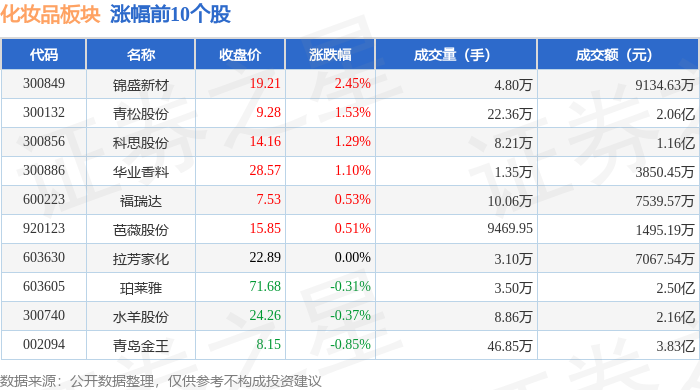
化妆品板块1月22日跌0.44%,贝泰妮领跌,主力资金净流出5488.34万元
Zheng Xing Xing Ye Ri Bao· 2026-01-22 09:02
Market Overview - The cosmetics sector experienced a decline of 0.44% on January 22, with Betaini leading the drop [1] - The Shanghai Composite Index closed at 4122.58, up 0.14%, while the Shenzhen Component Index closed at 14327.05, up 0.5% [1] Individual Stock Performance - Notable gainers included: - Jingsheng New Materials (300849) with a closing price of 19.21, up 2.45% on a trading volume of 48,000 shares and a turnover of 91.35 million yuan [1] - Qingsong Co. (300132) closed at 9.28, up 1.53% with a trading volume of 223,600 shares and a turnover of 206 million yuan [1] - Kesheng Co. (300856) closed at 14.16, up 1.29% with a trading volume of 82,100 shares and a turnover of 116 million yuan [1] - Decliners included: - Betaini (300957) closed at 42.37, down 1.42% with a trading volume of 71,400 shares [2] - Jiahen Home (300955) closed at 37.20, down 1.30% with a trading volume of 19,000 shares and a turnover of 71.10 million yuan [2] - Shanghai Jahwa (600315) closed at 23.41, down 1.22% with a trading volume of 89,200 shares [2] Capital Flow Analysis - The cosmetics sector saw a net outflow of 54.88 million yuan from institutional investors, while retail investors experienced a net inflow of 82.39 million yuan [2] - Key stocks with significant capital flow include: - Kesheng Co. (300856) with a net inflow of 12.48 million yuan from institutional investors [3] - Qingsong Co. (300132) with a net inflow of 9.15 million yuan from institutional investors [3] - Shanghai Jahwa (600315) had a net inflow of 4.16 million yuan from institutional investors [3]
化妆品交易额破1.1万亿元,线上销量占比接近2/3
Sou Hu Cai Jing· 2026-01-21 19:18
Core Insights - The Chinese cosmetics industry is projected to reach a total transaction value of 1.104245 trillion yuan by 2025, marking a year-on-year growth of 2.83%, and maintaining its position as the world's largest cosmetics consumer market [1][6]. Market Overview - The market is undergoing a significant transformation, with resources concentrating on leading brands and technology-driven companies, while weaker brands are being eliminated [3][9]. - The market share of domestic brands has increased for four consecutive years, reaching 57.37% by 2025, indicating a shift towards a "domestic brand-led" market [3][6]. Brand Dynamics - The number of brands with sales exceeding 100 million yuan is expected to rise from 746 in 2023 to 839 in 2025, reflecting an improvement in brand quality [6]. - The top 1000 online brands are increasingly dominated by domestic brands, which are now competing effectively against traditional powerhouses from France, the USA, Japan, and South Korea [3][6]. Market Structure Changes - The industry is experiencing a significant shakeout, with an estimated 27,000 brands expected to be eliminated by 2025, and only about 26% of lower-tier brands projected to achieve growth [9][12]. - The market is shifting from quantity-based competition to quality-based competition, focusing on brand value, technological innovation, and user experience [9][12]. Consumer Behavior - Consumer preferences are evolving towards high-cost performance products priced below 300 yuan and high-end products above 1000 yuan, while the mid-range market is being squeezed [13]. - The new consumer consensus emphasizes rational and refined purchasing decisions, focusing on ingredients, efficacy, cultural identity, and emotional value [13]. Regulatory Environment - New regulations are being introduced to create a fair competitive environment for both online and offline channels, with offline spaces being redefined as comprehensive areas for brand experience and social interaction [14]. - The regulatory framework is shifting from strict control to promoting development, with a focus on innovation incentives and reducing entry barriers for new products [14]. Technological Innovation - The integration of artificial intelligence is expected to reshape the industry significantly between 2026 and 2030, enhancing research and development, personalized content production, and supply chain efficiency [17]. - Companies are increasingly investing in R&D, with the average R&D expense ratio rising from 2.36% to 3.24% over five years, highlighting a trend towards innovation-driven growth [14][17]. Future Outlook - The industry aims to transition from being a "cosmetics manufacturing power" to a "cosmetics strong power," focusing on intelligent, green, and integrated development [16][18]. - The market is expected to expand towards the "silver economy" and international markets, with domestic brands enhancing their global presence [16][15].

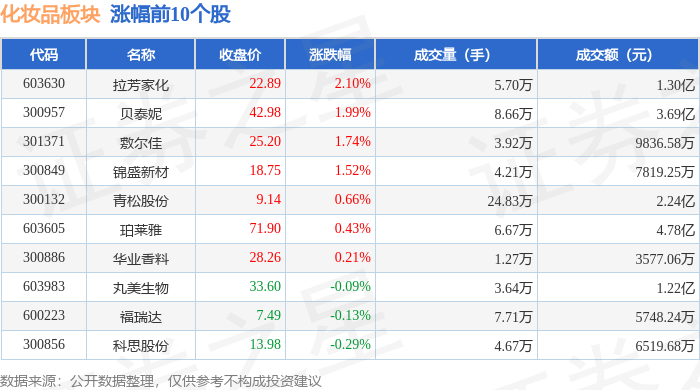
化妆品板块1月21日涨0.25%,拉芳家化领涨,主力资金净流出5552.25万元
Zheng Xing Xing Ye Ri Bao· 2026-01-21 09:08
Group 1 - The cosmetics sector experienced a slight increase of 0.25% on January 21, with Lafang Jiahua leading the gains [1] - The Shanghai Composite Index closed at 4116.94, up 0.08%, while the Shenzhen Component Index closed at 14255.12, up 0.7% [1] - Lafang Jiahua's closing price was 22.89, reflecting a rise of 2.10%, with a trading volume of 57,000 shares and a transaction value of 130 million yuan [1] Group 2 - The cosmetics sector saw a net outflow of 55.52 million yuan from institutional investors, while retail investors had a net inflow of 30.86 million yuan [2] - The trading data for various companies showed mixed performance, with some companies like Betaini and Lafang Jiahua experiencing net outflows from institutional investors [3] - Betaini had a net outflow of 14.09 million yuan from institutional investors, while Lafang Jiahua saw a net inflow of 13.43 million yuan [3]

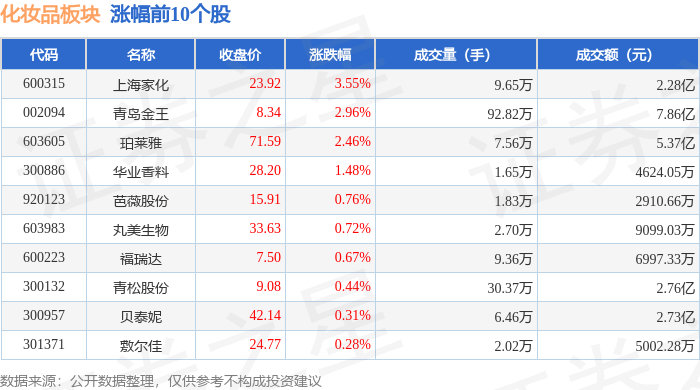
化妆品板块1月20日涨1.11%,上海家化领涨,主力资金净流入3030.2万元
Zheng Xing Xing Ye Ri Bao· 2026-01-20 08:59
Group 1 - The cosmetics sector experienced a rise of 1.11% on January 20, with Shanghai Jahwa leading the gains [1] - The Shanghai Composite Index closed at 4113.65, down 0.01%, while the Shenzhen Component Index closed at 14155.63, down 0.97% [1] - Key stocks in the cosmetics sector showed varied performance, with Shanghai Jahwa closing at 23.92, up 3.55%, and Qingdao Kingking at 8.34, up 2.96% [1] Group 2 - The cosmetics sector saw a net inflow of 30.3 million yuan from institutional investors, while retail investors experienced a net outflow of 54.5 million yuan [2] - Notable individual stock performances included Shanghai Jahwa with a net inflow of 20.5 million yuan from institutional investors, and Qingdao Kingking with a net inflow of 23.3 million yuan [3] - The overall market sentiment reflected a mixed response, with some stocks like Banlaya experiencing significant net outflows from both institutional and retail investors [3]

社零数据点评:12月社零+0.9%,化妆品持续复苏
HUAXI Securities· 2026-01-19 08:49
Investment Rating - Industry rating: Recommended [4] Core Insights - The retail sales of consumer goods in December 2025 showed a year-on-year increase of 0.9%, which was below the expected 1.5%. The total retail sales for the year 2025 increased by 3.7% year-on-year, with specific categories such as furniture, cultural office supplies, cosmetics, and gold and silver jewelry showing growth rates of 14.6%, 17.3%, 5.1%, and 12.8% respectively [1][2] - The real estate sector faced significant challenges, with new housing starts, completed areas, sales areas, and investment in residential development all declining year-on-year by 18.8%, 20.6%, 18.9%, and 36.5% respectively in December 2025 [2][3] Summary by Category Home Furnishing - The home furnishing industry is expected to stabilize due to dual support from policies and the economy. The real estate market is showing signs of gradual recovery, which is anticipated to improve the demand for home furnishings [2] - The implementation of trade-in subsidies for durable consumer goods starting in Q4 2024 is expected to significantly activate consumer demand for home furnishings [2] Cosmetics - The cosmetics industry is experiencing steady recovery, with retail sales reaching 465.3 billion yuan in 2025, a year-on-year increase of 5.1%. December sales alone were 38 billion yuan, reflecting an 8.8% year-on-year growth [3][6] - The demand for cosmetics is shifting towards quality, efficacy, and brand value, with consumers willing to pay a premium for high-end skincare and professional makeup products [3][6] Gold and Jewelry - The gold and jewelry sector saw retail sales of 373.6 billion yuan in 2025, a year-on-year increase of 12.8%. In December, sales were 32.8 billion yuan, with a 5.9% year-on-year growth [7] - Despite pressure on sales volumes due to rising gold prices, the increase in prices has positively impacted retail sales, indicating a potential for continued growth in the market [7] Investment Recommendations - For home furnishing, focus on leading companies with strong channel capabilities and diversified product lines, such as Oppein Home and Kuka Home. Also, consider companies like Sensun Holdings that are expected to benefit from the recovery in the North American real estate market [8] - In the cosmetics sector, pay attention to high-end brands with Eastern cultural characteristics, such as Mao Geping and Lin Qingxuan, as well as companies like Marubi and Dengkang Oral that show clear improvement trends [8] - In the gold and jewelry sector, companies with high brand premium capabilities and differentiated pricing models, such as Laopu Gold, are recommended due to the ongoing upward trend in gold prices [8]