国星宇航

Search documents
商业航天行业:太空光伏,逐日天穹,叩问千亿星辰市场
2026-01-26 02:49
Summary of the Conference Call on the Space Photovoltaics Industry Industry Overview - **Industry Focus**: Space Photovoltaics - **Key Players**: SpaceX, Amazon, Chinese satellite companies - **Market Potential**: Estimated to reach a trillion-dollar market Core Insights and Arguments 1. **Cost Reduction through Reusable Technology**: The advent of reusable rocket technology has significantly lowered launch costs, creating a golden opportunity for space photovoltaics. The successful exploration of reusable rockets by companies like SpaceX has led to a rapid decrease in launch costs, making commercial space activities more frequent [5][23][24] 2. **US-China Competition in Commercial Space**: The competition between the US and China in commercial space is accelerating, particularly in low Earth orbit (LEO) communications satellites, which is expected to drive demand for solar wings. The US currently leads in LEO satellite deployment, with China planning to submit applications for 203,000 satellites to the International Telecommunication Union (ITU) by December 2025, aiming to secure valuable orbital resources [5][44][46] 3. **AI and Space Computing**: The concept of deploying AI data centers in space is gaining traction among tech giants. Space-based computing, or "computing in space," is seen as a solution to energy and space limitations. The cost of deploying a 40MW AI data center in space is estimated at $8.2 million, significantly lower than ground deployment costs [5][52][53] 4. **Technological Developments in Photovoltaics**: - **Gallium Arsenide (GaAs)** is currently the mainstream choice for space photovoltaics due to its excellent performance, though it is costly and has material sourcing limitations. - **Heterojunction (HJT)** technology is expected to be a significant choice for large-scale industrialization due to its efficiency and simpler manufacturing process. - **Perovskite technology** shows promise but lacks sufficient empirical data for large-scale application in the short term [5][64] 5. **Investment Recommendations**: The space photovoltaics sector is entering an active exploration phase, with equipment manufacturers poised to benefit. Key companies to watch include: - **HJT/Perovskite Equipment Suppliers**: Maiwei Co., Aotwei, and Jiejia Weichuang - **Comprehensive Photovoltaic Companies**: Jing Sheng Mechanical and Gao Ce Co. [5][5] Additional Important Content 1. **Risks**: Potential risks include slower-than-expected development of the commercial space industry, uncertainties in the technological pathways for space photovoltaics, and lower-than-expected investment and application demand for space computing [5][5] 2. **Market Dynamics**: The global satellite launch frequency has increased significantly since 2020, with projections indicating around 4,000 launches annually by 2025, marking a growth rate exceeding 50% [5][38] 3. **Future Projections**: The estimated demand for space photovoltaics from existing satellite plans could reach nearly 10GW in the near term, with significant growth expected as more satellites are deployed [5][46][62] 4. **Cost Comparisons**: The Levelized Cost of Energy (LCOE) for space photovoltaics is projected to decrease significantly due to reduced launch costs and advancements in technology, potentially reaching $0.04/kWh by 2050 [5][33][34] 5. **Global Competition**: The competition for orbital resources is intensifying, with the US and China leading the charge in satellite deployments, highlighting the strategic importance of space resources [5][42][43] This summary encapsulates the key points discussed in the conference call regarding the space photovoltaics industry, emphasizing the technological advancements, market dynamics, and investment opportunities within this rapidly evolving sector.




“星算·智联”太空算力研讨会将召开;报道称三星电子将一季度NAND价格上调100%丨盘前情报
2 1 Shi Ji Jing Ji Bao Dao· 2026-01-26 01:01
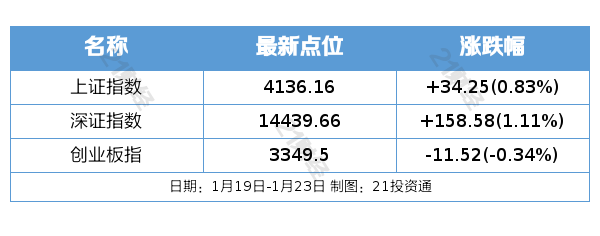
Market Performance - A-shares showed mixed performance in the past week, with the Shanghai Composite Index closing at 4136.16 points, up 0.83%, and the Shenzhen Component Index at 14439.66 points, up 1.11%. However, the ChiNext Index fell by 0.34% to 3349.50 points [1][2] - Over 77% of stocks experienced gains during the week, with 237 stocks rising over 15%, while only 14 stocks fell more than 15% [1] Sector Performance - The building materials, oil and petrochemicals, steel, and basic chemicals sectors saw increases, while the banking, telecommunications, non-bank financials, and food and beverage sectors experienced declines [1] International Market Overview - In the U.S. market, the Dow Jones Industrial Average fell by 285.30 points to 49098.71 points, a decrease of 0.58%. The S&P 500 rose slightly by 2.26 points to 6915.61 points, while the Nasdaq Composite increased by 65.22 points to 23501.244 points [3][4] - European markets showed mixed results, with the FTSE 100 down 0.07%, the CAC 40 down 0.07%, and the DAX up 0.18% [3][4] Commodity Prices - International oil prices rose, with WTI crude oil increasing by $1.71 to $61.07 per barrel, a rise of 2.88%, and Brent crude oil up by $1.82 to $65.88 per barrel, a rise of 2.84% [3][4] Industry Insights - The upcoming "Star Computing and Intelligent Connection" seminar aims to promote the integration of space information and intelligent computing, with a focus on developing a space computing infrastructure [5] - The global space economy is projected to reach $1.8 trillion by 2035, driven by the emergence of space infrastructure and applications [5] - Samsung Electronics plans to raise NAND flash memory prices by over 100% in Q1, indicating a significant supply-demand imbalance in the semiconductor market [7] - The Chinese securities market is expected to see a rise in demand for storage products due to AI-driven growth, with recommendations to focus on various segments of the storage industry [8] Investment Recommendations - Analysts suggest focusing on satellite internet and related sectors, including potential operators, communication equipment providers, and application service providers [5] - The semiconductor storage chain is viewed as having high certainty opportunities, with recommendations for companies involved in distribution, IC design, and domestic semiconductor supply chains [8]

2026太空赛道杀疯了!可回收火箭突破临界点,商业航天千亿产业链全曝光
材料汇· 2026-01-23 15:18
Core Viewpoint - The article emphasizes that commercial aerospace is poised for explosive growth by 2026, driven by government support, technological breakthroughs, capital influx, and market demand [6][8]. Group 1: Policy Support - The establishment of a Commercial Aerospace Department by the National Space Administration and supportive policies from over ten provinces have created a favorable environment for the industry [7][22]. - The government has included commercial aerospace in its work reports for two consecutive years, indicating a strategic focus on this sector [22]. Group 2: Technological Breakthroughs - Key advancements include successful tests of reusable rockets and the transition of satellite production to a "mass production" model, significantly enhancing launch capabilities [23][25]. - The Hainan launch site is now operational, supporting up to 16 high-density launches annually [23]. Group 3: Capital Influx - In 2025, the commercial aerospace sector saw a total financing of 18.6 billion yuan, a year-on-year increase of 32%, with significant investments in satellite applications and rocket manufacturing [28]. - More than ten companies are accelerating their IPO processes, indicating a robust interest from investors [28][29]. Group 4: Market Demand - The demand for low-orbit satellite constellations is increasing, with applications in satellite communication, space computing, and space tourism becoming more viable [7][35]. - The article highlights that there are 286 million non-internet users in China, representing a significant market opportunity for satellite communication services [7]. Group 5: Reusable Rocket Technology - Reusable rocket technology is expected to reduce launch costs by up to 60%, marking a shift towards "flight-like launches" in commercial aerospace [41]. - The first successful tests of vertical landing and recovery for rockets have been completed, with multiple rocket types set to debut in 2026 [42]. Group 6: Industry Structure - The commercial aerospace industry is characterized by a collaborative model involving state-owned enterprises, private companies, and local governments, creating a diversified ecosystem [16][22]. - The article outlines the differences between traditional and commercial aerospace, emphasizing the market-driven approach of the latter [15][16].
商业航天深度报告:火箭回收黎明将至,商业航天千帆竞发
Guoxin Securities· 2026-01-23 07:50
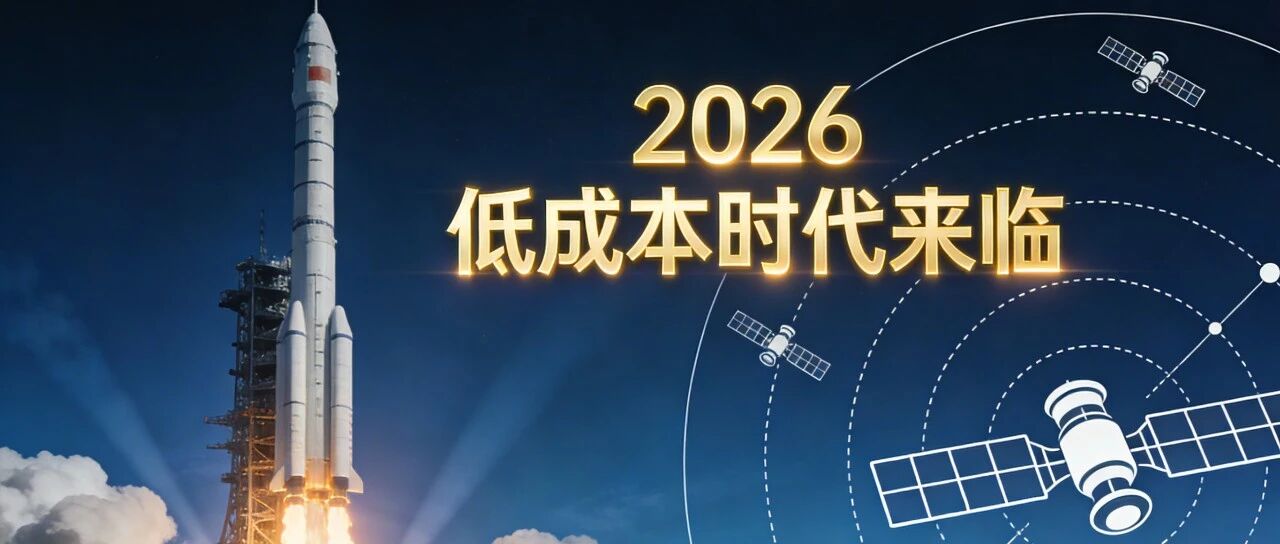
Investment Rating - The investment rating for the commercial aerospace industry is "Outperform the Market" (maintained) [1] Core Insights - The commercial aerospace sector is experiencing robust growth driven by a fourfold resonance of policy, technology, capital, and market dynamics. Key developments include clear policy frameworks, imminent technological breakthroughs in reusable rockets, increased capital inflow, and expanding market applications [2] - The industry is on the verge of entering a "Great Aerospace Era," with multiple rocket models expected to conduct reusable tests by 2025, paving the way for a low-cost era in commercial aerospace [2] - The commercial aerospace industry chain is entering a scale-up phase, with a projected increase of over 25% in rocket launches and satellite deployments in 2025 compared to 2024 [2] Summary by Sections 1. Policy, Technology, Capital, and Market Resonance - The commercial aerospace industry is supported by a series of government policies, including the establishment of a dedicated Commercial Aerospace Department and significant funding initiatives [20] - Technological advancements are imminent, particularly in reusable rocket technology, with several companies racing to validate their designs [21] - Capital market activity is high, with a projected total financing of 18.6 billion yuan in 2025, marking a 32% year-on-year increase [30] 2. Rocket Industry Chain - The rocket industry is characterized by a focus on reusable technology, which is expected to significantly reduce launch costs by up to 80% [13] - The industry is moving towards a more integrated supply chain, with upstream components and materials becoming increasingly valuable [66] 3. Satellite Industry Chain - The satellite manufacturing sector is transitioning to a mass production model, with several factories established to meet growing demand [26] - The cost structure of satellite production is being optimized through standardization and mass production techniques, leading to a decrease in unit costs [26] 4. Market Demand - National and commercial demands for satellite services are surging, driven by applications in military, telecommunications, and emerging sectors like space tourism [33][40] - The competition for low-Earth orbit resources is intensifying, with China submitting applications for over 200,000 satellites to the International Telecommunication Union [36]
ETF盘中资讯|重磅太空算力会议来袭!SpaceX将发射太阳能人工智能卫星?商业航天含量65%的通用航空ETF(159231)大涨3.4%强势收复10日均线
Sou Hu Cai Jing· 2026-01-23 03:31
Group 1 - The commercial aerospace and satellite navigation sectors are experiencing a resurgence, with stocks like Ruichuang Micro-Nano and Aerospace Electronics seeing significant gains of 20% and 10% respectively [1] - The General Aviation ETF Huabao (159231) is showing strong performance, up 3.4%, and has recovered its 10-day moving average, indicating positive market sentiment [1] - The upcoming "Star Computing and Intelligent Connection" seminar by the China Academy of Information and Communications Technology on January 26, 2026, will focus on advancements in space computing and infrastructure [3] Group 2 - The General Aviation ETF Huabao covers 50 aerospace stocks, with over 88% exposure to low-altitude economy, 65% to commercial aerospace, and 47% to satellite navigation, making it a comprehensive tool for investing in China's aerospace industry [4] - The fund does not charge a sales service fee, and the redemption fees are structured based on the holding period, with specific rates for different investment amounts [4]

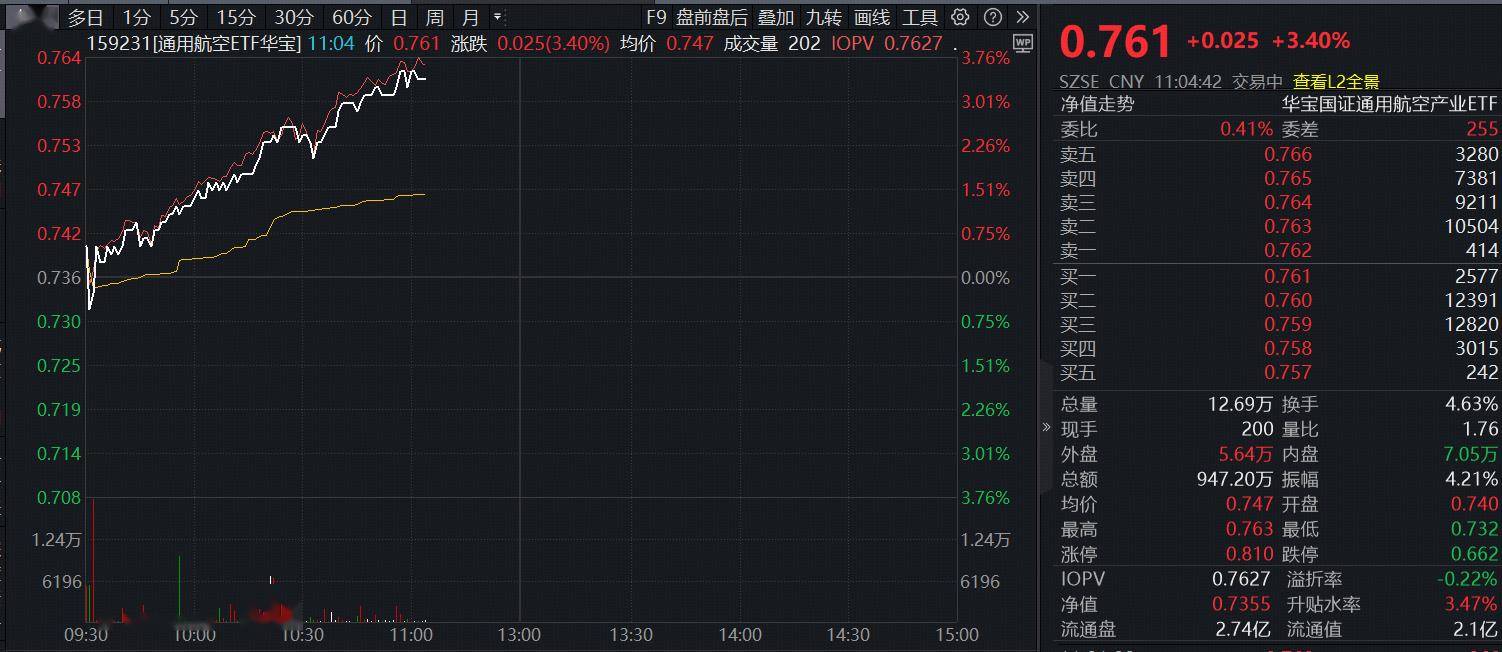
SpaceX将发射太阳能人工智能卫星?商业航天含量65%的通用航空ETF(159231)大涨3.4%强势收复10日均线
Xin Lang Cai Jing· 2026-01-23 03:19
Core Viewpoint - The commercial aerospace and satellite navigation sectors are experiencing a significant resurgence, with notable stock price increases for companies like Ruichuang Micro-Nano and Aerospace Electronics, indicating strong market interest and potential investment opportunities [1][5]. Group 1: Market Performance - Ruichuang Micro-Nano shares hit a 20% limit up, while Aerospace Electronics rose by 10%, and other companies like Zhongke Xingtou and Aerospace Huanyu saw increases of over 10% [1][5]. - The General Aviation ETF Huabao (159231) has seen its price rise by 3.4%, aiming for a third consecutive day of gains, and has successfully recovered its 10-day moving average [1][5]. Group 2: Industry Developments - The China Academy of Information and Communications Technology plans to hold a seminar on space computing power on January 26, 2026, which will include the launch of a report on the development of space computing [7]. - Elon Musk announced that SpaceX will launch solar-powered AI satellites in the coming years, as part of a broader initiative to develop solar energy capabilities [7]. - The national 14th Five-Year Plan emphasizes accelerating the development of the aerospace and low-altitude economy sectors, with various local policies being implemented to support this growth [7]. Group 3: Investment Opportunities - The General Aviation ETF Huabao covers 50 aerospace stocks, with over 88% exposure to low-altitude economy concepts, over 65% to commercial aerospace, and over 47% to satellite navigation, making it a strategic tool for investing in China's aerospace industry [8].
中国信通院:即将召开“星算 智联”太空算力研讨会 发布“算力星网”联合推进倡议
Zheng Quan Shi Bao Wang· 2026-01-23 02:51
人民财讯1月23日电,为深入贯彻落实国家关于发展新质生产力、建设航天强国和数字中国的重要部 署,把握空天信息与智能计算深度融合的战略机遇,谋划推动构建面向未来的太空算力基础设施体系。 中国信息通信研究院拟于1月26日召开2026年"星算.智联"太空算力研讨会。会议将举行"算力星网"联合 推进倡议暨《太空算力发展前瞻研究报告(2026年)》启动仪式。另外,国星宇航将介绍"国星宇航星算 计划",之江实验室将介绍"三体计算星座",北京空间飞行器总体设计部将进行太空数智基础设施发展 展望等。 ...
向天拓路:沿海城市台州的“低空”答卷
Xin Lang Cai Jing· 2026-01-21 07:05
Core Viewpoint - The establishment of the Zhejiang private "star chain" is marked by the successful launch of 64 satellites, achieving global communication coverage (excluding the polar regions) and supported by the Geely Satellite Super Factory in Taizhou Bay New Area, which innovates the aerospace industry with automotive manufacturing principles [1][3]. Industry Development - By 2025, Taizhou's low-altitude economy has developed a three-dimensional structure, with Taizhou Bay New Area leading as the only pilot zone for future aerospace industries and low-altitude economic integration in Zhejiang Province, ranking second nationally in industrial activity [3][4]. - The "one star, four machines" industrial concept initiated in 2016 has laid the foundation for Taizhou's aerospace ambitions, attracting key players like the China Aerospace Aerodynamics Research Institute and Geely's Taizhou Starry Sky Intelligent Technology Co., Ltd. [4][5]. Ecosystem and Collaboration - The establishment of a comprehensive industrial ecosystem includes partnerships with leading enterprises, resulting in a strategic ecological co-construction project worth billions in the special aircraft industry [4][5]. - By November 2025, seven projects with a total investment of 2.64 billion yuan were signed, enhancing the full industrial chain from manufacturing to operational services [5]. Technological Advancements - The successful launch of Geely's satellites and other significant projects like the "Tai Zhou" computing satellite and the "Blue Carbon No. 1" marine satellite highlight the region's advancements in aerospace technology [7]. - The integration of drones in various sectors, including agriculture and emergency services, demonstrates the practical applications of low-altitude logistics, significantly improving response times and operational efficiency [8][10]. Future Goals and Investments - Taizhou aims to establish itself as a national-level low-altitude economic comprehensive industrial demonstration zone, targeting an industry scale of 18 billion yuan by 2026 and 30 billion yuan by 2030 [13]. - The region has set up a low-altitude economic industry fund with an initial scale of 1 billion yuan, alongside various other funds to support the entire industrial cycle [13].

新一代AI基础设施,全球科技力量争相布局太空算力
Jin Rong Jie· 2026-01-19 23:43
Core Insights - The Space AI Center represents a new generation of AI infrastructure characterized by AI computing power deployment in space, aimed at overcoming energy, environmental, and spatial bottlenecks for AI development [1] - Global tech companies are actively investing in the construction of Space AI Centers, leading to rapid advancements in related technologies and applications [1] Group 1: Developments in Space Computing - Space computing is transitioning from concept validation to operational systems, with notable advancements from companies like NVIDIA, SpaceX, Google, and Starcloud [1] - NVIDIA has completed in-orbit testing of its H100 GPU, while SpaceX plans to deploy 100GW of space data centers annually within four years [1] - Google aims to launch a TPU prototype satellite by 2027, and Starcloud is working on establishing a 40MW data center [1] Group 2: China's Progress in Space AI - China has successfully established the world's first commercial AI satellite network, marking significant progress in space data centers [1] - In May 2025, China Guoxing Aerospace and Zhijiang Laboratory launched the first batch of 12 intelligent computing satellites equipped with AI chips and models, achieving a total computing power of 5 POPS [1] Group 3: Energy Solutions for Space Computing - CITIC Securities suggests that the energy supply for space computing will heavily rely on photovoltaic technology [1] - Perovskite, as a next-generation photovoltaic technology with high efficiency and low cost, is expected to become a crucial energy solution for space [1] - Since 2025, the industrialization of perovskite has accelerated, with breakthroughs in efficiency and stability, and multiple GW-level production lines have been launched [1]


2026,谁在竞逐“星辰大海”
Huan Qiu Shi Bao· 2026-01-16 22:44
Core Insights - The commercial space sector is experiencing rapid growth, with various countries and companies focusing on satellite networks and launch capabilities, indicating high commercial potential in this field [1][6][10] - The competition landscape is evolving, with key players like SpaceX leading in satellite deployment and launch frequency, while other nations and companies are striving to catch up [6][9][10] Group 1: Industry Dynamics - Commercial space activities are market-driven and include satellite manufacturing, rocket launches, satellite applications, and space tourism [1] - The focus on satellite launches is driven by the need for cost reduction through scale and the demand for commercial applications requiring extensive satellite networks [2][3] - The global competition in low Earth orbit (LEO) satellite networks is intensifying, with multiple countries planning to deploy over 100,000 satellites [2][6] Group 2: Technological Developments - The future of the space industry will heavily rely on advancements in reusable rocket technology, which is crucial for reducing launch costs [3][6] - The year 2026 is highlighted as a pivotal moment for breakthroughs in rocket recovery technology, with several companies planning tests [3][6] Group 3: Global Competition - The international landscape shows a clear division, with SpaceX at the forefront, followed by Chinese entities and other emerging players from Europe and Japan [6][9] - The U.S. commercial space sector benefits from supportive legislation and government collaboration, which has fostered innovation and competition [7][9] Group 4: Market Opportunities - The demand for satellite applications is expanding, particularly in areas like IoT, satellite communication, and space computing, which are expected to enhance economic growth [11][12] - Companies are exploring new applications for satellite technology, including direct satellite communication services that could become more affordable [11][12] Group 5: Space Governance - The increasing number of satellites raises concerns about orbital congestion and space debris, necessitating the establishment of a sustainable global space governance framework [13][14] - Experts emphasize the need for international cooperation to develop effective space traffic management rules and to monitor space objects [13][14]