润达医疗

Search documents
润达医疗(603108) - 关于“润达转债”预计满足赎回条件的提示性公告
2026-01-26 09:46
| 证券代码:603108 | 证券简称:润达医疗 | 公告编号:临 | 2026-011 | | --- | --- | --- | --- | | 转债代码:113588 | 转债简称:润达转债 | | | 上海润达医疗科技股份有限公司 关于"润达转债"预计满足赎回条件的提示性公告 本公司董事会及全体董事保证本公告内容不存在任何虚假记载、误导性陈述 或者重大遗漏,并对其内容的真实性、准确性和完整性承担法律责任。 一、可转债发行上市概况 (一)经中国证券监督管理委员会证监许可[2020]586 号文核准,上海润达 医疗科技股份有限公司(以下简称"公司")于 2020 年 6 月 17 日公开发行了 5,500,000 张(550,000 手)可转换公司债券,每张面值 100 元,发行总额 55,000 万元,发行期限 6 年,票面利率分别为:第一年 0.3%、第二年 0.6%、第三年 1.0%、 第四年 1.5%、第五年 1.8%、第六年 2.0%。 (二)经上海证券交易所"[2020]185 号"自律监管决定书同意,公司 55,000 万元可转换公司债券于 2020 年 7 月 13 日起在上海证券交易所 ...

计算机行业研究:动态漫Agent,景气的极致
SINOLINK SECURITIES· 2026-01-25 07:50
Investment Rating - The report indicates a positive investment outlook for the industry, highlighting a "golden window period" for the short drama sector, with expectations for significant growth in the coming years [2][11]. Core Insights - The short drama industry has reached a scale of nearly 1 trillion yuan, surpassing both the film and long video sectors, with a projected compound annual growth rate (CAGR) of over 50% from 2023 to 2026 [11]. - The market for animated dramas is expected to exceed 22 billion yuan by 2026, contributing 50% of the incremental growth in the short drama industry [11]. - ByteDance is positioned as the absolute leader in the animated drama sector, leveraging its "traffic + IP + AI" integrated strategy to dominate the market [2][17]. - The application of AI technology is transforming the production paradigm of animated dramas, reducing production cycles from over 50 days to under 30 days and significantly lowering costs [3][21]. Summary by Sections Section 1: The Golden Window for Short Dramas - The short drama market has surpassed 1 trillion yuan, with user engagement increasing, and the average daily viewing time expected to exceed 100 minutes by 2025 [11]. - The market has entered a phase of rapid growth and commercialization, with significant increases in both supply and demand for animated dramas [11][12]. Section 2: AI Reshaping Production Paradigms - AI technologies are enabling a shift from manual production to industrialized generation, with production costs dropping to the thousand-yuan level [3][21]. - The integration of AI in production processes is expected to streamline workflows, reducing the number of steps from 11 to 5 and cutting costs by 60% [3][24]. Section 3: Trends in AI Applications - The report anticipates a significant uptick in AI applications by 2026, driven by the need for software to leverage substantial computational investments [4][31]. - Companies are increasingly integrating AI into their business models, with some reporting that AI-related revenues account for over 10% of total income [4][31]. Section 4: Related Investment Targets - Key investment targets include companies such as DeCai Co., Zhaochi Co., and Wanxing Technology, among others, which are positioned to benefit from the growth in the animated drama and AI sectors [5][40].


马斯克盛赞中国AI+多部委重磅政策连发,AI应用板块风口已至,全产业链机遇深度拆解
Xin Lang Cai Jing· 2026-01-23 13:09
Group 1 - Zhejiang Wenchuang Internet focuses on digital marketing and cultural technology, integrating AI into smart marketing and digital content creation, enhancing brand marketing digital transformation across various industries [1][17] - Saiwu Technology collaborates with Suzhou University to establish the AI4S laboratory, creating a closed loop of "AI screening - process optimization - mass production," significantly increasing revenue in related businesses [1][18] - Huashi Technology strategically invests in Yuchuang Robotics, applying AI in various scenarios such as airport monitoring and risk warning, providing intelligent solutions for smart cities [1][19] Group 2 - Yidian Tianxia leverages AI for global smart marketing, developing a full-chain solution that includes multi-language digital content generation and intelligent ad optimization [2][18] - Tongda Hai builds a comprehensive legal knowledge graph using vast legal data, enhancing judicial efficiency through its self-developed AI platform [2][19] - Sanwei Communication's subsidiary, Juwang Technology, utilizes AI for advertising material generation and optimization, significantly improving marketing efficiency [2][19] Group 3 - BlueFocus is a leader in AI marketing, applying AI across the entire marketing chain, including creative generation and effect analysis, to drive digital transformation in the marketing industry [3][19] - Huashu Media actively promotes AI integration in broadcasting, enhancing user experience through smart content recommendations and network optimization [3][20] - Subot constructs a cross-disciplinary platform for material and intelligent mechanics, driving high-end material development and optimizing production processes [3][20] Group 4 - Shiji Tianhong integrates AI into education, enhancing digital transformation in educational support services through intelligent systems [4][20] - Hongbo Pharmaceutical's AI drug design platform focuses on cyclic peptide drug development, significantly improving drug design efficiency and accuracy [5][21] - Tianlong Group's self-developed platform empowers digital marketing across various industries, enhancing customer acquisition and conversion rates [5][21] Group 5 - Yanshan Technology integrates AI into internet services and supply chain management, optimizing marketing and operational efficiency [6][22] - ChaoTu Software merges AI with GIS, enabling intelligent spatial data processing and analysis for smart city applications [6][22] - Heren Technology focuses on smart healthcare, developing AI systems to assist medical personnel and improve operational efficiency [6][23] Group 6 - Youzu Network applies AI throughout game development and operation, enhancing player engagement and experience [6][23] - Jinka Intelligent integrates AI into gas metering, improving management efficiency and safety in gas supply [7][24] - Liard incorporates AI into display technology, optimizing visual experiences and expanding applications in smart displays [7][24] Group 7 - Guanshang Technology focuses on military equipment lifecycle management using AI for fault diagnosis and training simulation [7][25] - Zhidema applies AI in consumer decision-making and e-commerce marketing, enhancing product recommendations and marketing strategies [7][25] - Runda Medical enhances laboratory testing processes with AI, improving detection accuracy and efficiency [7][25] Group 8 - Tiandi Online specializes in digital marketing, utilizing AI for user profiling and intelligent ad targeting [8][26] - Qianfang Technology focuses on smart transportation, developing AI systems for traffic management and vehicle recognition [8][26] - Jiaxun Feihong integrates AI into communication and rail transit, enhancing operational efficiency and safety [8][26] Group 9 - Jiadu Technology applies AI in smart city and rail transit, enhancing safety monitoring and automation [8][27] - Jiuzhoutong empowers pharmaceutical supply chains with AI for demand forecasting and inventory management [8][27] - Weining Health focuses on comprehensive smart healthcare solutions, enhancing operational efficiency and cost control [8][27] Group 10 - Dianke Digital strengthens IT service capabilities with AI, focusing on data center operations and security [8][28] - Guangting Information specializes in intelligent connected vehicles, developing AI systems for driving assistance and data governance [8][28] - Rongxin Culture integrates AI into children's publishing, enhancing reading experiences and content creation [8][29] Group 11 - Zhaochi Co. introduces AI in consumer electronics and lighting, optimizing product performance and supply chain management [8][29] - Jinxiandai focuses on industrial software, enhancing digital transformation through AI-assisted development and operations [8][30] - Huatu Shanding integrates AI into architectural design, improving efficiency and precision in building projects [8][30] Group 12 - Lakala enhances payment services with AI, improving transaction security and merchant support [8][30] - Yingjianke focuses on building design software, utilizing AI for structural optimization and efficiency [8][30] - Borui Communication empowers media and digital culture with AI, enhancing content delivery and user engagement [8][31] Group 13 - Haoyun Technology enhances security IoT with AI, providing risk assessment and decision support [8][31] - Shenguang Group leverages AI for digital marketing, optimizing user targeting and ad performance [8][31] - Oriental Pearl actively promotes AI in broadcasting, enhancing content production and user experience [8][31] Group 14 - Zhizhen Technology focuses on IT operations in communication and government sectors, utilizing AI for efficient management [8][32]




AI医疗爆发,多股年内涨超30%
21世纪经济报道· 2026-01-23 04:53
Core Viewpoint - The AI healthcare sector is experiencing significant growth and interest in 2026, with the AI healthcare index rising over 11% in just 14 trading days, indicating a clear trend in capital market enthusiasm for this sector [1][2]. Market Performance - As of January 22, 2026, the AI healthcare index increased by over 11%, while the CSI Medical Index and Hang Seng Healthcare Index rose by 7.68% and 10.65%, respectively [1]. - Companies like Di'an Diagnostics and Baolait have seen their stock prices surge over 60%, with others like Weining Health and Chengdu Xian Dao also experiencing gains exceeding 30% [1]. Industry Growth Projections - According to Frost & Sullivan, the AI healthcare market in China is projected to grow from 8.8 billion yuan in 2023 to 315.7 billion yuan by 2033, with a compound annual growth rate (CAGR) of 43.1% [1]. Technological Advancements - Major tech companies are actively entering the AI healthcare space, with OpenAI launching a healthcare version of ChatGPT and other firms like Ant Group, Tencent, JD, and ByteDance developing AI healthcare models and applications [5][6]. - AI drug development is identified as the fastest-growing segment within AI healthcare, with companies like Insilico Medicine and WuXi AppTec significantly reducing drug development timelines [6][7]. Commercialization Challenges - Despite the enthusiasm, the commercialization of AI healthcare products is facing challenges, with many companies reporting losses. For instance, 24 out of 47 biomedicine companies forecasted losses or reduced profits for 2025 [10]. - Companies like KingMed Diagnostics and Anbiping are experiencing significant revenue declines, with Anbiping reporting a 28.29% drop in revenue year-on-year [10][11]. Regulatory Developments - Recent government policies are seen as a positive signal for the AI healthcare sector, with initiatives aimed at promoting and standardizing AI applications in healthcare [15][16]. - The National Healthcare Security Administration has clarified pricing for AI-assisted diagnostic services, which is expected to facilitate the integration of AI into routine clinical practice [15][16]. Future Outlook - Industry experts predict that 2026 will be a pivotal year for AI healthcare, with clearer payment structures and stronger financial backing expected to enhance commercialization prospects [16].


两个太空主题,今天火了
Zhong Guo Zheng Quan Bao· 2026-01-23 04:28
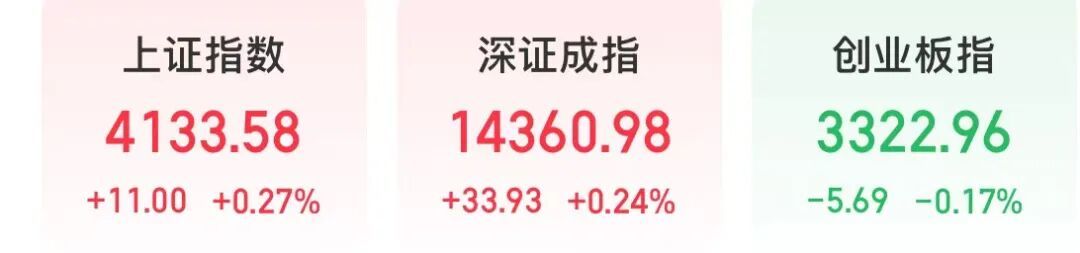
Group 1: Space Concepts - The space photovoltaic and space tourism concepts showed strong performance, with stocks like Maiwei Co., Longhua New Material, and Taili Technology experiencing significant gains [1][2] - The space photovoltaic concept led the market, boosting the photovoltaic sector, including photovoltaic equipment, BC batteries, and POE film, which saw substantial increases [2] - The technology behind space solar power involves collecting solar energy in space via satellites and transmitting it to Earth in the form of microwaves or lasers, achieving 2-3 times the efficiency compared to ground-based systems [3][4] Group 2: Market Performance - The commercial aerospace sector experienced a notable rise, while the computing power industry chain saw declines, with stocks like Zhongji Xuchuang and Xinyi Sheng falling significantly [1] - As of the morning close, the Shanghai Composite Index rose by 0.27%, the Shenzhen Component Index increased by 0.24%, while the ChiNext Index fell by 0.17% [1] Group 3: Space Tourism Developments - The "Chuan Yue Zhe" manned spacecraft was publicly showcased, with over 20 space tourists already booked for future flights, aiming for a manned launch by 2028 [5] - The company has completed comprehensive verification tests for the landing buffer system of the spacecraft, marking it as the third commercial aerospace enterprise globally to validate such technology [5] Group 4: Pharmaceutical Sector - The pharmaceutical sector saw gains, with significant increases in stocks like Renmin Tongtai and Yifeng Pharmacy, reflecting a positive trend in the industry [6][8] - A new policy document aimed at promoting high-quality development in the pharmaceutical retail sector was released, outlining 18 specific measures to enhance service quality and market vitality [9] - Leading companies in the pharmaceutical retail sector are expected to benefit from ongoing regulatory support, with opportunities for market share growth and diversification into non-pharmaceutical products [9]
AI医疗爆发三重奏:亢奋、焦虑与希望
2 1 Shi Ji Jing Ji Bao Dao· 2026-01-22 08:03
Core Viewpoint - The AI healthcare sector is experiencing significant growth and interest in 2026, with substantial increases in various healthcare indices and notable stock performance among key companies in the sector [1][2]. Market Performance - As of January 21, 2026, the AI healthcare index surged over 11%, while the CSI Medical Index and Hang Seng Healthcare Index rose by 8% and 11.67% respectively [1]. - Companies like Dean Diagnostics and Baolite have seen stock increases exceeding 60%, with others like Weining Health and Chengdu Xian Dao also showing gains over 20% [1]. Market Trends and Projections - The AI healthcare market in China is projected to grow from 8.8 billion yuan in 2023 to 315.7 billion yuan by 2033, reflecting a compound annual growth rate of 43.1% [2]. - The rapid advancement in AI healthcare applications is driven by technological breakthroughs, favorable policies, and increasing market demand [2]. Technological Developments - Major tech companies are actively entering the AI healthcare space, with OpenAI, Google, and domestic firms like Ant Group and Tencent launching various AI healthcare applications [4]. - Significant advancements have been made in AI-assisted diagnostics, medical imaging, and drug development, indicating a trend towards more efficient healthcare solutions [5][6]. Commercialization Challenges - Despite the enthusiasm, the commercialization of AI healthcare products faces challenges, including ethical concerns, regulatory risks, and slow progress in translating technological advancements into financial performance [10][11]. - As of January 21, 2026, over half of the 47 biomedicine companies that disclosed earnings forecasts reported losses or reduced earnings, highlighting the disparity between market excitement and actual financial results [10]. Regulatory Developments - Recent government initiatives aim to promote and standardize the application of AI in healthcare, with a focus on establishing high-quality data sets and clinical models by 2027 [13][14]. - The National Healthcare Security Administration has clarified pricing for AI-assisted diagnostic services, which is expected to enhance the commercial viability of AI healthcare products [14]. Future Outlook - Industry experts predict that 2026 will be a pivotal year for the commercialization of AI healthcare, driven by clearer payment structures and stronger market demand [13][14]. - The focus will likely be on AI applications in drug development, diagnostics, and operational efficiency, with expectations for rapid growth in the sector [14].
医药商业板块1月21日跌0.37%,鹭燕医药领跌,主力资金净流出2.54亿元
Zheng Xing Xing Ye Ri Bao· 2026-01-21 08:53
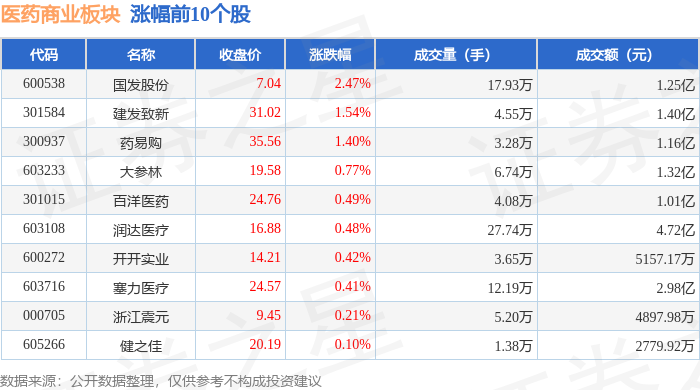
Market Overview - The pharmaceutical commercial sector experienced a decline of 0.37% on January 21, with Luyuan Pharmaceutical leading the drop [1] - The Shanghai Composite Index closed at 4116.94, up 0.08%, while the Shenzhen Component Index closed at 14255.12, up 0.7% [1] Stock Performance - Notable gainers in the pharmaceutical commercial sector included: - Guofa Co., Ltd. (600538) with a closing price of 7.04, up 2.47% and a trading volume of 179,300 shares [1] - Jianfa Zhixin (301584) closed at 31.02, up 1.54% with a trading volume of 45,500 shares [1] - Yaoyigou (300937) closed at 35.56, up 1.40% with a trading volume of 32,800 shares [1] - Other stocks with minor gains included Dacilin (603233), Baiyang Pharmaceutical (301015), and Rundar Medical (603108) [1] Capital Flow - The pharmaceutical commercial sector saw a net outflow of 254 million yuan from institutional investors, while retail investors had a net inflow of 313 million yuan [2] - The top stocks by net inflow from retail investors included: - Zhejiang Zhenyuan (000705) with a net inflow of 1.67 million yuan [3] - Rundar Medical (603108) with a net outflow of 50.04 million yuan [3] Individual Stock Analysis - Rundar Medical (603108) had a net inflow of 29.30 million yuan from institutional investors, but a significant outflow from retail investors [3] - Guofa Co., Ltd. (600538) experienced a net inflow of 8.32 million yuan from institutional investors, while retail investors showed a minor inflow [3] - Baiyang Pharmaceutical (301015) had a net inflow of 8.21 million yuan from institutional investors, but a net outflow from retail investors [3]

医药商业板块1月20日跌0.48%,鹭燕医药领跌,主力资金净流出4.97亿元
Zheng Xing Xing Ye Ri Bao· 2026-01-20 08:51
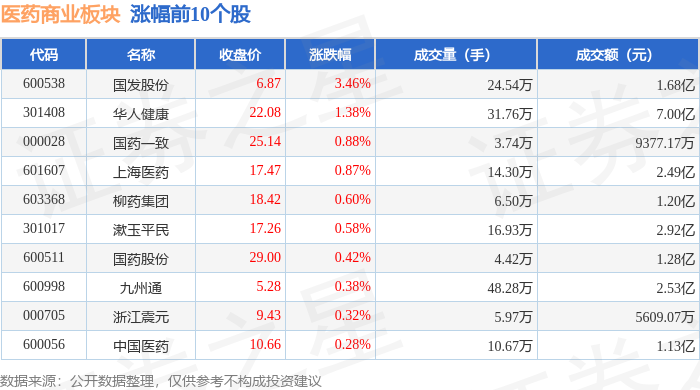
Market Overview - The pharmaceutical commercial sector experienced a decline of 0.48% on January 20, with Luyuan Pharmaceutical leading the drop [1] - The Shanghai Composite Index closed at 4113.65, down 0.01%, while the Shenzhen Component Index closed at 14155.63, down 0.97% [1] Stock Performance - Notable gainers in the pharmaceutical sector included: - Guofa Co., Ltd. (600538) with a closing price of 6.87, up 3.46% and a trading volume of 245,400 shares, totaling 168 million yuan [1] - Huaren Health (301408) closed at 22.08, up 1.38% with a trading volume of 317,600 shares, totaling 700 million yuan [1] - Conversely, significant decliners included: - Jianghe Pharmaceutical (002788) with a closing price of 16.64, down 6.04% and a trading volume of 872,500 shares, totaling 1.465 billion yuan [2] - Yingte Group (000411) closed at 13.84, down 2.40% with a trading volume of 230,300 shares, totaling 316 million yuan [2] Capital Flow - The pharmaceutical commercial sector saw a net outflow of 497 million yuan from institutional investors and a net outflow of 109 million yuan from speculative funds, while retail investors had a net inflow of 607 million yuan [2] - Key stocks with notable capital flows included: - Huaren Health (301408) with a net inflow of 46.16 million yuan from institutional investors, but a net outflow of 48.48 million yuan from retail investors [3] - Yifeng Pharmacy (603939) had a net inflow of 21.74 million yuan from institutional investors, but also saw a net outflow of 1.63 million yuan from retail investors [3]


可转债市场周度跟踪:当双高转债遇上潜在强赎风险-20260119
Huafu Securities· 2026-01-19 13:27
Report Industry Investment Rating No relevant content provided. Core Viewpoints of the Report - Last week, the CSI Convertible Bond Index rose 1.08%, with increased weekly amplitude, and the equity - style convertible bonds with "high price and high conversion premium" remained active. The balance - weighted increase of debt - biased convertible bonds was 0.03%, balanced convertible bonds rose 0.19%, and equity - biased convertible bonds rose 3.87%, further widening the style excess. The balance - weighted conversion premium rate of convertible bonds with an absolute price above 130 yuan approached the historical high [2][10]. - The "leverage" of equity - style "high - price and high - premium" convertible bonds can still explain the current valuation system changes. Convertible bonds have a certain degree of "leverage", and the investment behavior of secondary bond funds also indicates that convertible bonds are a leveraged tool for stocks [15][19]. - Redemption disturbances have begun to marginally affect the performance of equity - style convertible bonds. Some convertible bonds that have announced forced redemptions experienced a double - kill of stocks and bonds, and some equity - style convertible bonds that have not met the forced - redemption conditions also showed weak performance with a significant compression of the conversion premium rate [21]. - The strong performance of new convertible bonds is an important support for the "high - price and high - premium" situation, but potential regulatory policy risks need to be noted. As of last Friday, the balance - weighted implied volatility of convertible bonds listed within 6 months exceeded 85%. Considering the increased regulatory guidance on the equity market, there may be specific requirements for new convertible bonds [3][23]. - Historically, unexpected forced redemptions have a short - term impact on the valuation of equity - style convertible bonds. After the impact, it is recommended to focus on equity - style varieties with a higher certainty of non - forced redemption [29]. Summary According to the Directory 1 When "High - price and High - premium" Convertible Bonds Encounter Potential Forced - redemption Risks - **Market Performance**: The CSI Convertible Bond Index rose 1.08% last week. Equity - style convertible bonds with "high price and high conversion premium" were active. In terms of style, debt - biased convertible bonds rose 0.03%, balanced convertible bonds rose 0.19%, and equity - biased convertible bonds rose 3.87%. The balance - weighted conversion premium rate of convertible bonds with an absolute price above 130 yuan was close to the historical high [2][10]. - **Valuation Explanation**: The "leverage" of convertible bonds can explain the current valuation system. The convertible bond valuation is related to the weighted index of underlying stocks, and the investment behavior of secondary bond funds also shows that convertible bonds are a leveraged tool for stocks [15][19]. - **Redemption Impact**: Redemption disturbances affected the performance of equity - style convertible bonds. Some bonds with announced forced redemptions had a double - kill of stocks and bonds, and some bonds that had not met the forced - redemption conditions also had a compressed conversion premium rate [21]. - **New Bond Support and Risks**: The strong performance of new convertible bonds supported the "high - price and high - premium" situation. As of last Friday, the balance - weighted implied volatility of convertible bonds listed within 6 months exceeded 85%. There may be regulatory risks for new convertible bonds [3][23]. - **Forced - redemption Impact on Valuation**: Historically, in the 5 trading days before an unexpected forced - redemption event, the valuation of equity - style convertible bonds was likely to be compressed, with a median compression amplitude of about 1 - 2 percentage points. After the event, there was no obvious pattern in the valuation performance. It is recommended to focus on equity - style varieties with a higher certainty of non - forced redemption [29]. - **Forced - redemption Counting Details**: Multiple convertible bonds are in the forced - redemption counting stage, and some are close to triggering forced redemptions. For example, Fuli Convertible Bond, Sailong Convertible Bond, and Tianjian Convertible Bond need at least 1 more day to trigger forced redemptions [35].
开源鸿蒙打造智慧医疗“中国方案”
Zheng Quan Ri Bao· 2026-01-18 16:42
Core Insights - The article discusses the transformation of China's healthcare system through the implementation of the open-source HarmonyOS, which is enhancing the efficiency and interconnectivity of hospital operations [1][2][3]. Group 1: Technological Advancements - The Chongqing Liangjiang New Area People's Hospital has implemented a smart system based on HarmonyOS, allowing real-time monitoring of patient status and significantly improving response times to incidents [1][3]. - The system integrates various devices, creating a seamless data flow across the hospital, which enhances patient autonomy and reduces the workload on nursing staff [2][3]. - The deployment of over 3,000 terminal devices has reduced incident response times from minutes to seconds and increased the satisfaction rate of personalized patient needs by approximately 80% [3]. Group 2: Systemic Challenges and Solutions - Traditional healthcare models face inefficiencies due to fragmented information flow and reliance on manual processes, leading to increased costs and wasted resources [2]. - The adoption of HarmonyOS is seen as a strategic choice that allows for customized development tailored to specific medical needs, overcoming limitations of traditional closed systems [3][5]. Group 3: Broader Implications for Healthcare - The transformation is not limited to new facilities; existing hospitals are also undergoing upgrades using HarmonyOS, which is facilitating a comprehensive reconfiguration of healthcare services [4][5]. - The integration of AI and HarmonyOS is expected to create a new ecosystem in healthcare, enhancing data security and system autonomy, which is crucial for the future of the industry [5][6]. Group 4: Industry Engagement - Several listed companies are actively investing in HarmonyOS-based healthcare solutions, indicating a growing interest in the intersection of AI and healthcare [6][7]. - Companies like Xiamen Dinake and Jiangsu Runkai Hong Digital Technology are developing innovative solutions that leverage HarmonyOS for integrated healthcare services, showcasing the potential for industry-wide transformation [6][7].