
鸿蒙智行

Search documents
1月新能源汽车交付量,鸿蒙智行、小米领跑
21世纪经济报道· 2026-02-01 06:54
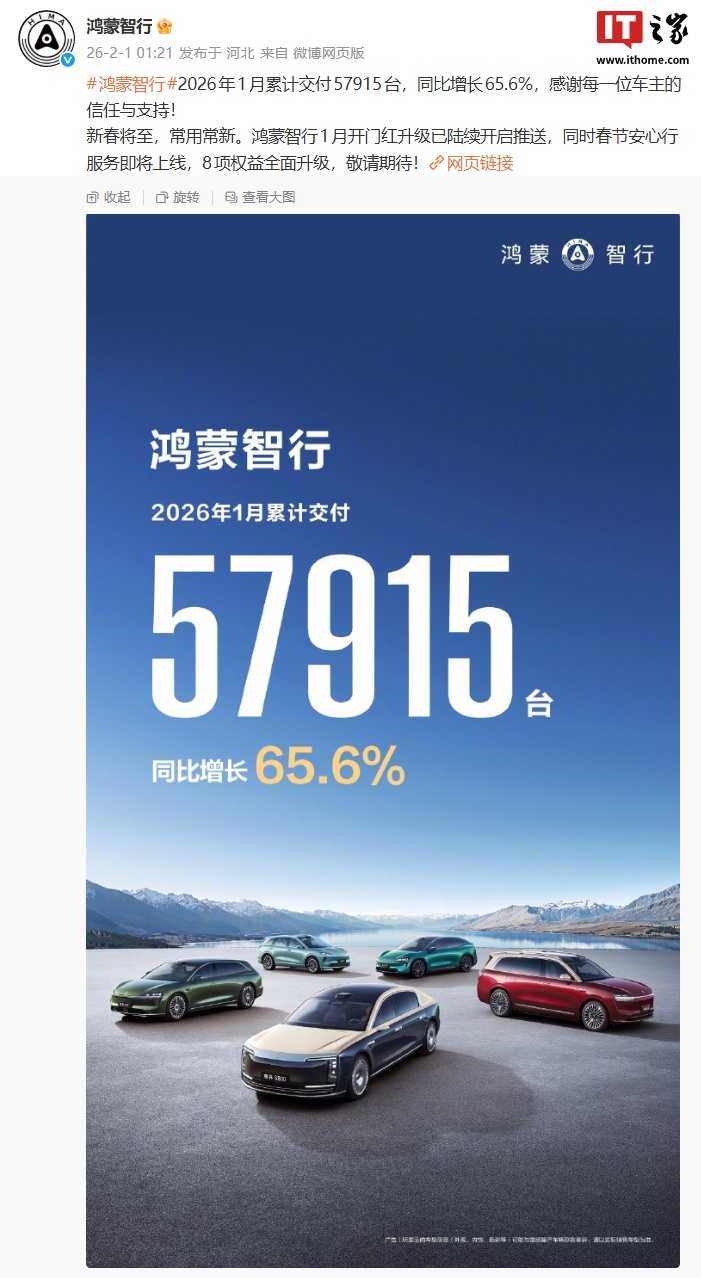
记者丨朱芷葵 编辑丨曾静娇 2月1日,多家车企陆续公布1月新能源汽车交付数据,绝大多数实现销量同比增长。其中鸿蒙 智行以近5.8万辆的交付量目前暂居榜首,零跑、小米等也交出超过3万辆的成绩。 详情如下: 鸿蒙智行:1月累计交付57915台,同比增长65.6%。其中,问界汽车1月交付40016辆,同比增 长83%。 小米汽车:1月交付量超过39000台。 昊铂埃安:1月销量23591辆,同比增长63.9%。 奕派科技:1月销量21269辆,同比增长145%。 岚图汽车:1月交付10515辆,同比增长31%。 SFC 出品丨21财经客户端 21世纪经济报道 21君荐读 官方明确个人每次挣钱低于1000元不用交增值税 腾讯元宝开撒10亿红包,网友:一大早就被刷屏了 深圳首个安居房项目开盘当天售罄 零跑汽车:1月全系交付达32059台,同比增长27%。 理想汽车:1月交付新车27668辆。 广汽传祺:1月份全系销量达到26937辆,环比增长25.07%,同比增长2.06%。 ...






鸿蒙智行2026年1月交付新车57915辆
Bei Jing Shang Bao· 2026-02-01 05:32
北京商报讯(记者 刘晓梦)2月1日,鸿蒙智行发布的数据显示,2026年1月累计交付新车57915辆,同 比增长65.6%。 ...
鸿蒙智行 2026 年 1 月累计交付 57915 台,同比增长 65.6%
Xin Lang Cai Jing· 2026-02-01 02:27
Core Insights - The company announced a total delivery of 57,915 units in January 2026, representing a year-on-year growth of 65.6% [1] - The OTA (Over-The-Air) update for January has been launched, featuring 63 new functions and 31 experience optimizations [4] Delivery Performance - In 2025, the company achieved a total delivery of 589,107 units, with a year-on-year increase of 32% [10][13] - December 2025 saw a record monthly delivery of 89,611 units, marking three consecutive months of historical high monthly deliveries [10] OTA Update Features - The January OTA update includes enhancements such as vehicle intention broadcasting, AR guidance for drivers, intelligent navigation for fuel efficiency, and stability controls for high-speed driving [6] - New safety features include a "down car guard" to reduce risks when opening doors, and a tire blowout stability control to prevent drifting during high-speed blowouts [6] User Experience Enhancements - The update aims to improve user experience with features like nearby parking support and a more intuitive vehicle collaboration [6] - The company is set to launch a "Spring Festival Safe Travel" service, although specific details have not yet been disclosed [1]
鸿蒙智行智界汽车全系OTA推送升级
Bei Jing Shang Bao· 2026-01-30 07:40
1月29日,鸿蒙智行智界汽车正式开启新版本全系OTA推送,新版OTA覆盖智驾、智趣与安全三大维度 共30余项功能焕新,新增三点式掉头、增强型自动紧急转向辅助(eAES)、车内外对话、3D车模改装 等功能。此次更新还正式上线了刘亦菲专属泊车语音包,当车辆进行离车泊入遇到行人阻挡等情况时, 车辆将对外播报如"车被挡住了,请让一让"的拟人化提示。 ...
尚界H5春节OTA升级:新增哨兵模式自动开启、驾驶员失能辅助等功能
Feng Huang Wang· 2026-01-30 07:13
Core Viewpoint - The article discusses the launch of the HarmonyOS Smart Driving H5's Spring Festival OTA upgrade, which introduces multiple enhancements in safety, intelligence, and entertainment features. Group 1: New Features - The upgrade includes an enhanced urban lane cruise assist feature that allows vehicles to stop at red lights and start at green lights based on traffic signals [1] - New safety features include automatic activation of the sentinel mode, driver incapacitation assistance (which can automatically pull over and call for rescue), and a "travel escort" function that reports real-time heart rate and medical information to rescue centers in case of an accident [1] - Additional features include pre-collision automatic window raising, enhanced automatic emergency steering assistance (eAES 2.0), and emergency steering assistance [1] Group 2: Convenience Enhancements - The system now offers nearby parking, three-point narrow road U-turn, karaoke without a microphone, and remote trunk opening functionalities, along with integration of third-party services like "Jie Parking" and "Ping An Good Car Owner" [1] - The OTA also optimizes existing navigation assistance for lane changing decisiveness, intersection passage capability, detour logic, and parking accuracy [1]
2026车企目标大“PK”
Guo Ji Jin Rong Bao· 2026-01-29 12:48
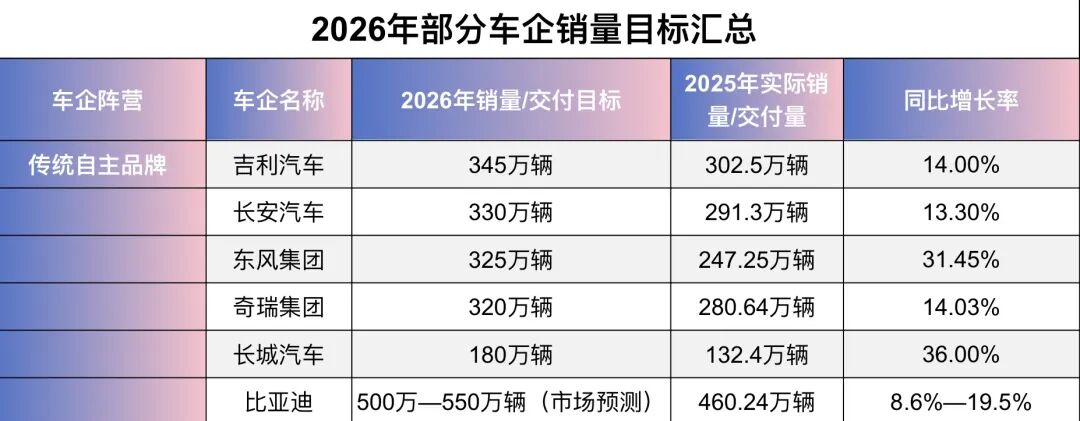
Core Insights - The Chinese automotive industry has shown impressive growth, with production and sales reaching 34.53 million and 34.40 million units respectively in 2025, marking a year-on-year increase of 10.4% and 9.4% [1] - New energy vehicle (NEV) sales reached 16.49 million units, achieving a penetration rate of 47.9% [1] - Major automakers have set ambitious sales targets for 2026, amidst challenges from policy changes, technological advancements, and global competition [1] Company Targets - Geely aims for a sales target of 3.45 million units in 2026, up 14% from 2025's 3.025 million units, with 64.3% of sales coming from NEVs [4] - Changan targets 3.3 million units, with NEV sales projected at 1.4 million units, reflecting a 26.2% increase [5] - Dongfeng Group's target is 3.25 million units, a 31.45% increase from 2025, with NEVs making up 52% of sales [6] - Great Wall Motors aims for 1.8 million units, a 36% increase, focusing on NEV and export markets [6] - BYD's projected sales for 2026 are between 5 million and 5.5 million units, with a growth rate of 8.5% to 19.5% [6] New Entrants and Growth - New entrants like Leap Motor and Hongmeng Zhixing are targeting sales of 1 million units, with significant growth rates of over 67% [7][9] - Leap Motor's sales target is 1 million units, up from 596,600 units in 2025 [9] - Hongmeng Zhixing is expected to reach between 1 million and 1.3 million units, with a growth rate of 70% to 120% [11] Industry Trends - The penetration rate of NEVs is expected to exceed 60% in 2026, driven by policy support and technological advancements [12] - The export model is shifting from "complete vehicle export" to "localized production and full industry chain layout," with significant growth in NEV exports [13] - The competitive landscape is transitioning from price wars to value-driven strategies, with a focus on technological innovation [15] - Market concentration is increasing, with leading brands capturing a larger market share, while weaker brands are likely to exit the market [15] Challenges and Uncertainties - The market faces uncertainties due to policy changes, such as the reduction of NEV purchase tax, which may affect consumer purchasing behavior [16] - Economic recovery is slower than expected, impacting consumer spending and demand for traditional vehicles [17] - Trade barriers and compliance risks are increasing for Chinese automakers expanding overseas, necessitating a balance between global operations and local compliance [17] Conclusion - The Chinese automotive market in 2026 is poised for significant transformation, emphasizing the shift towards NEVs and smart technologies, while navigating various uncertainties and competitive pressures [19]

未知机构:聚焦涨价环节AI太平洋新能源周展望系列20260123-20260123
未知机构· 2026-01-23 02:20
Summary of Key Points from Conference Call Records Industry Focus: Electric Vehicle and Energy Storage Sector Core Insights and Arguments 1. The electric vehicle and energy storage sectors are structurally improving, benefiting companies like CATL and EVE Energy. Recent announcements from multiple automakers reveal ambitious sales targets for 2026, including: - Leap Motor: 1 million units, a year-on-year increase of approximately 67.6% - NIO: 456,400 to 489,000 units, a year-on-year increase of 40% to 50% - Xiaomi Auto: 550,000 units, a year-on-year increase of approximately 34% - Hongmeng Zhixing: 1 million to 1.3 million units, with an upper limit year-on-year increase of approximately 120% [1][2] 2. According to Xinluo Lithium Battery data, global lithium battery production is expected to reach 2,297 GWh by 2025, a year-on-year increase of 48.5%. The core sources of growth will be: - Power batteries: 1,495 GWh, a year-on-year increase of 40.5% - Energy storage batteries: 636 GWh, a year-on-year increase of 92.7%, with a market share exceeding 27% [2] 3. CATL has signed a five-year strategic cooperation memorandum with Changan Automobile, focusing on advanced fields such as battery swapping, smart automotive robotics, flying cars, and embodied intelligence [2]. Upstream Lithium Carbonate Supply and Demand 1. The supply and demand for lithium carbonate continue to improve, benefiting companies like Salt Lake Industry and Dazhong Mining. By 2025, China's lithium carbonate production is projected to reach 976,300 tons, a year-on-year increase of 49%. The proportion of spodumene production is rising, while mica production is expected to decline significantly due to policy adjustments. The lithium carbonate market is anticipated to maintain a tight balance in 2026, with price centers expected to rise [3]. 2. Dazhong Mining plans to invest 3.688 billion yuan in a lithium mining project in Hunan, which is expected to produce approximately 80,000 tons of lithium carbonate annually upon reaching full capacity [3]. 3. The global solid-state battery sector is entering a critical phase of engineering and industrialization, with companies like Xiamen Tungsten and Putailai poised to benefit. Recently, Dongfeng Motor has initiated cold weather testing for solid-state batteries [3]. Industry Focus: Photovoltaic and Energy Storage Sector Key Developments 1. Investment in the power grid and AI-driven demand for electrical equipment are on the rise, benefiting companies like Sungrow Power Supply, Sieng Electric, and Sifang Co. The State Grid has announced a fixed asset investment of 4 trillion yuan for the 14th Five-Year Plan period (2026-2030), a 40% increase compared to the previous plan. The core objective is to support carbon peak by 2030 and to initially establish a new energy system [4]. 2. Smart microgrids are expected to be a key focus in 2026, with their core value lying in utilizing energy storage technology (especially grid-connected storage) to address renewable energy consumption and improve power supply reliability in remote areas [4].






注定悲剧的2026,还有多少车企不信邪?
汽车商业评论· 2026-01-22 23:07
Core Viewpoint - The article discusses the challenges and strategies of the Chinese automotive industry as it faces declining domestic sales and increasing pressure to transition towards higher-value and technology-intensive vehicles. The focus is on the 2026 sales targets set by various automakers amidst a backdrop of changing government policies and market dynamics [3][6][8]. Group 1: Market Overview - In 2025, China's automotive production and sales reached 34.4 million units, a 9.4% increase year-on-year, maintaining its position as the world's largest market for the 17th consecutive year [3]. - Domestic sales, excluding exports, were 27.3 million units, up 6.7%, with passenger vehicles accounting for approximately 24.1 million units, growing by 8.0% [5]. - However, December 2025 saw a significant decline in domestic sales, with only 2.519 million units sold, marking a 6.7% month-on-month drop and a 15.6% year-on-year decrease [5]. Group 2: Industry Challenges - The average profit margin in the Chinese automotive industry has fallen to 4.4%, only slightly above the historical low of 4.3% in 2024, indicating extremely thin profit margins [6]. - The new vehicle replacement subsidy policy, shifting from fixed subsidies to percentage-based subsidies, targets higher-priced vehicles, which may pressure companies that rely heavily on low-cost models [8]. Group 3: Sales Targets and Strategies - Major automakers have set ambitious sales targets for 2026, with a combined goal of approximately 35 to 36 million passenger vehicles, reflecting a year-on-year increase of 12% to 15% [5]. - Traditional automakers are focusing on stability and efficiency improvements, while new entrants are experiencing significant divergence in their growth strategies [10][30]. - For instance, Changan aims for a total sales target of 3.3 million units in 2026, with a strong emphasis on new energy vehicles, projecting 1.43 million units from this segment [12][15]. Group 4: New Energy Vehicle Focus - The article highlights the increasing importance of new energy vehicles (NEVs) in the sales strategies of various automakers, with companies like Dongfeng targeting 1.7 million NEVs in 2026, representing a significant portion of their overall sales goals [15][26]. - Geely plans to launch over ten new models in 2026, focusing on a comprehensive product matrix to drive sales growth [23]. Group 5: Export Market Dynamics - The export market for Chinese vehicles is thriving, with exports reaching 7 million units in 2025, a 21% increase year-on-year, and NEV exports doubling to 2.6 million units [49]. - Automakers are increasingly prioritizing overseas markets, with many setting aggressive export targets that significantly exceed their overall sales growth targets [51][54]. - For example, Changan's overseas sales target for 2026 is set at 750,000 units, accounting for nearly a quarter of its total sales goal [52].





开年价格战重现:汽车公司从最难的第一季度开始更难的一年
Xin Lang Ke Ji· 2026-01-22 00:03
Core Viewpoint - The automotive industry in China is facing a significant shift in 2026, with predictions of a price war initiated earlier than expected, influenced by changes in subsidy policies and market dynamics [2][3]. Group 1: Market Predictions - The China Passenger Car Association (CPCA) forecasts that domestic car sales in Q1 2026 may remain flat year-on-year but could drop by 25% compared to Q4 2025, with overall annual sales expected to show zero or minimal growth [2]. - Morgan Stanley predicts a substantial decline in Q1 2026 sales by 30%-35% due to reduced purchase tax subsidies, with an annual decrease of 5% anticipated, potentially reaching 7% without considering export sales [2]. - UBS shares a similar outlook, projecting a 2% decline in annual car sales, with export growth slowing from 28% in 2025 to 15% [3]. Group 2: Policy Changes - The National Development and Reform Commission and the Ministry of Finance have yet to announce the continuation of "two new" subsidies for 2026, with significant changes expected in the subsidy structure for new energy vehicles (NEVs) [3]. - The new policy will halve the purchase tax for NEVs, increasing costs for consumers, while the subsidy for new cars will be more detailed and based on vehicle price, with a maximum of 20,000 yuan [3]. Group 3: Industry Sentiment - Industry executives express cautious optimism regarding their companies' growth, with many expecting double-digit growth driven by overseas market expansion, despite a general conservative outlook on overall market growth [7]. - The total sales target for nine major automakers in 2026 is set at 18.339 million units, surpassing the actual sales of 3.86 million units in 2025 [7]. - New energy vehicle manufacturers have aggressive growth targets, with some aiming for increases of 70%-121%, while traditional automakers maintain more conservative targets [9]. Group 4: Price War Dynamics - A price war has already begun, with companies like BMW and Tesla implementing significant price cuts and financing options to stimulate demand ahead of the anticipated subsidy changes [10][13]. - Over 20 automakers have introduced purchase tax guarantees to attract customers, but initial sales data for January 2026 indicate a decline in demand compared to previous months [10][11]. - The adjustment of subsidy policies has raised the entry barriers for consumers, particularly affecting lower-priced vehicles, which may suppress demand in that segment [11]. Group 5: Competitive Landscape - The competition in the high-end market is expected to intensify, with new energy vehicles priced above 300,000 yuan becoming more competitive due to favorable subsidy policies [13]. - Companies like NIO, Xiaomi, and Xpeng are preparing to launch multiple new models in 2026, indicating a strategic focus on high-end segments [13].

汽车视点丨技术突围易,生态融入难?汽车隐形独角兽面临“成长的烦恼”
Xin Hua Cai Jing· 2026-01-20 08:23
Core Viewpoint - The article discusses the emergence of "invisible unicorns" in the Chinese automotive industry, highlighting their role in driving innovation and addressing structural growth challenges in a competitive market environment [1][2]. Industry Overview - The Chinese automotive industry is transitioning from an incremental market to a stock competition phase, with production expected to reach over 34 million vehicles by 2025, maintaining a range of 35 to 37 million in the following five years [2]. - Structural growth indicates a shift in focus from scale expansion to value creation and technological breakthroughs, providing a fertile ground for invisible unicorns to develop [2]. Technological Advancements - The penetration rate of new energy vehicles is projected to rise from 60% to 80% by 2030, with continuous iterations in key technologies like intelligent driving and smart cockpits injecting strong momentum into the industry [3]. - Despite a slight decrease in the number of automotive tech unicorns globally, their total valuation is expected to grow by 5.89% to 1.48 trillion yuan by 2025, indicating that technological value is becoming a key support for enterprise valuation [3]. Consumer Demand - Younger consumers prioritize new energy and smart features when purchasing vehicles, while older demographics may become significant users of intelligent vehicles due to advancements in smart driving technology [3]. Globalization Impact - China's automotive exports are anticipated to reach 8 to 9 million vehicles in the next five years, accounting for 30% of total production, thus providing new growth opportunities [3]. Unicorn Enterprises' Performance - Since 2018, 120 companies have been recognized as automotive invisible unicorns, with 40 establishing partnerships with major manufacturers, 3 becoming unicorns, and 4 going public [4]. - The total valuation of China's invisible unicorns is projected to exceed 2.2 trillion yuan by 2025, with an average valuation of 440 million yuan, and 34 companies in the automotive sector [4]. Challenges Faced - Nearly 40% of invisible unicorns are currently operating at a loss, with over 35% having profits of only 10 million yuan or less, indicating weak overall profitability [5]. - The automotive industry faces systemic challenges from macroeconomic conditions, industry ecology, and globalization, with over 50% of upstream companies expected to incur losses by mid-2025 [5][6]. Recommendations for Overcoming Challenges - Policy recommendations include enhancing innovation procurement and financial support, establishing a credit risk compensation mechanism, and creating a comprehensive financial support system for unicorns [10]. - The industry ecosystem needs to be restructured to foster open collaboration and innovation networks, with leading companies taking the initiative to build open innovation platforms [11]. - Unicorn enterprises should enhance their strategic resilience, focusing on sustainable profit models and adapting organizational structures and market strategies to navigate global expansion effectively [12].