
鼎龙股份

Search documents
AI热潮带飞马桶厂?不起眼的日企,控制了芯片命脉
3 6 Ke· 2026-02-02 04:05
Group 1 - The article highlights the unexpected rise of TOTO, a Japanese toilet manufacturer, whose stock surged by 11% due to its involvement in the semiconductor industry, particularly through its production of specialized ceramics used in semiconductor manufacturing [3][21]. - TOTO's new business in precision ceramics now accounts for 42% of its revenue, with a profit margin of 40%, significantly higher than the average of 7% across all departments [21]. - The company has leveraged its long-standing expertise in ceramics to develop electrostatic chucks, which are crucial for maintaining the precision required in semiconductor manufacturing [11][19]. Group 2 - The article discusses the broader trend of traditional Japanese companies successfully transitioning into the semiconductor industry, citing examples like Ajinomoto, which developed a specialized film for high-performance CPUs from its food production waste [26][28]. - Other companies, such as Kao and Fujifilm, have also found niches in the semiconductor supply chain, with Kao producing cleaning agents for wafers and Fujifilm supplying photoresists and chemicals necessary for semiconductor production [32][38]. - The narrative emphasizes that Japan's historical industrial strength and technological reserves have allowed these companies to adapt and thrive in the high-tech semiconductor market, despite their origins in seemingly unrelated industries [40][42]. Group 3 - The article suggests that China's semiconductor industry is on a similar path, with emerging companies developing high-purity materials and specialized products that could fill gaps in the supply chain, akin to Japan's historical industrial evolution [46][54]. - Companies like Xingfa Group and Huitian New Materials are highlighted for their successful transitions from traditional industries to high-tech sectors, indicating a growing trend of innovation and adaptation within China's industrial landscape [48][51]. - The overall message conveys optimism for China's future in the semiconductor industry, suggesting that with time and continued development, the country can achieve significant advancements [56].

400亿上市公司收购锂电企业!
起点锂电· 2026-02-01 09:36
Core Viewpoint - Dinglong Co., Ltd. is officially entering the new energy materials sector by acquiring 70% of Shenzhen Haofei New Materials Co., Ltd. for 630 million yuan, marking a strategic move to enhance its "innovative materials platform" strategy and capitalize on the growth opportunities in the lithium battery materials market [3][4]. Group 1: Acquisition Details - The acquisition of Haofei New Materials will allow Dinglong to quickly enter the high-growth new energy materials sector, avoiding the risks associated with starting from scratch [6][8]. - Haofei New Materials is a national high-tech enterprise specializing in key functional materials for lithium battery manufacturing, holding over 40 related invention patents and being a core supplier to top domestic and international new energy manufacturers [4][6]. - The total valuation for Haofei New Materials is approximately 900 million yuan, with expected revenues of 560 million yuan and net profits of 140-150 million yuan by 2026, resulting in a reasonable price-to-earnings ratio of about 6-7 times [6][8]. Group 2: Strategic Rationale - The acquisition aligns with Dinglong's need for new growth drivers, as its existing semiconductor materials and printing consumables businesses face limited growth potential [6][8]. - The synergy between Dinglong's existing technologies and Haofei's products is expected to enhance operational efficiency and product consistency, leveraging Dinglong's experience in raw material control and quality management [7][8]. - The collaboration is anticipated to open up a billion-level market space in lithium battery auxiliary materials, enhancing Dinglong's long-term competitiveness [8].
宁德时代签约云南;比亚迪越南电池厂落地;楚能70GWh项目提速;中创新航落子四川自贡;三大锂电铜箔龙头扭亏;鼎龙股份收购锂电企业
起点锂电· 2026-02-01 09:36
宁德时代签约云南 1月27日,宁德时代与云南省人民政府 签署了三方战略合作协议,将主要围绕新能源电池、绿色能源、绿色交通、低空经济4个方面开展深入 合作,规划建设锂电池绿色智造基地,计划2026年一季度开工。 消息显示,早在2022年12月,宁德时代便在昆明注册成立"云南时代新能源科技有限公司",注册资金10亿元。 比亚迪越南建电动车电池厂 1月27日,越南汽车制造商Kim Long汽车(越南金龙汽车)与比亚迪签约战略合作, 并同时举行比亚迪电池制造厂( 位于金龙汽车顺化汽车 制造组装工业园内 )建设奠基仪式。 Kim Long汽车将 在越南中部投建一座投资额1.3亿美元的新能源电池工厂。 工厂建设资金由Kim Long 汽车承担,比亚迪则提供全方位技术支持。 工厂分两期建设, 总投资1.3亿美元, 生产巴士、卡车、小型客车等商用车配套电池。 一期工程占地4.4公顷,建成后将成为越南乃至亚洲领 先的电动汽车电池工厂之一,年产能达3GWh,并采用最先进的技术。该工厂预计很快投产,将显著 提升产能 ,并确保金龙 汽车(KIM LONG MOTOR)的 电池供应稳定可靠 。二期工程将扩大投资范围,新增10公顷厂房, ...



1300+份新材料报告下载:做新材料领域的「攻坚者」
材料汇· 2026-01-29 16:39
Core Viewpoint - The article discusses the rapid growth and investment opportunities in advanced packaging materials, highlighting the potential for domestic companies to replace foreign suppliers in critical sectors [7][8]. Group 1: Market Overview - The global market for advanced packaging materials is projected to reach $2.032 billion by 2028, with the Chinese market expected to grow to 9.67 billion yuan by 2025 [8]. - Specific materials such as PSPI and conductive adhesives are identified as key growth areas, with PSPI's market size in China expected to increase from 7.12 billion yuan in 2021 to 9.67 billion yuan by 2025 [8]. Group 2: Investment Opportunities - The article outlines various advanced packaging materials and their respective market sizes, indicating significant investment potential in sectors like semiconductor materials and new display materials [8]. - Companies such as 鼎龙股份, 国风新材, and 三月科 are highlighted as domestic players poised to benefit from the shift towards local sourcing of advanced materials [8]. Group 3: Future Projections - The market for conductive adhesives is expected to reach $3 billion by 2026, while the market for chip bonding materials is projected to grow from approximately $4.85 billion in 2023 to $6.84 billion by 2029 [8]. - The article emphasizes the importance of innovation and R&D in maintaining competitive advantages in the rapidly evolving materials landscape [8].


加速国际化布局 1月湖北多家A股上市公司宣布筹划赴港上市
Sou Hu Cai Jing· 2026-01-29 12:39
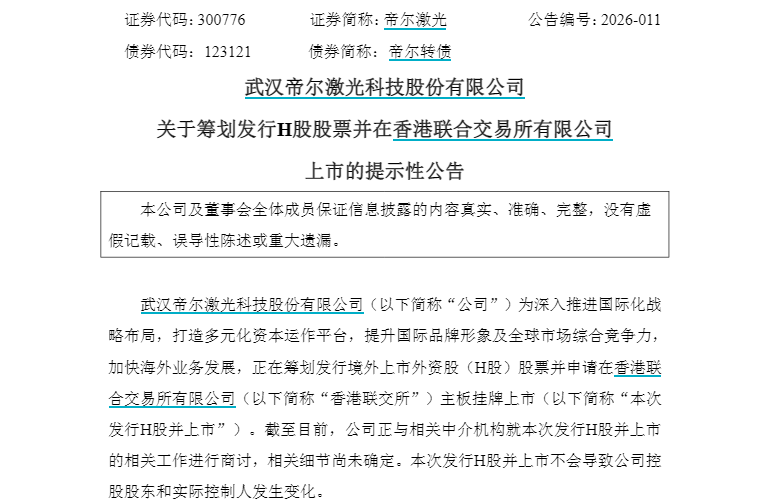
Group 1: Company Announcements - Four A-share listed companies in Hubei have announced plans to list in Hong Kong since January [1] - Dier Laser plans to list on the Hong Kong Stock Exchange to enhance its international strategy and brand image [1] - Lian Te Technology intends to issue H-shares and list in Hong Kong to support its international strategy and high-quality development [3] - Dinglong Co. is planning to issue H-shares and list in Hong Kong to deepen its global strategy and enhance its international competitiveness [5] - Huagong Technology has approved the issuance of H-shares for listing in Hong Kong to support its global strategy [7] Group 2: Company Profiles - Dier Laser specializes in precision laser processing solutions and serves major solar cell manufacturers [1] - Lian Te Technology focuses on the research, production, and sales of optical modules, achieving domestic leadership and global supplier status [3] - Dinglong Co. is enhancing its capabilities in innovative materials, particularly in semiconductor and display materials [5] - Huagong Technology has established multiple production bases and R&D centers both domestically and internationally, focusing on a global operational strategy [8]
鼎龙股份股价跌5.04%,南方基金旗下1只基金位居十大流通股东,持有1094.18万股浮亏损失2571.31万元
Xin Lang Cai Jing· 2026-01-29 06:23
1月29日,鼎龙股份跌5.04%,截至发稿,报44.27元/股,成交8.52亿元,换手率2.55%,总市值419.39亿 元。 资料显示,湖北鼎龙控股股份有限公司位于湖北省武汉市经济技术开发区东荆河路1号,成立日期2000 年7月11日,上市日期2010年2月11日,公司主营业务涉及打印复印通用耗材业务和光电半导体工艺材料 业务。主营业务收入构成为:半导体材料、芯片及打印复印通用耗材产品99.47%,其他0.53%。 南方中证500ETF(510500)基金经理为罗文杰。 截至发稿,罗文杰累计任职时间12年286天,现任基金资产总规模1713.58亿元,任职期间最佳基金回报 192.55%, 任职期间最差基金回报-47.6%。 声明:市场有风险,投资需谨慎。 本文基于第三方数据库自动发布,不代表新浪财经观点,任何在本 文出现的信息均只作为参考,不构成个人投资建议。如有出入请以实际公告为准。如有疑问,请联系 biz@staff.sina.com.cn。 责任编辑:小浪快报 从鼎龙股份十大流通股东角度 数据显示,南方基金旗下1只基金位居鼎龙股份十大流通股东。南方中证500ETF(510500)三季度减持 15.8 ...
2026年化工策略报告汇报-化工进入击球区-看好全球供给反内卷大周期-看好全球AI需求大周期
2026-01-29 02:43
2026 年化工策略报告汇报 化工进入击球区:看好全球供 给反内卷大周期,看好全球 AI 需求大周期 20260128 摘要 基础化工行业产能扩张放缓,在建工程与固定资产比值降至低位,叠加 行业协会和龙头企业推动反内卷,有望扭转亏损局面,双碳政策也限制 了新增产能,预示行业盈利能力将恢复。 全球流动性宽松及新兴产业发展驱动需求增长,化工品消费具全球性, 下游产业对海外消费依赖度高,人工智能、机器人等新兴产业对新材料 需求增加,共同推动化工行业景气度提升。 基础化工行业价差虽有复苏但仍处底部,安全度较高,自由现金流自 2022 年以来逐渐改善,预计 2025 年全年转正,预示行业拐点出现, 为投资者带来分红等回报机会,潜在股息率普遍超过 10%。 化工行业估值提升受益于自由现金流转正、投资放缓约束、库存低位和 开工率良好,反内卷及能耗政策约束,以及欧洲企业退出市场,共同推 动化工产品价格上涨。 欧洲化工企业因能源成本、人工成本及供应链效率等问题,长期低开工 率难以恢复,高成本产能逐步退出市场,将导致聚烯烃、有机硅等产品 供应减少,推升全球价格。 Q&A 2026 年至 2030 年化工行业的整体趋势如何? 从 ...
A股开年297单并购,跨界扎堆半导体
2 1 Shi Ji Jing Ji Bao Dao· 2026-01-29 00:26
Core Viewpoint - The A-share merger and acquisition (M&A) market remains active in early 2026, with over 297 disclosed M&A cases, including 12 major asset restructurings, highlighting a focus on strategic emerging industries like semiconductors and artificial intelligence [1] Group 1: M&A Activity - In January 2026, several companies, including Yingxin Development, Kangxin New Materials, and Dinglong Co., announced cross-industry M&A plans, particularly traditional manufacturing firms transitioning towards semiconductors and high-end equipment [1] - Notably, four out of eight disclosed cross-industry M&A cases involved semiconductor assets [5] - Companies like Kangxin New Materials and Mingyang Smart Energy are pursuing acquisitions to enhance their capabilities in the semiconductor sector, with Kangxin planning to acquire a 51% stake in Wuxi Yubang Semiconductor Technology for 392 million yuan [6][7] Group 2: Regulatory Scrutiny - Regulatory bodies have heightened scrutiny over cross-industry M&A transactions, focusing on the authenticity of disclosures and the reasonableness of valuations, as seen with inquiries sent to companies like Kangxin New Materials and Windfan Co. [1][10] - The Shanghai Stock Exchange has raised concerns regarding the feasibility of performance commitments made by companies, such as Kangxin's promise of significant profit growth for the acquired company, which exceeds historical performance [11][12] - The regulatory stance indicates a willingness to support beneficial cross-industry mergers while strictly monitoring those that appear speculative or high-risk [2][14] Group 3: Industry Trends and Challenges - Traditional enterprises facing stagnant core business performance are increasingly seeking cross-industry M&A as a means to rejuvenate growth and avoid potential delisting, which could lead to a "zombie" status [8] - Many of the companies engaging in cross-industry M&A have reported declining profits, with firms like Yanjiang Co. and Han Jian Heshan projecting losses in the coming years [7][8] - The trend of cross-industry M&A is seen as a necessary step for companies to enhance their operational quality and adapt to changing market conditions, despite the associated regulatory challenges [8][14]
A股开年297单并购,跨界扎堆半导体
21世纪经济报道· 2026-01-29 00:12
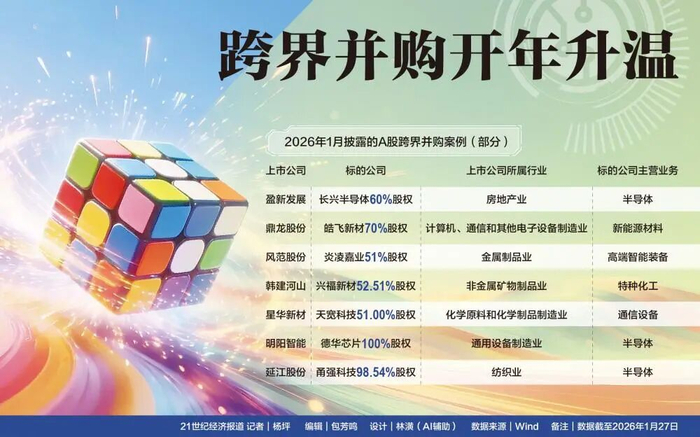
Core Viewpoint - The A-share merger and acquisition (M&A) market remains active in early 2026, with over 297 disclosed M&A cases, including 12 major asset restructurings, particularly in strategic emerging industries like semiconductors and artificial intelligence [1][6]. Group 1: M&A Activity - In January 2026, several companies, including Yingxin Development, Kangxin New Materials, and Dinglong Co., announced cross-industry M&A plans, with many traditional manufacturing firms transitioning towards semiconductors and high-end equipment [1][3]. - Notable cross-industry M&A cases include: - Yingxin Development acquiring 60% of Changxing Semiconductor for 520 million yuan [8]. - Kangxin New Materials planning to acquire 51% of Wuxi Yubang Semiconductor for 392 million yuan [8]. - Mingyang Smart Energy's acquisition of 100% of Dehua Chip Technology [8]. Group 2: Regulatory Scrutiny - Several cross-industry M&A cases have attracted regulatory attention due to concerns over the authenticity of disclosures and valuation rationality, with companies like Kangxin New Materials and Fengfan Co. receiving inquiry letters from regulators [2][12]. - The regulatory stance is supportive of cross-industry M&A that enhances company quality but is strict against speculative and high-risk transactions [2][15]. Group 3: Financial Performance and Challenges - Many companies engaging in cross-industry M&A face challenges in their core business performance, with some reporting continuous losses: - Yanjiang Co. has struggled with net profits below 30 million yuan [9]. - Kangjian Heshan is projected to incur a net loss of 8 to 12 million yuan in 2025 [9]. - Fengfan Co. anticipates a net loss of 320 to 380 million yuan in 2025 [9]. Group 4: Market Dynamics - The recent regulatory framework encourages compliant companies to pursue cross-industry M&A for industrial transformation and growth, reviving interest in cross-industry deals that had previously declined [5][6]. - The market is witnessing a surge in cross-industry M&A cases, with at least eight disclosed in early 2026, four of which involve semiconductor assets [7].

跨界并购开年升温
2 1 Shi Ji Jing Ji Bao Dao· 2026-01-28 23:12
Core Viewpoint - The A-share merger and acquisition (M&A) market remains active in early 2026, with over 297 disclosed M&A transactions, including 12 major asset restructurings, highlighting a focus on strategic emerging industries like semiconductors and artificial intelligence [1] Group 1: M&A Activity - In January 2026, several companies, including Yingxin Development, Kangxin New Materials, and Dinglong Co., announced plans for cross-industry mergers, particularly transitioning from traditional manufacturing to sectors like semiconductors and high-end equipment [1] - Notably, there have been at least eight disclosed cross-industry M&A cases this year, with four involving semiconductor assets [4] - Companies like Kangxin New Materials and Mingyang Smart Energy are actively pursuing acquisitions in the semiconductor sector, indicating a trend of traditional firms seeking new growth avenues through M&A [5][6] Group 2: Regulatory Scrutiny - Regulatory bodies have heightened scrutiny over cross-industry mergers, focusing on the authenticity of disclosures and the reasonableness of valuations, particularly for transactions that appear speculative or high-risk [1][7] - The Shanghai Stock Exchange has issued inquiries regarding the feasibility of performance commitments and the rationale behind significant valuation increases in recent M&A proposals [8][9] - Cases such as Kangxin New Materials' acquisition of Wuxi Yubang Semiconductor have drawn immediate regulatory attention due to concerns over inflated performance promises compared to historical performance [8][10] Group 3: Market Dynamics - The recent regulatory framework encourages well-structured cross-industry mergers that align with business logic and support industry transformation, aiming to revitalize previously stagnant cross-industry M&A activities [3] - Traditional companies facing stagnant core business performance are increasingly turning to cross-industry M&A as a means to rejuvenate growth and avoid potential delisting, despite the inherent risks involved [6][11] - The market is witnessing a shift where companies with weak main business operations are seeking new development momentum through strategic acquisitions, which could enhance the overall quality of listed companies [6]