
华菱钢铁

Search documents
2025年1-8月黑色金属矿采选业企业有1534个,同比增长0.59%
Chan Ye Xin Xi Wang· 2025-10-19 04:46
Group 1 - The core viewpoint of the article highlights the growth in the black metal mining and selection industry in China, with a slight increase in the number of enterprises from the previous year [1] - As of January to August 2025, there are 1,534 enterprises in the black metal mining and selection industry, representing a year-on-year increase of 0.59% [1] - The proportion of these enterprises in the total industrial enterprises stands at 0.29% [1] Group 2 - The report cites a significant change in the criteria for large-scale industrial enterprises, raising the threshold for annual main business income from 5 million to 20 million yuan since 2011 [1] - The article references a comprehensive market survey and investment outlook report for the black metal mining industry in China from 2026 to 2032 published by Zhiyan Consulting [1] - Zhiyan Consulting is recognized as a leading industry consulting firm in China, specializing in in-depth industry research and providing tailored consulting services [1]


钢价小幅回落,关注“十五五“规划指引
Minsheng Securities· 2025-10-19 04:05
Investment Rating - The report maintains a "Buy" recommendation for several steel companies, including Hualing Steel, Baosteel, Nanjing Steel, and others [3][4]. Core Insights - Steel prices have slightly declined, with the price of 20mm HRB400 rebar in Shanghai at 3210 CNY/ton, down 50 CNY/ton from the previous week [1][11]. - The report highlights a decrease in steel production and inventory levels, with total production of the five major steel products at 8.57 million tons, a decrease of 63,600 tons week-on-week [2][3]. - The report emphasizes the importance of the upcoming "14th Five-Year Plan" meeting, which is expected to guide long-term economic development and capacity regulation in the steel industry [3][8]. Summary by Sections Price Trends - As of October 17, steel prices have shown a downward trend, with specific price changes for various steel products, including a 120 CNY/ton decrease for hot-rolled steel [1][12]. Production and Inventory - The total inventory of the five major steel products decreased by 23,800 tons to 11.2451 million tons, with a notable reduction in rebar inventory [2][3]. Profitability - Steel margins have decreased, with rebar, hot-rolled, and cold-rolled steel margins down by 36 CNY/ton, 55 CNY/ton, and 17 CNY/ton respectively [1][3]. Investment Recommendations - The report recommends several companies for investment, including Hualing Steel, Baosteel, and Nanjing Steel in the general steel sector, and specific companies in the special steel and pipe sectors [3][4].


双焦价格持续偏强,吨钢利润短期承压
Xinda Securities· 2025-10-18 13:28
Investment Rating - The investment rating for the steel industry is "Positive" [2] Core Viewpoints - The steel sector has faced a decline of 2.62% this week, underperforming the broader market, with specific segments like special steel down 4.47% and long products down 2.47% [10] - Despite current challenges, including supply-demand imbalances and declining profits, the implementation of "stability growth" policies is expected to support steel demand, particularly in real estate and infrastructure [3][10] - The report suggests that the steel industry is likely to maintain a stable supply-demand situation, with potential for value recovery in undervalued companies, especially those with high gross margins and strong cost control [3] Supply Situation - As of October 17, the capacity utilization rate for blast furnaces in sample steel companies is 90.3%, a decrease of 0.22 percentage points week-on-week [24] - The average daily pig iron output is 2.4095 million tons, down 0.59 tons week-on-week but up 78,700 tons year-on-year [24] - The total output of five major steel products is 7.489 million tons, a decrease of 45,200 tons week-on-week [24] Demand Situation - The consumption of five major steel products reached 8.754 million tons as of October 17, an increase of 123,980 tons week-on-week, representing a 16.50% rise [33] - The transaction volume of construction steel by mainstream traders is 97,000 tons, down 1.24 tons week-on-week [33] Inventory Situation - Social inventory of five major steel products is 11.258 million tons, a decrease of 23,200 tons week-on-week, but an increase of 28.51% year-on-year [41] - Factory inventory of five major steel products is 4.564 million tons, down 161,400 tons week-on-week [41] Steel Prices & Profits - The comprehensive index for ordinary steel is 3,415.7 yuan/ton, down 44.57 yuan/ton week-on-week, and down 11.93% year-on-year [47] - The profit for rebar produced in blast furnaces is -66 yuan/ton, a decrease of 44 yuan/ton week-on-week [55] - The profit for electric arc furnace construction steel is -146 yuan/ton, an increase of 6 yuan/ton week-on-week [55] Raw Material Situation - The spot price index for Australian iron ore (62% Fe) is 781 yuan/ton, down 12 yuan/ton week-on-week [69] - The price of coking coal at the port is 1,690 yuan/ton, up 30 yuan/ton week-on-week [69] - The average profit for independent coking enterprises is -13 yuan/ton, down 22% week-on-week [69] Investment Suggestions - The report recommends focusing on regional leading companies with advanced equipment and environmental standards, as well as those with strong growth potential and cost control capabilities [3]
绿色转型与产能优化齐头并进!钢铁行业力稳基本盘
Sou Hu Cai Jing· 2025-10-18 06:45
Core Viewpoint - The Ministry of Industry and Information Technology and other departments have issued the "Steel Industry Stabilization and Growth Work Plan (2025-2026)", providing policy guidance for the development of China's steel industry, which is currently facing significant downward pressure due to oversupply and insufficient effective demand [1][3]. Industry Growth Targets - The plan sets an average annual growth target of approximately 4% for the steel industry's added value over the next two years, aiming for economic benefits to stabilize and recover [3]. - The China Iron and Steel Association indicates that while steel consumption demand is expected to decline in 2025, the reduction in supply will be more significant, optimizing the supply-demand relationship and boosting industry expectations [3]. Structural Improvement - 2024 is projected to be a turning point for the structure of China's steel products, with the output of medium-thick wide steel strips expected to exceed 200 million tons, surpassing rebar for the first time [5]. - The proportion of construction steel and industrial steel is expected to achieve a "50-50" split, reflecting a shift driven by adjustments in the real estate sector and industrial upgrades [5]. Production and Consumption Trends - In 2024, China's crude steel production is forecasted to be 1.005 billion tons, a decrease of 1.7% year-on-year, while domestic consumption is expected to drop by over 4% [6]. - The long-term trend indicates a decline in the demand for ordinary steel, but a slight recovery is anticipated in the coming years after adjustments [6]. Technological Advancements - The steel industry has made significant technological progress, overcoming previous challenges in producing high-end steel products, with 153 new products launched by leading steel companies by 2025 [7]. - The industry has entered a phase of quality leadership, focusing on high-end, intelligent, and green production rather than merely scaling up [6][7]. Environmental Upgrades - The steel industry has made notable advancements in ultra-low emissions, with significant investments leading to improved environmental performance, surpassing global standards [8]. - By the end of 2025, the industry aims to complete ultra-low emission transformations for over 80% of its capacity, reflecting a strong commitment to environmental sustainability [8]. Corporate Transformations - Many steel companies are actively transforming to adapt to changes in steel demand driven by economic restructuring, focusing on high-value-added products [9][10]. - Companies like Shagang and Hualing Steel have successfully shifted from traditional construction steel to manufacturing steel, maintaining stable sales even in a challenging market [10][11]. - Baosteel is leveraging AI technology to optimize processes and reduce costs, demonstrating the industry's embrace of digital transformation [11].

绿色转型与产能优化齐头并进 钢铁行业力稳基本盘
Zheng Quan Shi Bao· 2025-10-17 19:21
Core Viewpoint - The Ministry of Industry and Information Technology and other departments have issued a "Steel Industry Stabilization and Growth Work Plan (2025-2026)" to provide policy guidance for the development of China's steel industry, addressing challenges such as excessive supply and insufficient effective demand [1][2]. Industry Growth Targets - The plan sets an annual average growth target of approximately 4% for the steel industry's added value over the next two years, aiming for economic stability and recovery [2]. - The China Iron and Steel Association expresses confidence in achieving this target due to improving economic conditions and ongoing upgrades in the steel industry [2]. Structural Improvements - 2024 is projected to be a turning point for the structure of China's steel products, with the production of medium-thick wide steel strips expected to exceed 200 million tons, surpassing rebar for the first time [4]. - The ratio of construction steel to industrial steel is expected to reach a balanced "50-50" for the first time, reflecting a shift driven by real estate adjustments and industrial upgrades [4]. Demand and Supply Dynamics - Domestic steel demand has decreased by 160 million tons compared to peak levels, with crude steel production expected to decline to 1.005 billion tons in 2024, a 1.7% decrease from the previous year [4]. - The industry anticipates a gradual stabilization of total steel demand over the next decade, with projections indicating a decline to 880 million tons by 2030 and 820 million tons by 2035 [6]. Technological Advancements - The steel industry has made significant technological progress, with Chinese companies now capable of producing high-end steel products that were previously reliant on imports [7]. - By 2025, leading global steel companies are expected to have launched 153 new steel products, showcasing advancements driven by independent research and development [7]. Environmental Upgrades - The steel industry has made notable strides in achieving ultra-low emissions, with significant investments leading to improved environmental performance [8]. - By the end of 2025, the industry aims to complete ultra-low emission upgrades for over 80% of its production capacity, reflecting a commitment to sustainable development [8]. Corporate Transformations - Many steel companies are actively transforming their product structures to adapt to changing demand, focusing on high-value-added products such as plates and specialty steels [9][10]. - Companies like Shagang and Hualing Steel have successfully shifted from traditional construction steel to manufacturing steel, demonstrating resilience in a challenging market [9][10]. AI Integration - Domestic steel enterprises are increasingly adopting AI technologies to enhance operational efficiency, with Baosteel launching an AI transformation project that aims to cover over 85% of key processes by mid-2025 [11]. - AI applications have proven beneficial in areas such as scrap steel evaluation, showcasing the industry's commitment to innovation and modernization [11].
从硅钢到“三电” “十里钢城”的产业链升级
Xin Hua She· 2025-10-17 10:27
Core Insights - The news highlights the development of the silicon steel industry in Loudi, Hunan, focusing on the establishment of a complete industrial chain from crude steel to silicon steel products and their applications in electric motors and transformers [3][5] Group 1: Silicon Steel Industry - The silicon steel, known for its high production difficulty and market value, is widely used in large transformers, electric motors, and new energy vehicle motors [3] - Hunan Huazhong Lianyuan Steel Co., Ltd. has upgraded its production capacity, with high-end steel products now accounting for 81% of its output [3] - The industrial chain in Loudi has formed a structure that includes crude steel, silicon steel substrates, finished silicon steel coils, and components for motors and transformers [3] Group 2: Economic Impact and Growth - The Loudi Electric Motor Industrial Park has attracted 21 companies, achieving a production value of 642 million yuan in the first half of the year [5] - In 2021, Hunan Hongwang New Materials Technology Co., Ltd. signed a contract to establish a smart manufacturing industrial park in Loudi, with an annual production capacity of 960,000 tons of high-grade silicon steel [3] - From January to September, Loudi signed 65 new "three electric" projects (electric motors, transformers, home appliances) with a total contract value of 26.755 billion yuan, which is 95.8% of last year's total [5]
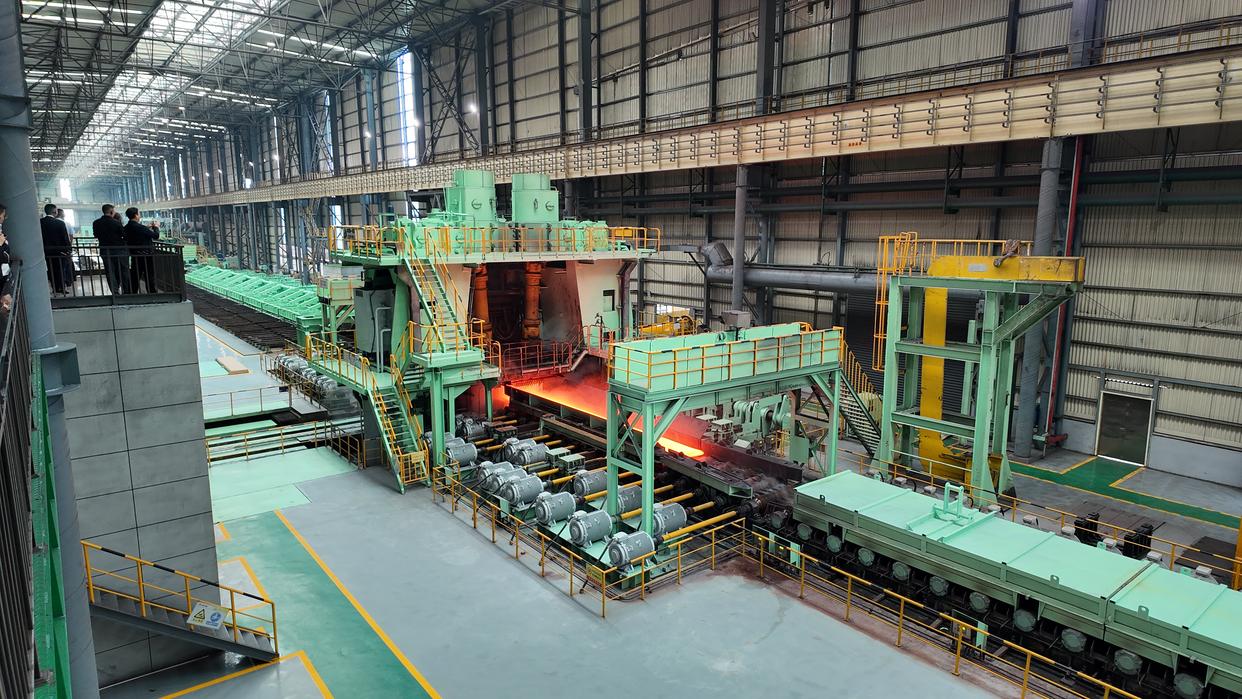
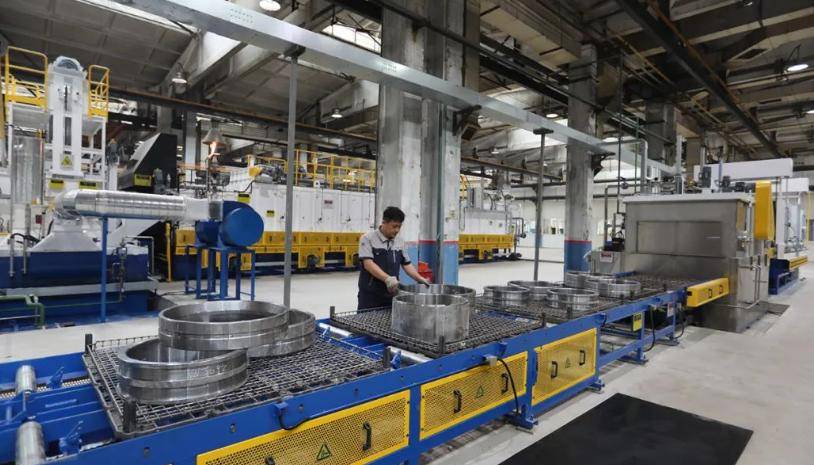
垄断我国98%市场,日德曾以10倍高价出售,自研成功却被日企盗用
Sou Hu Cai Jing· 2025-10-17 08:28
Group 1 - China has been the global leader in steel production since 1996, reaching 1.033 billion tons in 2021, accounting for over 50% of global output [1] - The consumption of steel in China also mirrors its production, with a total of 952 million tons, nearly 50% of global consumption [1] Group 2 - The production of high-quality bearing steel is technically challenging, requiring precise control over chemical composition, dimensions, and surface defects [3] - Historically, China lagged in this technology, leading to reliance on low-end raw material exports and high-priced imports of finished products [3][5] Group 3 - The high-end bearing steel market was dominated by foreign companies, particularly from the US, Japan, Germany, and Sweden, with Japanese firms controlling 98% of the Chinese market [6][8] - This monopoly affected critical sectors like aviation and military, highlighting China's weakness in high-end bearing production despite its large steel output [8] Group 4 - Xingtai Special Steel was established in 1993 to focus on high-quality bearing steel production, overcoming initial technological barriers to become a global leader [10] - The company achieved significant milestones, including a 1150-hour fatigue life for bearing steel, surpassing European products, and becoming the first Chinese firm to gain a green procurement channel from SKF [12][13] Group 5 - China's advancements in bearing steel have reduced dependency on imports, with projections indicating a decrease in import reliance to below 30% by 2025 [12] - The domestic bearing industry is expected to exceed 300 billion yuan in scale by 2025, reflecting the impact of increased R&D investments [12] Group 6 - Recent international market dynamics show Japanese companies, previously dominant, are now sourcing Chinese bearing steel due to production shortages [19] - Scandals involving Japanese firms mislabeling Chinese components as domestic products have highlighted the competitive pressures they face from Chinese manufacturing [21] Group 7 - The evolution of China's bearing steel technology has led to a gradual dismantling of foreign monopolies, with domestic firms increasing their market share and improving product quality [23] - The overall landscape of the manufacturing industry is shifting, with China's steel sector poised to become a dominant force in the global market [25]
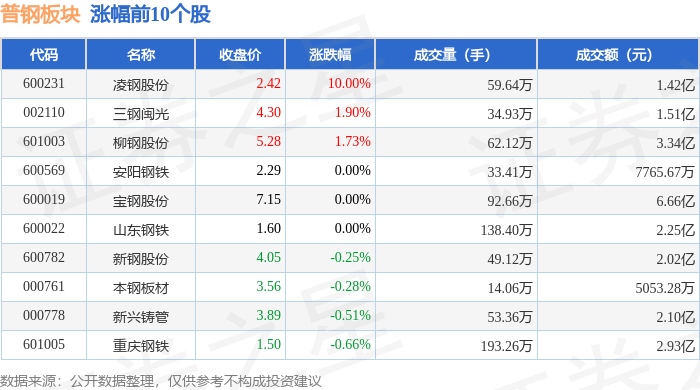
普钢板块10月17日跌0.68%,武进不锈领跌,主力资金净流出3.37亿元
Zheng Xing Xing Ye Ri Bao· 2025-10-17 08:28
Market Overview - On October 17, the general steel sector declined by 0.68% compared to the previous trading day, with Wujin Stainless Steel leading the decline [1] - The Shanghai Composite Index closed at 3839.76, down 1.95%, while the Shenzhen Component Index closed at 12688.94, down 3.04% [1] Individual Stock Performance - Lingang Co. (600231) saw a significant increase of 10.00%, closing at 2.42, with a trading volume of 596,400 shares and a transaction value of 142 million [1] - Other notable performers included Sansteel Minguang (002110) with a 1.90% increase, and Liugang Co. (601003) with a 1.73% increase [1] - Conversely, Wujin Stainless Steel (603878) experienced the largest drop of 8.54%, closing at 10.17, with a trading volume of 699,000 shares and a transaction value of 723 million [2] Capital Flow Analysis - The steel sector experienced a net outflow of 337 million from main funds, while retail investors contributed a net inflow of 244 million [2] - The main funds showed a significant net inflow in Liugang Co. (649.51 million) and Lingang Co. (586.69 million), while experiencing outflows in Wujin Stainless Steel and other companies [3] - Retail investors primarily contributed to the net inflow in stocks like Wujin Stainless Steel and Sansteel Minguang, despite overall sector outflows [3]


特钢概念下跌2.68% 主力资金净流出35股
Zheng Quan Shi Bao Wang· 2025-10-16 09:17
Core Points - The special steel concept index declined by 2.68% as of the market close on October 16, with major stocks like Beijing Lier hitting the limit down, while a few stocks like Yongxing Materials saw gains [1][2] - The special steel sector experienced a net outflow of 1.268 billion yuan, with 35 stocks seeing outflows, and 7 stocks having outflows exceeding 30 million yuan [1][2] Market Performance - The top-performing concept sectors included Hainan Free Trade Zone (+2.58%) and Military Equipment Restructuring (+1.98%), while the special steel concept was among the worst performers [1] - Stocks with significant net outflows included Baogang Co. (-1.44%, -325.48 million yuan), Wuzhou Xinchun (-6.04%, -202.36 million yuan), and Beijing Lier (-9.95%, -152.48 million yuan) [1][2] Stock Movements - The stocks with the highest net inflows were Yongxing Materials (+1.85%, +8.4352 million yuan), Changbao Co. (-2.87%, +4.5255 million yuan), and Bensteel Co. (-2.46%, +1.8115 million yuan) [1][2] - The overall trading volume and turnover rates varied, with stocks like Wuzhou Xinchun and Beijing Lier showing high turnover rates of 10.05% and 6.13% respectively [1][2]


8.65亿元主力资金今日撤离钢铁板块
Zheng Quan Shi Bao Wang· 2025-10-16 08:48
Core Points - The Shanghai Composite Index rose by 0.10% on October 16, with seven industries experiencing gains, particularly coal and banking, which increased by 2.35% and 1.35% respectively [1] - The steel industry faced the largest decline, dropping by 2.14%, with a net outflow of 865 million yuan in main capital [1] - Among the 44 stocks in the steel sector, only 2 rose while 42 fell, including 1 stock that hit the daily limit down [1] Industry Summary - The steel industry saw a significant drop of 2.14%, with a total of 865 million yuan in net capital outflow [1] - The top three stocks with the highest net capital outflow were Baogang Group (-32.55 million yuan), Hesteel (-11.88 million yuan), and Wujin Stainless Steel (-4.80 million yuan) [1] - The stocks with net capital inflow included Hainan Mining (28.66 million yuan), Xianglou New Materials (28.07 million yuan), and New Steel (27.13 million yuan) [1][2] Stock Performance - The top decliners in the steel sector included: - Baogang Group: -1.44% with a turnover rate of 5.76% and a net outflow of -32.55 million yuan [1] - Hesteel: -5.70% with a turnover rate of 2.34% and a net outflow of -11.88 million yuan [1] - Wujin Stainless Steel: -10.03% with a turnover rate of 13.00% and a net outflow of -4.80 million yuan [1] - The only stock that experienced a gain in the steel sector was Hainan Mining, which rose by 2.05% with a net inflow of 28.66 million yuan [2]