
国睿科技

Search documents
研判2025!中国空中交通管理系统行业发展历程、政策汇总、产业链、发展现状、竞争格局及发展趋势分析:行业国产化进程加速,为低空经济发展奠定坚实基础[图]
Chan Ye Xin Xi Wang· 2025-05-21 01:22
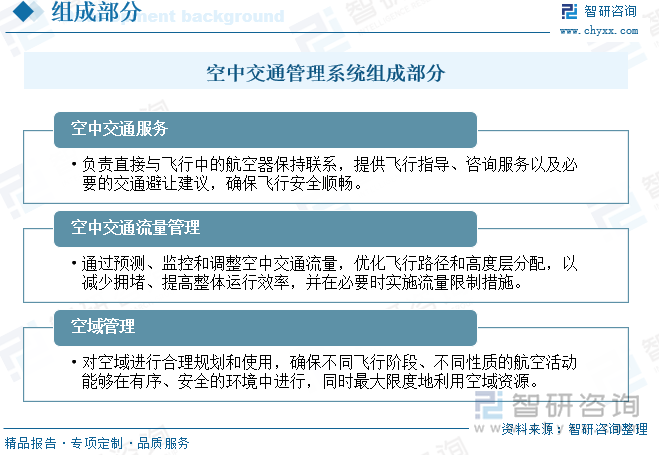
Core Viewpoint - The Chinese air traffic management system is undergoing significant advancements through domestic innovation and digital transformation, aiming to reduce reliance on foreign technology and enhance international competitiveness. The market size is projected to reach 6 billion yuan in 2024, reflecting a year-on-year increase of 15.38% [1][14]. Industry Overview - The air traffic management system (ATMS) is essential for overseeing and managing civil aviation operations, ensuring safety and efficiency in aircraft operations. It consists of three main components: air traffic services, air traffic flow management, and airspace management [3][10]. - The industry has evolved from relying on international products to achieving significant domestic technological breakthroughs, including the development of new-generation flight data processing systems and airport surveillance radars [1][14]. Industry Development History - The ATMS in China has developed from its inception in the early 1950s to a more sophisticated system today, marked by key reforms and technological advancements since the 2000s. The establishment of the Civil Aviation Administration of China in 1994 was a significant milestone [5][12]. Policy Support - Recent policies, such as the "14th Five-Year Plan for Civil Aviation Development" and the "Smart Civil Aviation Construction Roadmap," emphasize the modernization of the air traffic management system and the integration of advanced technologies [7][9]. Market Dynamics - The demand for air traffic management systems is increasing due to the rising passenger and cargo throughput in China's civil aviation sector, which is expected to continue growing post-pandemic [12][14]. - The market is characterized by both domestic and international players, with key domestic companies including Sichuan Chuan Da Zhisheng, Sichuan Electronic Technology, and Nanjing Lais Information Technology leading the way in technological capabilities [16][20]. Future Trends - The industry is moving towards greater intelligence and networking, leveraging technologies such as AI and big data to enhance operational efficiency and safety. This shift aims to create a more integrated and responsive air traffic management system [22][23]. - The integration of military and civilian air traffic management systems is becoming increasingly important, with a focus on collaboration and standardization to improve overall system coordination [24].


空中基建觉醒
3 6 Ke· 2025-05-21 00:10
Core Insights - The eVTOL (electric Vertical Take-off and Landing) industry is gaining momentum comparable to electric vehicles, large aircraft, and humanoid robots, with significant market potential in China [1][2] - The low-altitude economy is expected to drive industrial upgrades and technological innovation across multiple sectors, similar to the impact of electric vehicles [2][4] - The successful development of the eVTOL market hinges on the establishment of a comprehensive supporting infrastructure [3][5] Industry Overview - The low-altitude economy encompasses three main segments: eVTOL manufacturing, low-altitude operation services, and low-altitude infrastructure [4] - China aims to expand its eVTOL market globally, with a focus on building a robust low-altitude infrastructure [4][9] Market Comparison - As of the end of 2024, China has 475 registered general airports, only 11% of the number in the U.S., with an airspace openness rate of less than 30% [7] - The U.S. has over 5,000 public general aviation airports, highlighting its significant lead in the general aviation sector [8] Competitive Advantages - China's eVTOL manufacturing benefits from a unique industrial chain reuse advantage due to similarities with electric vehicles in battery, motor, and control technologies [9] - The country leads in 5G technology, which is crucial for communication and tracking of eVTOLs in densely populated urban areas [9] Infrastructure Development - The low-altitude infrastructure is seen as a critical market segment, with various industries such as agriculture, healthcare, and tourism expected to benefit [10] - Key players in low-altitude infrastructure include state-owned enterprises and innovative companies, with local governments beginning to allocate funds to this sector [11][13] Regional Initiatives - Guangdong has made significant progress in low-altitude infrastructure, completing the first eVTOL cross-city flight demonstration [15] - Cities like Hangzhou and Hefei are actively developing eVTOL operations and infrastructure, with Hefei recently obtaining the world's first operational qualification for a manned drone [13][15] Market Growth Projections - Goldman Sachs identified three high-growth sub-sectors within the low-altitude economy, with vertical take-off and landing airport services projected to grow at a compound annual growth rate of 39% [17] - The low-altitude economy market in China is expected to exceed 2 trillion yuan by 2030, with current infrastructure and flight support accounting for only 5% of the market [17] Infrastructure Components - Low-altitude infrastructure includes ground facilities such as general airports, vertiports, and charging stations, as well as airspace management systems [22][23] - The air traffic management (ATM) system is crucial for managing air traffic and ensuring safety [25] Key Players and Innovations - Companies like EHang and CATL are collaborating to develop eVTOL aircraft and charging infrastructure [29] - Domestic companies are increasingly replacing foreign firms in the air traffic management sector, with significant advancements in automation and monitoring systems [30][36] Technological Advancements - The integration of 5G-A technology is pivotal for the development of low-altitude infrastructure, enabling enhanced communication and data transmission for eVTOL operations [48][51] - Major telecommunications companies are actively developing low-altitude communication networks to support the growing eVTOL market [58][60] Future Outlook - The low-altitude infrastructure sector is still in its early stages, facing challenges such as compatibility issues and isolated developments [66][67] - The demand for drone countermeasures is anticipated to grow, with the global market projected to reach $10.3 billion by 2030 [68] - The competition in low-altitude infrastructure is intensifying, with a mix of state-owned enterprises, tech giants, and startups vying for market share [69][70]

上证中小国企改革指数报2422.51点,前十大权重包含国睿科技等
Sou Hu Cai Jing· 2025-05-19 08:50
金融界5月19日消息,A股三大指数收盘涨跌不一,上证中小国企改革指数 (中小企改,950080)报 2422.51点。 数据统计显示,上证中小国企改革指数近一个月上涨1.96%,近三个月上涨0.29%,年至今下跌3.24%。 据了解,上证中小国企改革指数优选已被中央和地方国资委列为国企改革试点、或已出台相关重大资产 重组方案、或已出台相关国企改革方案、或已完成国企改革的沪市国企上市公司证券作为指数样本,以 反映沪市中小国企改革主题上市公司证券的整体表现。该指数以2013年12月31日为基日,以1000.0点为 基点。 从指数持仓来看,上证中小国企改革指数十大权重分别为:华域汽车(3.25%)、申能股份 (3.21%)、物产中大(3.2%)、西部超导(3.11%)、天坛生物(3.02%)、老白干酒(2.95%)、扬 农化工(2.94%)、国睿科技(2.92%)、中直股份(2.91%)、生益科技(2.88%)。 从上证中小国企改革指数持仓的市场板块来看,上海证券交易所占比100.00%。 从上证中小国企改革指数持仓样本的行业来看,工业占比34.74%、可选消费占比12.12%、信息技术占 比11.73%、原材料占 ...
国防军工行业报告:我国首部国家安全白皮书发布
China Post Securities· 2025-05-19 08:30
证券研究报告:国防军工|行业周报 行业投资评级 强于大市|维持 | 行业基本情况 | | | | --- | --- | --- | | 收盘点位 | | 1484.75 | | 52 | 周最高 | 1712.48 | 52 周最低 1113.62 行业相对指数表现 -16% -11% -6% -1% 4% 9% 14% 19% 24% 29% 2024-05 2024-07 2024-10 2024-12 2025-03 2025-05 国防军工 沪深300 资料来源:聚源,中邮证券研究所 研究所 分析师:鲍学博 SAC 登记编号:S1340523020002 Email:baoxuebo@cnpsec.com 分析师:马强 SAC 登记编号:S1340523080002 Email:maqiang@cnpsec.com 近期研究报告 《中邮军工周报 5 月第 2 周:中国装备 在印巴冲突中表现突出,主机厂比上游 企业更受益于军贸增长》- 2025.05.13 国防军工行业报告 我国首部国家安全白皮书发布 ⚫ 投资要点 国务院新闻办公室 5 月 12 日发布《新时代的中国国家安全》白 皮书,旨在全面阐释新 ...
逐鹿“空中蓝海” 公募密集布局航空航天主题ETF
Zhong Guo Zheng Quan Bao· 2025-05-18 21:27
Core Viewpoint - The low-altitude economy sector is experiencing significant growth driven by favorable policies, leading to a surge in related ETF products in the market [1][2][4] Group 1: ETF Market Activity - Multiple fund companies, including Huaxia, Fuguo, and E Fund, have launched or reported new ETFs focused on the general aviation and aerospace sectors, with 6 ETFs tracking the National Index for General Aviation and 4 ETFs tracking the National Index for Aerospace [1][2] - The total scale of the listed related ETFs has exceeded 1.2 billion yuan, with a mix of individual and institutional investors among the top holders [3] Group 2: Industry Characteristics - The National Index for General Aviation reflects the price changes of listed companies in the general aviation sector, covering key players in the low-altitude economy, including large aircraft and commercial space [2] - The National Index for Aerospace focuses on core military companies and emphasizes low-altitude economy and large aircraft concepts [2] Group 3: Market Trends and Performance - Despite initial strong performance, several ETFs have faced net outflows this year, with some products dropping below 100 million yuan in scale shortly after launch [3] - The low-altitude economy is characterized by strong innovation, a long industrial chain, and diverse application scenarios, with significant progress in manufacturing, infrastructure, and operational services [4] Group 4: Policy Impact - Continuous policy support is expected to drive substantial market growth in the low-altitude economy, with recent developments including the issuance of operational certificates for manned civil drones and the establishment of low-altitude economic innovation cities [4][5]
国防军工行业2024年报及2025一季报综述:板块业绩结构性特征明显,关注订单基本面复苏机遇
China Securities· 2025-05-18 16:10
Investment Rating - The report indicates a positive outlook for the military industry, suggesting that the industry is nearing a bottom and is expected to recover in 2025 [1][2]. Core Insights - The military sector reported a total revenue of 764.903 billion yuan in 2024, reflecting a year-on-year increase of 1.16%. Key segments such as shipbuilding, aerospace engines, and aviation maintained positive revenue growth [1][2][11]. - The net profit attributable to shareholders in the military sector decreased to 26.655 billion yuan in 2024, a decline of 38.01% year-on-year, primarily due to lower downstream demand and price reductions for certain products [11][12]. - In Q1 2025, the military sector's revenue reached 153.894 billion yuan, up 2.35% year-on-year, with segments like ground equipment and aerospace showing signs of recovery [28][31]. Summary by Sections 1. 2024 Annual Report and 2025 Q1 Review - The military sector's revenue structure shows significant characteristics, with a focus on the recovery of order fundamentals. The shipbuilding sector saw a revenue increase of 10.87%, while ground equipment and aerospace segments are expected to stabilize [11][28]. - The military sector's net profit for 2024 was 26.655 billion yuan, down 38.01% year-on-year, with only the shipbuilding sector showing positive growth [11][12]. 2. Key Target Profit Forecasts and Valuations - Investment strategies suggest focusing on traditional military sectors with expected order recovery, including aerospace engines, shipbuilding, and aviation [3]. - New domains and new qualities are recommended, emphasizing low-cost, intelligent, and systematic characteristics in industries like precision-guided munitions and unmanned systems [3]. 3. Investment Strategy - The report recommends three main investment lines: traditional military sectors, new domains with significant growth potential, and companies with expected asset integration and competitive military trade markets [3]. - Specific recommended stocks include aerospace engine manufacturers, shipbuilding companies, and firms involved in commercial aerospace and low-altitude economies [3]. 4. Market Performance - The military sector's performance is closely monitored, with various companies announcing contracts and showing signs of recovery in the fundamentals of the military sector [46][47].


季报板块业绩结构性回暖,关注订单基本面触底回升
China Securities· 2025-05-18 15:15
Investment Rating - The report suggests a positive outlook for the military industry, indicating a potential recovery in performance by 2025, with a focus on companies with order recovery expectations and performance support [2][10][44]. Core Insights - The military sector reported a total revenue of 764.903 billion yuan in 2024, a year-on-year increase of 1.16%. Key segments showing positive growth include shipbuilding, aerospace engines, and aviation [2][10]. - The net profit for the military sector decreased to 26.655 billion yuan in 2024, down 38.01% year-on-year, primarily due to lower downstream demand and price reductions for certain products [12][10]. - The first quarter of 2025 is expected to show signs of recovery, particularly in ground equipment and aerospace segments, with a projected increase in associated transaction amounts [2][29]. Summary by Sections 1. Industry Overview - The military sector's revenue growth was driven by shipbuilding (10.87% increase), aerospace engines (4.46% increase), and aviation (2.75% increase), while ground equipment and commercial aerospace saw significant declines [10][12]. - The report highlights a structural recovery in the military sector, with positive signals emerging from major companies regarding contract announcements and performance stabilization [2][38]. 2. Investment Strategy - The report recommends focusing on three main investment lines: 1. Traditional military sectors with expected order recovery, particularly in aerospace engines, shipbuilding, and aviation [2][44]. 2. New domains characterized by low-cost, intelligent, and systematic features, including precision-guided munitions and unmanned systems [2][44]. 3. Companies with asset integration expectations and competitive positions in military trade markets [2][44]. 3. Recommended Stocks - Traditional military direction: Recommended stocks include Aerospace Power, Aerospace Control, and Huayin Technology [3][45]. - New domain and new quality direction: Recommended stocks include High De Infrared, North Navigation, and Aerospace Rainbow [3][45]. - Reform and overseas direction: Recommended stocks include Guorui Technology and Construction Industry [3][45].


华创交运低空经济周报(第39期):海外市场观察:美股eVTOL标的Archer周涨幅50%
Huachuang Securities· 2025-05-18 10:50
Investment Rating - The report maintains a "Recommendation" rating for the low-altitude economy industry, expecting the industry index to outperform the benchmark index by more than 5% in the next 3-6 months [49]. Core Views - The report highlights the significant growth potential in the low-altitude economy, particularly in three major application scenarios: new consumption in cultural tourism, manned (passenger) transportation, and specialized uses. It emphasizes the importance of low-altitude new infrastructure investments, including digitalization and radar systems [37][38]. - The report notes that the U.S. eVTOL company Archer has seen a substantial increase in its stock price, with a weekly rise of 50%, reflecting market recognition of the future potential of eVTOL in urban air mobility [4][28]. Summary by Sections Industry Overview - The low-altitude economy industry consists of 122 listed companies with a total market value of approximately 32,496.40 billion yuan and a circulating market value of about 27,825.55 billion yuan [1]. - The Huachuang Transportation Low-altitude 60 Index experienced a weekly decline of 1.1% but has increased by 1.7% year-to-date, indicating a mixed performance compared to other indices [29][30]. Company Analysis: Archer - Archer's stock surged due to positive quarterly results and operational highlights, including successful overseas expansion and strategic partnerships with major airlines and technology firms [5][7][10]. - Archer's eVTOL aircraft, "Midnight," is set to play a significant role in the upcoming 2028 Los Angeles Olympics as the official air taxi provider, showcasing the company's accelerating commercialization efforts [8][10]. - Financially, Archer reported a narrowed loss of $0.93 billion in Q1 2025, with a significant cash reserve of $1 billion, indicating strong liquidity despite ongoing operational losses [20][24]. Market Insights - The report suggests that the valuation of U.S. eVTOL companies like Archer and Joby reflects the market's confidence in the future of eVTOL for urban air transportation, despite their current inability to mass-produce or deliver products [28]. - The report anticipates that the U.S. regulatory environment will facilitate the commercialization of eVTOL operations, paving the way for significant market opportunities [26][27]. Investment Recommendations - The report advises focusing on key segments within the low-altitude economy, including manufacturers, supply chains, new infrastructure, and operational entities, to capitalize on the expected growth from 2025 to 2027 [37][38].

华创交运低空经济周报(第39期):海外市场观察:美股eVTOL标的Archer周涨幅50%-20250518
Huachuang Securities· 2025-05-18 10:12
Investment Rating - The industry investment rating is "Recommended," indicating an expected increase in the industry index by more than 5% over the next 3-6 months compared to the benchmark index [51]. Core Insights - The report highlights the significant rise of the eVTOL company Archer, which saw a weekly increase of 50%, reaching a market capitalization of $7.3 billion (approximately 52.6 billion RMB) [4][5]. - Archer's operational highlights include successful overseas expansion, partnerships with major airlines, and being selected as the official air taxi provider for the 2028 Los Angeles Olympics, indicating a rapid acceleration in commercialization [7][10]. - Financially, Archer reported a narrowed loss of $93 million in Q1, with a substantial cash reserve of $1 billion (approximately 7.2 billion RMB), showcasing strong liquidity [20][24]. Industry Overview - The report provides an overview of the transportation industry, noting a total of 122 listed companies with a total market value of 324.96 billion RMB and a circulating market value of 278.26 billion RMB [1]. - The Huachuang Transportation Low Altitude 60 Index experienced a weekly decline of 1.1% but has increased by 1.7% year-to-date, contrasting with the performance of the CSI 300 Index, which has decreased by 1.2% [29][31]. Company-Specific Developments - Archer's strategic partnerships include collaboration with United Airlines to launch air taxi services in New York, aiming to reduce travel time significantly [7][8]. - The company has also secured a $500 million order from Soracle Corporation in Japan for up to 100 Midnight aircraft, indicating strong international demand [16][17]. - Archer's eVTOL aircraft, Midnight, is designed to travel at speeds of 150 mph and can carry up to four passengers, highlighting its potential for urban air mobility [11]. Financial Performance - Archer's Q1 EPS loss has significantly narrowed to $0.17 from $0.36 in the previous quarter, reflecting improved operational efficiency [20]. - The company anticipates an adjusted EBITDA loss of $100-120 million for Q2, indicating ongoing investment in growth despite current losses [21]. Market Insights - The report emphasizes the competitive landscape, suggesting that both Chinese and American companies are well-positioned in the eVTOL market, with the potential for significant market share in the future [28]. - The FAA's new regulations for vertical takeoff and landing aircraft are expected to pave the way for commercial operations, enhancing the market outlook for eVTOL companies [26][27].
金融工程定期:军工板块的资金行为监测
KAIYUAN SECURITIES· 2025-05-17 12:25
2025 年 05 月 17 日 金融工程研究团队 魏建榕(首席分析师) 证书编号:S0790519120001 张 翔(分析师) 证书编号:S0790520110001 傅开波(分析师) 证书编号:S0790520090003 高 鹏(分析师) 证书编号:S0790520090002 苏俊豪(分析师) 证书编号:S0790522020001 胡亮勇(分析师) 证书编号:S0790522030001 王志豪(分析师) 证书编号:S0790522070003 盛少成(分析师) 证书编号:S0790121070009 苏 良(分析师) 证书编号:S0790121070008 何申昊(分析师) 证书编号:S0790524070009 陈 威(研究员) 证书编号:S0790123070027 蒋 韬(研究员) 证书编号:S0790123070037 相关研究报告 《 AIGC 板 块 的 资 金 行 为 监 测 》 -2024.11.24 《 芯 片 板 块 的 资 金 行 为 监 测 》 -2024.12.28 《 机 器 人 板 块 的 资 金 行 为 监 测 》 -2025.01.24 《 农 业 板 块 的 ...