奈雪的茶

Search documents
恋缩时代降临,品牌七夕如何“过情关”?
Xin Lang Cai Jing· 2025-08-30 01:29
Core Insights - The annual Qixi Festival marketing strategies are evolving as young people's perceptions of love change, leading to a shift towards virtual companionship and singlehood [1] - Brands are challenged to adapt their narratives beyond traditional romantic themes, focusing on new audience psychology [1] Group 1: Brand Marketing Strategies - This year's Qixi marketing highlights collaborations, such as the partnership between "Love and Producer" and Tmall, which integrates agricultural themes into romantic narratives [3] - "World Beyond" collaborates with MAC, featuring male characters as beauty customers, blending gaming with beauty marketing [4] - "Like a Kite" partners with Nayuki to create themed products, successfully engaging fans through offline experiences [6] Group 2: Consumer Engagement and Trends - Players are increasingly seeking diverse participation experiences, with events like "Critical Heartbeat Parties" and themed activities enhancing community engagement [14] - Social media campaigns, such as large-scale declarations of love for game characters, blur the lines between official and fan-driven content, amplifying brand reach [16] - The trend of Qixi becoming a "pan-relationship festival" reflects a broader audience, including friends and family, rather than just couples [37] Group 3: Competitive Landscape in Retail - The ongoing competition among delivery platforms intensifies during Qixi, with major players like Meituan and Taobao Flash Sale leading promotional efforts [18] - Meituan's "Mai Rui Mi" campaign offers zero-cost promotions, while Taobao Flash Sale emphasizes significant discounts and celebrity endorsements [22][26] - Tea brands are adopting a more cautious approach this year, focusing on strategic collaborations rather than large-scale promotions [27] Group 4: Luxury Brand Strategies - International luxury brands continue to express love and romance subtly during Qixi, with some attempting to integrate traditional craftsmanship into modern designs [38] - Despite some innovative approaches, luxury brands face criticism for their lack of differentiation and slow adaptation to market trends [42] - The emphasis on emotional resonance in marketing campaigns indicates a shift towards deeper narratives, although many brands still struggle with originality [43]




五家茶饮股上半年业绩出炉
Di Yi Cai Jing Zi Xun· 2025-08-29 15:51
| | 2025年上半年 | | | | | --- | --- | --- | --- | --- | | 证券简称 | 营业收入(亿元) | 同比 | 期内利润(亿元) | 目比 | | 蜜雪集团 | 148. 7 | 39. 30% | 27. 18 | 44% | | 古茗 | 56. 63 | 41. 20% | 16.26 | 120% | | 茶百道 | 25 | 4% | 3.3 | 39. 50% | | 奈雪的茶 | 21. 78 | -14.4% | -1. 19 | | | 沪上阿姨 | 18. 18 | 9. 70% | 2. 03 | 20. 90% | | | 7 | | 截至2025年6月30日财务数据 第 1财经 | | 本文字数:312,阅读时长大约1分钟 微信编辑| 雨林 2025.08.29 近日,蜜雪集团、古茗、茶百道、奈雪的茶、沪上阿姨5家在港上市茶饮股纷纷披露了2025年中期业绩 报告。财报显示,蜜雪集团、古茗、茶百道、沪上阿姨上半年营利双增,奈雪的茶期内利润亏损同比收 窄,但营收下滑14%。 此外,在美上市的霸王茶姬今日披露2025年第二季度财报,第二季度净收入 ...
五家茶饮股上半年业绩出炉
第一财经· 2025-08-29 15:28
2025.08. 29 微信编辑 | 雨林 第 一 财 经 持 续 追 踪 财 经 热 点 。 若 您 掌 握 公 司 动 态 、 行 业 趋 势 、 金 融 事 件 等 有 价 值 的 线 索 , 欢 迎 提 供 。 专 用 邮 箱 : bianjibu@yicai.com (注:我们会对线索进行核实。您的隐私将严格保密。) 推荐阅读 多地遴选小学教师转岗初中 本文字数:312,阅读时长大约1分钟 近日,蜜雪集团、古茗、茶百道、奈雪的茶、沪上阿姨5家在港上市茶饮股纷纷披露了2025年中期业绩 报告。财报显示,蜜雪集团、古茗、茶百道、沪上阿姨上半年营利双增,奈雪的茶期内利润亏损同比收 窄,但营收下滑14%。 此外,在美上市的霸王茶姬今日披露2025年第二季度财报,第二季度净收入33.32亿元,同比增长 10.2%;调整后净利润6.3亿元。 | | 2025年上半年 | | | | | --- | --- | --- | --- | --- | | 证券简称 | 营业收入 (亿元) | 同比 | 期内利润(亿元) | 同比 | | 蜜雪集团 | 148. 7 | 39. 30% | 27. 18 | 44% | ...

茶百道:半年门店仅增59家,业绩修复可持续吗?
Guan Cha Zhe Wang· 2025-08-29 14:49
Core Viewpoint - Tea Baidao (02555.HK) reported a revenue growth of 4% year-on-year for the first half of 2025, achieving total revenue of 2.5 billion yuan and a profit increase of 40% to 333 million yuan, driven by supply chain cost reductions and a decrease in franchisee subsidies [1][2]. Financial Performance - Total revenue reached 2.5 billion yuan, with a year-on-year growth of 4% [1] - Gross profit amounted to 815 million yuan, with a gross margin of 32.6% [1] - Net profit increased to 333 million yuan, reflecting a 40% year-on-year growth [1] Factors Driving Profit Growth - Supply chain cost reduction: The number of national distribution centers increased to 26, with approximately 93.8% of stores achieving next-day delivery after ordering, and 95% receiving deliveries twice or more weekly, leading to an 0.9 percentage point increase in gross margin [1] - Decrease in franchisee subsidies: The company reduced material discounts and advertising subsidies from approximately 200 million yuan last year, resulting in a 2% increase in net profit margin [1] - Stagnation in expansion: The total number of stores increased to 8,444, with a net increase of only 59 stores in the first half of the year, leading to a 2-3 percentage point decrease in sales and distribution expense ratio [1] Market Position and Competition - The company is in the early stages of exploring overseas markets, with operations in 8 countries and over 40 signed stores, but revenue contribution remains below 1% [2] - Competitors are experiencing varied expansion rates, with some brands like Mi Xue Bing Cheng rapidly increasing their store count, while others like Naixue's Tea have slowed down significantly [2] - The company has approximately 3.7 billion yuan in cash and no interest-bearing debt, indicating potential for future expansion [2] Challenges Ahead - The company faced a closure of 890 stores in 2024, with higher closure rates in lower-tier cities, which could widen the gap in procurement, logistics, and marketing costs compared to competitors [3] - The long-term scale disadvantage due to stagnation in store expansion could impact the company's competitive position in the market [2][3]

茶饮股上半年业绩出炉:四家茶饮股上半年营利双增
Di Yi Cai Jing· 2025-08-29 14:24
财报显示,蜜雪集团、古茗、茶百道、沪上阿姨上半年营利双增。 近日,蜜雪集团、古茗、茶百道、奈雪的茶、沪上阿姨5家在港上市茶饮股纷纷披露了2025年中期业绩报告。财报显示,蜜雪集团、古茗、茶百道、 沪上阿姨上半年营利双增,奈雪的茶期内利润亏损收窄,但营收下滑14%。 | | 2025年上半年 | | | | | --- | --- | --- | --- | --- | | 证券简称 | 营业收入 (亿元) | 同比 | 期内利润(亿元) | 同比 | | 蜜雪集团 | 148. 7 | 39. 30% | 27. 18 | 44% | | 古茗 | 56. 63 | 41. 20% | 16. 26 | 120% | | 茶百道 | 25 | 4% | 3.3 | 39.50% | | 奈雪的茶 | 21. 78 | -14.4% | -1. 19 | | | 沪上阿姨 | 18. 18 | 9.70% | 2. 03 | 20. 90% | | | | | 截至2025年6月30日财务数据 第二则经 | | 此外,在美上市的霸王茶姬今日披露2025年第二季度财报,第二季度净收入33.32亿元,同比增长10. ...

聚势AI·共启智慧零售新生态,第七届中国智慧零售大会在深成功举办
Zhong Guo Zhi Liang Xin Wen Wang· 2025-08-29 14:19
Core Insights - The seventh China Smart Retail Conference was successfully held in Shenzhen, focusing on the theme "Gathering AI, Co-initiating a New Ecology of Smart Retail" [1] - The conference aimed to explore the integration of AI technology with the retail industry, providing strong momentum for high-quality development in smart retail [1][3] Group 1: Conference Highlights - The conference featured six core segments, including the launch of the "Smart Retail Laboratory," the authoritative release of the "Smart Retail Ecological First Report," and the presentation of annual innovative case studies [1][3] - The "Smart Retail Ecological First Report" analyzed the current state of smart retail development and predicted future trends, offering important references for enterprises [3] - Three major "Smart Retail Innovation Achievements" were announced, recognizing nearly 30 companies for their outstanding contributions in technology innovation and industry impact [3] Group 2: Smart Retail Laboratory - The "Smart Retail Laboratory" was launched to explore paths for digital, intelligent, and smart upgrades for enterprises, aiming to reduce trial and error costs and foster innovation [5] - The laboratory seeks to establish a collaborative ecosystem for smart retail, promoting structural reforms in supply-side and supporting high-quality development in the retail sector [5] Group 3: Expert Insights - Experts shared insights on organizational, technological, ecological, and scenario dimensions, emphasizing the shift from traditional retail structures to customer-centric agile networks [7][8] - AI's role in enhancing efficiency and precision in retail operations was highlighted, with applications in areas such as franchise review, site selection, and marketing strategies [8] - The concept of "AI Smart Code" was introduced as a second-generation ID for products, enabling full lifecycle data integration and improving supply chain efficiency [10] Group 4: AI Solutions and Applications - The conference included a session on eight innovative AI solutions, with representatives from various companies presenting core solutions for digital upgrades in retail [11] - AI's potential to empower retail chains and enhance operational efficiency was discussed, with examples of successful AI applications in the retail sector [12] - A panel discussion addressed the challenges and future directions of AI in the retail industry, providing strategic insights for decision-making [13]

食饮吾见 | 一周消费大事件(8.25-8.29)
Cai Jing Wang· 2025-08-29 13:29
Group 1: Alcohol Industry - Laobai Ganjiu reported a slight revenue increase of 0.48% to 2.481 billion yuan, with a 3.81% decline in revenue from products priced below 100 yuan [1] - Shanxi Fenjiu's revenue grew by 5.35% to 23.96 billion yuan, with out-of-province revenue reaching 15.143 billion yuan [2] - Wuliangye's revenue increased by 4.19% to 52.771 billion yuan, with a notable growth in daily bottle opening and scanning for its products [3] Group 2: Dairy Industry - Mengniu achieved a revenue of 41.57 billion yuan, with a 13.4% increase in operating profit, driven by product innovation and channel upgrades [4] Group 3: Food and Beverage Industry - Haitian Flavor Industry reported a revenue of 15.23 billion yuan, a 7.59% increase, with a 10.45% rise in seasoning product revenue [5] - Juewei Foods experienced a revenue decline of 15.57% to 2.82 billion yuan, with a 40.71% drop in net profit [6] - Three Squirrels reported a revenue of 5.478 billion yuan, with a significant growth in offline distribution and daily sales [6] Group 4: Meat Industry - Wens Foodstuff Group's revenue reached 49.852 billion yuan, a 5.91% increase, with net profit soaring by 159.12% [7] Group 5: Retail and Snacks - Liangpin Shop reported a revenue of 2.829 billion yuan, a 27.21% decline, with a net loss of 93.55 million yuan [7] - Nongfu Spring's total revenue was 25.622 billion yuan, a 15.6% increase, with tea beverage revenue growing by 19.7% [8] - Xiaobai Xiaobai Group's revenue decreased by 18.9% to 1.94 billion yuan, but its takeaway revenue grew by 22.4% [9] Group 6: Tea Industry - Nayuki Tea's revenue fell by 14.4% to 2.178 billion yuan, while average daily orders per store increased by 11.4% [10] - Guming reported a revenue increase of 41.2% to 5.663 billion yuan, with a significant expansion in store numbers [10] Group 7: Restaurant Industry - Quanjude's revenue was 630 million yuan, with a net profit of 12.38 million yuan, demonstrating strong operational resilience [11] Group 8: Snack Industry - Wancheng Group's revenue reached 22.583 billion yuan, a 106.89% increase, with net profit soaring by 50358.8% [12]
茶咖日报|奈雪的茶上半年收入下滑超14%,关店160家仍难扭亏
Sou Hu Cai Jing· 2025-08-29 12:17
Group 1: Nayuki Tea's Financial Performance - Nayuki Tea reported a net loss of RMB 118 million for the first half of 2025, closing 160 stores [1] - Revenue for the period was RMB 2.178 billion, a decrease of 14.4% year-on-year; adjusted net loss narrowed by 73.1% [1] - Direct store revenue accounted for 87.8% of total revenue, with an average daily sales per store of RMB 7,600 and 296.3 orders [1] Group 2: Yili Group's Market Insights - Yili Group's management noted that the substitution of packaged liquid milk by freshly made tea drinks has peaked, with diminishing impact expected [2] - The company emphasized that consumer demand for liquid milk remains unchanged despite the competition from tea drinks [2] Group 3: Sinopec Easy Coffee Expansion - Sinopec Easy Coffee opened its 1,000th store in Shanghai, marking a significant milestone in its "on-the-go coffee" model [3] - The brand has expanded to cover 23 provinces and 107 cities, leveraging its extensive network of gas stations and convenience stores [3] - Future strategies include enhancing quality, expanding scenarios, and increasing network coverage to become China's largest travel coffee brand [3] Group 4: Bawang Tea's Community Engagement - Bawang Tea launched a "Pet-Friendly Season" initiative, engaging 135 stores and promoting pet welfare through various activities [4][5] - The initiative saw participation from approximately 45,000 tea lovers, contributing over 90,000 "companionship points" for animal rescue efforts [5] - Bawang Tea aims to explore innovative models of "tea + public welfare" as part of its mission [5] Group 5: Tims Coffee's Revenue Breakdown - Tims Coffee reported a 4.9% year-on-year decline in total revenue to RMB 349 million for Q2 2025, while system sales increased by 1.4% to RMB 409.5 million [6] - Food sales grew by 8.6%, accounting for 35.2% of system sales, driven by a differentiated strategy of "coffee + fresh meals" [6] - The company faced increased marketing costs due to the launch of 43 new products, including 15 food items, and a 3.4% rise in delivery costs [6]

2025中国最新消费趋势:拿旧世界地图,找不到新世界的宝藏
创业家· 2025-08-29 10:03
Core Insights - The article emphasizes that Chinese consumers are adapting to a new normal and are no longer fixated on returning to past economic growth levels [5][6][7] - It highlights three key trends in consumer behavior that reflect changing spending patterns and priorities [4] Group 1: Consumer Adaptation - Consumers are no longer waiting for economic recovery but are actively planning their spending in a more rational and positive manner [5][6][7] - This shift in mindset is crucial as it sets the stage for understanding subsequent trends in consumer behavior [8] Group 2: Consumer Confidence and Behavior Segmentation - There is a noticeable segmentation in consumer confidence and spending behavior among different demographic groups [9][10] - Rural consumers, particularly the elderly, show increased confidence due to rural revitalization policies and income growth [11] - In contrast, urban Z-generation consumers face challenges such as high youth unemployment and lower income growth expectations, leading to a decline in their confidence [12][13] - Wealthy urban elderly consumers have seen a 20% drop in confidence, likely due to asset depreciation and poor corporate performance [14] - The most pessimistic group is low-income millennials in lower-tier cities, concerned about job stability and rising living costs [15] - Understanding these segments is essential for businesses to tailor their product strategies and communication effectively [16] Group 3: Shifts in Spending Priorities - Consumers are increasingly focusing on personal achievements and value-driven spending [18] - The highest expected spending growth is in education, with a 5.7% increase, as consumers seek to enhance their skills and knowledge for future security [19] - The health sector also sees significant growth, with expected spending increases of 2.7% on health products and services, and 2.4% on medical services, reflecting a prioritization of health and quality of life [20][21][22] - Travel spending is expected to grow by 1.9%, indicating a continued desire for cultural experiences and personal enrichment [23] - Wealthy urban consumers are also willing to invest in tangible assets like home renovations and automobiles, which signify improvements in quality of life [24] - Businesses should consider how their products and services can help consumers achieve their personal goals and enhance their sense of fulfillment [25] Conclusion - The article concludes that the primary challenge for businesses is not a declining market but rather the need to adapt to the evolving consumer logic and preferences [26] - Chinese consumers are still spending, but their spending logic has shifted towards valuing real benefits and addressing specific needs [27][28]

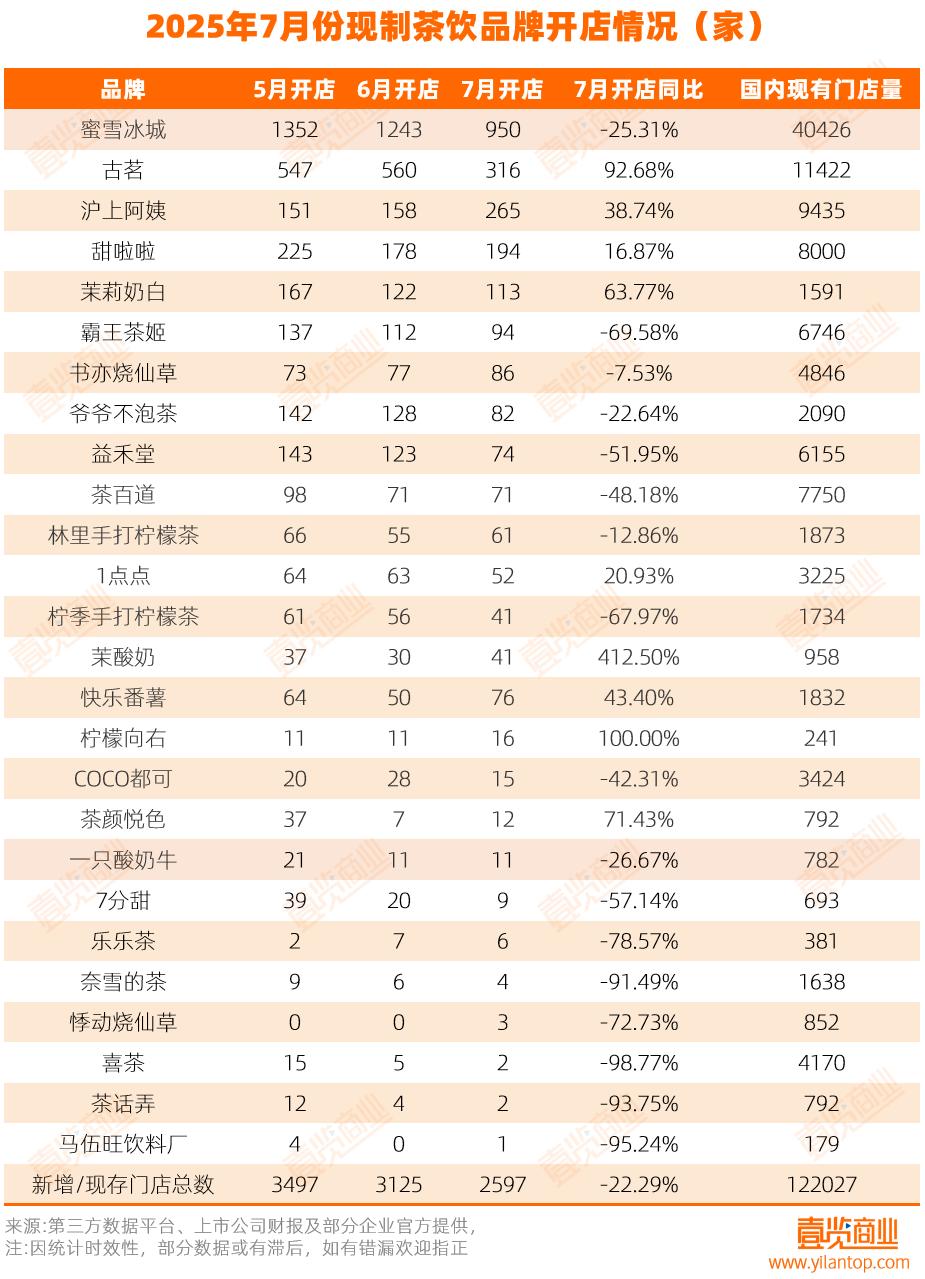
7月,新茶饮开店2597家
3 6 Ke· 2025-08-29 03:05
Core Insights - The ready-to-drink tea market is showing signs of recovery, with a total of 122,027 stores as of July 2025, an increase of 5,049 stores from June, despite a month-on-month decrease in new store openings [1][3]. Store Opening Performance - In July, 2,597 new stores were opened, a decrease of 16.70% month-on-month and a decline of 22.29% year-on-year [1][2]. - The leading brand, Mixue Ice City, opened 950 new stores in July, maintaining a strong expansion despite a gradual decline in monthly openings over the past three months [3][4]. - Gu Ming opened 316 new stores in July, marking a year-on-year increase of 90.68%, attributed to market recovery and adjusted expansion strategies [3][4]. - Other notable brands include Hu Shang A Yi with 265 new stores, Tian La La with 194, and Wei Li Nai Bai with 113 [3][4]. Competitive Landscape - The industry is characterized by contrasting strategies of expansion and contraction among brands. Gu Ming and Hu Shang A Yi are expanding rapidly, while brands like Cha Bai Dao are experiencing a decline in store numbers [6][4]. - The total number of stores for Cha Bai Dao has decreased from 8,449 to 7,750 over the past year, indicating a net reduction of 699 stores [6]. Product Innovation - In July, the total number of new product launches decreased significantly to 86 SKUs from 124 in June, reflecting a shift in focus among brands [6][8]. - Gu Ming and Mei Suan Nai launched the highest number of new products, with 9 SKUs each, while other brands like Cha Bai Dao and Nai Xue's Tea followed closely with 8 SKUs [6][8]. Seasonal Trends and Collaborations - The product focus for July included refreshing and healthy beverages, with many brands introducing seasonal fruit flavors such as green grapes, apples, and peaches [9][10]. - A total of 12 brands engaged in 18 collaborative marketing activities in July, maintaining the same level of engagement as in June, indicating a trend towards diverse and frequent collaborations [10][11]. - Collaborations have expanded beyond traditional media to include cultural and public institutions, enhancing brand visibility and engagement with different consumer segments [10].