康方生物

Search documents
国证国际港股晨报-20251125
Guosen International· 2025-11-25 06:20
Group 1: Market Overview - The Hong Kong stock market experienced a rebound, with the Hang Seng Index rising by 1.97%, the Hang Seng China Enterprises Index increasing by 1.79%, and the Hang Seng Tech Index climbing by 2.78% [2] - Northbound capital saw a net inflow of HKD 8.571 billion, with Alibaba, Tencent, and Kuaishou being the most actively traded stocks [2] - The technology sector showed significant growth, driven by positive news from various tech companies, including Alibaba's AI assistant app surpassing 10 million downloads in its first week [3][4] Group 2: Company Analysis - Haiwei Co., Ltd. - Haiwei Co., Ltd. is a leader in China's capacitor film market, established in 2006, with a market share of 10.9% in capacitor base films as of 2024 [7] - Revenue projections for Haiwei are expected to reach RMB 330 million in 2024, with a net profit of RMB 86.42 million, despite a slight decline in early 2025 [7] - The company benefits from strong R&D capabilities, a diversified product portfolio, and an experienced management team [9] Group 3: Industry Outlook - The Chinese capacitor base film market is projected to grow at a CAGR of 19.7%, increasing from 46,000 tons in 2019 to 113,000 tons by 2024, and expected to reach 224,000 tons by 2029 [8] - The market for capacitor base films used in electric vehicles is anticipated to grow from 48,000 tons in 2025 to 87,000 tons by 2029, with a CAGR of 16.2% [8] - The market for capacitor base films in new energy power systems is expected to grow from 34,000 tons in 2025 to 80,000 tons by 2029, with a CAGR of 23.6% [8]
恒生科技指数劲升1.15%,哔哩哔哩、小米、阿里领涨
Mei Ri Jing Ji Xin Wen· 2025-11-25 04:24
Group 1 - The Hang Seng Index rose by 0.61%, the Hang Seng Tech Index increased by 1.15%, and the Hang Seng China Enterprises Index climbed by 0.75% during the midday session, with a market turnover of HKD 133.003 billion [1] - In the technology sector, Bilibili surged by 5.12%, with Kango Bio, Xiaomi, and Alibaba rising over 4%, while Baidu Group increased by 3.22% and Kuaishou by 2.55%. On the downside, Kingdee International fell by 1.46%, Midea Group by 1.13%, and JD Group by 0.44% [1] - The influx of southbound funds reached a record HKD 1.3 trillion by 2025, with a significant increase in the technology sector's share, making it a core focus for domestic investors in Hong Kong stocks [1] Group 2 - The influx of funds is supported by a loose liquidity environment, with the one-year fixed deposit rate in China dropping to a historical low of 0.95%. The trend of "activating" deposits is evident, with M1 year-on-year growth reaching 7.2% in September [2] - A total of CNY 1.3 trillion in resident demand deposits shifted to the capital market during July and August, indicating a strong movement towards investment [2] - The trend of "de-dollarization" globally has led to a rapid increase in the allocation of funds from Asia-Pacific (excluding Japan) to the Chinese market, enhancing the valuation recovery of Hong Kong's technology sector [2]

港股创新药概念股表现活跃
Mei Ri Jing Ji Xin Wen· 2025-11-25 02:41
每经AI快讯,11月25日,港股创新药概念股表现活跃,乐普生物、康方生物涨超4%,石药集团、信达 生物、康诺亚涨超3%。 ...
IVD巨头共识下注肿瘤早筛
Century Securities· 2025-11-24 12:21
Investment Rating - The report does not explicitly state an investment rating for the industry [2] Core Insights - The pharmaceutical and biotechnology sector experienced a decline of 6.88% from November 17 to November 21, underperforming compared to the Wind All A index (-5.13%) and the CSI 300 index (-3.77%) [3][8] - All sub-sectors within the industry reported losses, with raw materials (-8.6%), offline pharmacies (-8.58%), and other biological products (-7.99%) leading the decline [3][8] - Major companies in the IVD sector are increasingly investing in cancer early screening, with Abbott announcing a $21 billion acquisition of Exact Sciences and Roche entering a partnership with Freenome valued at over $200 million [3][12] - Flu activity is on the rise, with the percentage of flu-like illness cases reported in southern provinces reaching 6.7%, up from 5.5% the previous week, and higher than the same period in previous years [3][11] Summary by Sections Market Weekly Review - The pharmaceutical and biotechnology sector fell by 6.88%, underperforming the broader market indices [8] - All sub-sectors declined, with raw materials and offline pharmacies showing the largest drops [8] - Individual stock performances varied, with Hainan Haiyao increasing by 23.8% while Jindike fell by 25.5% [11] Industry News and Key Company Announcements Important Industry Events - The report highlights the increase in flu cases in both southern and northern provinces, surpassing levels from previous years [11] Industry News - GE HealthCare announced a $2.3 billion acquisition of Intelerad, indicating a focus on cloud and AI solutions in healthcare [12] - Significant acquisitions and partnerships in the cancer diagnostics space were noted, including Abbott's acquisition of Exact Sciences and Roche's collaboration with Freenome [12][15] Company Announcements - Various companies announced significant developments, including clinical trial approvals and new drug applications, reflecting ongoing innovation in the sector [15][16]


医药生物行业投资策略周报:理解MNC供应链的壁垒-20251124
CAITONG SECURITIES· 2025-11-24 09:01
Core Insights - The pharmaceutical MNC supply chain has extremely high entry barriers, requiring years for supplier certification through cross-departmental audits in technology, quality, EHS, and compliance. Once included in the qualified supplier list, a strong lock-in effect is formed, making it difficult for new entrants to disrupt the existing supply structure even if they meet technical standards, thus demonstrating a strong first-mover advantage [4][7]. - MNCs demand far more than conventional quality compliance, emphasizing full-process controllability and risk management capabilities. Compliance with guidelines such as EU GMP and ICHQ is required, along with the establishment of traceability systems and safety stock. Any process changes or relocation of production sites must undergo strict and time-consuming certification [4][7]. - In procurement decisions, MNCs are relatively insensitive to price factors, prioritizing the integrity of the supply chain over cost. For MNCs, API costs represent only a small portion of their terminal formulation sales, leading them to pay a premium for stable, traceable, and zero major quality incident supply capabilities, viewing supply chain resilience as a core competitive advantage rather than a cost item. Thus, entering the MNC supply chain often means effectively avoiding "price internalization" [4][7]. - Investment recommendations include innovative drug and device companies such as Furuya Co., Aonlikang, Shutaishen, Weichuang Bio, and others. From the perspective of CXO and raw materials, companies like WuXi AppTec, Jiuzhou Pharmaceutical, Chengda Pharmaceutical, and others are suggested for attention [4][7]. Market Performance Overview - As of November 21, 2025, the TTM-PE of the pharmaceutical and biotechnology industry is 48.84 times, which is 100% higher than the historical lowest PE valuation of 24.38 times on January 3, 2019. The premium rate relative to the CSI 300 is 252%, exceeding the historical lowest valuation premium of 124% on February 6, 2018, by 128 percentage points, and is 11 percentage points higher than the average valuation premium rate of 241% over the past decade [8][12]. - From November 17 to November 21, 2025, the pharmaceutical and biotechnology sector experienced a decline of 6.88%, ranking 22nd among 27 sub-industries. The chemical raw materials sector saw the largest decline at -8.60% [12][15]. Industry Dynamics - Pfizer's Class 1 new drug, Matacizumab, was approved for marketing on November 21, 2025, for the routine prevention and treatment of bleeding in patients with severe hemophilia A or B [20]. - Boehringer Ingelheim's Class 1 new drug, BI764198, was proposed for inclusion as a breakthrough therapy on November 18, 2025, targeting primary focal segmental glomerulosclerosis [21]. - The PD-1 inhibitor H drug, Surulutumab, developed by Fuhong Hanlin, was officially included as a breakthrough therapy on November 20, 2025, for gastric cancer treatment [22]. - On November 17, 2025, FDA approved the biosimilar of Tysabri, developed by Sandoz, for multiple sclerosis and Crohn's disease [23].
掘金创新药丨双抗药物Ⅱ期赛跑 康宁杰瑞、康方生物谁能率先突围?
Mei Ri Jing Ji Xin Wen· 2025-11-24 07:53
Core Viewpoint - The article discusses recent developments in the pharmaceutical industry, particularly focusing on new drug applications and innovations in cancer treatment, highlighting the competitive landscape and market potential for various companies involved in drug development [5][12][20]. Group 1: New Drug Applications - From May 24 to May 30, the National Medical Products Administration received applications for 9 new chemical drugs and biological products from 6 listed companies [5]. - Companies such as Heng Rui Medicine, Hansoh Pharmaceutical, and Kangfang Biotech each submitted 2 clinical applications, while others like Canaan and Bai Jie Shen Zhou submitted 1 application each [6]. Group 2: Key Innovations in Cancer Treatment - Kangning Jereh's KN035, a subcutaneous PD-L1 inhibitor, has been submitted for clinical trials, potentially becoming the first of its kind globally. It targets multiple indications, with 3 applications already submitted and 7 ongoing clinical studies [12][13]. - KN035 offers advantages over traditional intravenous methods, including better patient compliance and reduced costs, which could enhance its market share [13]. - The competitive landscape includes existing PD-L1 inhibitors like Merck's Atezolizumab and AstraZeneca's Durvalumab, with KN035 targeting different cancer types [14]. Group 3: Dual Antibody Developments - Kangfang Biotech's AK104, a PD-1/CTLA-4 dual-specific antibody, has received approval for clinical trials, with 13 indications currently in phase II trials [17]. - The dual antibody approach is gaining traction due to the limitations of existing PD-1/L1 therapies, which have low efficacy rates in solid tumors [18]. - The market for dual antibodies is expected to grow significantly, with 217 candidates in various clinical stages globally [19]. Group 4: COVID-19 Vaccine Developments - CanSino's inhaled COVID-19 vaccine is in phase II trials and is applying for emergency use, which could enhance public acceptance due to its non-invasive administration method [20][21]. - Sinovac has expanded the emergency use of its vaccine to children aged 3 and above, with positive safety and efficacy results from clinical trials [24][25].



掘金创新药丨PD-1竞争还在加剧,石药集团、复宏汉霖孰能突围宫颈癌适应症
Mei Ri Jing Ji Xin Wen· 2025-11-24 07:52
Core Insights - The article discusses the recent clinical trial applications submitted by several pharmaceutical companies, focusing on the competitive landscape of PD-1 inhibitors in the oncology market [12][11]. Group 1: New Drug Applications - From June 13 to June 18, the National Medical Products Administration received applications for 9 new chemical and biological drugs from 6 listed companies [4]. - Companies such as Hengrui Medicine, Innovent Biologics, and CSPC Pharmaceutical Group submitted 2 clinical applications each, while companies like Ascletis Pharma, Junshi Biosciences, and Kintor Pharmaceutical submitted 1 application each [7]. Group 2: Focus on Oncology Drugs - All applications during this period were for anti-tumor drugs, indicating a strong focus on oncology within the pharmaceutical industry [8]. - The article highlights that the PD-1 inhibitors submitted by Shijiazhuang Yiling Pharmaceutical and Junshi Biosciences are still in clinical trials, with no products yet on the market [12]. Group 3: Competitive Landscape - Currently, there are 8 PD-1/PD-L1 products approved in China, leading to intense competition among companies [12]. - Shijiazhuang Yiling's PD-1 is in Phase I clinical trials for ovarian cancer and Phase II for advanced/metastatic cervical cancer, while Junshi's PD-1 is at the application stage for MSI-H solid tumors [12][13]. - The article suggests that both companies need to adopt differentiated development strategies to avoid excessive competition and achieve market success [12]. Group 4: Market Positioning - Junshi's PD-1, known as Surulitinib, is positioned to be the first anti-PD-1 monoclonal antibody for treating MSI-H solid tumors in China, despite its later market entry [12]. - In contrast, Shijiazhuang Yiling's prospects for its PD-1 product appear less optimistic, as there are no approved PD-1 products for cervical cancer in the domestic market [13]. Group 5: Historical Context - Shijiazhuang Yiling previously had a partnership with Junshi Biologics for a PD-1 product but terminated the agreement to avoid potential conflicts with another in-house PD-1 candidate [14]. - This decision has led to a delay in Shijiazhuang Yiling's PD-1 development, while Junshi's product has been on the market for over two years, generating significant revenue [14].

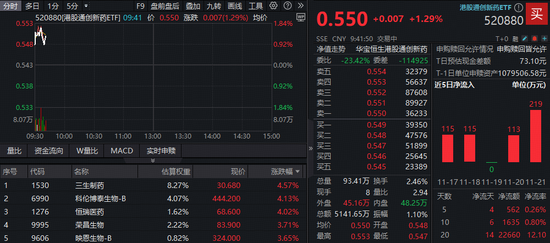
创新药突破不断,港股通创新药ETF(520880)盘初上探1.66%!三生制药等龙头股领衔修复行情
Xin Lang Ji Jin· 2025-11-24 01:55
Core Insights - The Hong Kong innovative drug sector is experiencing a rebound, with the Hong Kong Stock Connect innovative drug ETF (520880) rising by 1.66% at one point [1] - Major stocks such as Sanofi, Kelun-Biotech, and Hengrui Medicine saw increases of over 4%, while stocks like China Resources Pharmaceutical and Fuxing Pharmaceutical faced adjustments [1] Industry Trends - The innovative drug industry is shifting from a quantity-driven approach to a quality-driven one, entering a phase where product efficacy is paramount [3] - There is a growing focus on differentiated and internationalized pipelines, with an emphasis on products that can generate profits [3] - Oral peptide drugs, such as PCSK9 inhibitors and IL-23 antagonists, are showing promising clinical data and have the potential to reshape treatment paradigms [3] Market Dynamics - Chinese innovative pharmaceutical companies are deeply involved in global drug development, with the number of clinical trials ranking first worldwide, particularly in cell therapy, ADCs, and bispecific antibodies [3] - By 2024, it is expected that 38% of globally approved new drugs will have their first launch in China, highlighting the country's growing importance in the pharmaceutical landscape [3] - The upcoming expiration of patents for multinational corporations (MNCs) is creating opportunities for Chinese assets, which are becoming significant sources for important projects [3] ETF Performance - The Hong Kong Stock Connect innovative drug ETF (520880) and its linked funds are passively tracking the Hang Seng Hong Kong Stock Connect Innovative Drug Select Index, which includes top-weighted stocks like BeiGene, China Biologic Products, and Innovent Biologics [3]
小核酸药物:三家标杆2026年的催化剂有哪些?:医药生物
Huafu Securities· 2025-11-23 10:39
Investment Rating - The report maintains an "Outperform" rating for the pharmaceutical sector [6]. Core Insights - The small nucleic acid drug industry is entering a significant commercialization phase in 2025, with major advancements in product launches and new platform validations expected [16]. - Alnylam's AMVUTTRA is projected to exceed $2 billion in sales, marking a significant milestone for small nucleic acid drugs [3][17]. - Ionis is anticipated to have multiple catalysts in 2026, with key products like Olezarsen showing promising results [25]. - Arrowhead has launched its first commercial product, Plozasiran, and is focusing on its innovative Trim platform for weight loss and CNS projects [35]. Summary by Sections 1. Weekly Performance of Recommended Pharmaceutical Combinations - The recommended combinations outperformed the pharmaceutical index by 2.4 percentage points but underperformed the broader market by 0.6 percentage points [12]. 2. Small Nucleic Acid Industry Update - The small nucleic acid sector is witnessing rapid commercialization and platform breakthroughs, with significant investment opportunities emerging [16]. - Alnylam's AMVUTTRA sales are expected to reach $2.475 to $2.525 billion for the year, reflecting strong market demand [23]. - Ionis's Olezarsen has shown a 72% reduction in triglycerides in patients, indicating a strong commercial outlook [17][25]. - Arrowhead's Plozasiran is now approved for treating familial chylomicronemia syndrome, marking a significant achievement for the company [17]. 3. Weekly Market Review of the Pharmaceutical Sector - The CITIC Pharmaceutical Index fell by 6.8% during the week of November 17-21, 2025, underperforming the CSI 300 Index by 3 percentage points [47]. - The pharmaceutical sector has seen a year-to-date increase of 14.7%, outperforming the CSI 300 Index by 1.5 percentage points [47]. - The top-performing stocks in the sector included Hainan Haiyao (+23.8%) and Changyao Holdings (+19.7%) [59]. 4. Market Trends and Future Outlook - The report suggests a continued focus on innovative drugs, CXO, and the pharmaceutical supply chain, especially with upcoming ASH conference data releases [4]. - The overall valuation of the pharmaceutical sector is currently at 28.5, indicating a relative premium over the broader market [54].
大消费大跳水,医疗、科技、银行紧随其后
Ge Long Hui· 2025-11-23 04:37
银行也没能幸免,截至收盘下跌1.85%。其中重庆农村商业银行大跌4.43%,光大银行、重庆银行、邮 储银行、民生银行等多股跌幅均在3%上方。 内容只是个人观点,仅供参考,不作为投资依据!欢迎关注交流,互相学习、共同探讨! 大消费低开低走后全天弱势,截至收盘大跌3.36%。其中京东健康大跌8.6%,金沙江中国、美高梅、康 方生物、信达生物、药明生物等多股跌幅均在5%上方。 恒生医疗低开低走,盘中虽有反弹,但最终还是无功而返,截至收盘下跌3.02%。其中三生制药大跌 9.44%,百济神州、药明康德、石药集团等超10只个股跌幅在4%上方。 开盘后执行跳水,随后全天震荡下行,截至收盘恒生指数2.38%。大消费跌幅居前,恒生医疗、互联 网、恒生科技、银行等紧随其后。 ...