
招商银行

Search documents
海致科技:AI除幻第一股,叩开产业级智能体深水区大门
智通财经网· 2026-02-03 05:49
Core Insights - The article highlights Haizhi Technology's unique graph-model fusion technology, which allows AI agents to integrate into core business processes across various industries, taking on high-precision tasks such as analysis, decision-making, and execution [1][10] - Haizhi Technology is positioned as a key player in the AI industry, focusing on the deep-water zone of industrial-grade AI agents, creating dual barriers in technology and commercialization, and capitalizing on the explosive growth of the industry [1][15] Technology and Innovation - Haizhi Technology is the first company in China to effectively reduce the hallucination problem of large models through knowledge graphs, enhancing accuracy, reducing hallucination rates, and improving complex logical reasoning capabilities [1][2] - The company's graph-model fusion technology addresses the hallucination issue at its source, integrating knowledge graphs with large models to provide verifiable factual bases for AI outputs [2][5] - The core competitiveness of Haizhi Technology lies in its "trinity" approach: superior graph computing capabilities, graph-model fusion technology, and application expertise [5][6] Market Position and Growth - Haizhi Technology has established a significant market presence, holding a 50% market share in China's graph-based AI agent market, far exceeding its competitors [15] - The industrial-grade AI solutions market in China is projected to grow from approximately RMB 654 billion in 2025 to about RMB 2,861 billion by 2029, with a compound annual growth rate of 44.6% [15] - The company's revenue is expected to reach RMB 503.1 million in 2024, with a compound growth rate of 26.8% from 2022 to 2024, indicating a strong growth trajectory [15][19] Application and Client Engagement - Haizhi Technology's solutions have successfully addressed core pain points for clients, leading to significant risk reduction in financial services, such as a 20% increase in fraud detection for Shanghai Bank [10][11] - The company has served over 360 government and enterprise clients across various sectors, establishing a high customer retention rate and willingness to pay for its services [11][21] Future Outlook - The company is in the process of an IPO, with funds aimed at enhancing its graph-model fusion technology, optimizing its Atlas AI agent, and expanding into new markets [22] - Haizhi Technology's focus on a niche vertical technology path differentiates it from larger competitors, positioning it for long-term growth in the industrial-grade AI sector [22]

A500ETF基金(512050)上涨1%,成分股星宇股份、福斯特涨停,多家A股公司业绩预喜
Xin Lang Cai Jing· 2026-02-03 05:12
Group 1 - The A500 Index (000510) increased by 0.65% as of February 3, 2026, with notable gains from stocks such as Robotech (up 17.37%), Jing Sheng (up 17.17%), and Maiwei (up 11.77%) [1] - The A500 ETF Fund (512050) rose by 1.00%, with a latest price of 1.22 yuan, and showed active trading with a turnover rate of 27.7% and a transaction volume of 10.922 billion yuan [1] - Over the past three months, the A500 ETF Fund's scale increased by 202.30 billion yuan, indicating significant growth [1] Group 2 - As of January 31, 2026, 2,956 A-share listed companies had disclosed their 2025 annual performance forecasts, with a disclosure rate of 54% and 1,092 companies expecting positive results, resulting in a positive forecast rate of 37% [1] - China Galaxy Securities highlighted structural clues from the performance forecasts, noting a high positive forecast rate in the technology manufacturing sector, benefiting from price increases and product structure improvements in certain cyclical industries [1] - The A500 Index consists of 500 securities selected from various industries based on market capitalization and liquidity, reflecting the overall performance of representative listed companies [2]

徐明杰正式履新招商银行首席风险官!去年末该行不良率下降
Nan Fang Du Shi Bao· 2026-02-03 04:05
最新发布的业绩快报显示,截至2025年12月31日,招商银行不良贷款率0.94%,较上年末下降0.01个百 分点,是12家股份制银行中唯一低于1%的;拨备覆盖率391.79%,虽然较上年末下降 20.19个百分点, 但依然远超其他股份制银行。 资产规模方面,截至2025年12月31日,该行资产总额130705.23亿元,较上年末增加9184.87亿元,增幅 7.56%;负债总额117896.24亿元,较上年末增加8710.63亿元,增幅7.98%。 作为头部股份制银行,招商银行近年资产质量一直稳中向好。 2月3日晚,招商银行发布公告称,该行收到《国家金融监督管理总局关于徐明杰招商银行首席风险官任 职资格的批复》。根据上述批复,徐明杰招商银行首席风险官的任职资格已获得核准,其任期自2026年 1月30日起生效,至第十三届董事会届满之日止。 去年10月31日,招商银行曾发布公告称,该行首席风险官钟德胜因工作原因辞任,董事会同意聘任徐明 杰为首席风险官。如今国家金融监督管理总局核准徐明杰招商银行首席风险官的任职资格,意味着他正 式掌管该行风险防控工作。 简历显示,徐明杰是该行副行长,也是一名"老招行人"。他1968 ...


突然反转!黄金、白银直线拉升!此前白银基金紧急公告,有人称“两天亏掉一个月利润”
Sou Hu Cai Jing· 2026-02-03 03:46
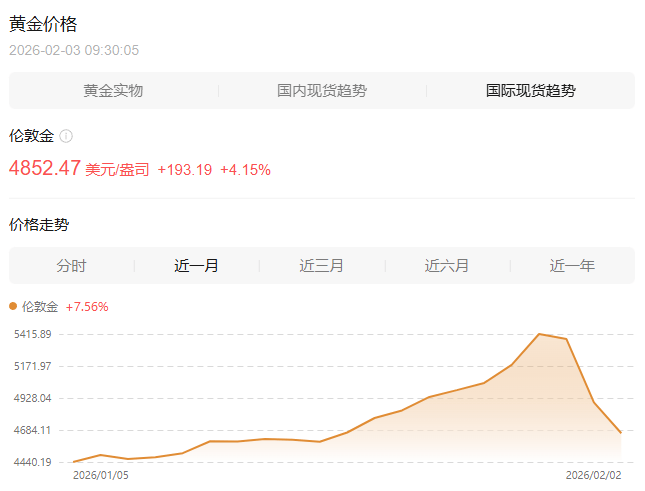
2月3日,现货金银日内走高。截至9:30,现货黄金涨至4852.47美元/盎司,日内涨4.15%。 历史罕见!国投白银LOF跌超31% 有人称"两天亏掉一个月利润" 受国际银价大幅波动影响,2月2日,复牌即被牢牢封死跌停板的国投白银LOF成为市场关注焦点。 同日晚间,国投白银LOF最新公告称,鉴于近期白银国际主要市场价格出现显著波动,与上期所白银期货差异较大,国投瑞银经与相关基金托管人协商一 致,决定参考白银期货国际主要市场的价格变动幅度,对基金资产进行合理重估。 受估值方式调整影响,国投白银LOF 2月2日单日净值跌幅达31.5%,创公募基金单日下跌历史纪录。同时,据此计算,目前二级市场价格溢价率达 109.92%。业内人士提醒,投资者不要盲目跟风,理性评估风险与收益,普通投资者不要参与高溢价品种的炒作。 白银价格持续反弹。截至09:34,现货白银涨幅扩大至8%,报85.5美元/盎司;纽约期银日内涨超11%,现报85.60美元/盎司。 黄金开年一路飙升至历史新高,1月30日却骤然遭遇20世纪80年代以来最大跌幅。更糟糕的是,2月2日,现货黄金再次一度暴跌约10%,逼近4400美元/关 口。据智通财经,黄金三 ...
“三年存款到期 续作利率腰斩 钱存哪里?”银行主推分红险
Zhong Guo Zheng Quan Bao· 2026-02-03 03:02
Core Viewpoint - The banking industry is shifting its focus from traditional deposit products to insurance products, particularly dividend insurance, in response to declining deposit interest rates and changing consumer preferences [1][2][3]. Group 1: Market Trends - Banks are no longer emphasizing deposit renewals but are instead promoting insurance products like dividend insurance and annuity insurance as attractive alternatives for customers [1][2]. - The trend reflects a resurgence of the bank-insurance channel, indicating a strategic pivot in how banks engage with customers regarding their financial products [1]. Group 2: Product Details - Dividend insurance is becoming the primary product recommended by bank staff, with major insurance companies shifting their focus to these products as of 2026 [3]. - The dividend insurance products offer a combination of guaranteed returns and potential floating dividends, appealing to consumers seeking both security and growth [4]. Group 3: Consumer Behavior - Customers are increasingly considering insurance products due to the significant drop in deposit interest rates, with some experiencing a reduction of over 50% compared to previous rates [2]. - Many customers who do not need immediate access to their funds are opting for insurance products to lock in current interest rates, while those needing liquidity within three years are more likely to choose bank wealth management products or bond funds [2][4]. Group 4: Financial Implications - The promotion of dividend insurance allows banks to expand their non-interest income and maintain long-term relationships with clients, enhancing overall service offerings [4]. - Analysts predict that the insurance sector's performance in the upcoming "opening red" period will be strong, with dividend insurance playing a central role in this growth [3].
“三年存款到期 续作利率腰斩 钱存哪里?”银行主推分红险
Zhong Guo Zheng Quan Bao· 2026-02-03 03:01
Core Insights - The banking industry is shifting its focus from traditional deposit products to insurance products, particularly dividend insurance, in response to declining deposit interest rates [1][2][3] Group 1: Market Trends - Banks are no longer emphasizing deposit renewals but are instead promoting insurance products like dividend insurance and annuity insurance to customers [1][2] - The trend reflects a broader resurgence of the bank-insurance channel, as insurance products offer long-term yield locking advantages in a low-interest-rate environment [1][3] Group 2: Product Details - The recommended dividend insurance products provide a fixed return of around 1.75% plus potential floating dividends, appealing to customers seeking long-term value [3][4] - For example, a specific dividend insurance product has a three-year accumulation period with a total return of approximately 3.2% per year, with potential total benefits increasing significantly over 20 years [2] Group 3: Consumer Behavior - Consumers are increasingly considering insurance products when faced with significantly lower deposit rates, with many opting for these products if they do not need immediate access to their funds [2][4] - The insurance products are seen as a way to secure current interest rates, especially for clients who can afford to lock in their funds for longer periods [2][3]
中国金融-跟踪行业风险:短期增长小幅放缓,但未来风险显著降低-China Financials-Tracking industrial risks modestly slower near term growth, but notably lower future risks
2026-02-03 02:49
February 2, 2026 12:08 PM GMT China Financials | Asia Pacific Tracking industrial risks: modestly slower near term growth, but notably lower future risks Key Takeaways More sectors' capex growth slowed in Dec 2025 amid steady progress of capacity control. 82.5% of sectors (by total liability) saw capex growth moderation in Dec 2025 vs. 1H24, up from 78.7% last month. Agricultural product processing and furniture sectors posted notable FAI growth slowdowns after months of stabilizing. Overall Industrial prof ...
中国银行业_中国机遇论坛与金融调研核心要点China banks_ Key takeaways from China Opportunity Forum and the financial tour
2026-02-03 02:06
Summary of Key Points from the Conference Call Industry Overview - **Industry**: Chinese Banking Sector - **Key Takeaways**: The recent conference and financial tour indicated a net positive outlook for Chinese banks, with improved net profit growth rates driven by recovery in net interest income (NII), positive fee growth, and stable asset quality [2][5][6]. Core Insights - **Profit Growth**: Banks are experiencing improved net profit growth rates, with SOE banks expressing greater optimism compared to Joint Stock Banks (JSBs) regarding revenue and profit growth trajectories [2][5]. - **NII Recovery**: A recovery in NII is expected, with banks anticipating positive net interest income growth in 2026, although some JSBs expect a decline [5][6]. - **Loan Growth**: Moderate increases in new loan volumes are anticipated, primarily driven by corporate lending focused on infrastructure and technology [6]. - **Fee Income Divergence**: SOE banks expect robust fee income growth, while JSBs foresee only slight positive growth due to weak consumption and regulatory pressures [6]. - **Investment Income**: Banks are managing their investment portfolios actively, with unrealized gains providing a buffer against future income fluctuations [6]. Monetary Policy and Interest Rates - **Dovish Monetary Policy**: The monetary policy remains dovish, with expectations of further cuts to the Loan Prime Rate (LPR) and deposit rates [5]. - **Deposit Management**: Banks are focusing on managing high-rate time deposits maturing in 2026, with a projected retention rate of 90% due to clients' low risk appetite [5][6]. Asset Quality and Risk Management - **Stable Asset Quality**: Asset quality is expected to remain stable, with non-performing loan (NPL) formation having peaked, particularly in the property sector [6]. - **Retail Loan Risks**: Increased pressure on retail loan asset quality is noted, with some banks experiencing elevated NPL formation [6]. Future Outlook - **Profit Growth Expectations**: SOE banks expect positive net profit growth in 2026, driven by NII growth and cost control, while some banks remain cautious due to external macroeconomic factors [6]. - **Capital Management Review**: One bank is reviewing its capital management policy, considering the balance between CET1 ratio, dividend payout, and return on equity (ROE) [6]. Investment Strategy - **Insurance Sector Insights**: A leading insurance company plans to maintain a 30% allocation to equities for net new premiums in 2026, focusing on high-dividend stocks and Hong Kong equities [7]. Company Recommendations - **Top Picks**: Among SOE banks, the top picks include China Construction Bank (CCB-H), Bank of China (BOC-H), and Bank of Communications (Bocom-A/H) [2]. Additional Notes - **Market Performance**: While the banking sector is expected to see absolute share price upside in 2026, it may underperform the broader market [2].

银行业以高质量发展护航“十五五”开局
Jin Rong Shi Bao· 2026-02-03 01:49
Core Viewpoint - The banking industry is focusing on supporting the real economy through strategic transformation and risk management, with several banks reporting improved performance for 2025, indicating a shift towards high-quality development [1][2][3]. Group 1: Performance of Listed Banks - Multiple A-share listed banks, including China Merchants Bank, CITIC Bank, and Industrial Bank, have reported significant increases in both operating income and net profit for 2025, demonstrating a recovery in profitability [2]. - CITIC Bank and Pudong Development Bank have both entered the "10 trillion yuan club," with total assets of 10.13 trillion yuan and 10.08 trillion yuan respectively, marking growth rates of 6.28% and 6.55% year-on-year [2]. - The overall trend for joint-stock banks in 2025 is characterized by stable growth, optimized structure, risk control, and improved efficiency, showcasing strong resilience against economic cycles [2]. Group 2: Strategic Focus on Real Economy - The banking sector is shifting from "scale expansion" to "high-quality development," emphasizing targeted support for key areas and weak links in the economy [3]. - Major state-owned banks have outlined systematic plans to enhance their service to the real economy, aligning their strategies with national priorities and focusing on specific sectors such as agriculture and global expansion [4]. Group 3: Digital Transformation and Innovation - Digital transformation is identified as a key support for enhancing the effectiveness of banks in serving the real economy, with banks like Bank of Communications and Postal Savings Bank implementing AI and other digital strategies [5]. - The banking industry is increasingly focusing on technology finance, with significant growth in loans to technology enterprises, such as a 23.44% increase in technology finance loans at Hangzhou Bank [6][7]. Group 4: Support for Key Sectors - Banks are concentrating their resources on critical areas such as expanding domestic demand, technological innovation, and green development, with a focus on providing tailored financial solutions for small and micro enterprises [6][7]. - The emphasis on regional development and industrial upgrades is evident, with banks enhancing their service layouts to support local economies and specific industries, such as manufacturing [7]. Group 5: Future Outlook - The banking industry is expected to continue optimizing financial resource allocation and enhancing support for key sectors, while also deepening financial innovation and improving service precision [8]. - Collaboration among different types of banks is crucial for effectively serving the real economy, with large state-owned banks leading the way and smaller banks focusing on local needs [8].



银行业韧性凸显 增长可期
Jin Rong Shi Bao· 2026-02-03 01:49
Core Viewpoint - The performance reports of listed banks for 2025 reveal a resilient banking sector, with significant growth in profitability, particularly among small and medium-sized banks, providing insights for predicting the industry's trajectory in 2026 [1][2]. Group 1: Profitability and Growth - All ten listed banks reported positive growth in net profit, with nine achieving increases in both operating income and net profit [2]. - City commercial banks led the profitability growth, with Qingdao Bank showing a 21.66% increase in net profit, while Hangzhou Bank, Ningbo Bank, and Nanjing Bank reported growth rates of 12.05%, 8.13%, and 8.08% respectively [2]. - National joint-stock banks exhibited steady growth, with Shanghai Pudong Development Bank leading at 10.52% net profit growth, followed by CITIC Bank, China Merchants Bank, and Industrial Bank with growth rates of 2.98%, 1.21%, and 0.34% respectively [2]. Group 2: Revenue Structure Optimization - Revenue structure optimization was a key driver for many banks' performance, with Ningbo Bank's net fee and commission income reaching 6.085 billion yuan, a 30.72% year-on-year increase [3]. - Shanghai Pudong Development Bank improved its asset-liability management and reduced funding costs, stabilizing its net interest margin [3]. - Asset expansion was notable, with China Merchants Bank surpassing 13 trillion yuan in total assets, and several small and medium-sized banks showing significant growth rates in total assets, such as Qingdao Bank at 18.12% [3]. Group 3: Credit Growth and Asset Quality - Accelerated credit issuance was identified as a core driver for asset expansion among small banks, with strong demand in quality regions supporting growth [4]. - Asset quality remained stable, with five banks reporting a decrease in non-performing loan ratios, and overall fluctuations were kept within single-digit basis points [5][6]. - Notably, CITIC Bank and China Merchants Bank saw their non-performing loan ratios decrease by 1 basis point to 1.15% and 0.94% respectively, while the provisioning coverage ratios for several banks remained well above regulatory requirements [6]. Group 4: Future Outlook and Strategic Focus - Analysts predict a positive outlook for the banking sector in 2026, emphasizing the importance of loan growth, particularly in corporate lending, and the stability of asset quality [8]. - Major state-owned banks are focusing on developing differentiated strategies and enhancing operational efficiency as part of their 2026 goals [9][10]. - National joint-stock banks and local small and medium-sized banks aim to optimize their business structures and diversify income sources to improve profitability stability [10].